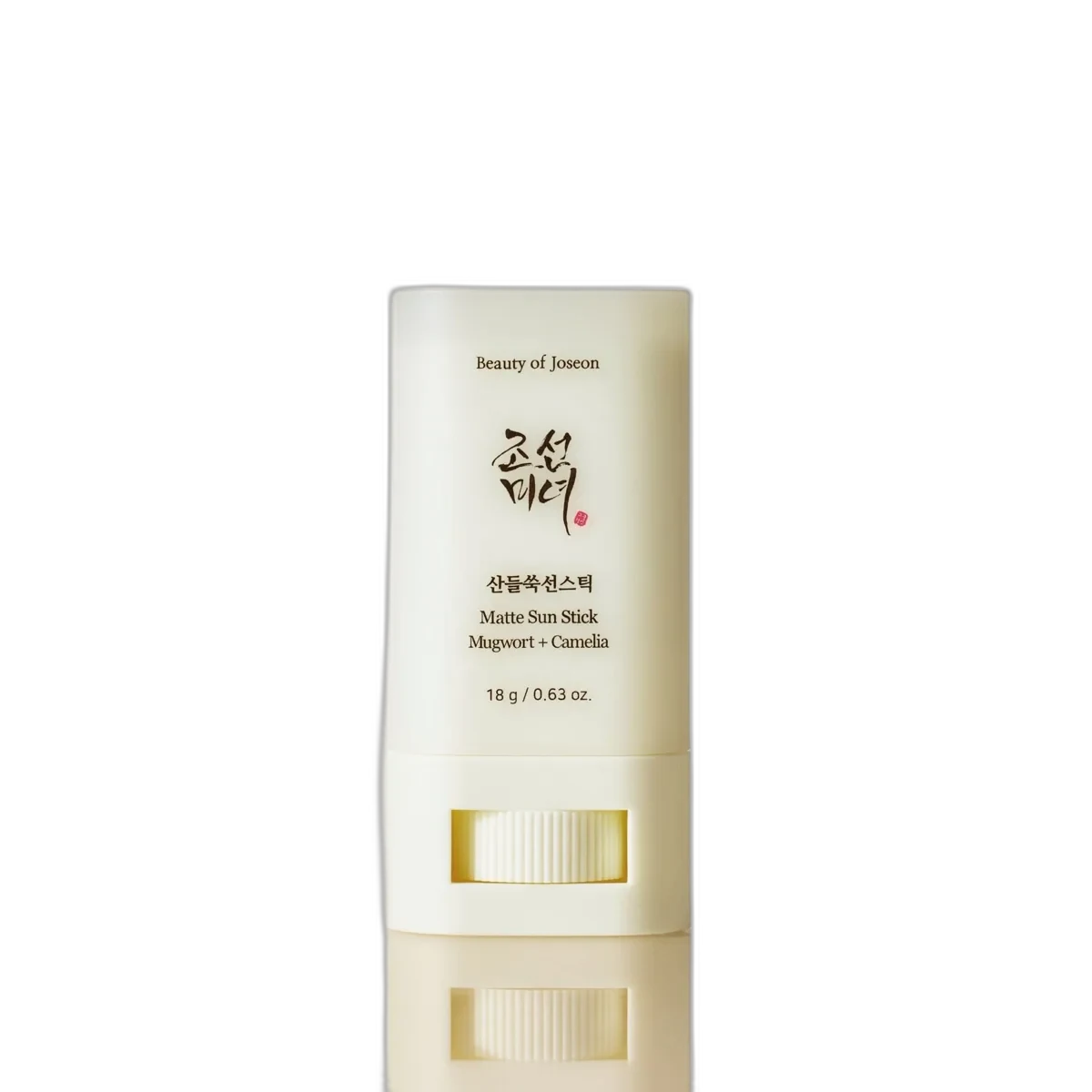
Matte Sun Stick: Mugwort + Camelia SPF 50+
K-Beauty Reapplication MVP
 Verified reviewer
Pros & cons.
- +Next-generation photostable UV filters (Tinosorb S, DHHB) provide robust broad-spectrum protection
- +Genuinely matte, pore-blurring finish that controls shine for hours — not just marketing language
- +Zero white cast on any skin tone thanks to exclusively chemical UV filter system
- +Stick format allows effortless reapplication over makeup without hands or mirror
- +Soothing mugwort and centella asiatica extracts provide anti-inflammatory benefits under UV stress
- +Fragrance-free formula minimizes irritation risk for a sunscreen product
- −18g size runs out quickly with daily use — better as a reapplication tool than sole sunscreen
- −Too mattifying and drying for dry skin types — can feel tight and chalky
- −Stick format makes it difficult to gauge whether you've applied adequate coverage for full SPF rating
- −Can pill under certain moisturizers or foundations with incompatible formulation bases
- −Contains isopropyl palmitate which is comedogenic for some acne-prone skin types
The full review.
The dirty secret of sunscreen is that almost nobody uses it correctly. You apply it in the morning, feel virtuous, and then forget about it for the rest of the day. By 2 PM, your protection has degraded significantly — but the thought of pulling out a cream sunscreen and reapplying over makeup, in a restroom, with your fingers, is enough to make most people just accept the UV damage. This is the problem the Matte Sun Stick was designed to solve, and it solves it with uncommon elegance.
The stick format is the product’s defining feature and its primary reason for existing. You uncap it, glide it across your face in overlapping strokes, recap it, and you’re done. No hands, no mirror required, no makeup disrupted. The solid formula doesn’t run, drip, or pool in fine lines. And because the finish is genuinely matte — not the grudging matte of a sunscreen trying its best, but the confident, powdery matte of a product engineered for it — your reapplication actually improves the look of your makeup rather than ruining it.
That matte finish comes from silica and boron nitride, two optical diffusers that blur imperfections and absorb oil on contact. The effect is immediate and noticeable: pores appear minimized, shine disappears, and skin takes on a soft-focus quality. On oily and combination skin, this translates to hours of controlled shine without the need for blotting papers or additional powder. On dry skin, however, this same effect can feel tight, chalky, and uncomfortable — a genuine limitation that the product doesn’t try to hide.
The UV filter system is where Beauty of Joseon demonstrates real formulation sophistication. Instead of relying on older, less stable filters, they’ve deployed a quartet of next-generation chemical sunscreens. Tinosorb S provides broad-spectrum UVA/UVB coverage (280-400nm). DHHB targets the long-wave UVA1 range (340-400nm) that’s most responsible for photoaging and hyperpigmentation — a range that many sunscreens under-protect against. Ethylhexyl triazone adds UVB-specific protection. And Polysilicone-15, a silicone-grafted UV filter, provides additional UVB coverage while contributing to the smooth, non-greasy feel. All four filters are photostable, meaning they don’t break down under UV exposure the way avobenzone does.
The botanical inclusions are more than decoration. Mugwort (Artemisia capillaris) is a cornerstone of Korean herbal medicine, used for centuries for its anti-inflammatory properties. In a sunscreen, it serves a practical purpose: calming skin that’s under UV stress. Centella asiatica provides similar soothing benefits, while camellia seed oil — a traditional Japanese and Korean beauty oil — adds conditioning without greasiness. These aren’t revolutionary actives, but they transform the product from a pure-function UV shield into something that’s pleasant to wear and genuinely considerate of skin comfort.
The application experience is smooth and uneventful — which for a sunscreen stick is high praise. No dragging, no pilling, no white residue. The stick deposits product evenly and sets quickly. The challenge, as with all stick sunscreens, is applying enough. A single light swipe per area doesn’t deliver the two milligrams per square centimeter needed for the rated SPF 50+ protection. You need deliberate, overlapping strokes — think of it like coloring in a picture rather than sketching an outline.
This leads to the product’s most honest tension: it excels as a reapplication tool but has limitations as a primary sunscreen. The 18g size and the application technique required for full coverage mean that if you’re using this as your only SPF, you’ll burn through it in three to five weeks — and at roughly $16, the per-gram cost adds up. The smarter approach is to use a standard cream or fluid sunscreen for your morning application and reserve this stick for the midday touch-ups that actually make or break your long-term UV protection strategy.
Pilling can occur under certain moisturizers or foundations, particularly those with high water content or silicone-heavy formulas. This is a compatibility issue rather than a quality defect, and a quick test with your existing products will tell you whether you’ll experience it. Generally, lightweight, water-based products layer well underneath, while heavy creams can create friction.
At $16 for 18g, the value equation depends entirely on how you frame it. As a daily primary sunscreen, it’s expensive. As a dedicated reapplication tool that you carry in your bag and use once midday, it becomes very reasonable — the stick lasts two to three months in that use case, and the convenience it provides is genuinely unmatched by any other format.
The Matte Sun Stick doesn’t pretend to be everything to everyone. It’s a specialized tool that does one thing better than almost anything else on the market: make midday sunscreen reapplication fast, clean, and cosmetically elegant. For oily skin types who’ve been searching for an SPF that controls shine rather than adding to it, and for anyone who knows they should reapply but never actually does, this stick is the answer to a very specific and very common problem.
Formula
Ingredient analysis.
Full INCI list
Methyl Methacrylate Crosspolymer, Synthetic Wax, Dibutyl Adipate, Coco-Caprylate/Caprate, Isopropyl Palmitate, Caprylyl Methicone, Caprylyl Trimethicone, Ethylhexyl Palmitate, Silica, Vinyl Dimethicone/Methicone Silsesquioxane Crosspolymer, Diethylamino Hydroxybenzoyl Hexyl Benzoate, Bis-Ethylhexyloxyphenol Methoxyphenyl Triazine, Boron Nitride, Butyloctyl Salicylate, Ethylhexyl Triazone, Microcrystalline Wax, Polysilicone-15, Vinyl Dimethicone, Camellia Japonica Seed Oil, Curcuma Longa (Turmeric) Root Extract, Corallina Officinalis Extract, Melia Azadirachta Bark Extract, Ocimum Sanctum Leaf Extract, Moringa Oleifera Seed Oil, Coccinia Indica Fruit Extract, Solanum Melongena (Eggplant) Fruit Extract, Amber Powder, Aloe Barbadensis Flower Extract, Simmondsia Chinensis (Jojoba) Seed Oil, Artemisia Capillaris Extract, Camellia Sinensis Leaf Extract, Camellia Sinensis Seed Oil, Hyaluronic Acid, Bambusa Vulgaris Extract, Centella Asiatica Extract, Morinda Citrifolia Extract, Vigna Radiata Seed Extract, Polyglyceryl-4 Diisostearate/Polyhydroxystearate/Sebacate, Water, 1,2-Hexanediol, Panthenol, Butylene Glycol, Propanediol, Glycerin, Methylpropanediol, Ethylhexylglycerin
Skin match.
The science.
The Science
This stick uses four complementary filters to cover the full UV spectrum with excellent photostability, following current best practices in cosmetic photoprotection.
Bis-ethylhexyloxyphenol methoxyphenyl triazine (Tinosorb S) is a broad-spectrum filter covering 280-400nm. Research in Photochemistry and Photobiology shows its superior photostability; it keeps over 95% of its filtering capacity after extended UV exposure, while avobenzone loses significant efficacy within hours.
Diethylamino hydroxybenzoyl hexyl benzoate (DHHB, marketed as Uvinul A Plus) targets UVA1 radiation (340-400nm). This part of the UV spectrum penetrates deepest into the dermis, causing collagen degradation, elastic fiber damage, and hyperpigmentation. A study in the Journal of the American Academy of Dermatology emphasized UVA1 protection for preventing photoaging, making DHHB a critical component in anti-aging sunscreen formulations.
Ethylhexyl triazone (Uvinul T 150) provides strong UVB absorption and photostabilizes other filters in the formula. Its high extinction coefficient delivers potent UVB protection at low concentrations.
Polysilicone-15 is a silicone-grafted UVB filter that provides UV protection and a smooth, non-greasy feel. Its polymeric nature keeps it on the skin surface rather than penetrating, which aids safety and longevity.
The matte finish technology uses silica and boron nitride—two mineral powders that absorb oil and diffuse light. These ingredients physically absorb sebum and scatter light to create a blurred, soft-focus effect without pigment or tint.
Dermatologist Perspective
Dermatologists rank sunscreen reapplication as one of the most neglected parts of UV protection. Board-certified dermatologists note the best sunscreen is the one you actually reapply, and stick formats lower the barrier to midday reapplication. Photoprotection researchers consider the UV filter combination in this product (Tinosorb S, DHHB, ethylhexyl triazone) state-of-the-art, offering superior photostability to older filter systems. Dermatologists recommend stick sunscreens to complement—not replace—a thorough morning cream application, using the stick for 2-hour reapplication touchups.
Where it fits in your routine.
Apply the stick to clean, moisturized skin as your last morning step. Use overlapping strokes for full coverage. Cover the forehead, cheeks, nose, chin, and neck with multiple passes. For midday reapplication, press and glide the stick over makeup using the same pattern. Reapply every 2 hours during extended sun exposure. Remove in the evening with an oil-based cleanser or micellar water; the wax and silicone base needs more than water to dissolve.
At $16 for 18g, the price per gram is premium compared to liquid or cream sunscreens. Value depends on how you use it. As a primary daily sunscreen, the cost is high; one stick lasts 3-5 weeks. As a midday reapplication tool used with a separate morning sunscreen, the stick lasts 2-3 months and the per-use cost is reasonable. The advanced UV filter system and matte finish justify the format premium over basic sunscreen sticks. For oily skin types needing both sunscreen and a mattifying product, this two-in-one function adds value.
Oily and combination skin types want a sunscreen that controls shine instead of adding to it. This stick removes excuses for those who skip midday SPF reapplication. It works for makeup wearers reapplying over foundation, commuters needing portable sun protection, and K-beauty enthusiasts wanting advanced UV filter technology.
Dry skin types will find this uncomfortably mattifying and flaky. Skip this if you need a primary sunscreen for generous daily application — the 18g size makes this too expensive as your only SPF. Also skip if your existing moisturizer or foundation pills when layered with silicone-heavy products.
Product details.
This smooth solid stick glides on like a balm and sets to a matte, powdery finish. Silica and boron nitride blur pores.
No added fragrance. Virtually undetectable scent.
Compact twist-up stick. It is portable and fits in a pocket for reapplication. The cap clicks securely for travel.
Glides smoothly without dragging. It gives an immediate matte, blurred finish that minimizes pore appearance. There is no white cast. It feels powdery, like a primer.
3-5 weeks with daily face application and one midday reapplication
12 months
spring summer
The backstory.
Beauty of Joseon's sunscreen line became a global sensation with their Relief Sun cream, and the Matte Sun Stick addressed the reapplication problem — most people skip midday reapplication because liquid formulas disturb makeup. The stick format allows touch-free reapplication over makeup, while mugwort extract honors the brand's hanbang heritage.
About Beauty of Joseon
Established Brand (5–20 years)Beauty of Joseon launched in 2016 and updated its focus in 2019. The brand combines traditional Korean hanbang ingredients with modern formulation science. Beauty of Joseon has a large global following and sells at Sephora, with products that earn high user ratings on many retail platforms.
Common myths.
Sunscreen sticks provide weaker UV protection than creams.
SPF 50+ PA++++ stays the same in any format. Stick application requires enough product; use overlapping strokes across each area instead of a single swipe.
Chemical sunscreen filters are dangerous.
Tinosorb S, DHHB, and ethylhexyl triazone are some of the newest, most tested UV filters. The EU and Korea approve them using comprehensive safety data.
FAQ.
Can I use the Matte Sun Stick as my only sunscreen?
Yes, but apply it heavily with overlapping strokes. A cream sunscreen provides more reliable coverage for your first morning application. Use this stick for easy midday reapplication.
Does this sunscreen stick leave a white cast?
No — this uses chemical UV filters (Tinosorb S, DHHB, ethylhexyl triazone) that are transparent on all skin tones. Silica and boron nitride provide the matte finish and are also colorless.
Can I apply this over makeup?
Yes — the solid stick format lets you press and glide it over makeup without disturbing it. The matte finish sets makeup instead of disrupting it.
Is the Matte Sun Stick good for dry skin?
Not ideal. The silica and mattifying agents absorb moisture, which can leave dry skin tight and flaky. Consider Beauty of Joseon's Relief Sun cream for a hydrating SPF 50+ alternative.
How often should I reapply?
Reapply every 2 hours during direct sun exposure, or after swimming/sweating. One midday reapplication works for indoor days. Use overlapping strokes for adequate coverage.
What the community says.
"Perfect for on-the-go reapplication over makeup"
"Truly matte finish that controls shine all day"
"No white cast on any skin tone"
"Smooth application"
"18g size runs out quickly — expensive per gram"
"Can pill under certain moisturizers"
"Too drying for dry skin types"
"Hard to gauge adequate coverage with stick format"
People also looked at.