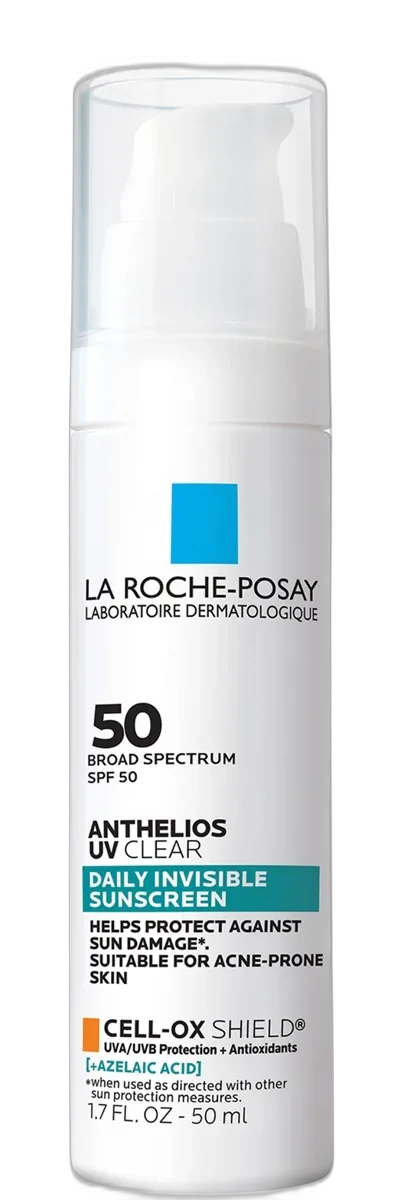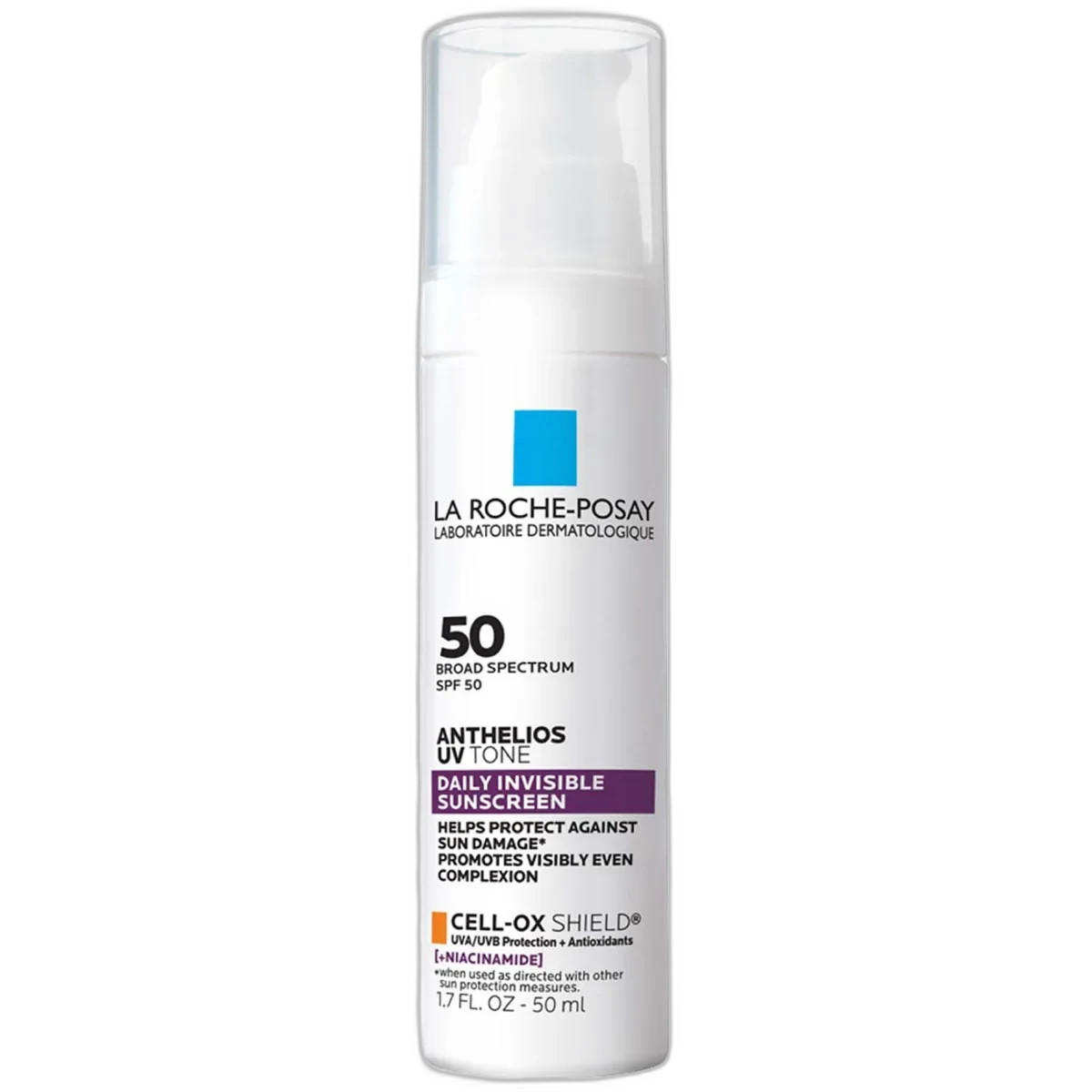
Anthelios UV Tone Daily Invisible Sunscreen SPF 50
Derm Office Staple
 Verified reviewer
Pros & cons.
- +Photostable avobenzone system reinforced with Oxynex ST antioxidant booster
- +Meaningful niacinamide dose for tone-evening and pigmentation prevention
- +Lightweight serum-fluid texture with zero white cast on any skin tone
- +Layers cleanly under makeup without pilling
- +Fragrance-free, oil-free, non-comedogenic
- +Pregnancy-safe SPF option for melasma-prone pregnancies
- +Cell-Ox Shield antioxidant complex adds free-radical defense
- +Strong option specifically for deep skin tones where mineral SPFs fail
- −Expensive at $39.99 for only 1.7 oz — high per-ounce cost
- −Uses 7% homosalate and 7% octocrylene that some users prefer to avoid
- −Not water-resistant enough for heavy sweat or swim sessions
- −Small tube runs out fast at the recommended full daily dose
- −Jojoba esters may bother fungal-acne-prone skin
The full review.
For years, US chemical sunscreens forced a trade-off: you chose a photostable avobenzone system for UVA protection, a cosmetically elegant serum-fluid texture without white cast, or a meaningful dose of a secondary active like niacinamide. Usually, you picked two and paid a premium for the third. Anthelios UV Tone is La Roche-Posay’s attempt to provide all three, and the formulation mostly succeeds. The UV filter system uses the standard US chemical quartet: 3% avobenzone for UVA, octocrylene and octisalate at stabilizing doses to prevent avobenzone photodegradation, and 7% homosalate for broad UVB. This formulation improves on Anthelios predecessors by adding diethylhexyl syringylidenemalonate. Part of L’Oréal’s Mexoryl research family, this ingredient acts as an antioxidant and photostability booster to extend avobenzone activity under UV exposure. Consequently, this sunscreen maintains its labeled SPF 50 protection longer than unboosted avobenzone formulas. The ‘UV Tone’ name reflects the niacinamide content. It sits high in the INCI list—above stabilizers and before functional polymers—indicating a meaningful dose. Niacinamide has strong clinical evidence for treating hyperpigmentation. It works by inhibiting melanosome (pigment-containing package) transfer from melanocytes to keratinocytes. Daily use over weeks visibly lightens existing hyperpigmentation and reduces new dark spots. Combining this mechanism with UV protection is the correct strategy for melasma-prone and post-inflammatory hyperpigmentation-prone skin: block the trigger, disrupt the pigment response, and repeat daily. Texture-wise, this sunscreen is pleasant, which was rare for US chemical SPFs during most of the 2010s. This fluid serum spreads like a light moisturizer, settles to a satin finish within one minute, and leaves zero white cast on any skin tone because the formula contains no titanium dioxide or zinc oxide. This texture makes it usable on deep skin tones where mineral SPFs often fail cosmetically. It layers under foundation without pilling, does not sting the eyes like some chemical filters, and feels lighter than the original Anthelios Melt-In Milk lotion. The supporting ingredients are solid. Tocopherol and cassia alata extract complete the Cell-Ox Shield antioxidant complex, scavenging free radicals from UVR, infrared, and visible-light stress. The formula is fragrance-free, alcohol-free, oil-free, and non-comedogenic. It works for most skin types: oily skin gets a light finish, dry skin gets glycerin cushion, and sensitive skin gets a LRP-grade irritation profile. There are two main drawbacks. First, price: at $39.99 for 1.7 oz, the $24-per-ounce cost is high for premium dermatology brands and expensive compared to Asian-import sunscreens. A full two-finger dose for the face and neck lasts six to eight weeks, which adds up annually. Second, the filter load includes 7% homosalate and 7% octocrylene, both of which are scrutinized in markets outside the US. While these concentrations lack evidence of real-world harm and are standard in US chemical sunscreens, some users avoid them. Anthelios UV Tone succeeds because it is built for its marketed purpose. Most ‘sunscreen for dark spots’ products are just sunscreens with a niacinamide sprinkle. This product pairs a photostable filter system, a Mexoryl-family antioxidant booster, a meaningful niacinamide dose, and a modern texture in one daily product, backed by a 50-year-old dermatology brand. If you have deep skin, active melasma, or post-acne marks, this is one of the few chemical sunscreens in the US market worth the premium.
Ingredient analysis.
Full INCI list
Active Ingredients: Avobenzone 3%, Homosalate 7%, Octisalate 5%, Octocrylene 7%. Inactive Ingredients: Water, Glycerin, C15-19 Alkane, Niacinamide, Propanediol, C12-22 Alkyl Acrylate/Hydroxyethylacrylate Copolymer, Tocopherol, Sodium Stearoyl Glutamate, Cetearyl Alcohol, Sclerotium Gum, Hydroxyacetophenone, Caprylyl Glycol, Sodium Starch Octenylsuccinate, Glyceryl Stearate, Jojoba Esters, Helianthus Annuus (Sunflower) Seed Wax, Hydroxypropyl Starch Phosphate, Trisodium Ethylenediamine Disuccinate, Pentylene Glycol, Diethylhexyl Syringylidenemalonate, Cassia Alata Leaf Extract, Maltodextrin, Sodium Hydroxide, Caprylic/Capric Triglyceride, Polyglycerin-3, Citric Acid
Skin match.
The science.
The Science
This formula uses one of the best-studied photoprotection combinations: avobenzone paired with octocrylene and octisalate as photostabilizers. Avobenzone alone degrades fast under UV exposure, losing filter capacity within hours. Photochemistry literature shows octocrylene and octisalate extend avobenzone's photostability, making this pairing the US-market standard for UVA protection. Diethylhexyl syringylidenemalonate (trade name Oxynex ST) adds a second layer of stabilization. It comes from L'Oréal's research on photoprotection boosters and works as both an antioxidant and a filter stabilizer to extend protection time under real-world UV exposure. The niacinamide mechanism for hyperpigmentation is well-established. Clinical studies show niacinamide inhibits melanosome transfer from melanocytes to keratinocytes, the step where pigment becomes visible at the skin surface. Research in the British Journal of Dermatology and the International Journal of Cosmetic Science shows topical niacinamide reduces hyperpigmentation and improves skin tone evenness over 4-8 week treatment windows. Combining this with daily sun protection is strategic: UV triggers melanogenesis, so blocking UV while disrupting the downstream pigment-transfer step provides a two-pronged approach to hyperpigmentation that neither intervention alone delivers. The Cell-Ox Shield antioxidant complex (tocopherol plus cassia alata extract) adds free-radical defense against reactive oxygen species from UV and visible light that pass the filters. This aligns with dermatology guidance that high-compliance sunscreens should include antioxidant support for environmental damage beyond the UVR window.
Dermatologist Perspective
Dermatologists specializing in hyperpigmentation and melasma often recommend sunscreens with niacinamide to patients needing both UV protection and a pigment-pathway active; the Anthelios UV franchise is a common prescription for this use case. Board-certified dermatologists note that daily broad-spectrum SPF 50 is the most important intervention for any pigmentation regimen—more impactful than tranexamic acid, hydroquinone, or other treatments—and that a cosmetically elegant formula like this one drives the compliance required for clinical results. This specific product is frequently recommended for patients with medium to deep skin tones who cannot tolerate mineral sunscreens cosmetically, and for patients managing melasma during pregnancy when most prescription pigment-targeting actives are contraindicated. Dermatologists also note the fragrance-free and oil-free formulation makes it a safe recommendation for acne-prone patients who aren't specifically fungal-acne prone.
Guidance
Where it fits in your routine.
Apply this as the final morning step, after serums and moisturizer, before makeup. Use a full two-finger-length strip — one finger's length from base to tip on each index finger — to reach the labeled SPF 50 level on your face and neck. Press the lightweight fluid into skin with palms instead of rubbing to prevent pilling. Wait 60-90 seconds before applying makeup. Reapply every two hours in direct sun; reapply immediately after heavy sweating or towel-drying. Do not skimp on dose — underapplication is the main reason real-world SPF falls below the label.
At $39.99 for 1.7 oz, this sunscreen runs about $24 per ounce — expensive in absolute terms and meaningfully above the drugstore baseline. The premium is defensible if your primary skin concern is hyperpigmentation or melasma, where the combination of photostable UV filters, Oxynex ST booster, and a meaningful niacinamide dose delivers a benefit you'd otherwise need two products to get. For users whose only concern is basic UV protection, cheaper Anthelios SKUs or drugstore options deliver comparable SPF at half the price. Unfortunately, there's no larger size available, so the per-ounce cost can't be lowered by buying bigger — committing to daily use means committing to the budget.
This works for anyone with hyperpigmentation, melasma, post-acne marks, or uneven skin tone, especially medium to deep skin tones wary of white-casting mineral sunscreens. It manages pregnancy-era melasma well and sits under makeup daily. It complements vitamin C or tranexamic acid serums by acting as the SPF layer that locks in those treatments.
Skip this if you need water resistance for sports, the beach, or heavy sweat. Skip this if you have a tight budget and do not need the niacinamide benefit. Skip this if you are fungal-acne prone, as jojoba esters may cause breakouts — the UV Clear variant with azelaic acid is safer for that skin type.
Product details.
All Year
The backstory.
The UV Tone SPF 50 launched as part of La Roche-Posay's 2024 Anthelios UV line reformulation in the US market — the relaunch that finally brought the brand's Advanced Research filter complexes and serum-fluid textures into a format that matched the cosmetic experience European users had enjoyed for years. UV Tone is positioned as the daily-driver for users whose primary skin concern is hyperpigmentation and melasma prevention.
About La Roche-Posay
Legacy Brand (20+ years)La Roche-Posay launched in 1975. The Anthelios sunscreen franchise is one of the most clinically-studied sun protection lines in dermatology, using decades of photoprotection research from L'Oréal's Advanced Research labs.
Common myths.
Niacinamide in sunscreen does nothing; it is just marketing.
Niacinamide has clinical data showing it inhibits melanosome transfer and reduces hyperpigmentation. Including niacinamide in a daily-use sunscreen is practical because it stays on the skin while UV drives pigment production. The mechanism is cumulative, not immediate, but it is not placebo.
Chemical sunscreens are bad for melasma.
The opposite is true — UVA and visible light primarily worsen melasma, and modern chemical filters like photostabilized avobenzone provide strong UVA protection. People sensitive to heat or visible light sometimes need a tinted mineral sunscreen for the iron oxide pigmentation — but a well-formulated chemical sunscreen with niacinamide is not "bad" for melasma.
FAQ.
What's the difference between Anthelios UV Tone, UV Clear, and UV Hydra?
Both use the same UV filter backbone but differ in their supporting active. UV Tone adds niacinamide to even skin tone and treat hyperpigmentation. UV Clear uses azelaic acid for post-inflammatory pigmentation and clogged-pore-prone skin. UV Hydra adds hyaluronic acid for dehydrated skin. Pick the one whose secondary benefit matches your skin concern.
Will this sunscreen really fade dark spots?
It is not a dedicated treatment serum. Daily use prevents new hyperpigmentation and fades existing spots over 4-8 weeks. This works because of the niacinamide and because UV protection is the most important part of any hyperpigmentation regimen. Use it with a vitamin C or tranexamic acid serum for faster results.
Does this sunscreen leave a white cast?
No. UV Tone uses 100% chemical filters without titanium dioxide or zinc oxide, so it leaves zero white cast on any skin tone. The fluid texture dries clear and matte-satin. This makes it safe for medium and deep skin tones where mineral sunscreens often fail cosmetically.
Is Anthelios UV Tone safe for acne-prone skin?
Mostly yes. The formula is oil-free, non-comedogenic-tested, and fragrance-free. But if you get breakouts from fungal acne (malassezia), the C15-19 alkane and jojoba esters in this formula may cause issues. Anthelios UV Clear with azelaic acid is the better acne-prone option in the line.
Can I wear this under makeup?
Yes — this is a strong chemical sunscreen for layering makeup. The serum-fluid texture sets to a satin finish within a minute and does not pill under foundation or concealer. Apply it as your final skincare step, wait 60-90 seconds, then apply makeup as usual.
Is this sunscreen safe during pregnancy?
Yes. Dermatologists consider the filters used (avobenzone, homosalate, octisalate, octocrylene) pregnancy-safe. Niacinamide is one of the few pigmentation-targeting actives widely recommended during pregnancy. It is a strong option for melasma-prone pregnancies where hormonal triggers make daily SPF non-negotiable.
How much should I apply?
Apply a full two-finger-length strip to your face and neck for the labeled SPF 50 protection. Most users under-apply sunscreen, which lowers real-world protection below the SPF on the label. If this amount feels too heavy, apply a lighter layer in the AM and reapply throughout the day instead of reducing your total dose.
What the community says.
"Invisible finish with no white cast"
"Lightweight serum-like texture"
"Doesn't pill under makeup"
"Visible tone improvement with consistent use"
"Fragrance-free and non-irritating"
"Expensive compared to Asian sunscreens"
"High homosalate content concerns some users"
"Small 1.7 oz tube for the price"
"Not water-resistant enough for heavy sweat or swim"
Featured in.
People also looked at.