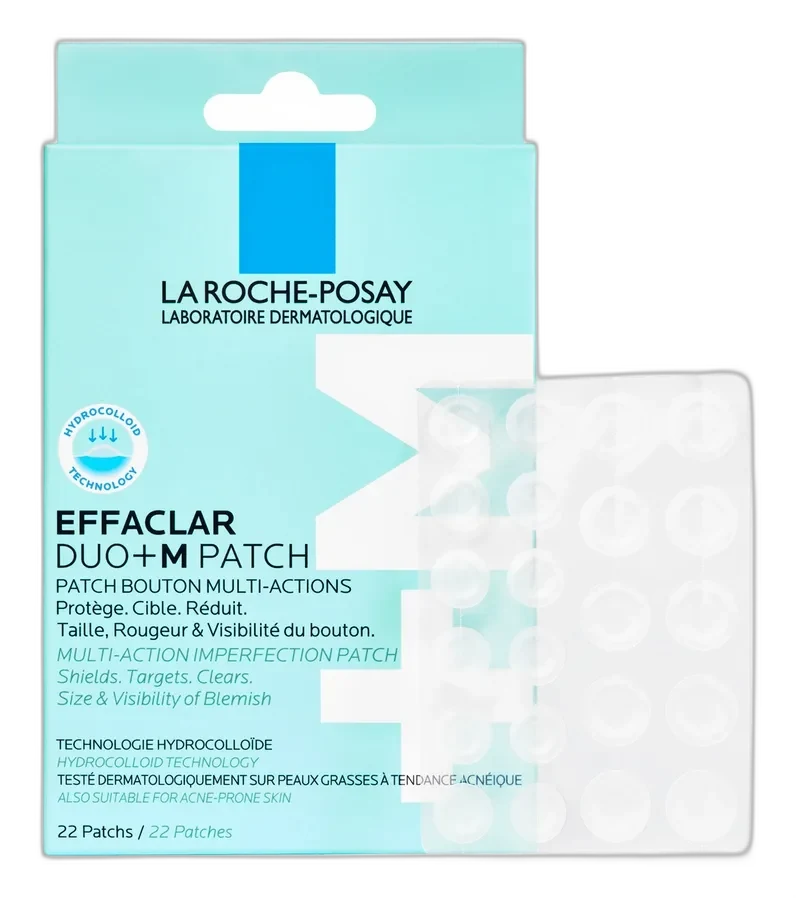
Effaclar Multi-Target Blemish Patches
Derm Office Staple
 Verified reviewer
Pros & cons.
- +420-micron reinforced thickness genuinely stays on overnight
- +Two patch sizes in one pack cover most blemish shapes
- +Zero active ingredients means no irritation to surrounding skin
- +Pregnancy-safe and nursing-safe spot treatment option
- +Invisible enough to wear under light makeup and foundation
- +Fragrance-free and sensitive-skin tested
- +Compatible with tretinoin, adapalene, and other active routines
- −22-count pack runs out fast for frequent or multi-spot breakouts
- −Higher per-patch cost than K-beauty hydrocolloid alternatives
- −Won't help deep cystic acne that hasn't reached the surface
- −Medium patches can still be too small for larger cystic pustules
- −Requires completely dry, product-free skin for adhesion to work
The full review.
Loyal hydrocolloid pimple patch users know the frustration: you apply a patch to a whitehead, expect a flattened spot and a cloudy disc of absorbed goo by morning, but wake up to a curled, sticky patch on your pillow and an unchanged blemish. La Roche-Posay’s Effaclar Multi-Target Blemish Patches solve this specific failure. At 420 microns—thicker than the 200-to-300-micron patches common in drugstore and K-beauty aisles—they use a flexible polymer matrix to stay flat against the cheek, chin, or forehead all night. This is the core claim, and it works. The formulation is simple. The INCI has five ingredients: a cellulose gum hydrocolloid (the active absorber), two hydrogenated polymers for structure and adhesion, mineral oil as a plasticizer for flexibility, and a stabilizer. That’s it. No fragrance. No tea tree oil. No salicylic acid. No centella extract. For a brand with an acne line full of actives, stripping the patch down to only hydrocolloid is a smart choice. A pimple patch shouldn’t deliver more actives to inflamed skin; it should create a moist wound-healing environment that encourages the blemish to drain and flatten while absorbing fluid. Adding salicylic acid or benzoyl peroxide to a patch mostly increases irritation risk for the surrounding skin without helping the spot. The two-size strategy is also notable. The pack includes 12 small patches for typical whiteheads and 10 mediums for larger pustules or spots near pores and crease lines. Most brands force you to choose one size, but La Roche-Posay includes both in one sachet. The medium patches are also wide enough to cover clusters of two or three close blemishes, a scenario drugstore patches often ignore. Performance-wise, these do what hydrocolloid patches should do, but more reliably. Apply one to a clean, completely dry whitehead or pustule—“completely dry” means no residual oil or serum, which ruins adhesion and absorption—and the center turns cloudy within hours. By morning, the patch is a white dome filled with visible exudate, and the spot underneath is usually flattened. Mature pustules respond best. Hydrocolloid cannot reach early cystic bumps that haven’t surfaced, so they get no benefit. There are limitations. The 22-count pack is small for frequent breakouts, and at around $14.99, the per-patch cost is higher than K-beauty options. The medium patches aren’t “large”; they barely cover a genuinely big surfaced pustule. Because they contain no active ingredient, they are strictly a reactive tool for existing spots, not a preventative one. The sensitive-skin focus shows their dermatology pedigree. For patients using tretinoin, adapalene, benzoyl peroxide, or azelaic acid, adding a salicylic-acid-infused patch can cause new irritation. These deliver zero additional actives, so they won’t disrupt your routine. They are also one of the few pregnancy-safe spot treatments available, as most effective options (retinoids, salicylic acid at treatment strengths, adapalene) are contraindicated or cautioned. If you have a solid routine and need a patch that survives sleep, absorbs fluid, and won’t fight your other actives, these are the correct answer.
Formula
Ingredient analysis.
Full INCI list
Hydrogenated Poly(C6-20 Olefin), Cellulose Gum, Hydrogenated Styrene/Butadiene Copolymer, Paraffinum Liquidum / Mineral Oil, Pentaerythrityl Tetra-Di-T-Butyl Hydroxyhydrocinnamate
Skin match.
The science.
The Science
The mechanism behind hydrocolloid pimple patches is borrowed wholesale from modern wound care, where hydrocolloid dressings have been standard clinical practice for pressure ulcers, minor burns, and post-surgical wounds for decades. The underlying principle is moist wound healing — the observation, consistently supported in dermatology and wound-care literature, that wounds heal faster and with less scarring when kept in a moist, occluded environment rather than allowed to dry and scab over. A hydrocolloid dressing like this patch creates exactly that environment. The cellulose gum absorbs serous exudate from the blemish while the polymer matrix traps it against the skin surface, preventing evaporation and maintaining the hydration that encourages keratinocyte migration and healing. For acne specifically, the clinical picture is that hydrocolloid patches reduce inflammation and visible size of surfaced pustules and whiteheads, while also physically preventing picking — which is arguably their second-most important function. The pick prevention alone reduces the risk of post-inflammatory hyperpigmentation and scarring significantly, since most acne scars and PIH come from mechanical damage to the skin during an active breakout rather than the breakout itself. The 420-micron thickness matters because hydrocolloid absorption capacity scales with material volume; a thicker patch can absorb more fluid before saturating and losing efficacy. Research on hydrocolloid wound dressings has consistently shown a correlation between dressing thickness, exudate management, and wear time — which is why this patch outperforms thinner options on overnight wear in practical terms. The fragrance-free, active-free formulation also has a simple clinical rationale: the evidence for adding tea tree, salicylic acid, or other actives to the hydrocolloid matrix is weak and the irritation risk is real, so a dermatology brand building a sensitive-skin-first product would reasonably strip those out.
Dermatologist Perspective
Dermatologists frequently recommend hydrocolloid patches as a low-risk, high-compliance tool for patients prone to picking at surfaced blemishes — which, in clinical experience, is one of the leading causes of post-inflammatory hyperpigmentation and acne scarring. Board-certified dermatologists note that the physical barrier alone justifies use, even when the absorption benefit is modest, because the reduction in picking behavior prevents the kind of mechanical skin damage that turns a two-day pimple into a two-month dark spot. This particular patch is commonly recommended for patients already using sensitizing actives like tretinoin or adapalene, where the absence of a secondary active ingredient prevents stacking irritation. Dermatologists generally agree that hydrocolloid patches are among the safest spot treatments available during pregnancy and nursing, and this La Roche-Posay option is often cited specifically because its dermatologist-developed formulation is free of fragrance and common allergens. It's not a substitute for a full acne routine — it's a complementary tool for surfaced blemishes that already exist.
Where it fits in your routine.
Clean the area with a gentle cleanser and pat dry. Residual moisture, serum, or oil prevents adhesion. Peel one patch from the backing and press it over a surfaced whitehead or pustule. Press the edges down firmly for a few seconds to activate the adhesive. Leave on for at least 6 hours, ideally overnight. Remove by peeling from one edge and discard — do not reuse. For daytime use under makeup, apply the patch to bare skin first, then dot concealer or foundation lightly over the top with a finger. Do not use spot treatments, serums, or moisturizers on the same blemish.
At $14.99 for 22 patches, each patch costs about $0.68. This exceeds the K-beauty category average of $0.20-$0.40 per patch. This price covers three features: 420-micron thick construction, two sizes in one pack, and La Roche-Posay's sensitive-skin formulation standards. Daily users will find the cost high; a K-beauty multi-pack offers better per-spot value. Occasional users who break out a few times a month and need patches that stay put overnight will find the premium worth it. The main limitation is the lack of a larger value size; a 44 or 66-count would lower the per-patch cost without changing the formulation.
Use these if you get surfaced whiteheads or pustules and thin hydrocolloid patches curl off overnight. They work well for people on active-heavy acne routines (tretinoin, adapalene, benzoyl peroxide) needing a non-irritating spot tool, or during pregnancy or nursing when most acne actives are off-limits.
Skip these patches if your acne is mostly deep cystic breakouts that do not surface; they do nothing for spots without a head. Skip these if you break out so heavily that a 22-count pack lasts only one week, as cheaper K-beauty alternatives cost less. Skip these if you want a spot treatment with an active ingredient for preventative work.
Product details.
Thin, flexible, translucent hydrocolloid discs use a soft adhesive matrix. They are firmer than a Band-Aid and thinner than a gel bandage.
Fragrance-free.
Flat resealable foil sachet keeps the patches sterile and stops the adhesive from drying out.
Press a patch over a clean, dry blemish. Within a few hours, the hydrocolloid absorbs fluid and turns cloudy or white. Most whiteheads look flatter by morning. The patch has no stinging, burning, or active ingredient sensation.
Occasional breakout users see results in 1-2 months; nightly spot-patching users see results in 2-3 weeks.
All Year
The backstory.
La Roche-Posay's Effaclar line has been the brand's acne-focused franchise for over two decades, built on input from dermatologists treating patients with sensitive-and-oily skin. The multi-target patches were developed to answer the request derms kept hearing: patients wanted a sensitive-skin-safe spot treatment that didn't require an active ingredient like benzoyl peroxide or salicylic acid, which often over-dry the surrounding area on top of drying the blemish itself.
About La Roche-Posay
Legacy Brand (20+ years)La Roche-Posay launched in 1975 and ranks among the top dermatologist-recommended sensitive-skin brands globally. Dermatologists treating acne-prone and oily skin helped develop the Effaclar line.
Common myths.
Pimple patches work on cystic acne.
Hydrocolloid patches only absorb material near or at the surface. A deep cyst without a head has nothing for the cellulose gum to pull out, so the patch looks unchanged in the morning. They work on whiteheads, pustules, and surfaced papules — not early subsurface cysts.
You can layer these over serums or spot treatments.
You can't. Moisture, oil, or leave-on products under the patch disrupt adhesion and stop the hydrocolloid from sealing against the skin. Apply to clean, completely dry skin only. Spot-treat with an active in a separate session on a different blemish.
FAQ.
How long should I leave these patches on?
Wear for at least 6 hours, or ideally overnight or a full workday. The hydrocolloid absorbs gradually; the patch flattens only after several hours of continuous contact. Replace the patch when it turns fully white or cloudy. This shows it is saturated and cannot absorb more.
Will these work on cystic acne?
No, not directly. Hydrocolloid patches absorb fluid from a blemish surface. A deep cyst without a visible head lacks surface fluid for the patch to pull. Once a cyst comes to a head, a patch works; before then, an active-ingredient treatment like adapalene or a steroid injection from a dermatologist works better.
Can I wear these under makeup?
The medium size is thin enough to sit under light makeup and foundation, but a subtle bump remains visible. Apply the patch first and let it settle. Dot concealer or foundation over the top using a finger or damp sponge. Do not rub, or you will lift the edges.
Are these patches safe during pregnancy?
Yes. The patches have no active ingredients, fragrance, retinoids, or salicylic acid — only inert hydrocolloid and polymer materials. This makes them a safe spot treatment for pregnancy and nursing, when most acne actives are off-limits.
How are these different from cheaper K-beauty pimple patches?
The main differences are thickness, sizing strategy, and adhesive quality. At 420 microns, these are thicker than most K-beauty options (200-300 microns). This thickness improves all-night adhesion and absorption capacity. One pack includes two sizes. K-beauty patches often have a lower price per patch, but these perform better during all-night wear.
Do these leave marks or irritate the skin?
No. Hydrocolloid is inert on surrounding skin, unlike salicylic acid or benzoyl peroxide spot treatments; it only interacts with moisture from the blemish. The fragrance-free formula and sensitive-skin testing leave the surrounding skin calmer than before the patch went on.
Can I reuse a patch if it still looks clear?
Don't reuse it. Once applied and removed, the adhesive picks up dead skin cells, sebum, and bacteria from the original site. Reapplying it spreads that material. Use a fresh patch each time — the 22-count pack is for this purpose.
What the community says.
"Stay on overnight without curling"
"Two sizes cover most pimple shapes"
"Visibly flatten whiteheads by morning"
"Invisible enough to wear under light makeup"
"Don't irritate surrounding skin"
"Pricier per patch than K-beauty alternatives"
"22-count pack runs out fast for frequent breakouts"
"Won't help deep cystic acne that hasn't surfaced"
"Medium patches can be too small for larger cystic bumps"
Featured in.
People also looked at.