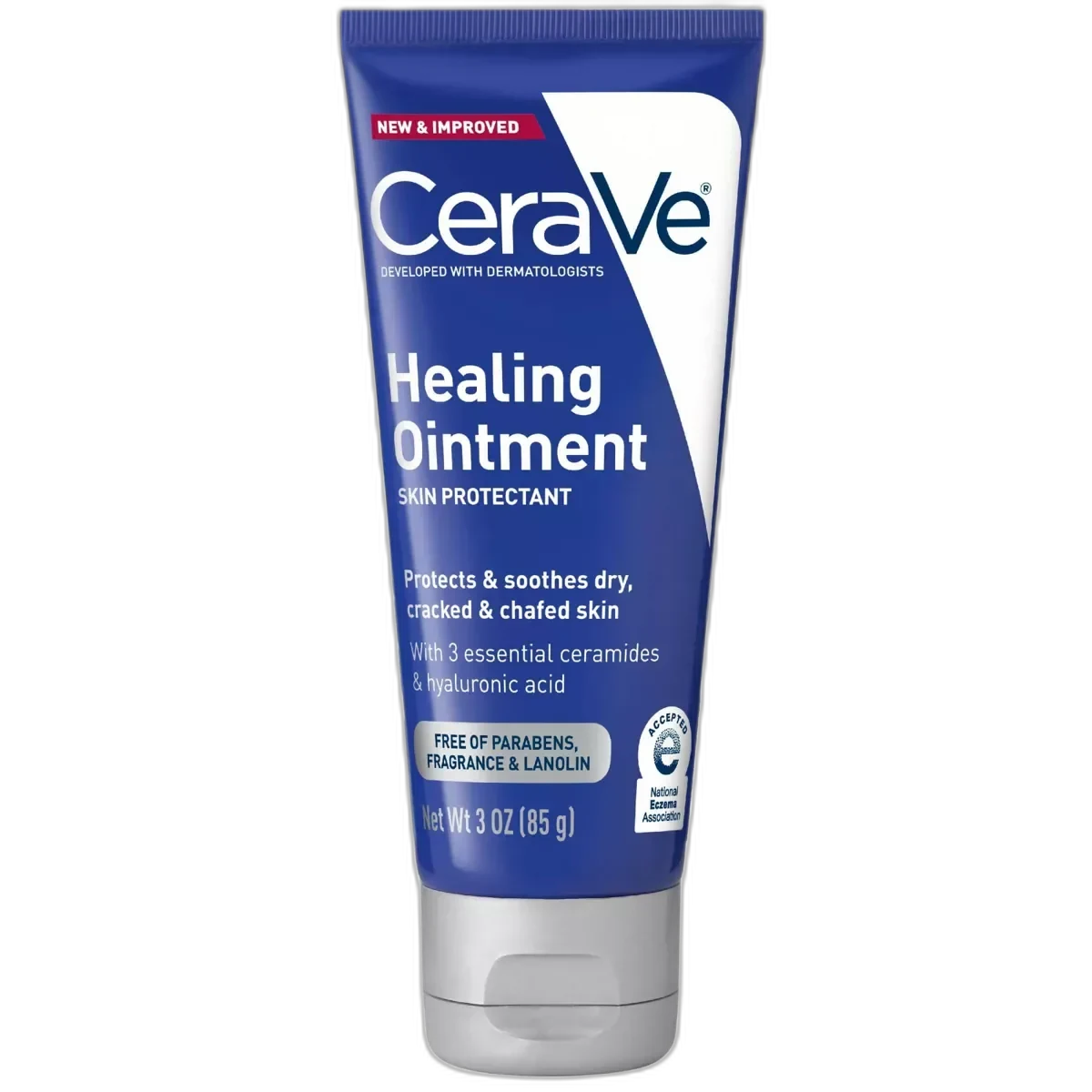
Healing Ointment
Barrier Rescue Hero
 Verified reviewer
Pros & cons.
- +Petrolatum at 46.5% provides the most effective occlusive seal available in skincare
- +Three ceramides plus cholesterol actively repair the barrier rather than just sealing it
- +Lanolin-free formula avoids a common allergen found in many competing ointments
- +Fragrance-free and paraben-free with minimal potential irritants
- +HSA and FSA eligible, making it accessible through health spending accounts
- +National Eczema Association Seal of Acceptance validates eczema suitability
- +Hyaluronic acid and panthenol add hydration and healing under the occlusive layer
- +Exceptional value at approximately twenty-one dollars for twelve ounces
- −Not suitable for oily or acne-prone skin due to heavy occlusive nature
- −Jar packaging in the largest size is less hygienic for facial application
- −Can transfer onto pillowcases if over-applied at night
- −Too heavy for daytime facial use under makeup or sunscreen
- −Contains mineral oil which some consumers prefer to avoid
The full review.
About CeraVe
Somewhere around 2019, the internet collectively decided that slathering petroleum jelly on your face before bed was not only acceptable but aspirational. They called it slugging, presumably because the resulting sheen made you look like a very well-hydrated gastropod. And while Vaseline had served this purpose for decades at a fraction of the cost, the CeraVe Healing Ointment became the slugging community’s product of choice for a reason that goes beyond aesthetics or brand loyalty: the formula actually does something under that occlusive seal.
Myth
Petrolatum, at 46.5% of this formula, is the foundation — and for good reason. It remains the single most effective occlusive ingredient available, capable of reducing transepidermal water loss by up to 98%. A 1992 study in the Journal of the Society of Cosmetic Chemists demonstrated that petrolatum does not merely sit on the skin surface like an inert film; it actually permeates into the intercellular lipid domain of the stratum corneum, integrating with the existing barrier structure. This means the petrolatum in CeraVe’s ointment is not just a lid on a pot — it is actively participating in barrier architecture.
Reality
But what elevates this product from commodity ointment to clinical tool is everything else in the formula. Three skin-identical ceramides — NP, AP, and EOP — work alongside cholesterol and phytosphingosine to replenish the lipid matrix that compromised skin is desperately missing. In conditions like eczema, where ceramide depletion in the stratum corneum is a well-documented pathological feature, adding these lipids back is not a luxury — it is addressing the root biomechanical deficit. The fact that they are delivered under a petrolatum occlusive layer means they have nowhere to go but into the skin, maximizing their integration into the barrier.
How to Use
Hydrolyzed hyaluronic acid sits beneath the occlusive cap, drawing and holding moisture in a reservoir that the skin can access throughout the night. This is a genuinely clever formulation strategy. In a leave-on serum, hyaluronic acid can sometimes pull moisture from the skin in very dry environments. But sealed under petrolatum, it has access only to the moisture already present — and that moisture cannot escape. The result is sustained hydration rather than the boom-and-bust cycle that open-air hyaluronic acid products can sometimes produce.
Works for
Panthenol, the provitamin B5 that converts to pantothenic acid in the skin, adds a wound-healing dimension that pure petrolatum products lack. For post-procedure skin, cracked winter hands, or the raw patches that eczema leaves behind, panthenol accelerates tissue repair while the ceramides rebuild the lipid matrix and the petrolatum prevents further moisture loss. It is a three-layer approach to healing that mirrors what dermatologists would prescribe if they could custom-compound an ointment on the spot.
Texture
The texture is thick — there is no pretending otherwise. This is an ointment in the truest sense of the word, with the semi-solid heft of a product that means business. But it is remarkably less greasy than straight petroleum jelly, thanks to the dimethicone that adds slip and the ozokerite wax that gives the formula structure. When warmed between fingertips, it melts and spreads into a surprisingly thin, even layer. A small amount covers the entire face, which is good because the temptation to over-apply is real and the consequences are a pillowcase that looks like it lost a fight with a glazed donut.
AM routine
For nighttime slugging, the protocol is simple: complete your entire PM routine — cleanser, serums, moisturizer — then apply a thin layer of the Healing Ointment as the final seal. The ceramides and hyaluronic acid in your other products get locked in along with the ones already in the ointment, creating a concentrated recovery environment. Morning skin after a night of slugging with this product has a particular quality — plump, calm, almost suspiciously smooth — that is difficult to achieve with moisturizers alone.
Best for
The ointment excels in acute situations. Cracked knuckles in January, chapped lips, post-laser or post-peel skin, the angry red patches that eczema flares leave behind — this is where the Healing Ointment justifies its name rather than being just another occlusive. The National Eczema Association Seal of Acceptance is not given to products that merely avoid irritants; it requires demonstration that the product actively benefits eczema-prone skin.
Not ideal for
Limitations exist and are worth stating plainly. This is not a product for oily skin, and using it on acne-prone areas of the face can trap sebum and bacteria under the occlusive layer, potentially worsening breakouts. The claim of being non-comedogenic is accurate in a controlled patch-test setting, but real-world application on already oily T-zones is a different situation. If you have combination skin, strategic application — on cheeks and jawline, avoiding the nose and forehead — is the smarter approach.
Packaging
The jar packaging of the 12-ounce size, while economical, is suboptimal for facial use. Dipping fingers into a shared jar introduces bacteria; the squeeze tubes in the smaller sizes are more hygienic. For face-only slugging, the 3-ounce tube makes more sense. For body use or household sharing, the jar’s volume justifies its format.
Best Season
At approximately twenty-one dollars for twelve ounces, the value proposition is exceptional. This quantity lasts months for facial use — possibly the better part of a year if you are using it only on targeted areas. The ingredient list, which includes ceramides, cholesterol, hyaluronic acid, panthenol, and vitamin E in addition to the petrolatum base, would cost significantly more in a branded barrier repair treatment from a prestige label. CeraVe delivers the same functional ingredients at a price point that removes any economic barrier to consistent use.
Who Should Buy
The Healing Ointment does not need to be your daily moisturizer, and it should not try to be. It is a specialized tool — the thing you reach for when your skin is in trouble, when the weather has turned hostile, when a procedure has left your face raw, or when you want to wake up with skin that looks like it spent eight hours in a ceramide bath. For that specific, important job, almost nothing at this price point comes close.
Ingredient analysis.
Full INCI list
Active Ingredient: Petrolatum 46.5%. Inactive Ingredients: Mineral Oil, Paraffin, Ozokerite, Dimethicone, Ceramide NP, Ceramide AP, Ceramide EOP, Carbomer, Water, Sodium Lauroyl Lactylate, Proline, Cholesterol, Phenoxyethanol, Tocopheryl Acetate, Tocopherol, Hydrolyzed Hyaluronic Acid, Panthenol, Pantolactone, Phytosphingosine, Xanthan Gum, Ethylhexylglycerin
Skin match.
The science.
The Science
The CeraVe Healing Ointment's efficacy rests on the synergy between its occlusive petrolatum base and its barrier-repair lipid complex. Petrolatum's mechanism of action was elucidated in a foundational 1992 study by Ghadially et al. published in the Journal of the Society of Cosmetic Chemists, which demonstrated that petrolatum permeates into the interstices of the stratum corneum rather than remaining purely on the surface, effectively integrating into the barrier structure while reducing transepidermal water loss.
The ceramide complex (NP, AP, EOP) combined with cholesterol and phytosphingosine mirrors the physiological lipid composition of healthy stratum corneum. Research published in the Journal of Dermatological Science has established that eczema-prone skin exhibits significant ceramide depletion, particularly of ceramide subtypes NP and AP. A 2021 qualitative review by Kono et al. in The Journal of Dermatology confirmed that ceramide-containing formulations demonstrate clinically significant improvements in both water retention and barrier function, with effects measurable via transepidermal water loss reduction.
The inclusion of panthenol is supported by research showing that dexpanthenol (provitamin B5) accelerates epidermal wound healing by stimulating proliferation of dermal fibroblasts. A systematic review published in Skin Pharmacology and Physiology confirmed that topical panthenol enhances stratum corneum hydration, reduces transepidermal water loss, and maintains skin softness and elasticity.
The formulation strategy of delivering ceramides and humectants under a petrolatum occlusive layer maximizes their efficacy by preventing evaporation and creating sustained contact time with the skin — a principle supported by research showing that occlusion enhances the penetration and retention of topically applied active ingredients.
References
- Effects of petrolatum on stratum corneum structure and function — Journal of the Society of Cosmetic Chemists (1992)
- Clinical significance of the water retention and barrier function-improving capabilities of ceramide-containing formulations: A qualitative review — The Journal of Dermatology (2021)
Dermatologist Perspective
Dermatologists frequently recommend the CeraVe Healing Ointment as a post-procedure occlusive for patients recovering from chemical peels, laser treatments, and microneedling, where maintaining a moist wound-healing environment is critical for optimal outcomes. Board-certified dermatologists note that the ceramide-enriched formula offers advantages over plain petrolatum for patients with barrier dysfunction conditions like eczema and contact dermatitis, as it addresses the underlying lipid depletion rather than simply preventing water loss. The product is commonly recommended as part of eczema management protocols alongside prescription treatments, and its fragrance-free, lanolin-free formulation minimizes the risk of contact sensitization in already compromised skin.
Where it fits in your routine.
For facial slugging, apply a thin, even layer as the final PM skincare step, after all serums and moisturizers. Use a pea-sized amount for the full face. For targeted treatment of dry, cracked, or chafed skin on the body, apply directly to affected areas as needed during the day. For post-procedure care, follow your dermatologist's specific instructions on application frequency and timing. Wait 15-20 minutes for absorption before lying on a pillowcase to minimize transfer.
At $20.99 for twelve ounces, the CeraVe Healing Ointment offers high value for a ceramide-infused occlusive treatment. The jar lasts six to eight months for facial slugging alone, making the per-use cost negligible. Smaller 1.89-ounce and 3-ounce tubes offer portability and more hygienic facial application, but the per-ounce cost is higher. Compared to prestige brand barrier repair balms with similar ingredients at two to four times the price for less volume, the value gap is large—especially with CeraVe's two decades of dermatologist validation.
Use this if you have dry, eczema-prone, or compromised skin needing heavy occlusive barrier protection. It works for slugging enthusiasts, post-procedure patients, and people with cracked skin in cold weather. Retinol users can also use it as an occlusive overlay to buffer irritation.
Oily or acne-prone skin types should avoid full-face application. The heavy occlusive layer traps sebum and worsens breakouts. Users who dislike any greasy feel will find this product challenging, even when applied thinly.
Product details.
This is fragrance-free. It has a faint, neutral ointment base scent that most users will not notice.
Available in squeeze tubes (1.89 oz, 3 oz) and a wide-mouth jar (12 oz). The jar is easy to scoop but less hygienic for the face; the tube works better for targeted application.
The first application provides immediate relief — dry, tight, or cracked skin feels soothed and sealed. The texture is thick but melts on contact and spreads easier than it looks. It has no tingling, stinging, or adjustment period. A visible sheen stays on the skin until the ointment absorbs over 20-30 minutes. ***
6-8 months of nightly facial use from the 12 oz jar; 2-3 weeks if used generously on body
12 months ***
fall winter ***
The backstory.
CeraVe developed the Healing Ointment to address a gap in the ointment market: most occlusive products stopped at petrolatum and called it a day. By incorporating their signature ceramide complex into an ointment base, CeraVe created a product that appeals to both the slugging community and dermatologists prescribing post-procedure care — a rare crossover between skincare trend and clinical utility.
About CeraVe
Legacy Brand (20+ years)Dermatologists helped develop CeraVe in 2005. It is the number-one dermatologist-recommended skincare brand in the U.S. Peer-reviewed research backs its ceramide-based formulations, and multiple products carry the National Eczema Association Seal of Acceptance.
Common myths.
Petrolatum clogs pores and causes acne.
Petrolatum feels heavy but most dermatological standards classify it as non-comedogenic. CeraVe labels this specific formula non-comedogenic. However, applying a thick occlusive over oily skin traps sebum and causes breakouts — the issue is application context, not the ingredient.
Petroleum-based products are unsafe or toxic for skin.
This product uses pharmaceutical-grade petrolatum, which is highly refined. Doctors have used it safely in medical and dermatological applications for over a century. It is one of the most studied and well-tolerated skincare ingredients available.
FAQ.
Can I use CeraVe Healing Ointment on my face?
Yes — this ointment is non-comedogenic. Use it on the face as the final step in your nighttime routine, a practice called slugging. Apply a thin layer over your serums and moisturizer to lock them in. If you have oily or acne-prone skin, apply it to dry patches instead of the full face.
What is the difference between CeraVe Healing Ointment and Aquaphor?
The main difference is CeraVe includes three skin-identical ceramides, cholesterol, and hyaluronic acid to repair the skin barrier instead of just sealing it. Aquaphor contains lanolin (a potential allergen for some), but CeraVe's formula is lanolin-free. Both use petrolatum as their primary occlusive, but CeraVe's formula restores the barrier rather than just protecting it.
Is CeraVe Healing Ointment good for eczema?
Yes — it has the National Eczema Association Seal of Acceptance. Combining petrolatum occlusion with ceramide barrier repair helps eczema-prone skin, which often has low ceramide levels in the stratum corneum. The lanolin-free, fragrance-free formula also avoids common eczema triggers.
Can I use CeraVe Healing Ointment over retinol?
Yes, many dermatologists recommend this approach. Applying a thin layer of this ointment over retinol reduces irritation and peeling while the retinol works beneath the occlusive seal. The ceramides in the ointment buffer the barrier disruption retinol causes, which works well for retinol beginners.
Is CeraVe Healing Ointment safe during pregnancy?
Yes. This ointment lacks retinoids, salicylic acid, or other ingredients flagged during pregnancy. Petrolatum, ceramides, hyaluronic acid, and panthenol are safe for pregnancy and nursing.
How often should I use CeraVe Healing Ointment?
Apply nightly as the last step of your PM routine for general dry skin maintenance. For acutely cracked, chafed, or post-procedure skin, apply two to three times daily to affected areas. A thin layer works; over-application does not increase effectiveness and feels greasy.
Does CeraVe Healing Ointment contain lanolin?
No. This formula is lanolin-free, unlike many petroleum-based ointments. This makes it suitable for people with lanolin allergies or sensitivities. It uses ceramides, cholesterol, and phytosphingosine instead of lanolin to provide emollient and barrier-supporting properties.
Community
What the community says.
"Immediate relief for cracked and chafed skin"
"Non-greasy for an ointment — absorbs better than expected"
"A little goes a very long way"
"Excellent as a slugging occlusive over nighttime skincare"
"Paraben-free and lanolin-free formula"
"Too heavy and occlusive for oily or acne-prone skin"
"Jar packaging is less hygienic than a tube"
"Can feel greasy on pillowcases if over-applied"
"Smaller sizes run out quickly for full-body use"