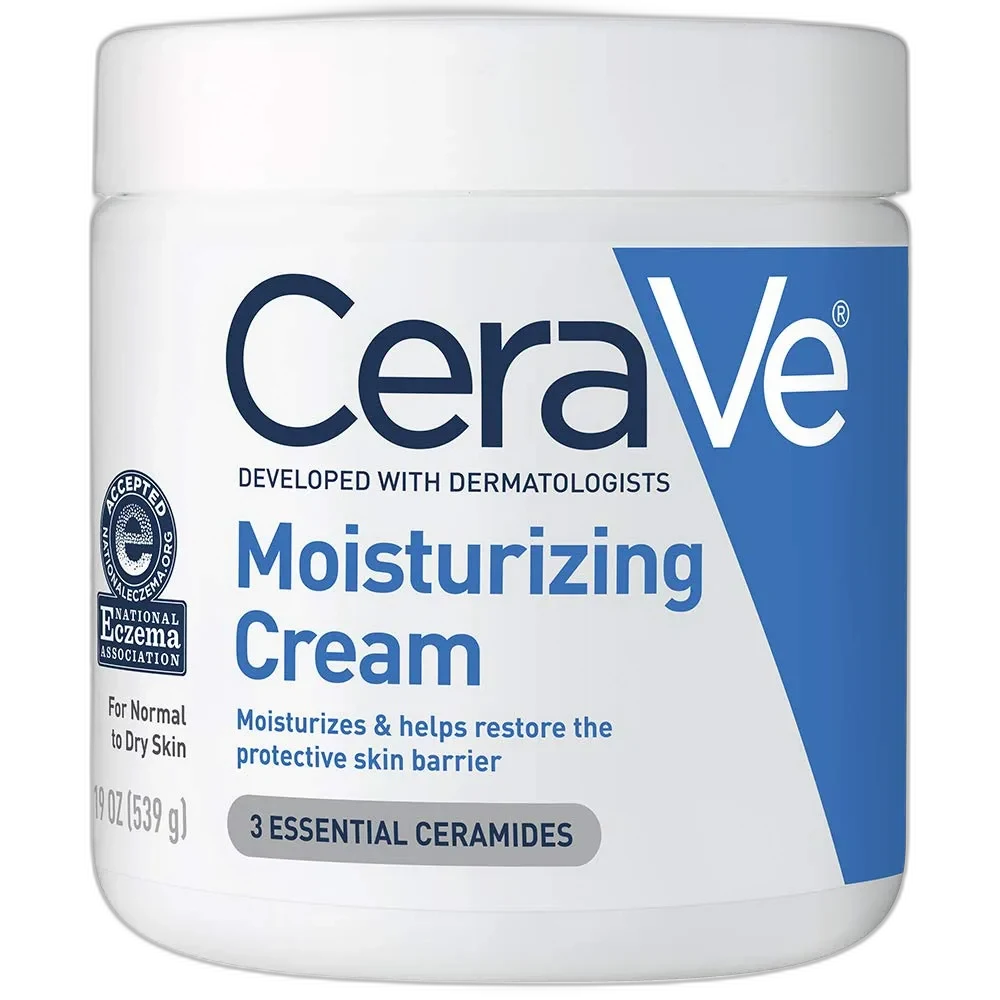
Moisturizing Cream
Budget Holy Grail
 Verified reviewer
Pros & cons.
- +Three ceramides with cholesterol and phytosphingosine mirror the skin's natural lipid barrier composition
- +MVE delivery technology provides sustained 24-hour ingredient release
- +Exceptional value at approximately one dollar per ounce in the 19 oz tub
- +National Eczema Association Seal of Acceptance validates suitability for reactive skin
- +Non-comedogenic and fragrance-free — suitable for face and body use
- +Over two decades of consistent dermatologist recommendation and clinical validation
- +Multi-humectant system (glycerin plus hyaluronic acid) sealed by petrolatum and dimethicone
- +Family-friendly formula suitable for ages 3 and up
- −Jar packaging is less hygienic than a pump for facial application
- −Too heavy for oily skin types, particularly in warm and humid conditions
- −Contains petrolatum which some consumers prefer to avoid
- −Aesthetically plain packaging lacks the appeal of prestige moisturizers
- −May not provide sufficient hydration for extremely dry or eczema-flaring skin without supplementation
The full review.
Dermatologists often run a thought experiment: if you could only recommend one moisturizer to every patient, what would it be? The answer is almost always the CeraVe Moisturizing Cream. It is not novel or exciting, and the packaging lacks flair. It works for nearly everyone and costs less per ounce than most pantry staples.
The Moisturizing Cream launched in 2005 as part of CeraVe’s original product line. Dermatologists built the brand to solve a practical problem. The skin barrier consists of ceramides, cholesterol, and fatty acids in a specific ratio. When dryness, eczema, aging, over-washing, or environmental exposure compromise that barrier, emollients alone cannot fix the structural deficit. You must replenish the lipids in the correct ratio and deliver them so they integrate into the barrier rather than sitting on the surface.
The formula uses purposeful simplicity. Glycerin and sodium hyaluronate provide humectant hydration at two depths: glycerin at the surface and hyaluronate slightly deeper. Petrolatum and dimethicone create an occlusive seal to stop moisture evaporation. Three ceramides—NP, AP, and EOP—along with cholesterol and phytosphingosine, replenish the lipid matrix of the barrier. These ingredients function as the structural architecture of healthy skin.
The MVE — Multivesicular Emulsion — delivery technology is CeraVe’s patented mechanism for sustained release. Instead of dumping all ceramides and humectants on the skin surface where they might evaporate or wipe off, the MVE system encapsulates ingredients in concentric lipid layers that dissolve over 24 hours. Each layer releases its payload as the previous one depletes. This is a controlled-release system used in pharmaceutical drug delivery, applied to a nineteen-dollar jar of moisturizer.
The cream has a distinct physical feel. It scoops from the jar with a thick, dense consistency. It melts on warm skin and absorbs within two to three minutes, leaving a soft, sealed finish that is not greasy. This absorption profile is key: it is thick enough for dry and eczema-prone skin, but light enough for facial use under sunscreen after absorption. This dual capability for face and body, dry and normal skin, and winter and summer, makes it a universal recommendation.
The sensory experience is unremarkable. There is no fragrance, tingle, cooling, or warming sensation, and no dramatic immediate effect from active ingredients. You apply it, your skin feels moisturized, and you move on. This is the product’s strength and why it lacks Instagram fame. In a market favoring novelty, the CeraVe Moisturizing Cream is like a well-built foundation: invisible, essential, and only noticed when compared to life without it.
The National Eczema Association Seal of Acceptance requires proof that a product benefits eczema-prone skin without common irritants or allergens. For millions managing eczema, dermatologists often recommend this cream first. It serves as a daily maintenance product that keeps the barrier intact between flares, reducing the frequency and severity of episodes.
Packaging
The packaging is purely functional. The white tub with a blue lid is iconic and instantly recognizable, though not beautiful. The jar format is economical but raises hygiene concerns for facial use because dipping fingers into a shared jar introduces bacteria. CeraVe now offers the cream in a tube with a pump, which costs more per ounce but is more hygienic for the face. The jar remains practical for body use.
At approximately nineteen dollars for nineteen ounces—about a dollar per ounce—the value is high. This ceramide-based moisturizer contains hyaluronic acid, petrolatum occlusion, cholesterol, phytosphingosine, and patented delivery technology for less than many products with fewer ingredients. Smaller sizes—8 ounce, 12 ounce, and a travel size—exist, but the 19-ounce tub offers the best per-ounce value.
Not ideal for
The limitations are clear. Oily skin types, especially in warm, humid climates, may find this cream too heavy. The petrolatum and fatty alcohols are non-comedogenic in testing, but can feel heavy on skin with excess sebum. For oily skin, CeraVe’s Moisturizing Lotion—a lighter version in the same ingredient family—is a better daily choice.
The paraben-free, fragrance-free, phenoxyethanol-preserved formula meets modern standards and maintains the barrier-repair efficacy seen for over two decades. The ingredient list is stable; CeraVe has not reformulated to add trendy ingredients, keeping the proven composition.
The CeraVe Moisturizing Cream needs no novel angle. It is a battle-tested, scientifically grounded, and universally endorsed moisturizer available without a prescription. More dermatologists recommend it, more patients purchase it, and more users repurchase it than almost any other moisturizer in the American market. It costs nineteen dollars, lasts months, and works. In skincare, that is the whole story.
Ingredient analysis.
Full INCI list
Aqua/Water/Eau, Glycerin, Cetearyl Alcohol, Caprylic/Capric Triglyceride, Cetyl Alcohol, Ceteareth-20, Petrolatum, Potassium Phosphate, Ceramide NP, Ceramide AP, Ceramide EOP, Carbomer, Dimethicone, Behentrimonium Methosulfate, Sodium Lauroyl Lactylate, Sodium Hyaluronate, Cholesterol, Phenoxyethanol, Disodium EDTA, Dipotassium Phosphate, Tocopherol, Phytosphingosine, Xanthan Gum, Ethylhexylglycerin
Skin match.
The science.
The Science
The CeraVe Moisturizing Cream repairs the barrier using a biomimetic approach. Its three-ceramide complex (NP, AP, EOP), cholesterol, and phytosphingosine mimic the stratum corneum's physiological lipid composition, which consists of ceramides (approximately 50%), cholesterol (25%), and free fatty acids (15%). Imokawa et al. showed in the Journal of Investigative Dermatology that ceramide depletion marks barrier-compromised skin, and topical application of physiological ceramide ratios restores barrier function.
CeraVe's MVE (Multivesicular Emulsion) delivery technology is a patented system from pharmaceutical controlled-release drug delivery. Concentric lipid bilayers encapsulate active ingredients and dissolve sequentially to release them over 24 hours. This matters for ceramides, which need prolonged contact time to integrate into the lamellar lipid matrix instead of just coating the skin surface.
A 2023 consensus review in the Journal of Drugs in Dermatology confirmed that ceramide-containing moisturizers improve transepidermal water loss, stratum corneum hydration, and clinical signs of barrier dysfunction. The review noted that products combining ceramides with cholesterol and fatty acids in physiological ratios outperform products with isolated ceramides.
The petrolatum occlusive layer reduces transepidermal water loss by up to 98%, letting ceramides and humectants work optimally. The dual humectant system — glycerin at the surface and sodium hyaluronate in the deeper stratum corneum — provides layered hydration that the occlusive seal locks in, using a three-mechanism moisturizing approach.
References
- The Importance of a Healthy Skin Barrier From the Cradle to the Grave Using Ceramide-Containing Cleansers and Moisturizers: A Review and Consensus — Journal of Drugs in Dermatology (2023)
- Effects of petrolatum on stratum corneum structure and function — Journal of the Society of Cosmetic Chemists (1992)
Dermatologist Perspective
Dermatologists in the United States recommend The CeraVe Moisturizing Cream more than any other moisturizer. Board-certified dermatologists prescribe it for almost every skin condition involving barrier dysfunction — eczema, contact dermatitis, xerosis, post-procedure recovery, and as a maintenance moisturizer for patients using drying prescription treatments like retinoids, benzoyl peroxide, and isotretinoin. Dermatologists value its consistent formulation, the MVE delivery system, the physiological ceramide ratio, and the price point that aids patient compliance. Dermatological enthusiasm for this product comes from two decades of observed clinical outcomes rather than marketing relationships.
Where it fits in your routine.
Scoop a large amount from the jar (or dispense from the tube) and apply to face and body. For facial use, apply a thin, even layer after serums and treatments. Wait two to three minutes for absorption before sunscreen. For body use, apply to damp skin after showering to lock in moisture. Use twice daily — morning and evening — to maintain the barrier. For facial application from the jar, use a clean spatula or spoon to avoid bacteria. A pea-to-nickel-sized amount covers the full face.
At approximately $18.99 for nineteen ounces, the CeraVe Moisturizing Cream offers arguably the best value in the entire skincare market. The per-ounce cost is roughly one dollar for a ceramide-based moisturizer with patented delivery technology, hyaluronic acid, petrolatum, cholesterol, and phytosphingosine. Other sizes are available — 8 oz, 12 oz, and travel sizes — though the 19 oz tub provides significantly better per-ounce value. Comparable formulations from prestige or pharmacy-exclusive brands range from $25 to $60 for less than half the volume. The tube format with pump is slightly more expensive per ounce but worth the premium for hygienic facial application.
Anyone with dry, normal, sensitive, or eczema-prone skin can use this affordable, dermatologist-recommended moisturizer for face and body. Dermatologists recommend The CeraVe Moisturizing Cream widely because it works for more skin types and conditions than almost any other single product.
People with oily skin find thick creams heavy and pore-clogging, especially in warm weather. This cream also lacks elegant packaging or a luxury experience; it is clinically functional, not aesthetically aspirational.
Product details.
All Year
The backstory.
The CeraVe Moisturizing Cream was part of the brand's founding product line in 2005, developed by dermatologists who wanted to create a moisturizer that replicated the skin's natural barrier composition at a price accessible to everyone. Built around the patented MVE delivery technology that releases ceramides gradually, it became the product that dermatologists recommended more than any other moisturizer — not because of marketing spend, but because it worked consistently for virtually every patient they recommended it to.
About CeraVe
Dermatologists helped develop CeraVe in 2005, and the Moisturizing Cream launched with the brand. It is the number-one dermatologist-recommended moisturizer in the U.S. and has over two decades of peer-reviewed research. Multiple products carry National Eczema Association seals.
Common myths.
Expensive moisturizers are better than drugstore options.
The CeraVe Moisturizing Cream uses the same barrier-repair ingredient classes — ceramides, cholesterol, hyaluronic acid, and phytosphingosine — as prestige moisturizers costing five to ten times more. The MVE delivery technology is patented and proprietary. Price reflects marketing and packaging, not formulation quality.
The CeraVe Moisturizing Cream clogs pores because it contains petrolatum.
The formula is tested and certified non-comedogenic. Petrolatum is an occlusive, but it is one of the least comedogenic occlusives available. The cream does not clog pores for most users on the face. Those with very acne-prone skin should patch-test, as with any thick moisturizer.
FAQ.
Can I use CeraVe Moisturizing Cream on my face?
Yes — this cream is non-comedogenic and works for both face and body. For facial application, apply a thin layer and let it absorb for two to three minutes before applying sunscreen. If using the jar format, use a clean spatula or spoon to avoid bacteria from your fingers.
Is CeraVe Moisturizing Cream good for eczema?
Yes — it has the National Eczema Association Seal of Acceptance. The three ceramides with cholesterol and phytosphingosine fix the ceramide depletion common in eczema-prone skin, while the petrolatum creates an occlusive barrier to stop moisture loss. Dermatologists widely recommend this cream as a maintenance moisturizer for eczema-prone skin.
What is the difference between CeraVe Moisturizing Cream and Moisturizing Lotion?
The Cream (in the tub or jar) is thick and uses petrolatum for stronger occlusive protection—best for dry to very dry skin. The Lotion is thin and light, better for normal skin or warmer weather. Both use the same three ceramides and hyaluronic acid, but The Cream seals in more moisture.
Why is CeraVe Moisturizing Cream so popular with dermatologists?
It provides three barrier-repair mechanisms: ceramide replenishment, humectant hydration, and occlusive sealing. The price allows for consistent patient use. This fragrance-free, non-comedogenic formula works for many skin types and conditions without causing reactions, so it is a safe recommendation. This cream offers the reliability and accessibility dermatologists value.
How long does a tub of CeraVe Moisturizing Cream last?
The 19-ounce tub lasts about four to six months using it twice daily on the face, or six to eight weeks using it daily on the full body. The large volume and low price allow liberal application for consistent barrier maintenance.
Is CeraVe Moisturizing Cream safe during pregnancy?
Yes. This cream lacks retinoids, salicylic acid, or other ingredients flagged during pregnancy. Its ceramides, glycerin, hyaluronic acid, and petrolatum are safe for pregnancy and breastfeeding. Obstetricians and dermatologists frequently recommend this moisturizer to pregnant women.
What the community says.
"Incredibly effective for the price — the best value in skincare"
"Works on both face and body without causing breakouts"
"Relieves dryness and eczema symptoms noticeably"
"The tub lasts forever with daily use"
"Fragrance-free and gentle enough for the whole family"
"Jar packaging is less hygienic than a pump for facial use"
"Can feel too heavy for oily skin, especially in summer"
"Contains petrolatum which some users prefer to avoid"
"Basic white packaging is not aesthetically exciting"