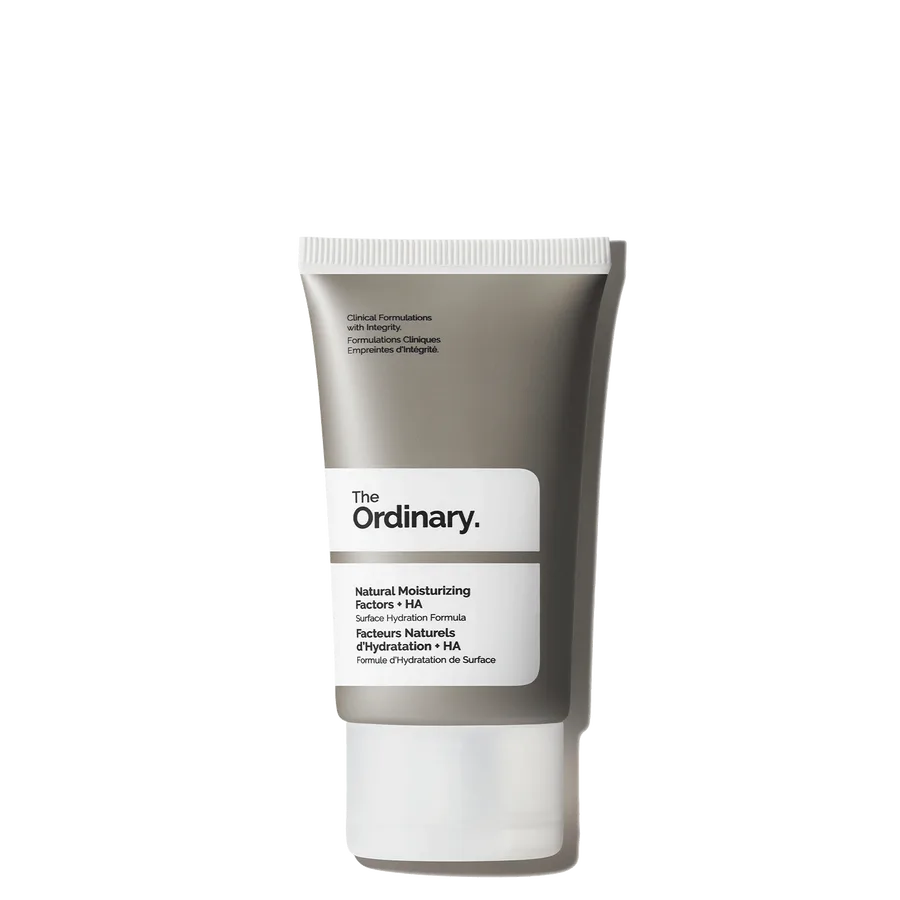
Natural Moisturizing Factors + HA
Everyday Essential
 Verified reviewer
Pros & cons.
- +Systematically replicates the skin's Natural Moisturizing Factor with amino acids, PCA, urea, and sugars
- +National Eczema Association Seal of Acceptance validates suitability for compromised skin
- +Extraordinary value at .70 for 30 mL or 4.00 for 100 mL
- +Zero conflicts with any active ingredient — works over retinoids, acids, vitamin C, and peptides
- +Fragrance-free, silicone-free, oil-free, and vegan
- +Available in two sizes with the 100 mL offering excellent per-unit value
- +Semi-matte finish works well under makeup and sunscreen for most skin types
- −Not moisturizing enough for very dry skin without an additional occlusive or oil layer
- −Slightly thick application texture does not spread as effortlessly as silicone-based moisturizers
- −Can pill when layered over thick water-based serums if not fully absorbed
- −The 30 mL tube runs out in approximately one month with twice-daily use
- −No treatment benefits beyond hydration — purely a maintenance moisturizer
The full review.
Skin hydration science is simple. Your stratum corneum produces Natural Moisturizing Factor, a mix of small, water-attracting molecules like amino acids, pyrrolidone carboxylic acid, urea, sugars, and minerals. These compounds hold water in skin cells to keep them plump and functional. When NMF levels drop due to aging, harsh cleansing, UV exposure, or low humidity, your skin gets dry. A good moisturizer replaces those molecules and adds a lipid layer to slow evaporation. That is the science. Everything else is marketing.
The Ordinary Natural Moisturizing Factors + HA follows this science literally. The ingredient list mirrors a dermatology textbook chapter on stratum corneum hydration: eleven amino acids, PCA, sodium PCA, sodium lactate, urea, allantoin, four sugars including trehalose, sodium hyaluronate, lecithin, and a blend of fatty acids. These are the actual components of NMF, plus hyaluronic acid for more humectant capacity and phospholipids for barrier support. It works like replacing lost electrolytes with an electrolyte solution—giving your skin the exact molecules and proportions it already uses.
The product launched in 2017, early in The Ordinary’s existence. It was designed as the brand’s default moisturizer—the first recommendation, the one that works for everyone, and the base layer that makes treatment serums comfortable. It has met this goal consistently, earning nearly 20,000 reviews and the National Eczema Association Seal of Acceptance.
The cream is medium-weight. It lacks the airy, whipped texture of a Korean gel-cream and the thick, dense consistency of a nighttime barrier repair cream. It sits in the middle—thick enough to feel substantive, but light enough to absorb within a minute and leave a non-greasy, semi-matte finish. Application requires brief working; it lacks the effortless slip of silicone-based moisturizers because it contains no silicones. Once settled, it feels comfortable and nearly invisible under sunscreen or makeup.
For normal, combination, and oily skin, NMF + HA provides standard daily hydration. Amino acids and PCA draw moisture into the stratum corneum, hyaluronic acid binds water at the surface, and fatty acids and cetyl/stearyl alcohols provide a mild occlusive layer to prevent transepidermal water loss without feeling heavy. For sensitive and eczema-prone skin, the NEA certification matters—this product meets clinical standards for barrier compatibility and contains no common triggers like fragrance, essential oils, or harsh preservatives.
For dry skin, NMF + HA may not be enough alone. The occlusive layer is mild; in dry climates or winter, the water-binding ingredients need a heavier layer on top to lock in moisture. Layering a few drops of squalane or a facial oil underneath—or applying an occlusive like Aquaphor over it at night—works better for dry skin. In this way, NMF + HA is an excellent first moisturizing layer, but it needs backup.
The conflict-free profile is a major feature. NMF + HA contains no actives that interact poorly with other skincare ingredients. Use it over retinol, after AHA exfoliation, under vitamin C in the morning, or on top of a peptide serum at night. The arginine in the formula even interacts with AHAs to produce a time-release effect that can reduce acid irritation. For complex multi-product routines, a moisturizer that never causes problems is highly practical.
The two sizes—30 mL at .70 and 100 mL at 4.00—offer different values. The 100 mL tube costs roughly 36% less per milliliter and lasts three to four months with twice-daily use. The 30 mL size is for trials and lasts about a month with regular use. If you know the product works for your skin, the 100 mL is the obvious choice.
At .70 for the standard size, The Ordinary Natural Moisturizing Factors + HA challenges the prestige moisturizer market. The amino acids, PCA, urea, and hyaluronic acid in this formula are chemically identical to those in moisturizers costing 0, 0, or 00. The fatty acids and phospholipids serve the same barrier-support function. The only differences are packaging, marketing budgets, and brand stories. None of those factors fix dry skin.
This is not The Ordinary’s most exciting product. It lacks a novel mechanism like EUK 134 or a cutting-edge peptide complex like Matrixyl. It is a moisturizer. It moisturizes. It uses the same molecules your skin naturally produces, in a formula the National Eczema Association certified as safe for compromised skin, at a price similar to a large coffee. There is nothing to argue with.
Formula
Ingredient analysis.
Full INCI list
Aqua (Water), Caprylic/Capric Triglyceride, Cetyl Alcohol, Propanediol, Stearyl Alcohol, Glycerin, Sodium Hyaluronate, Arginine, Aspartic Acid, Glycine, Alanine, Serine, Valine, Isoleucine, Proline, Threonine, Histidine, Phenylalanine, Glucose, Maltose, Fructose, Trehalose, Sodium PCA, PCA, Sodium Lactate, Urea, Allantoin, Linoleic Acid, Oleic Acid, Phytosteryl Canola Glycerides, Palmitic Acid, Stearic Acid, Lecithin, Triolein, Tocopherol, Carbomer, Isoceteth-20, Polysorbate 60, Sodium Chloride, Citric Acid, Trisodium Ethylenediamine Disuccinate, Pentylene Glycol, Triethanolamine, Sodium Hydroxide, Phenoxyethanol, Chlorphenesin
Skin match.
The science.
The Science
Natural Moisturizing Factor (NMF) is a complex of hygroscopic molecules in corneocytes — the terminally differentiated keratinocytes that form the stratum corneum. NMF comes from the proteolysis of filaggrin, a structural protein that breaks down into amino acids and derivatives as keratinocytes mature and flatten. NMF components make up 20-30% of the stratum corneum dry weight and keep cells hydrated even at low environmental humidity.
Dermatological literature well-characterizes the NMF composition. Free amino acids account for about 40%, PCA (pyrrolidone carboxylic acid, derived from glutamic acid) is 12%, lactate is 12%, urea is 7%, and various sugars, organic acids, and minerals make up the rest. Research in the British Journal of Dermatology (Rawlings and Harding, 2004) shows NMF levels decline with age, UV exposure, and impaired filaggrin expression — a genetic factor in atopic dermatitis.
This moisturizer replicates the NMF composition topically: eleven amino acids, PCA and sodium PCA, sodium lactate, urea, allantoin, and sugars including trehalose — a disaccharide that stabilizes proteins and protects cellular structures from dehydration stress. The added sodium hyaluronate increases humectant capacity beyond endogenous NMF, while the lipid components (lecithin, linoleic acid, oleic acid, palmitic acid, stearic acid) replicate the intercellular lipid matrix of the stratum corneum.
Research shows topical NMF supplementation increases stratum corneum hydration and reduces transepidermal water loss. The National Eczema Association's certification of this product confirms its barrier compatibility, as NEA standards require non-irritancy on compromised, atopic skin.
Dermatologist Perspective
Dermatologists recommend barrier-supporting moisturizers as a skincare routine foundation; NMF + HA follows established barrier-repair moisturization principles. Board-certified dermatologists note that the NMF-mimicking approach — topically replenishing the molecules the skin naturally produces — is pharmacologically sound and backed by decades of stratum corneum research. The NEA certification makes this a practical choice for patients with atopic dermatitis, contact dermatitis, and post-procedure skin. Dermatologists often recommend this as a gentle, conflict-free moisturizer when starting retinoids, when the barrier is most vulnerable to disruption.
Where it fits in your routine.
Apply a pea-to-nickel-sized amount to the face and neck once serums and treatments absorb. Use in the morning before sunscreen and at night as the final step (or before an occlusive for dry skin). Pat the cream into the skin instead of rubbing to prevent pilling over water-based serums. Mix a few drops of squalane or facial oil into the cream for dry skin. A thin layer works for oily skin — the semi-matte finish does not add shine.
At .70 for 30 mL and 4.00 for 100 mL, this is one of the most affordable moisturizers on the market that replicates the full NMF complex with hyaluronic acid support. The 100 mL size offers excellent per-unit value at approximately /bin/bash.14/mL, lasting 3-4 months with twice-daily use and keeping the annual cost under 0. Comparable NMF-based or barrier-repair moisturizers from pharmacy and prestige brands typically cost 5-50 for similar volumes. The value here is not just about price — it is about getting clinically validated barrier support at a price point that removes any excuse for skipping moisturizer.
This is a reliable, no-frills daily moisturizer for every skin type and active ingredient. It works well for sensitive and eczema-prone skin (NEA certified), budget-conscious routines, and users who want a moisturizer that supports barrier function without competing with treatment products.
If you have very dry skin and want one product for thick, heavy-duty hydration without layering, this cream feels insufficient. It is also the wrong choice if you want pleasant scents, beautiful packaging, or luxurious textures — NMF + HA is purely functional and lacks aesthetic appeal.
Product details.
This medium-weight cream feels slightly thick at first but absorbs within a minute to a comfortable, non-greasy finish. It is heavier than a gel-cream but lighter than a night cream, sitting in a middle ground that works for most skin types.
No discernible scent — truly fragrance-free
Opaque white plastic squeeze tube with flip-top cap. Standard The Ordinary minimalist black-and-white design. Foil seal under cap for freshness. Available in 30 mL and 100 mL sizes. Hygienic tube format prevents contamination.
The cream feels slightly thicker than expected on first use. It takes a moment to spread evenly, but absorbs within a minute and leaves skin hydrated and comfortable. It causes no tingling, no adjustment period, and no irritation. Some users see pilling when applying over thick water-based serums — let each layer absorb before applying.
1-2 months with twice-daily face application (30 mL); 3-4 months (100 mL)
12 months
All Year
The backstory.
DECIEM developed NMF + HA to be The Ordinary's entry-level moisturizer — the product you recommend to someone who has never used the brand and wants a no-frills, works-for-everyone daily cream. The formulation draws on decades of dermatological research into Natural Moisturizing Factor, translating published science about the stratum corneum's endogenous hydration system into a consumer product at a fraction of the price competitors charge for similar concepts. It has since become one of the brand's highest-volume products.
About The Ordinary
Established Brand (5–20 years)The Ordinary launched under DECIEM in 2016. It disrupted skincare by offering clinical-grade actives at unprecedented price points. Now owned by Estée Lauder Companies, the brand has nearly a decade of consumer trust from ingredient transparency and accessible pricing.
Common myths.
A .70 moisturizer is less effective than a 0 one.
This moisturizer uses amino acids, PCA, urea, hyaluronic acid, phospholipids, and fatty acids. These same compounds appear in moisturizers costing 5-10 times more. Price differences reflect marketing, packaging, and brand positioning, not ingredient quality or efficacy. The National Eczema Association does not certify products based on price.
Natural Moisturizing Factors is another name for hyaluronic acid
NMF is a complex of 20+ different molecules the skin produces naturally. Hyaluronic acid is one part, but amino acids, PCA, urea, sugars, and minerals make up most of NMF. This moisturizer replicates the full NMF complex instead of just the HA component. This is why it lists over a dozen NMF-specific ingredients alongside sodium hyaluronate.
FAQ.
Is The Ordinary Natural Moisturizing Factors + HA moisturizing enough for dry skin?
NMF + HA provides moderate hydration, which feels insufficient for very dry skin or dry climates. It works well as a base moisturizer when you layer it over a hydrating serum (like The Ordinary Hyaluronic Acid 2% + B5) and seal it with facial oil or squalane. For severely dry skin, add an occlusive like Aquaphor at night.
Can I use The Ordinary NMF + HA with retinol?
Yes — this moisturizer has no conflicts with any active ingredient. Apply your retinol first, let it absorb, then layer NMF + HA on top. The amino acids and urea in the formula buffer retinol irritation and make the adjustment period more comfortable.
What are Natural Moisturizing Factors?
Natural Moisturizing Factors (NMF) are water-soluble humectant molecules in the skin's outermost layer. They consist of amino acids (~40%), pyrrolidone carboxylic acid (~12%), lactate (~12%), urea (~7%), and various sugars and minerals. This moisturizer applies these compounds topically to supplement the hydration system that declines with age, UV exposure, and harsh cleansing.
Is The Ordinary NMF + HA good for oily skin?
Yes. NMF + HA is a cream, but it is lightweight enough for oily skin and absorbs to a non-greasy, semi-matte finish. It hydrates without adding oils or heavy occlusives that cause congestion. The oil-free, silicone-free formula is non-comedogenic.
Which size of NMF + HA should I buy?
The 100 mL tube (4.00) has better value per milliliter — about /bin/bash.14/mL vs. /bin/bash.22/mL for the 30 mL (.70). If you like the product, the 100 mL lasts 3-4 months and saves money. The 30 mL works better for first-time testing.
Does The Ordinary NMF + HA cause pilling?
NMF + HA pills for some users when layered over thick, water-based serums. To prevent this, let each previous product absorb fully before applying the moisturizer. Pat the skin instead of rubbing. If pilling persists, apply NMF + HA to slightly damp skin without a serum layer underneath. ---
What the community says.
"Exceptional value — .70 for a well-formulated daily moisturizer"
"Lightweight, non-greasy hydration that works well under makeup and sunscreen"
"Fragrance-free and gentle enough for sensitive and eczema-prone skin"
"Works beautifully as a base layer over The Ordinary serums"
"NEA Seal of Acceptance provides clinical credibility for barrier support"
"Not moisturizing enough for very dry skin or dry climates as a standalone"
"Can feel thick and draggy during application — does not spread as easily as gel-creams"
"Occasional pilling when layered over thick water-based serums"
"The 30 mL tube runs out quickly with twice-daily use"
"Utilitarian packaging lacks the premium feel of competing moisturizers"