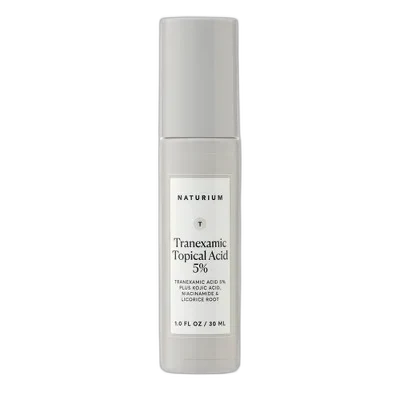
Tranexamic Topical Acid 5%
Multi-Pathway Dark Spot Eraser
 Verified reviewer
Pros & cons.
- +Four distinct brightening mechanisms in one formula — mirrors dermatologist-prescribed protocols
- +5% tranexamic acid at the high end of effective OTC concentrations
- +Exceptionally affordable at $20 with a jumbo size available for extended treatment
- +Lightweight serum texture absorbs instantly and layers invisibly under other products
- +Fragrance-free and silicone-free — minimal unnecessary additives
- +Clinically tested with demonstrated 8-week dark spot improvement
- +Gentle enough for daily twice-daily use on most skin types
- −Results require 8-12 weeks of patience — not for those seeking immediate gratification
- −Standard 1 oz size is insufficient for a full 8-week treatment course at twice-daily use
- −Kojic acid may cause contact sensitivity in very reactive skin types
- −Less effective for deep dermal melasma than oral tranexamic acid or prescription treatments
- −Limited independent long-term clinical data on this specific OTC formulation
The full review.
The story of tranexamic acid in skincare begins in a place you would never expect — the surgical suite. Developed in the 1960s by Japanese researchers as an antifibrinolytic agent to control excessive bleeding, tranexamic acid spent decades as a purely medical intervention. Then, in the early 2000s, dermatologists in Asia began noticing something peculiar: patients taking oral tranexamic acid for bleeding disorders were reporting that their melasma was fading. It was a side effect so consistent that it could not be ignored, and it launched an entirely new chapter in pigmentation science.
Naturium’s Tranexamic Topical Acid 5% takes that clinical heritage and packages it into a $20 serum that would have been unthinkable at this price point five years ago. What makes this product genuinely interesting is not just the tranexamic acid — it is the strategic layering of four distinct brightening mechanisms in one formula. This is not a single-active serum with some hydrating filler. This is a calculated multi-pathway attack on hyperpigmentation.
Let us walk through the architecture. Tranexamic acid at 5% works by inhibiting plasminogen activator, which in turn reduces the production of plasmin — a molecule that triggers melanocyte activity when skin is inflamed or UV-exposed. It addresses pigmentation at the signaling level, upstream of melanin production itself. Kojic acid then picks up the next step, directly inhibiting tyrosinase — the enzyme that catalyzes melanin synthesis. Niacinamide enters at the transport phase, blocking the transfer of melanosomes (melanin packages) from melanocytes to the keratinocytes that form the visible skin surface. And licorice root extract, via its active compound glabridin, provides yet another tyrosinase-inhibiting pathway with bonus anti-inflammatory effects.
Four ingredients, four mechanisms, one goal. This is the kind of combinatorial approach that dermatologists assemble when prescribing custom compounded brightening formulas — they know that attacking pigmentation from multiple angles produces better results than any single ingredient alone. That Naturium has assembled this cocktail in a $20 OTC serum is, from a formulation standpoint, genuinely impressive.
Texture
The texture is everything a treatment serum should be: lightweight, fast-absorbing, and completely invisible once applied. The water-gel consistency spreads easily, and there is no stickiness, greasiness, or film left behind. It layers seamlessly under moisturizer and sunscreen, which is critical because you absolutely must wear SPF while using any brightening treatment. Without sun protection, you are trying to bail water out of a boat while the ocean pours in.
Experience
The experience is remarkably uneventful — and that is a compliment. No tingling, no burning, no visible reaction for most users. Tranexamic acid is inherently gentle, and the formula’s panthenol and licorice root provide soothing backup. Kojic acid can occasionally cause contact sensitivity in very reactive skin types, but at the supporting concentration used here, most users tolerate it without issue.
Patience
Patience is the price of admission. This is not an overnight miracle product. Tranexamic acid works gradually, and the clinical study Naturium commissioned showed significant improvement at the 8-week mark. In practice, most users begin noticing their dark spots looking slightly lighter at 3-4 weeks, with progressive improvement through weeks 8-12. For melasma specifically, the timeline may stretch to 12-16 weeks. This is normal and expected — melanin turnover takes time, and any product promising faster results for established pigmentation is likely overpromising.
Value
The value proposition here is almost unfairly strong. Prescription tranexamic acid treatments, whether oral or compounded topical, typically cost $50-150 or more per month. Competing brightening serums from clinical or luxury brands with similar multi-active approaches run $45-90. Naturium delivers a more comprehensive active lineup than most of those options at less than half the price. The jumbo 2 oz size, available at a per-ounce discount, makes the math even better for those who commit to the full treatment course.
Limitations
There are limitations to acknowledge. The 1 oz standard bottle feels small for a product designed for consistent twice-daily use over 8-12 weeks — the jumbo size is the smarter buy. The product targets pigmentation specifically, so if you are looking for broad anti-aging, exfoliation, or texture refinement beyond what pigment correction provides, you will need additional products in your routine. And while the evidence for topical tranexamic acid is strong and growing, it is not as robust as the evidence for oral tranexamic acid — topical penetration remains a limiting factor that higher-concentration prescriptions address more aggressively.
Naturium may still be proving itself as a brand, but this formulation needs no such grace period. The science behind every active in this bottle is independently validated by decades of dermatological research. The combination is rational, the concentrations are meaningful, and the price respects the consumer’s intelligence. For anyone fighting dark spots, post-inflammatory hyperpigmentation, or the early signs of melasma, this serum deserves a place in the conversation — not because of the brand on the label, but because of the chemistry inside the bottle.
Ingredient analysis.
Full INCI list
Water, Isopentyldiol, Tranexamic Acid, Propanediol, Citric Acid, Kojic Acid, Niacinamide, Hydroxyacetophenone, Isododecane, Polyacrylate Crosspolymer-6, Glycyrrhiza Glabra (Licorice) Root Extract, Panthenol, Glycerin, Xanthan Gum, Tremella Fuciformis Sporocarp Extract, Phenoxyethanol, Ethylhexylglycerin, Betaine, Sodium Hyaluronate, Sodium Phytate, Potassium Sorbate, Tocopherol
Skin match.
The science.
The Science
Tranexamic acid uses a different anti-pigmentation mechanism than traditional brightening agents. As a plasmin inhibitor, it blocks the skin from converting plasminogen to plasmin—a process that triggers melanocyte activity via prostaglandin and arachidonic acid pathways. A randomized controlled trial in the Journal of the American Academy of Dermatology (Kim et al., 2016) shows topical 5% tranexamic acid reduces melasma severity index scores more than a placebo over 12 weeks.
Combining it with kojic acid creates a dual-mechanism approach: tranexamic acid works upstream at the signaling level, while kojic acid chelates copper at the tyrosinase active site to stop the enzyme from converting tyrosine to melanin. Research in the Journal of Cosmetic Dermatology shows kojic acid works as a depigmenting agent, especially when paired with other brightening actives.
The Hakozaki et al. study (British Journal of Dermatology, 2002) shows niacinamide's role; 5% niacinamide significantly reduces melanosome transfer and visible hyperpigmentation. Niacinamide uses a mechanism distinct from both tranexamic acid and kojic acid—it prevents melanin delivery to visible skin layers instead of suppressing melanin production.
Licorice root extract (Glycyrrhiza glabra) contains glabridin, which inhibits tyrosinase activity in melanocyte cultures at concentrations as low as 0.1 μg/mL. A study in the Journal of Agricultural and Food Chemistry shows glabridin's potency as a depigmenting agent and its anti-inflammatory properties via cyclooxygenase inhibition—making it a brightening active and an irritation buffer in this formula.
References
- Efficacy of topical tranexamic acid in the treatment of melasma — Journal of the American Academy of Dermatology (2016)
- The effect of niacinamide on reducing cutaneous pigmentation and suppression of melanosome transfer — British Journal of Dermatology (2002)
Dermatologist Perspective
Board-certified dermatologists increasingly use topical tranexamic acid in melasma and hyperpigmentation protocols. Dermatologists note this formula's multi-active approach—combining tranexamic acid with kojic acid, niacinamide, and licorice root—matches evidence-based combination therapy that targets melanogenesis at multiple points in the cascade. This strategy works better than single-agent therapy, especially for stubborn pigmentation. Dermatologists note topical tranexamic acid is well-tolerated across skin types and lacks the photosensitivity risks of hydroquinone, making it a strong option for maintenance therapy after initial brightening results.
Where it fits in your routine.
Apply 3-5 drops to clean, dry skin every morning and evening after cleansing. Spread the product evenly over the face, focusing on hyperpigmentation or dark spots. Let it absorb for 1-2 minutes before applying moisturizer. Always use SPF 30+ in the morning; brightening treatments require sun protection to work. You can layer this under or over vitamin C serum. For best results, use it twice daily for at least 8-12 weeks.
At $20 for 1 oz (or better per-ounce value in the jumbo size), this is a top cost-effective multi-active brightening serum. Prescription compounded brightening formulas with tranexamic acid usually cost $75-150 per month. Competing OTC serums with fewer brightening actives — like SkinCeuticals Discoloration Defense at $110 — cost five times more. The per-ounce cost is low enough to make the choice easy: buy the jumbo size, use it for 12 weeks, and pair it with diligent SPF use.
This works for post-inflammatory hyperpigmentation, sun-induced dark spots, early melasma, or uneven skin tone. It uses a multi-active approach at a budget-friendly price. It suits people who find hydroquinone too irritating or want a long-term maintenance brightening product.
Skip this if you need aggressive treatment for deep dermal melasma — prescription-strength options (oral tranexamic acid, hydroquinone, or combination peels) work better. This is also not ideal if you won't commit to 8+ weeks of consistent use, as results are gradual.
Product details.
This lightweight, slightly viscous serum has a water-gel consistency. It absorbs quickly and completely without residue or stickiness. It sits well under moisturizer and sunscreen.
No added fragrance. Virtually no detectable scent.
Frosted glass bottle with dropper dispenser. A jumbo 2 oz size costs less per ounce.
The serum absorbs almost instantly on first application. Most users feel no tingling, stinging, or visible reaction. Some sensitive skin types feel very mild warmth from the kojic acid, but this subsides quickly. Purging or adjustment periods are not typical. Results are gradual; do not expect visible changes in the first week. The product is undetectable once absorbed.
1. 5-2 months using standard size twice daily on the full face; 3-4 months using jumbo size
12 months
All Year
The backstory.
Tranexamic acid's skincare origin story is genuinely fascinating — it was originally developed as a blood-clotting medication, and its pigment-reducing properties were discovered accidentally when patients noticed their melasma improving as a side effect. The ingredient went from operating rooms to dermatology clinics in Asia before making its way into OTC skincare. Naturium's version brought this clinical-grade ingredient to the mass market at a fraction of the typical cost.
About Naturium
Emerging Brand (2–5 years)Beauty journalist and influencer Susan Yara and brand accelerator The Center co-founded Naturium in 2020. e.l.f. Beauty acquired Naturium in 2023 for $355 million. Naturium formulations use well-studied ingredients at effective concentrations, but the brand has a short track record and limited independent clinical validation for its specific products.
FAQ.
Can I use Naturium Tranexamic Acid with vitamin C?
Yes — tranexamic acid and vitamin C use different brightening mechanisms and complement each other. Apply your vitamin C serum first, wait 1-2 minutes for absorption, then layer this tranexamic acid serum on top. Follow both with SPF 30+ in the morning to protect against future pigmentation.
How long does it take to see results from Naturium Tranexamic Acid?
Naturium's clinical study shows visible improvement in dark spots after 8 weeks of consistent use. Most users see subtle brightening at 3-4 weeks, with progressive improvement through weeks 8-12. Stubborn melasma or deep sun damage takes 12-16 weeks. Use the product for maintenance to prevent recurrence.
Is Naturium Tranexamic Acid safe for sensitive skin?
Tranexamic acid is well-tolerated and rarely irritates. However, this formula also contains kojic acid, which can cause contact sensitivity in reactive skin types. Apply once daily and monitor for redness or irritation. The panthenol and licorice root in the formula buffer potential sensitivity.
What is the difference between the regular and jumbo size?
The jumbo size contains 2 oz (twice the standard 1 oz) and saves 10% per ounce. If you use this product for the 8-12 weeks needed for full results, the jumbo size offers better value and prevents mid-treatment reorders.
What the community says.
"Visible fading of dark spots within 6-8 weeks"
"Lightweight serum texture absorbs instantly"
"Affordable alternative to prescription treatments"
"Multi-active approach targets pigmentation effectively"
"Gentle enough for daily use on most skin types"
"Results are slow — requires 8+ weeks of patience"
"Kojic acid may cause sensitivity in reactive skin"
"Small 1 oz bottle for twice-daily use"
"Not effective enough for deep or stubborn melasma alone"
Featured in.
People also looked at.