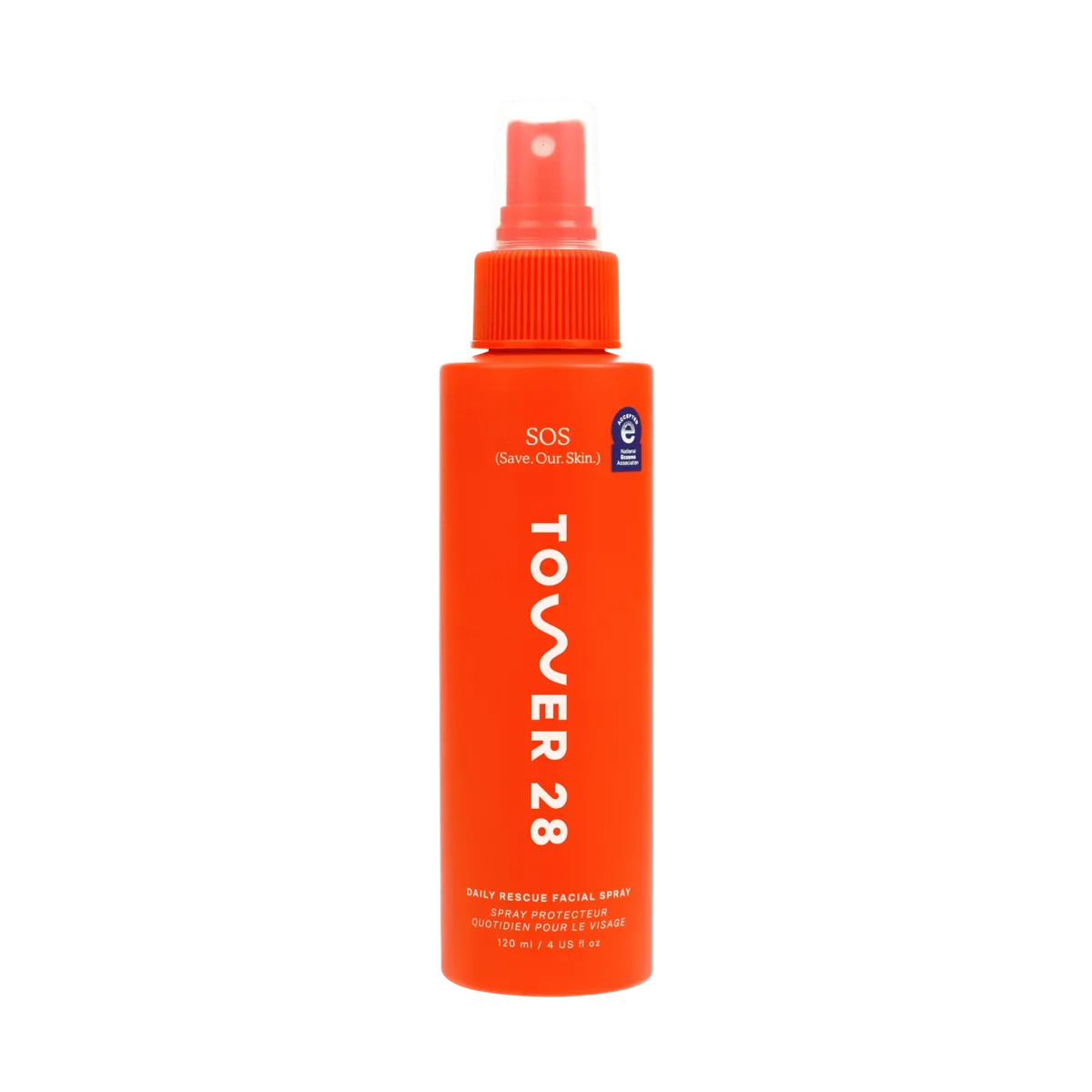
SOS Save Our Skin Daily Rescue Facial Spray
Reactive-Skin Cult Favorite
 Verified reviewer
Pros & cons.
- +Triple dermatology-organization validation for eczema, psoriasis, and rosacea
- +Works over makeup without disturbing the base underneath
- +Zero sting even on broken or compromised skin
- +Fine-mist dispenser delivers a true facial mist rather than a squirt
- +Pregnancy, breastfeeding, and pediatric-safe tolerability profile
- +Measurably reduces post-workout acne when used immediately after sweating
- +Available in travel size and larger refill for flexible usage
- +Stabilization technology keeps HOCl active for full product life
- −Provides no hydration, barrier repair, or traditional moisturizer benefits
- −Price runs higher than medical-grade HOCl sprays from wound-care suppliers
- −Light-sensitive formula requires opaque bottle and 6-month open shelf life
- −Plastic sprayer can crack if dropped on tile or stone
- −Easy to underestimate dosing because texture is essentially water
The full review.
Five years ago, if you asked a dermatologist about hypochlorous acid, you got a nod and a mention of wound care clinics. Ask one today, and there is a reasonable chance they will tell you to spray this on your face after your workout. That shift — hypochlorous acid as a clinical curiosity to hypochlorous acid as a mainstream skincare step — happened almost entirely because of this one product. The SOS Daily Rescue Spray did not invent the chemistry, and it was not the first HOCl product on a shelf, but it was the first one that combined a stable formulation, an actually pleasant mister, and enough marketing savvy to put the active in front of people who had never heard of it. Everything else in the category that came after is chasing this bottle.
Amy Liu founded Tower 28 in 2019 specifically because her daughter’s severe eczema had left her unable to find products she could use without triggering a flare. The SOS line grew out of the observation that hypochlorous acid — long used in hospital wound irrigation and ophthalmology — was nearly impossible to find as a stable, consumer-friendly product. The version she launched was essentially a medical technology in a pretty bottle, and the bet paid off: the spray has accumulated three separate dermatology-organization seals (National Eczema, National Psoriasis, National Rosacea), thousands of overwhelmingly positive Sephora reviews, and the kind of word-of-mouth that makes it show up in dermatology waiting rooms nationwide.
The experience of using it is almost anticlimactic in the best way. You hold the bottle about six inches from your face, pump the mister, and a very fine veil of water settles across your skin. There is a faint pool-chlorine note for the first two seconds — entirely the chemistry of the active, not an added scent — and then it is gone. Within thirty seconds the mist has absorbed with zero residue. If your skin was flushed or stinging when you started, it usually is not by the time you reach for your next product. If it was not, you will not notice much, because this spray is not doing anything visual on healthy skin. It is a quiet, corrective tool that reveals its value when things go wrong.
And things go wrong in a lot of ways. The spray shines for people dealing with the full menu of reactive skin situations: post-gym breakout prevention by reducing surface bacteria on sweat-prone zones, rosacea flare management, eczema calming during an active patch, post-procedure recovery after a peel or laser, and the general ‘my face is angry and I don’t know why’ situation that hits most adult skin occasionally. It is pregnancy-safe, breastfeeding-safe, and gentle enough that parents use it on children with eczema. The tolerability ceiling is so high that it is genuinely difficult to find a skin scenario where this spray is contraindicated.
The honest limitations are worth naming. It provides no hydration despite being wet, no barrier repair, no brightening, no exfoliation — nothing that most people associate with the word ‘treatment.’ It is a calming and antimicrobial step, full stop, and needs to be paired with a real moisturizer to finish the job. The formula is also photosensitive — the opaque bottle is not a design choice but a stability requirement — and you have to finish an opened bottle within six months before the HOCl slowly reverts to glorified saltwater. And the price, while not absurd, runs meaningfully higher than medical-grade HOCl sprays from wound-care suppliers, which will do the core antimicrobial job for a fraction of the cost.
What you are paying for in the Tower 28 version is the stabilization engineering, the fine-mist dispenser that actually delivers a facial mist rather than a water squirt, and the brand’s willingness to put the product through three separate dermatology-nonprofit validation processes. Those seals are not marketing decoration — they require ingredient review and real-world testing on the relevant patient population. For someone managing rosacea or eczema, that validation is load-bearing. For someone who just wants to mist their face after a run, it is legitimately worth asking whether a generic HOCl spray from a medical supplier would do the same job for less.
It’s also worth noting the sizing options. The 4 oz bottle is the most popular, but Tower 28 sells a 1 oz travel-size version and — critically — a 16 oz refill that drops the per-ounce price meaningfully. If you use this daily, the refill is the version to buy. If you want to test the waters, the travel size is the most affordable entry point into the line.
The bottom line: this is the best version of a category it essentially created. For reactive skin, post-procedure recovery, acne-prone skin that breaks out after workouts, or anyone coming off a course of tretinoin who needs a buffer, the spray earns its shelf space and then some. For someone with resilient, cooperative skin who wants their skincare spending to do more structural work, this is not the place to start — but it is still a nice thing to have in the cabinet for the days when things go sideways.
Ingredient analysis.
Full INCI list · pH 4.5
Water (Aqua), Sodium Magnesium Fluorosilicate, Sodium Phosphate, Sodium Chloride, Hypochlorous Acid
Skin match.
The science.
The Science
Neutrophils produce hypochlorous acid endogenously during the innate immune response. At physiological concentrations, this weak acid is both potently antimicrobial and non-cytotoxic to human cells. This dual profile supports its use in wound care, ophthalmology, and inflammatory dermatology. A 2018 review in the Journal of Drugs in Dermatology examined stabilized hypochlorous acid preparations for chronic skin conditions; it found they offer favorable tolerability and symptom reduction in atopic dermatitis and related inflammatory disorders. Clinical work on HOCl preparations also shows meaningful reductions in Staphylococcus aureus colonization on atopic skin. This matters because S. aureus overgrowth correlates with eczema flare severity. HOCl stability is a constant formulation challenge; in aqueous solution, it slowly reverts to sodium chloride when exposed to light, heat, or pH drift. The sodium magnesium fluorosilicate and sodium phosphate buffer in this spray holds the reaction equilibrium in favor of the active HOCl species throughout the product's shelf life. The pH 4.5 target is intentional. HOCl biological activity depends on pH, and this slightly acidic buffer keeps the largest fraction of the molecule in its most bioactive protonated form without irritating compromised skin. The three dermatology-organization seals provide patient-level tolerability evidence that a typical cosmetic ingredient review lacks.
References
- Stabilized Hypochlorous Acid Cleanser and Gel in Skin Disorders — Journal of Drugs in Dermatology (2018)
Dermatologist Perspective
Dermatologists use this specific spray more than most indie skincare products because stabilized hypochlorous acid solves a clinical problem. Patients with rosacea, atopic dermatitis, or post-procedure skin often cannot tolerate standard over-the-counter calming products, so dermatologists need a reliable recommendation. Board-certified dermatologists frequently use this spray for isotretinoin patients with skin too compromised for normal toners, for rosacea patients experiencing triggers, and for acne-prone patients who want to reduce post-sweat bacterial load without drying their skin. Dermatologists also note that the triple dermatology-organization seals reduce the clinical due diligence required to recommend it, as relevant patient advocacy groups have already done the validation work.
Where it fits in your routine.
Hold the bottle six inches from your face and mist evenly. Use on clean skin after cleansing but before serums and moisturizer. Mist again throughout the day after workouts, during a rosacea flare, over makeup, or after redness-triggering events. Let it absorb for 15–30 seconds before layering other products. You can spray it directly onto active breakouts, eczema patches, or post-procedure skin. Use an opened bottle within six months; hypochlorous acid loses potency when exposed to air and light.
At $28 for the 4 oz flagship size, this is a mid-range facial treatment — more than a drugstore toner, less than most luxury mists. The 1 oz travel size costs around $12, while the 16 oz refill offers the best value, lowering the per-ounce cost for daily users. Tower 28 charges a premium over unstabilized or medical-grade HOCl products for its formulation engineering, fine-mist dispenser, and dermatology validation seals. For reactive-skin patients who need a product that will not sting, the math is easy. Casual users should start with the 1 oz travel size before committing to the refill pipeline.
Use this if you have rosacea, eczema, sensitive skin, inflammatory acne, or a compromised barrier — or if you break out after workouts. It is also a smart purchase for people recovering from peels, lasers, microneedling, or a course of tretinoin, and for parents managing eczema on themselves or their children.
This formula does not provide hydration, brightening, or exfoliation for people with resilient skin. Skip this if you want structural skincare or if you already own a medical-grade HOCl product and do not need the dispenser upgrade.
Product details.
Ultra-fine water mist leaves zero residue. It absorbs within 15 seconds and has no tackiness, slip, or visible layer.
A faint swimming-pool note appears on the first spray and disappears almost immediately. This is the signature HOCl smell, not added fragrance.
4 oz frosted-plastic bottle with a continuous fine-mist sprayer. The opaque bottle protects the hypochlorous acid from light. It also comes in a 1 oz travel size and a 16 oz refill.
The first spray feels briefly cool and damp with a hint of pool-chlorine scent. Moisture evaporates within 30 seconds, and reactive or flushed skin feels calmer. There is no purging, no tingling, and no adjustment period.
One 4 oz bottle lasts about 3–4 months with daily face use, or much longer if used only as a post-workout or flare spot treatment.
6 months
All Year
The backstory.
Amy Liu launched Tower 28 in 2019 after years in the beauty industry left her unable to find products gentle enough for her daughter's severe eczema. The SOS Daily Rescue Spray was the brand's first SOS product and became an almost immediate cult favorite among dermatologists, who had long used hypochlorous acid in clinical settings but had never had a stabilized consumer version they could reliably recommend. It has since become the product that essentially defined the hypochlorous-acid-for-skincare category.
About Tower 28
Emerging Brand (2–5 years)Tower 28 was founded in 2019 by Amy Liu for sensitive and eczema-prone skin. The SOS Daily Rescue Spray is the brand's flagship product and carries seals from the National Eczema Association, National Psoriasis Foundation, and National Rosacea Society — a rare trifecta of dermatology-organization validation for any skincare product.
Common myths.
Hypochlorous acid is bleach and shouldn't go near your face.
HOCl is a different compound than sodium hypochlorite (bleach). At the low concentration and near-skin pH in this spray, it is the same molecule your immune system produces during wound healing. It has a long safety record in hospital wound care and eye irrigation.
It's basically just saltwater, so I can DIY it.
Stable HOCl needs saline electrolysis followed by precise buffering and stabilization. DIY versions revert to salt water within days and lack enough active ingredient to work. Stabilization chemistry makes the bottled version clinically useful.
FAQ.
What does the SOS Daily Rescue Spray actually do?
It delivers stabilized hypochlorous acid — the same compound immune cells produce during wound healing — as a fine facial mist. The active calms inflammation, reduces surface bacteria on acne-prone zones, and shortens recovery for rosacea, eczema, and post-procedure flares.
How is this different from the SOS Intensive Rescue Serum?
Both are stabilized HOCl products. The spray uses a fine-mist dispenser for daily full-face use and comes in a 4 oz size. The serum uses a pump bottle for targeted dosing on specific flare spots. Most people wanting a daily calming step pick the spray; those managing stubborn localized flares often prefer the serum.
Can I spray this over makeup?
Yes — it became a cult product because you can mist it over full makeup all day without disturbing the base. It works well for skin that flushes during the day.
Is it safe to use on kids, during pregnancy, or on eczema?
Yes to all three. Hypochlorous acid is a gentle active ingredient. The formula has no retinoids or essential oils, and the National Eczema Association seal means it is pediatric-safe. Many parents use it on children with eczema under dermatologist guidance.
Why does my bottle smell faintly like a pool?
That is hypochlorous acid. It shares chemistry with pool disinfectants, though the concentration and formulation differ. The scent vanishes in seconds; this shows your bottle is active rather than a quality problem.
How long does one bottle last?
The 4 oz bottle lasts 3–4 months with daily face use. Tower 28 recommends using it within 6 months of opening because HOCl loses potency when exposed to air. The 16 oz refill has better per-ounce value for regular users.
Will this replace my toner?
It replaces a calming or hydrating toner, but it does not exfoliate. If you use a glycolic or salicylic acid toner for texture or acne, this won't do the same job. Use it as a calming step, not a resurfacing one.
What the community says.
"Calms redness and irritation on contact"
"Perfect for post-workout breakout prevention"
"Safe enough for eczema and rosacea flares"
"Travel and TSA friendly"
"No sting even on broken skin"
"Expensive compared to medical-grade HOCl sprays"
"Feels like mist — some expect more substance"
"Plastic bottle cracks if dropped"
"Must be used within 6 months of opening"