Good Skin Ampoule Hyaluronic Acid
K-Beauty Budget Hydration Pick
 Verified reviewer
Pros & cons.
- +Stacks at least four hyaluronic acid molecular weights for layered hydration
- +Supported by glycerin, trehalose, niacinamide and panthenol
- +Thin, essence-weight texture layers cleanly under any moisturizer
- +Fragrance-free, alcohol-free, and essential-oil-free
- +Budget-friendly K-beauty price around $13 for 30ml
- +Works well as a buffer before retinoids or actives
- −Dropper pipette is short and awkward for full-face dosing
- −Hydration won't hold without a cream sealed over it in dry climates
- −Not fungal acne safe due to PEG-60 hydrogenated castor oil
- −Nothing clearly differentiates it from cheaper K-beauty HA ampoules
- −Limited long-term English-language review data
The full review.
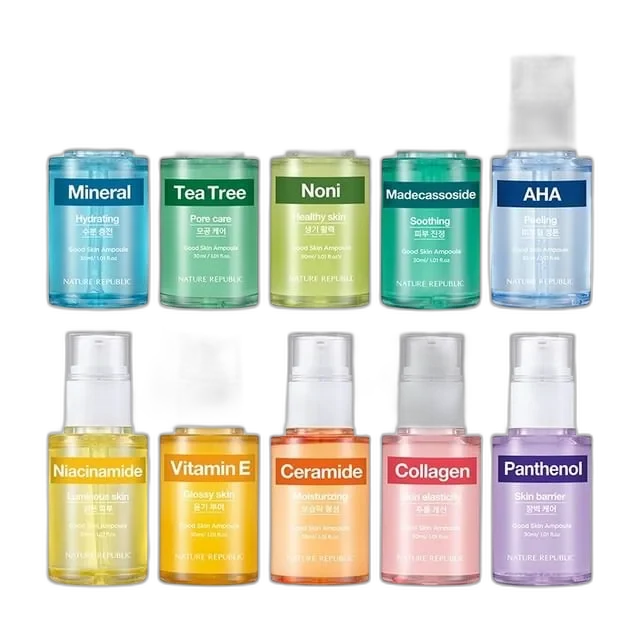
Nature Republic spent its first decade defined by one product. The Aloe Vera 92% Soothing Gel became a mid-2010s cult object—a cheap, goopy green tub found in college dorms and travel bags globally—and the brand’s identity centered on that low-commitment K-beauty staple. The Good Skin Ampoule line, launched in 2022, is its most visible attempt to pivot toward technical skincare. Each of the ten SKUs uses a named active—niacinamide, madecassoside, ceramide, panthenol, or AHA—and this Hyaluronic Acid variant is the hydration entry.
For around $13, you get a 30ml frosted glass dropper bottle of thin, essence-weight liquid with a texture between a toner and a conventional serum. The formula is the reason to buy it. Instead of using one sodium hyaluronate as the hero, Nature Republic uses at least four hyaluronic acid derivatives: standard sodium hyaluronate, a smaller hydrolyzed version, a hydroxypropyltrimonium hyaluronate (a cationic variant with slight affinity for negatively charged skin surfaces), and a sodium hyaluronate crosspolymer that forms a film to extend moisture retention. Behind the HA complex, glycerin acts as a small-molecule humectant, trehalose—an osmolyte disaccharide that helps cells maintain water balance in dry conditions—and panthenol supports the barrier. Niacinamide is present at a supporting level, not a headline one.
This ingredient stack matters more than the HA percentage on the box, as hyaluronic acid marketing has become confused lately. A single high-dose HA is not automatically better than a multi-weight approach; you want water to reach multiple depths of the upper skin and the surface to retain that hydration. A well-composed HA formula solves both. This one does, for a budget K-beauty product.
The texture is thin enough to layer under heavier products without pilling. Application is unremarkable: no stickiness, no tack, and no residue. It works well under sunscreen. Using it as a buffer before retinoids is sensible, especially if dryness limits your ability to tolerate tretinoin or retinaldehyde. In humid climates, you may only need it under a light gel moisturizer; in dry winter conditions, seal it with something substantial, as unsealed hyaluronic acid can pull water in the wrong direction when ambient humidity drops.
The limits. The Good Skin Ampoule line competes in a crowded K-beauty category against brands with longer track records at similar prices, such as COSRX, Some By Mi, and Pyunkang Yul. This product is on par with its peers rather than notably better. The dropper pipette is short and awkward for full-face dosing, requiring more frequent bottle openings. Long-term English-language review data is thin, so the line lacks deep validation. Also, despite Nature Republic’s aloe-based roots, this ampoule is not strictly fungal acne safe; PEG-60 hydrogenated castor oil in the formula makes it unsuitable for those with confirmed Malassezia reactivity.
You are paying for a well-composed hydration formula in mid-tier K-beauty packaging from a brand proving it can move beyond soothing gel. It is not an ampoule for Reddit skincare shelfies. But for a budget routine needing a hydration step that delivers, this one works without theatrics, without fragrance, and without unbacked claims. That is a reasonable definition of a good ampoule. At $13, it is a fair deal.
Formula
Ingredient analysis.
Full INCI list · pH 5.5
Water, Butylene Glycol, Glycerin, Dipropylene Glycol, Niacinamide, 1,2-Hexanediol, Sodium Hyaluronate, Hydrolyzed Hyaluronic Acid, Hydroxypropyltrimonium Hyaluronate, Hydrolyzed Sodium Hyaluronate, Sodium Hyaluronate Crosspolymer, Panthenol, Allantoin, Betaine, Trehalose, Carbomer, Arginine, Ethylhexylglycerin, Adenosine, Disodium EDTA, PEG-60 Hydrogenated Castor Oil, Pentylene Glycol, Tocopherol
Skin match.
The science.
The Science
Topical hyaluronic acid has strong evidence for hydration and fine-line smoothing. In vitro and in vivo studies show molecular weight affects penetration and effect. Lower molecular weight fragments (below about 50 kDa) diffuse into the upper viable epidermis, while higher molecular weight versions (above 1000 kDa) stay on the surface and form an occlusive-like film that reduces transepidermal water loss. This ampoule combines multiple weights, which controlled studies show outperforms single-weight HA formulations for short-term skin hydration and barrier recovery metrics, though specific combinations vary. Glycerin, high on the INCI, is the gold standard humectant in dermatological research; decades of literature document its role in stratum corneum hydration and barrier function recovery. Trehalose is a newer cosmetic ingredient that functions as an osmolyte and stabilizes membrane structure under desiccation stress. Panthenol converts to pantothenic acid in the skin; multiple controlled studies show it improves stratum corneum hydration and barrier repair after surfactant injury. This formula builds redundancy into the hydration system: the HA stack delivers water to multiple depths, glycerin and trehalose bind it, and panthenol and niacinamide support barrier function. It applies hydration-formulation research at a price point where most competitors cut corners.
Dermatologist Perspective
Dermatologists often recommend hyaluronic acid serums to hydrate patients with dehydrated or barrier-compromised skin, especially those using retinoids or chemical exfoliants. Multi-weight HA formulations generally beat single-weight products for penetration depth and hydration persistence. Board-certified dermatologists advise applying HA serums to slightly damp skin and sealing them with a moisturizer to prevent pulling water from deeper layers in low-humidity environments. For the dehydration-focused use case this product targets, dermatologists note that the ingredient category is effective but not brand-sensitive. Most well-formulated HA ampoules perform similarly, so purchase decisions usually depend on texture, packaging preference, and price rather than dramatic clinical differences.
Where it fits in your routine.
Apply after cleansing and toning. Put 3 to 5 drops in clean palms or on slightly damp skin, then press it across the face and neck. Do not rub hard; HA-heavy serums ball up if over-worked. Wait 30 seconds for absorption, then layer a moisturizer on top to seal in hydration. In dry climates, use a moisturizer. In the morning, finish with sunscreen. At night, use it as a buffer before retinoids if you have dryness. Applying on damp skin improves the plumping effect.
At $13 for 30ml, this ampoule costs less than most K-beauty hydration products, though it stays within a few dollars of COSRX, Pyunkang Yul, and Some By Mi alternatives. The real value lies in the formulation: a multi-weight HA complex with trehalose and niacinamide usually costs more in a Western sensitive-skin brand. No larger-size option exists, which limits the value, and the dropper format costs more per use than a pump. For a buyer building a budget K-beauty routine seeking a hydration-focused serum without luxury branding, this is a reasonable but not category-leading purchase.
Buy this for budget K-beauty hydration using a multi-weight HA stack. It contains no fragrance or essential oils. Use it daily for dehydrated skin, as a buffer under retinoids, or during transitional seasons when skin shifts between normal and dry.
Skip this if you want to treat anti-aging, hyperpigmentation, or active breakouts — this ampoule only targets hydration. Skip this if you have confirmed fungal acne, because PEG-60 hydrogenated castor oil may cause issues, or if you want a more differentiated, category-leading HA serum and will pay more for it.
Product details.
Thin, watery, almost essence-like liquid that spreads without dragging.
Very mild, essentially scentless — no fragrance added.
30ml frosted glass dropper bottle, clean and functional but the dropper pipette is short and can be awkward for full-face dosing.
The first use feels like a thin serum—nearly water with slight slip. Expect mild, pleasant plumping within minutes, especially on damp skin. It has no tingling and no adjustment period.
Roughly 6-8 weeks with daily twice-a-day use of 3-4 drops.
12 months
All Year
The backstory.
Nature Republic's Good Skin Ampoule line was launched in 2022 as a response to the K-beauty market's shift toward targeted, single-concern ampoules — a departure from the brand's earlier identity as a generalist road-shop staple. Each SKU in the 10-ampoule line is built around a named active; the HA variant was positioned as the hydration entry point.
About Nature Republic
Established Brand (5–20 years)Nature Republic launched in 2009 and is a mid-tier K-beauty road-shop staple, famous for its Aloe Vera 92% soothing gel. The brand has a broad track record in Asian markets, but the Good Skin Ampoule line is a newer targeted-actives series. Long-term independent validation for individual SKUs in the line is still accumulating.
Common myths.
More hyaluronic acid always means better hydration.
Size distribution and supporting humectants matter most. This formula uses multiple HA weights with glycerin and trehalose. This provides better hydration than a single high-concentration HA entry alone.
FAQ.
How many types of hyaluronic acid are in this ampoule?
The formula uses at least four hyaluronic derivatives — sodium hyaluronate, hydrolyzed hyaluronic acid, sodium hyaluronate crosspolymer, and hydroxypropyltrimonium hyaluronate — to cover a wide molecular weight range. This delivers hydration to multiple depths of the stratum corneum.
Do I need to use a moisturizer after this ampoule?
Yes, especially in dry climates. Hyaluronic acid draws water and requires an emulsion, cream, or occlusive to seal it in. Without this, it pulls water from deeper skin layers when ambient humidity is low.
Can I use this with vitamin C or retinol?
Yes. This hydration-only ampoule has no conflicting actives. It layers cleanly under vitamin C in the morning and under retinoids at night. Using it as a buffer layer before retinoids often reduces dryness from tretinoin or retinaldehyde.
Is this ampoule fragrance-free?
Yes — the formula has no added fragrance or essential oils. It has a mild, water-like scent from the base ingredients.
Who should skip this ampoule?
If you target wrinkles, hyperpigmentation, or active acne instead of hydration, this is a supporting product, not a headline one. It also fails as a top pick for confirmed fungal acne sufferers who want minimal-humectant formulas.
How does this compare to the Nature Republic Aloe Vera 92% gel?
Different formats suit different needs. The aloe gel is a cheap, mostly water-based soothing product; this ampoule is a more concentrated, hydration-focused serum step with a specific HA stack and a higher price.
What the community says.
"Genuinely watery, fast-absorbing"
"Plays well under sunscreen"
"Solid hydration at a budget price"
"No stickiness"
"Hydration doesn't last without a cream on top"
"Plastic dropper is fiddly"
"Limited standout features versus other K-beauty HA ampoules"
People also looked at.