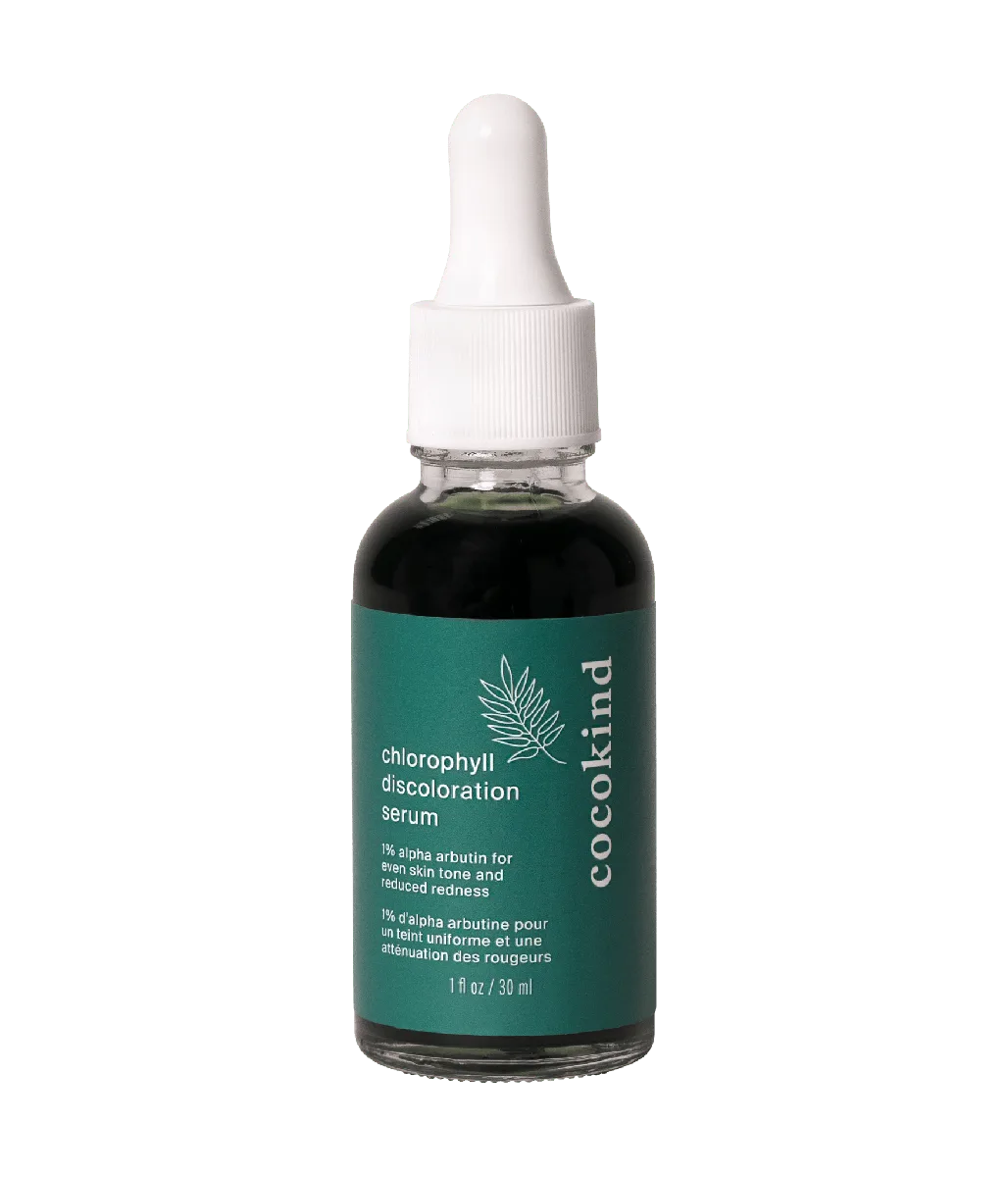
Chlorophyll Discoloration Serum
Budget Brightening Hero
 Verified reviewer
Pros & cons.
- +One percent alpha-arbutin provides clinically meaningful brightening at a fraction of luxury prices
- +Multi-pathway brightening approach with both alpha-arbutin and licorice root extract
- +Completely free of fragrance alcohol silicone and common irritants for true sensitive skin safety
- +Prebiotic fructooligosaccharides support skin microbiome health alongside brightening actives
- +Exceptional value at $20 for a formula comparable to products five to ten times the price
- +Lightweight invisible texture that layers seamlessly under any routine
- +Vegan and cruelty-free with recyclable packaging
- −Chlorophyllin evidence base is emerging and less established than the other actives
- −Brightening results require patience with full effects taking 8-12 weeks
- −May not be potent enough for deep longstanding hyperpigmentation or melasma
- −The green bottle and chlorophyll branding may oversell the ingredient's actual contribution
The full review.
The green bottle catches your eye at Target. That is by design. In a wall of serums competing for attention with clinical-sounding names and minimalist packaging, a verdant green dropper bottle stands out. Cocokind knows this. The chlorophyllin — a stabilized derivative of the plant pigment chlorophyll — is as much a branding decision as it is a formulation one. But here is the thing about this serum: the ingredient you barely notice on the label is doing most of the heavy lifting.
Alpha-arbutin at one percent is the real engine of this formula. Derived from the bearberry plant, alpha-arbutin inhibits tyrosinase — the enzyme responsible for the rate-limiting step in melanin synthesis — with a mechanism that is well-documented in dermatological literature. It does this without the irritation risk of hydroquinone, without the stability issues of vitamin C, and without the photosensitivity concerns that come with certain exfoliating acids. For a serum marketed at sensitive skin, it is arguably the ideal brightening active.
Licorice root extract (Glycyrrhiza Glabra) provides a second brightening pathway. Glabridin, its most studied active compound, inhibits melanin production through a mechanism distinct from alpha-arbutin’s tyrosinase inhibition. Having two brightening agents working through different mechanisms is more than a marketing bullet point — it is a formulation strategy that addresses hyperpigmentation from multiple angles, increasing the likelihood of visible results without increasing irritation.
The chlorophyllin-copper complex is where things get more nuanced. In vitro studies have demonstrated antioxidant activity, and there is some evidence for wound-healing and anti-inflammatory benefits. But the clinical evidence for topical chlorophyllin as a brightening agent is thin compared to the decades of research behind alpha-arbutin and licorice root. In this formula, chlorophyllin functions best as an antioxidant and anti-inflammatory support — reducing the oxidative stress that triggers post-inflammatory hyperpigmentation — rather than as a primary brightening active.
What Cocokind has done exceptionally well is build the formula around sensitive skin needs without sacrificing efficacy. Panthenol sits high in the ingredient list, providing meaningful barrier repair and hydration. Fructooligosaccharides — a prebiotic — support the skin’s microbiome. Hyaluronic acid provides hydration. Camellia oleifera (tea seed) extract adds antioxidant support. And the formula is fragrance-free, alcohol-free, silicone-free, oil-free, and vegan. The irritant list is essentially empty — a remarkable achievement for a treatment serum.
The texture reflects this gentle philosophy. The serum has a lightweight, watery consistency that absorbs almost immediately. The green tint visible in the dropper — which causes understandable hesitation at first glance — vanishes completely upon application. There is no residue, no stickiness, no color left behind. It layers invisibly under moisturizer and sunscreen, making it easy to incorporate into any routine without adjustments.
Results are gradual, as they should be with melanin-modulation approaches. Most users report subtle improvement in skin brightness and evenness within the first two weeks, with more noticeable fading of dark spots and post-acne marks at the four-week mark. Deep, long-standing hyperpigmentation takes longer — eight to twelve weeks for significant improvement — and the serum works best in combination with rigorous daily sunscreen use.
At twenty dollars for an ounce, the value proposition is remarkable. You are getting one percent alpha-arbutin, licorice root extract, panthenol, a prebiotic, hyaluronic acid, and chlorophyllin in a clean, irritant-free formula for the price of a casual lunch. Luxury brightening serums containing the same alpha-arbutin concentration routinely cost five to ten times more. The Cocokind formula does not have the sensory luxury or the proprietary complexes of those products, but the functional ingredients are equivalent.
Cocokind’s Chlorophyll Discoloration Serum is not trying to be the most potent brightening treatment available. It is not competing with prescription-strength retinoids or dermatologist-administered peels. What it is doing — and doing exceptionally well — is providing gentle, effective, affordable brightening that sensitive skin can tolerate daily without complaint. The chlorophyll may have gotten you to pick it up, but the alpha-arbutin and licorice root are what will keep you coming back.
Ingredient analysis.
Full INCI list
Water/Eau, Butylene Glycol, Glycerin, Triethyl Citrate, Pentylene Glycol, Panthenol, Fructooligosaccharides, Alpha-Arbutin, Beta Vulgaris (Beet) Root Extract, Phenoxyethanol, Hydroxyethylcellulose, Camellia Oleifera Leaf Extract, Tetrasodium Glutamate Diacetate, Ethylhexylglycerin, Glycyrrhiza Glabra (Licorice) Root Extract, Hyaluronic Acid, Biosaccharide Gum, Chlorophyllin-Copper Complex, Citric Acid, Maltodextrin
Skin match.
The science.
The Science
Alpha-arbutin is a well-studied topical brightening agent. A study in the Journal of Cosmetic Dermatology shows alpha-arbutin inhibits tyrosinase activity in human melanocytes in a dose-dependent manner. This reduces melanin synthesis without cytotoxic effects on the melanocytes. At 1% concentration, multiple clinical studies show a statistically significant reduction in melanin index after 4-8 weeks of topical application.
Glycyrrhiza Glabra (licorice) root extract contains glabridin. Research in the Journal of Agricultural and Food Chemistry shows glabridin inhibits melanin production through a mechanism distinct from tyrosinase inhibition. It suppresses the activity of DOPA chrome tautomerase (TRP-2) in the melanin synthesis pathway. This complementary mechanism supports the formula's multi-pathway brightening strategy.
Chlorophyllin-copper complex has antioxidant properties in vitro. Research in Food and Chemical Toxicology shows it neutralizes reactive oxygen species. While direct clinical evidence for topical brightening is limited, its anti-inflammatory and antioxidant properties support reduction of post-inflammatory hyperpigmentation by addressing the oxidative stress that triggers excess melanin production.
Fructooligosaccharides function as prebiotics that selectively promote beneficial skin microbiome species. Research in the Journal of Investigative Dermatology shows a balanced skin microbiome supports barrier function and reduces inflammatory signaling that can contribute to hyperpigmentation.
Dermatologist Perspective
Board-certified dermatologists recognize alpha-arbutin as a well-validated, gentle alternative to hydroquinone for addressing hyperpigmentation. At 1%, it is within the effective range shown in clinical studies. Dermatologists frequently recommend alpha-arbutin for patients who cannot tolerate irritation from vitamin C, retinoids, or hydroquinone. The licorice root extract provides a complementary brightening mechanism that dermatologists view favorably. The formula's fragrance-free, alcohol-free, minimalist approach aligns with dermatological recommendations for treating hyperpigmentation in sensitive skin. Inflammation and irritation can worsen pigmentation, making gentle formulations more effective for some patients.
Where it fits in your routine.
Apply 3-4 drops to clean, dry skin after cleansing and toning. Press the serum into discoloration and across the full face to brighten. Use morning and evening. Always follow with sunscreen in the morning; UV exposure stimulates melanin production and counteracts the serum's brightening effects. Results are cumulative. Use daily for 4-8 weeks to see meaningful improvement in dark spots.
At $20 for 1 fl oz, this serum offers high value for brightening. The 1% alpha-arbutin alone justifies the price, since luxury serums with similar concentrations cost $80-200. Adding licorice root, panthenol, a prebiotic, and hyaluronic acid makes this one of the most generous budget brightening serums. The only trade-offs against luxury alternatives are fewer actives (like vitamin C or niacinamide) and the thinner texture and packaging. This serum is nearly unbeatable for brightening efficacy per dollar.
This works for anyone with dark spots, post-acne marks, sun damage, or uneven skin tone seeking gentle, effective brightening at an accessible price. It is ideal for sensitive skin types who find vitamin C serums or harsh brightening treatments irritating. It also suits those new to brightening actives who want a low-risk, high-reward option.
Deep, stubborn hyperpigmentation or melasma often requires prescription-strength retinoids or in-office procedures. For the fastest brightening, users often choose higher-potency vitamin C or combination acid formulas, though these increase irritation risk. This serum is redundant, not additive, if your current brightening routine already works.
Product details.
This lightweight, water-based serum has a faint green tint from the chlorophyllin that disappears after absorption. It leaves no residue, no stickiness, and no fragrance.
Fragrance-free with no detectable scent
Simple green-tinted glass dropper bottle matches Cocokind's minimalist, eco-conscious branding. The packaging is recyclable.
The serum applies smoothly with a lightweight, watery consistency. The green tint disappears when blended into the skin, leaving no color residue. It causes no stinging, tingling, or adjustment period. It feels like applying nothing, which fits a sensitive-skin-friendly formula.
2-3 months with twice-daily application
12 months
All Year
The backstory.
Cocokind developed this serum to address a gap in the brightening market — most effective dark spot treatments are too harsh for sensitive skin, while most gentle formulas are not effective enough to deliver visible results. The chlorophyllin-copper complex was chosen both for its antioxidant properties and as a visual brand differentiator, giving the product a distinctive green identity that stands out on shelf at Target and Ulta.
About Cocokind
Established Brand (5–20 years)Priscilla Tsai founded Cocokind in 2015 to make clean, effective skincare affordable. The brand grew from a small indie operation to wide distribution at Target, Ulta, and Whole Foods. Cocokind earns credibility through ingredient transparency and barrier-friendly formulations.
Common myths.
Chlorophyll in skincare is a trend with no real benefits
Evidence for topical chlorophyllin is emerging, but in vitro studies show antioxidant and anti-inflammatory properties. In this formula, chlorophyllin supports alpha-arbutin and licorice root instead of brightening alone — it is a supporting player, not the headline act.
Affordable serums match luxury ones for dark spot efficacy
Alpha-arbutin at 1% is alpha-arbutin at 1% at any price. This serum uses the same well-studied brightening agent found in products costing five to ten times more. The licorice root and panthenol supporting cast is also evidence-based. The formula's simplicity is a feature, not a limitation.
FAQ.
Does Cocokind Chlorophyll Discoloration Serum actually work?
Yes — the 1% alpha-arbutin inhibits tyrosinase to reduce melanin production at dark spots. Combined with licorice root extract, another proven brightening agent, the formula inhibits melanin via multiple pathways. Most users see visible improvement in dark spots and post-blemish marks within 4 weeks of consistent twice-daily use.
Will this serum turn my skin green?
No — chlorophyllin tints the serum green in the bottle, but the skin absorbs it completely without leaving color. Reviewers confirm no green residue or transfer to clothing or pillows.
Is Cocokind Chlorophyll Serum safe for sensitive skin?
This serum targets sensitive skin. It is fragrance-free, alcohol-free, silicone-free, and lacks common irritants. Alpha-arbutin brightens more gently than vitamin C or hydroquinone. Panthenol and prebiotic fructooligosaccharides support skin barrier and microbiome health.
Pairs Well With
Can I use this serum with retinol?
Yes — alpha-arbutin and retinol use different mechanisms and are safe to use together. Apply the chlorophyll serum first, then apply your retinol product. The panthenol in this serum helps buffer retinol irritation.
How does this compare to vitamin C serums for dark spots?
Alpha-arbutin brightens differently than vitamin C. Alpha-arbutin inhibits tyrosinase to reduce melanin production, while vitamin C interrupts melanin synthesis and provides antioxidant protection. Both work, but alpha-arbutin is gentler and more stable. This serum works for people who find vitamin C serums irritating or unstable.
Is Cocokind Chlorophyll Serum pregnancy-safe?
Yes — the formula lacks retinoids, hydroquinone, or other pregnancy-contraindicated ingredients. Alpha-arbutin, chlorophyllin, licorice root, and panthenol are safe for pregnancy. Always confirm with your healthcare provider.
Community ---
What the community says.
"Remarkably effective for such a gentle fragrance-free formula"
"Visible reduction in acne scars and dark spots within a month"
"Beautiful lightweight texture that absorbs without residue or green tint"
"Incredible value at $20 compared to luxury brightening serums"
"Brightening results are gradual and require patience"
"Chlorophyllin evidence base is less established than vitamin C or retinol"
"Some users see minimal improvement on deeper hyperpigmentation"
"Green color in the bottle may initially look unusual"
Featured in.
People also looked at.