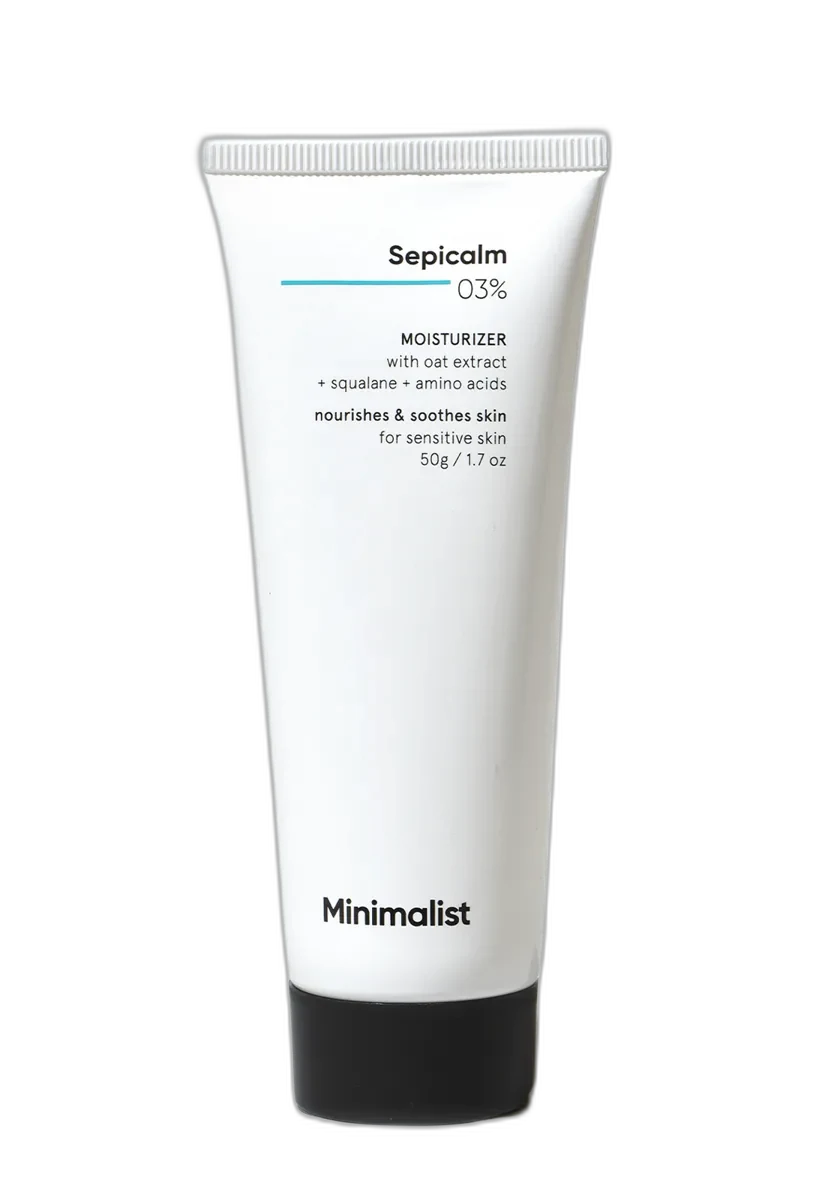
Sepicalm 3% + Oat Face Moisturizer
Budget Sensitive-Skin Pick
 Verified reviewer
Pros & cons.
- +Sepicalm dosed at the manufacturer's full 3% efficacy level
- +Active concentration printed transparently on the front of the box
- +Genuinely fragrance-free — no masking scent or essential oils
- +Stacks oat, bisabolol and panthenol for layered soothing
- +Under $12 price undercuts most international sensitive-skin creams
- +Works well as a buffer layer under retinoids or azelaic acid
- +Plays well under sunscreen with no pilling
- −50g tub runs out in six to eight weeks with twice-daily use
- −Jar-and-spatula packaging feels cheaper than a pump would
- −Not fungal acne safe due to fatty alcohols and PEG-100 stearate
- −Availability outside India is inconsistent and adds shipping cost
- −Not rich enough for the driest winter skin as a standalone night cream
The full review.
Minimalist built its whole brand identity around a single piece of packaging design: putting active concentrations in bold type on the front of every box. In a market where hero-ingredient marketing has historically done a lot of heavy lifting — sometimes for formulas containing whisper-dose amounts of their flagship active — that kind of transparency was genuinely new when founder Mohit Yadav launched the brand out of Jaipur in 2020. This moisturizer is one of the clearest examples of why that choice mattered. The box says 3% Sepicalm, and the formula actually uses 3% Sepicalm. That is, stubbornly, still worth pointing out.
Sepicalm S is a branded soothing active from the French ingredient supplier Seppic, built around sodium palmitoyl proline combined with Nymphaea alba (water lily) flower extract. Its proposed mechanism is osmolyte-assisted, helping skin cells maintain water balance under stress, which in practice translates to reduced visible redness and faster recovery from irritation. The supplier’s own in-use recommendation tops out around 3 percent, which is exactly where Minimalist has landed. Stacked behind it you get oat kernel extract (the avenanthramides do the same calming work through a slightly different inflammatory pathway), panthenol, bisabolol from chamomile, and a sensible emollient backbone of squalane, caprylic/capric triglyceride and dimethicone. Glycerin sits third on the INCI list, which is where you want it in a daily moisturizer rather than whispered in near the preservative.
Texture
The texture is medium-weight — not the whipped, airy feel of a gel-cream, not the thick occlusive cushion of a classic dry-skin moisturizer. It sinks in with a few seconds of work, leaves behind a soft natural finish, and gets along fine with mineral and chemical sunscreens layered on top.
Scent
There’s no scent. Not a masking fragrance, not essential oils playing the unscented card — genuinely nothing. If you’ve been using fragranced moisturizers and your skin is acting up, the first few minutes with this cream tend to be quietly revelatory.
Works for
Where it earns its keep is in the stacking. A single soothing active in an otherwise unremarkable base can do real work, but formulators who care about reactive skin tend to build redundancy — different mechanisms calming inflammation from different angles, so that if one user doesn’t respond well to Sepicalm, the oat and the bisabolol are still pulling their weight. This formula does that. It’s also a sensible buffer product: applied before a low-dose retinoid (the sandwich method) or layered after azelaic acid, the cream takes the edge off without blunting the actives entirely.
Not ideal for
The limits are worth being honest about. The 50g jar disappears quickly if you’re using this twice daily on face and neck — figure six to eight weeks of runway. The jar-and-spatula packaging is hygienic enough but feels cheaper than it needs to, and there’s no travel-friendly pump option. Availability outside India has improved but is still inconsistent through secondary marketplaces, which means shipping costs can close the gap between this and the international sensitive-skin brands it’s meant to undercut. And it’s not fungal acne safe — the cetearyl alcohol and PEG-100 stearate rule it out for a specific minority of Malassezia-reactive users.
The other thing worth noting is that Minimalist was acquired by Hindustan Unilever in 2024. For some buyers that raises the usual questions about whether indie quality survives a multinational roll-up; so far the formulations haven’t visibly changed, but it’s something to watch over the next year or two.
Best for
What this product gives you, for the money, is a soothing moisturizer that gets the active concentration right, pairs it with several real supporting ingredients, and doesn’t make you pay for luxury packaging or a brand heritage surcharge. If your skin is reactive, if you’re rebuilding your barrier after going too hard on actives, if you’ve been priced out of the $30-and-up sensitive-skin aisle — this is a specifically good answer. It’s not the richest moisturizer for deep winter, it’s not the most elegant format on the market, and it won’t replace prescription-strength interventions for severe rosacea. But at under $12 with a transparent label and a formula that actually backs up what the box claims, it’s doing something increasingly rare in skincare: telling you the truth and charging you a fair price for it.
Ingredient analysis.
Full INCI list · pH 5.5
Aqua, Caprylic/Capric Triglyceride, Glycerin, Propanediol, Sodium Palmitoyl Proline (and) Nymphaea Alba Flower Extract, Avena Sativa (Oat) Kernel Extract, Cetearyl Alcohol, Dimethicone, Glyceryl Stearate, PEG-100 Stearate, Cetyl Alcohol, Squalane, Panthenol, Allantoin, Bisabolol, Tocopherol, Xanthan Gum, Disodium EDTA, Phenoxyethanol, Ethylhexylglycerin
Skin match.
The science.
The Science
Sepicalm S, oat, and established soothing auxiliaries drive this formula. Sepicalm S is a Seppic branded ingredient complex that combines sodium palmitoyl proline with Nymphaea alba extract. It supports the skin's osmolyte response to environmental stress; manufacturer in-use testing at 2-3% shows reduced visible erythema. Because peer-reviewed studies on the specific Sepicalm complex are limited, the evidence relies on its individual components and category. Oat extract's soothing role is better established—multiple in vitro studies show avenanthramides, the polyphenolic compounds in Avena sativa, inhibit NF-κB activation and reduce pro-inflammatory cytokine release in human keratinocytes. This supports the FDA's classification of colloidal oatmeal as a skin protectant. Panthenol (pro-vitamin B5) has decades of data showing it hydrates the stratum corneum and accelerates barrier repair after surfactant or tape-stripping injury. Bisabolol, the main active in chamomile, inhibits prostaglandin synthesis in multiple in vitro models to provide anti-inflammatory effects. This formula works through redundancy rather than a single mechanism, which matters because reactive users respond to different soothing pathways. Stacking Sepicalm (osmolyte support), oat (NF-κB modulation), and bisabolol (prostaglandin inhibition) in a fragrance-free, squalane-cushioned base mimics the best soothing moisturizers on the market, which is unusual at this price point.
Dermatologist Perspective
Dermatologists often recommend simple, fragrance-free moisturizers with well-studied soothing ingredients for patients with rosacea, sensitive skin, and barrier compromise—and this formula meets those criteria. Board-certified dermatologists typically look for glycerin high on the INCI, no fragrance or essential oils, at least one evidence-backed soothing active, and a supportive lipid component; this product has all four. Post-procedure patients (after chemical peels, microneedling, or laser) often use products combining panthenol with oat or chamomile-derived soothers during recovery. The main caveat is the presence of cetearyl alcohol and PEG-100 stearate, making it unsuitable for Malassezia-driven folliculitis. For typical sensitive or reactive patients without that specific condition, clinicians would consider this a reasonable budget daily moisturizer.
Where it fits in your routine.
Apply a pea-to-almond-sized amount to clean, damp skin after water-based serums. In the morning, layer it before sunscreen—wait 30 to 60 seconds for absorption to prevent pilling under mineral SPFs. At night, use it as the final step alone, or as a buffer before a low-dose retinoid (the sandwich method: moisturizer, retinoid, moisturizer again) if your skin is adjusting. Apply more generously and reapply during the day for active flare-ups or post-procedure skin. Use the included spatula to keep the jar hygienic, and keep the tub out of direct sunlight.
At roughly $10 for 50g, this moisturizer offers clear value for sensitive skin. The 3% Sepicalm dose hits the supplier's recommended efficacy ceiling rather than acting as a marketing sprinkle. The oat, panthenol, bisabolol, and squalane also belong in formulas priced two to three times higher. Sizing limits the value: the 50g tub is the only option, so users applying this to face and neck will use it quickly. No larger-size upgrade path exists. Even so, the per-use cost stays well below what international sensitive-skin brands charge for comparable formulas, and front-of-box transparency ensures you pay for what is inside.
Buy this for reactive, sensitive, or easily-irritated skin if you want an honestly-dosed soothing moisturizer without the sensitive-skin tax. It works well for rebuilding the skin barrier after overusing actives, for rosacea-prone skin needing a daily calm-down layer, and for anyone using retinoids or azelaic acid who wants a buffer.
Skip this if you have confirmed fungal acne — the cetearyl alcohol and PEG-100 stearate may aggravate Malassezia-driven folliculitis. Also skip if you need a thick, occlusive overnight cream for very dry winter skin, or if you prefer a pump over the jar-and-spatula format.
Product details.
Medium-weight white cream that rubs in without any tackiness or white cast.
None — genuinely fragrance-free, no masking scent.
50g screw-top plastic jar includes a plastic spatula — it is hygienic, but a pump works better.
The first application feels unremarkable—no tingle, sting, or heat. If layering actives has left your skin feeling raw, the sting stops within seconds of applying. There is no purge or adjustment period; this isn't that kind of product.
About 6-8 weeks with twice-daily full-face application.
12 months
All Year
The backstory.
Minimalist launched in 2020 specifically to push back against the Indian skincare market's tradition of hiding actives behind hero-ingredient marketing. This moisturizer was one of the brand's early sensitive-skin picks, built around Seppic's Sepicalm S — a branded osmolyte-soothing active — paired with oat extract for everyday use on reactive skin. Hindustan Unilever acquired the brand in 2024.
About Minimalist
Emerging Brand (2–5 years)Minimalist (legally Be Minimalist, acquired by Hindustan Unilever in 2024) launched in 2020 in Jaipur. The brand uses a transparency-first approach, printing active concentrations on every box front. Minimalist builds credibility in South Asia using cosmetic-chemist-led formulations, but independent long-term clinical validation of specific SKUs remains limited.
Common myths.
Moisturizers gentle enough for sensitive skin lack the strength to work.
This formula is 'gentle' because it omits fragrance, essential oils, and denatured alcohol — not because it lacks actives. Sepicalm at 3% is an active ingredient that works.
FAQ.
What is Sepicalm and why is it in this moisturizer?
Sepicalm S is a branded soothing active from Seppic. It uses sodium palmitoyl proline and water lily extract. Minimalist doses this at 3% — the manufacturer's recommended upper efficacy level — to calm visible redness and support the natural osmolyte response in reactive skin.
Can I use this moisturizer with retinol or azelaic acid?
Yes — the fragrance-free, bisabolol-and-oat-buffered base makes it a good pairing for retinoids and azelaic acid. Many users apply this cream before a low-dose retinoid as a sandwich-method buffer or layer it after azelaic acid to calm the initial tingle.
Is this moisturizer fungal acne safe?
Not strictly. It contains cetearyl alcohol and PEG-100 stearate, which react with some Malassezia-sensitive users. If you have confirmed fungal acne, avoid this — use a simpler glycerin-and-squalane-only formula instead.
Is Minimalist Sepicalm moisturizer fragrance-free?
Yes, it is. There is no added fragrance, no essential oils, and no masking scent. Out of the jar, it smells faintly of the emulsifier base and nothing else.
How does this compare to more expensive sensitive-skin moisturizers?
The formulation hits key soothing checkpoints — a branded calming active at efficacy level, oat extract, panthenol, bisabolol, and squalane — at a price lower than most international sensitive-skin creams. You trade off premium packaging, higher occlusivity, and the long track record of legacy derm brands.
Is it safe to use during pregnancy?
The formula contains no ingredients typically flagged for pregnancy — no retinoids, no salicylic acid, and no high-risk essential oils. As always, consult your OB if you are uncertain.
What the community says.
"Genuinely calms redness"
"Lightweight but not drying"
"Honest pricing for the active"
"Doesn't pill under sunscreen"
"Small 50g tub disappears fast"
"Occasional separation reported in older batches"
"Limited availability outside India"