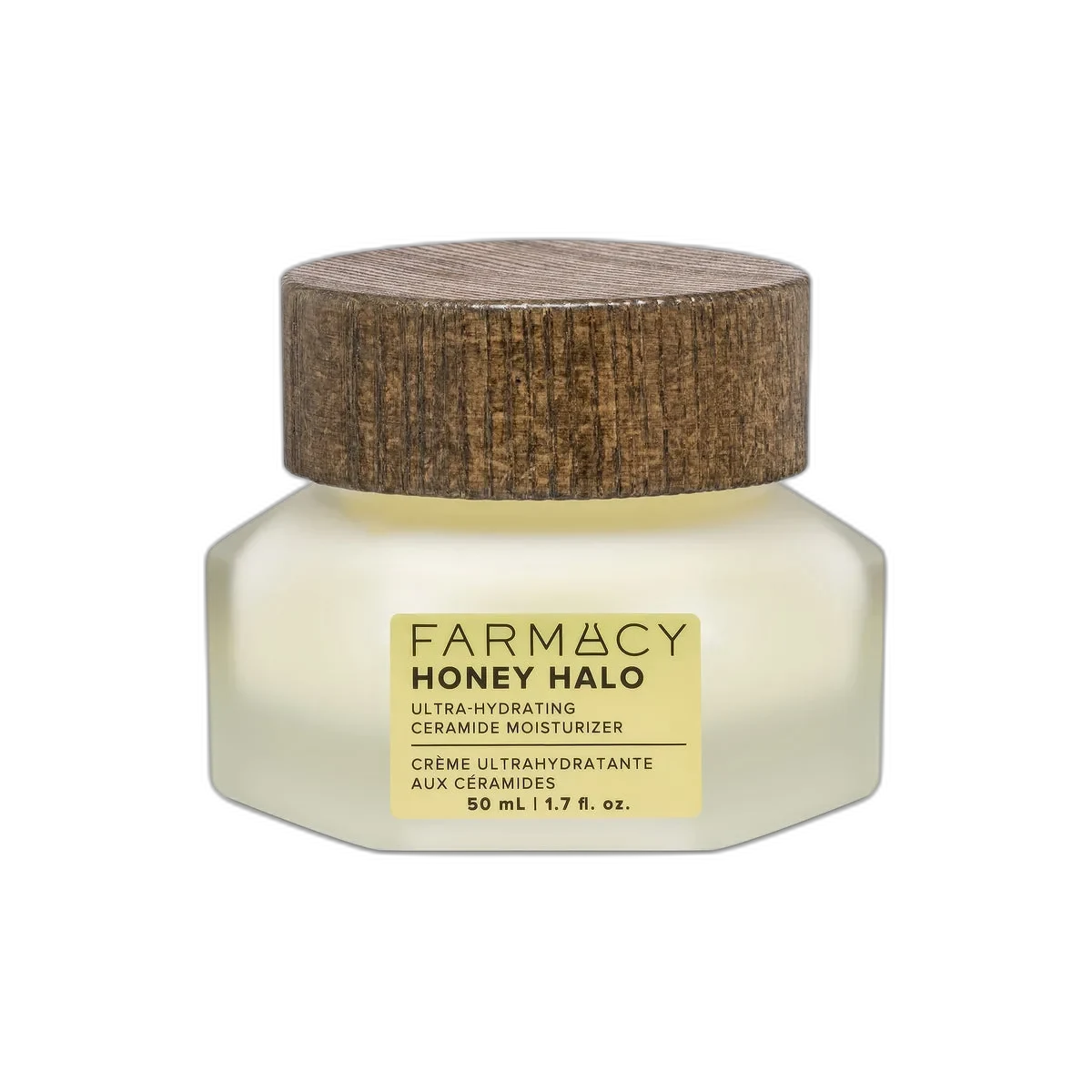
Honey Halo Ceramide Face Moisturizer
Clean Beauty Comfort Blanket
 Verified reviewer
Pros & cons.
- +Genuinely effective barrier repair from ceramide NP, honey extract, and panthenol working together
- +Rich balm-like texture melts on skin contact and absorbs without lasting greasiness
- +Silicone-free clean formula using plant-derived emollients exclusively
- +Triple bee-ingredient complex provides humectant, antimicrobial, and antioxidant benefits simultaneously
- +Beautiful recyclable glass jar with magnetic spatula for hygienic dispensing
- +Jumbo 100 mL size available for better per-unit value
- +Sephora Clean and Leaping Bunny certified
- −Polarizing honey scent from Flavor/Aroma ingredient may not suit fragrance-sensitive users
- −Too rich and heavy for oily or combination skin especially in warm weather
- −Contains bee-derived ingredients — unsuitable for those with bee allergies or vegans
- −Jar packaging exposes product to air more than tubes or pumps
- −Marketed as fragrance-free but contains Flavor/Aroma — potentially misleading
The full review.
Honey has been smeared on human skin for at least four thousand years. Cleopatra supposedly bathed in it. Ancient Egyptian medical papyri prescribed it for wounds. And somewhere in a Brooklyn office around 2018, the team at Farmacy decided to build an entire moisturizer franchise around it. The Honey Halo launched in 2019 and promptly became the brand’s bestselling product — a thick, golden-hued cream that promises to do for your skin barrier what honey does for toast: seal everything in and make it better.
The formula centers on a trio of bee-derived ingredients: honey extract for humectant hydration, propolis extract for anti-inflammatory and antioxidant support, and royal jelly extract for its cocktail of amino acids and fatty acids. These aren’t token inclusions — honey extract appears relatively high on the ingredient list, suggesting meaningful concentration. The supporting cast is equally purposeful: ceramide NP to rebuild the lipid barrier, panthenol for wound-healing acceleration, shea butter for deep emollience, and glycerin as the primary humectant workhorse.
What makes this formula interesting from a skin science perspective is the marriage of humectant and barrier-repair strategies. Most moisturizers lean toward one camp or the other — they’re either humectant-heavy (glycerin, hyaluronic acid) or barrier-focused (ceramides, fatty acids, cholesterol). The Honey Halo tries to do both, using honey and glycerin to pull water into the skin while ceramide NP, shea butter, and sunflower seed oil unsaponifiables work on the structural repair. It’s an ambitious formulation approach, and the reformulated 2023 version — which swapped out some older oils for caprylic/capric triglyceride and hydrogenated rapeseed oil — suggests Farmacy has been refining the balance.
Texture
The texture is the first thing anyone will notice. In the jar, this looks and feels like butter — thick, dense, and rich with a pale golden color. It seems like it would sit on your skin like a mask. But the formulation team earned their salary here: it melts on contact with body heat, transforming from a balm-like solid into a spreading, absorbent cream. The absorption isn’t instant — you’ll want to give it three to five minutes before sunscreen or makeup — but it does absorb, settling into a dewy, non-greasy finish that lasts.
Scent
And then there’s the scent. The honey fragrance is this product’s most controversial feature. It comes from a ‘Flavor (Aroma)’ ingredient rather than synthetic parfum, which technically supports Farmacy’s fragrance-free marketing claims. But make no mistake — this cream smells like honey, unmistakably and immediately. Some users adore it, describing it as warm, comforting, and natural. Others find it cloying, too sweet, or teetering between ‘real honey from a farmers market’ and ‘honey-flavored cough drop.’ The scent dissipates within a few minutes of application, but if you’re someone who cannot tolerate any fragrance in your skincare, the marketing terminology here may mislead you.
Best for
Performance is where the Honey Halo earns its devoted following. On dry, compromised skin — the retinol-ravaged, winter-battered, eczema-adjacent kind — this cream delivers. The immediate plumping effect is noticeable from the first application, and within a week of consistent use, dry patches and flakiness are visibly reduced. The ceramide NP doesn’t just sit on top of the skin; over time, it integrates into the lipid barrier, improving the skin’s ability to hold moisture on its own. Users recovering from retinoid irritation report particular success, as the combination of barrier lipids and soothing panthenol addresses both the structural and inflammatory components of retinol damage.
Works for
The silicone-free formula is a genuine differentiator. Most rich creams achieve their slip and spreadability through dimethicone or cyclopentasiloxane. The Honey Halo uses plant-derived emollients instead — caprylic/capric triglyceride, C13-15 alkane, and pentaerythrityl tetraisostearate. The result is a different kind of skin feel: more emollient and less ‘smoothing,’ with a finish that feels nourishing rather than sealed. For clean beauty adherents who avoid silicones, this is one of the few rich moisturizers that delivers without them.
Packaging
The hexagonal glass jar is beautiful and very much designed for the ‘shelfie’ generation. The magnetic spatula attached to the lid is a smart touch — jar packaging is inherently less hygienic than pumps or tubes, and the spatula at least reduces finger-dipping. The glass is recyclable, which aligns with Farmacy’s sustainability positioning.
Not ideal for
Limitations are real and predictable. This is a rich moisturizer designed for dry skin, and it behaves like one. Oily and combination skin types will almost certainly find it too heavy for daytime use, and even some normal skin types may feel it sits too richly in warmer months. The bee-derived ingredients — honey, propolis, and royal jelly — are potential allergens for a small percentage of the population; if you’re allergic to bee stings or bee products, this is not your cream. And the jar, beautiful as it is, means the product is exposed to air and fingers more than it would be in a tube or pump, potentially shortening the effective shelf life of the more sensitive ingredients.
Price
At forty-eight dollars for fifty milliliters, the Honey Halo sits at a mid-premium price point. The jumbo one-hundred-milliliter size at eighty-four dollars brings the per-unit cost down meaningfully and is worth considering if you know you love the product. For the ingredient quality, the silicone-free clean formulation, and the packaging, the price is reasonable — not cheap, but not overreaching.
Farmacy built the Honey Halo around a simple idea: that an ingredient humans have used on their skin for millennia might still have something to offer in the age of ceramide science and barrier repair. The result is a cream that feels like a warm hug for your face — literally warm, given the way it melts on contact — and performs with genuine efficacy on dry, damaged skin. The honey scent is going to be the deciding factor for most people. If you can love it, or at least tolerate it, the Honey Halo delivers.
Ingredient analysis.
Full INCI list
Water/Aqua/Eau, Glycerin, Butyrospermum Parkii (Shea) Butter, Caprylic/Capric Triglyceride, C13-15 Alkane, Cetearyl Alcohol, Pentaerythrityl Tetraisostearate, 1,2-Hexanediol, Bis-Diglyceryl Polyacyladipate-1, Diisostearyl Malate, Xylitylglucoside, Honey Extract, Betaine, Panthenol, Hydrogenated Rapeseed Oil, Helianthus Annuus (Sunflower) Seed Oil Unsaponifiables, Ceramide NP, Propolis Extract, Royal Jelly Extract, Tocopherol, Ficus Carica (Fig) Fruit Extract, Hippophae Rhamnoides Oil, Glucose, Bisabolol, Xylitol, Anhydroxylitol, Cetearyl Glucoside, Triolein, Acrylates/C10-30 Alkyl Acrylate Crosspolymer, Hydroxyethyl Acrylate/Sodium Acryloyldimethyl Taurate Copolymer, Arginine, Flavor (Aroma), Hydroxyacetophenone, Xanthan Gum, Glyceryl Dioleate, Sodium Dilauramidoglutamide Lysine, Sodium Phytate, Sorbitan Isostearate, Citric Acid, Potassium Sorbate, Sodium Benzoate
Skin match.
The science.
The Science
Modern research validates the millennia of wound-healing tradition behind this formula's honey extract. Burlando and Cornara (Journal of Cosmetic Dermatology, 2013) documented honey as a humectant and emollient in cosmetic formulations; its antimicrobial properties come from hydrogen peroxide release and the low-pH environment honey creates. At cosmetic concentrations, honey works primarily as a moisture-binding humectant rather than an active treatment, but its gentle skin-conditioning properties are well-supported.
Ceramide NP provides the barrier-repair backbone. A 2024 review by Schild et al. (International Journal of Cosmetic Science) emphasized that ceramide efficacy in topical formulations depends on proper formulation—specifically, ceramides must fully dissolve during manufacturing to integrate into the stratum corneum's lamellar lipid structures. Undissolved ceramide particles sit on the surface without functional benefit. The reformulated Honey Halo uses caprylic/capric triglyceride as a solvent base, which may improve ceramide dissolution compared to the original vegetable oil base.
Propolis and royal jelly add more than basic moisturization. Pasupuleti et al. (Oxidative Medicine and Cellular Longevity, 2017) reviewed the biological actions of bee products, finding that propolis reduces free radical activity during wound healing while royal jelly protects against UV-B-induced photoaging by stimulating collagen production. Kurek-Gorecka et al. (Molecules, 2020) confirmed the antibacterial, anti-inflammatory, and anti-aging properties of the bee product trilogy.
The prebiotic sugar complex—xylitylglucoside, xylitol, and anhydroxylitol—adds microbiome support to complement the antimicrobial honey and propolis. This prebiotic complex improves skin hydration by supporting the skin's natural microflora rather than disrupting it.
References
- Honey in dermatology and skin care: a review — Journal of Cosmetic Dermatology (2013)
- The role of ceramides in skin barrier function and the importance of their correct formulation for skincare applications — International Journal of Cosmetic Science (2024)
- Honey, Propolis, and Royal Jelly: A Comprehensive Review of Their Biological Actions and Health Benefits — Oxidative Medicine and Cellular Longevity (2017)
- Bee Products in Dermatology and Skin Care — Molecules (2020)
Dermatologist Perspective
Dermatologists view ceramide-based moisturizers as effective barrier-repair tools. The Honey Halo's combination of ceramide NP, humectant honey, and soothing panthenol aligns with evidence-based barrier restoration principles. Board-certified dermatologists note the honey-and-propolis combination offers mild antimicrobial benefits that help skin prone to irritation without the harshness of traditional antiseptics. However, dermatologists caution that the 'Flavor (Aroma)' ingredient and bee-derived extracts are potential sensitizers, making this less ideal for patients with documented fragrance or bee product allergies. For patients seeking a thick, barrier-supportive moisturizer in a clean-beauty framework, dermatologists frequently mention this as a quality option.
Where it fits in your routine.
Use the magnetic spatula to scoop a small amount. Warm it between fingertips until it melts. Press it into clean skin, moving from the face center outward to the jawline and neck. In the morning, wait three to five minutes for full absorption before you apply sunscreen. At night, apply it as the final step over serums or treatments. For intense overnight hydration, apply a thicker layer as a sleeping mask. Keep the lid closed to minimize air exposure.
At $48 for 50 mL, Honey Halo is mid-premium. It costs more than drugstore ceramide creams but stays well below luxury tier pricing. The silicone-free, clean-beauty formulation has Sephora Clean and Leaping Bunny certifications, which justifies the premium over simpler alternatives. The jumbo 100 mL size at $84 cuts the per-milliliter cost by 12% and is the better buy for committed users. Mini sizes ($16 for 15 mL, $25 for 25 mL) offer low-commitment entry points. Using it twice daily, the standard size lasts about two to three months, making the daily cost $0.50-$0.80.
Dry to normal skin types want a thick, barrier-repairing moisturizer with clean-beauty credentials. It works for retinol-induced dryness, winter barrier damage, or chronic dehydration. Use this if you like bee-derived ingredients and a honey scent. It is a silicone-free option for clean beauty shoppers who want a thick texture.
Oily or combination skin types who find thick creams too heavy for daily use. Anyone with bee product allergies (honey, propolis, royal jelly). Those who are fragrance-sensitive and cannot tolerate scented ingredients. Vegans seeking animal-product-free skincare.
Product details.
The warm honey fragrance is the product's most polarizing feature. Some users find it pleasant and natural, while others find it too sweet or borderline artificial. The scent comes from 'Flavor (Aroma)' in the ingredients, not synthetic fragrance. ***
A hexagonal frosted glass jar with a golden lid uses honeycomb geometry. A magnetic metal spatula attaches to the lid for hygienic dispensing. The glass is recyclable. The presentation looks premium on a shelf.
The thick texture surprises new users, but it melts fast when pressed into skin. It gives immediate softness and a subtle dewy glow. It causes no stinging or irritation. Dry patches feel soothed within hours. The honey scent is noticeable but fades within minutes of application.
Apply to the face twice daily for 2-3 months; use once daily for 3-4 months.
12 months ***
fall winter ***
The backstory.
Farmacy launched Honey Halo in 2019 as the brand's answer to extreme dryness, building on its farm-to-face philosophy by centering the formula around honey — one of nature's oldest skin remedies. The product quickly became Farmacy's bestselling moisturizer, earning a reformulation around 2023 that upgraded the oil base and removed synthetic fragrance. The hexagonal jar design is a deliberate nod to the honeycomb structure that produces the star ingredient.
About Farmacy
Farmacy launched in 2015 using a 'farm-to-face' philosophy that blends sustainably sourced ingredients with cosmetic science. Procter & Gamble acquired the brand in 2021. Over its decade on the market, the brand has become a Sephora Clean-certified leader in clean beauty.
Common myths.
Products labeled 'fragrance-free' contain no scenting ingredients.
This cream contains 'Flavor (Aroma)', a natural scenting component. It provides the honey fragrance but avoids the 'fragrance/parfum' label in cosmetic labeling. This is a common clean-beauty workaround. It contains fewer sensitizers than synthetic fragrance blends, but it is not unscented.
Thick moisturizers always clog pores and cause breakouts.
The emollient base uses shea butter, caprylic/capric triglyceride, and plant-derived alkanes instead of mineral oil or comedogenic waxes. This thick texture suits oily skin less, but the ingredient profile is not pore-clogging for most skin types.
FAQ.
Is Farmacy Honey Halo good for sensitive skin?
ceramide NP, panthenol, and bisabolol in this formula are gentle, barrier-supporting ingredients for sensitive skin. But it has bee-derived ingredients (honey, propolis, royal jelly) and a natural Flavor/Aroma component — people with bee product allergies or extreme fragrance sensitivities should patch test first.
Is Farmacy Honey Halo really fragrance-free?
The formula contains no synthetic fragrance (parfum), but uses 'Flavor (Aroma)' to create a honey scent. This meets many clean-beauty fragrance-free standards, but the product is not unscented and can trigger reactions in highly sensitive individuals.
Can I use Farmacy Honey Halo with retinol?
Yes — the ceramide-and-shea-butter base buffers retinol-induced dryness well. Apply your retinol first, let it absorb, then seal with Honey Halo. The barrier-repair ingredients counteract how retinol disrupts the lipid barrier.
Is Farmacy Honey Halo vegan?
No — the formula uses three bee-derived ingredients: honey extract, propolis extract, and royal jelly extract. The product is Leaping Bunny certified cruelty-free, but it is not vegan.
What sizes does Farmacy Honey Halo come in?
The standard 50 mL (1.7 fl oz) size costs $48. A jumbo 100 mL (3.4 fl oz) size costs $84 and has better per-ounce value. Mini 15 mL and 25 mL sizes cost $16 and $25, which work well for travel or testing.
Is Farmacy Honey Halo too heavy for combination skin?
Yes for most combination skin types, especially in warmer months. The thick, balm-like texture targets dry to normal skin. Combination skin users can use it as a nighttime-only moisturizer or during dry winter months, but it feels too heavy for daily AM use on oilier zones.
What the community says.
"Intensely nourishing without feeling greasy after absorption"
"Visibly plumps and smooths dry skin from first use"
"Beautiful hexagonal glass jar packaging with hygienic magnetic spatula"
"Effective barrier repair for retinol recovery and winter dryness"
"Silicone-free formula appeals to clean beauty preferences"
"Works well under makeup once fully absorbed"
"Honey scent is polarizing — some find it overpowering or artificial"
"Too heavy and rich for oily or combination skin types"
"Contains Flavor/Aroma despite being marketed as fragrance-free"
"Jar packaging is less hygienic than pump despite the included spatula"
"Takes longer to absorb than lighter moisturizers"