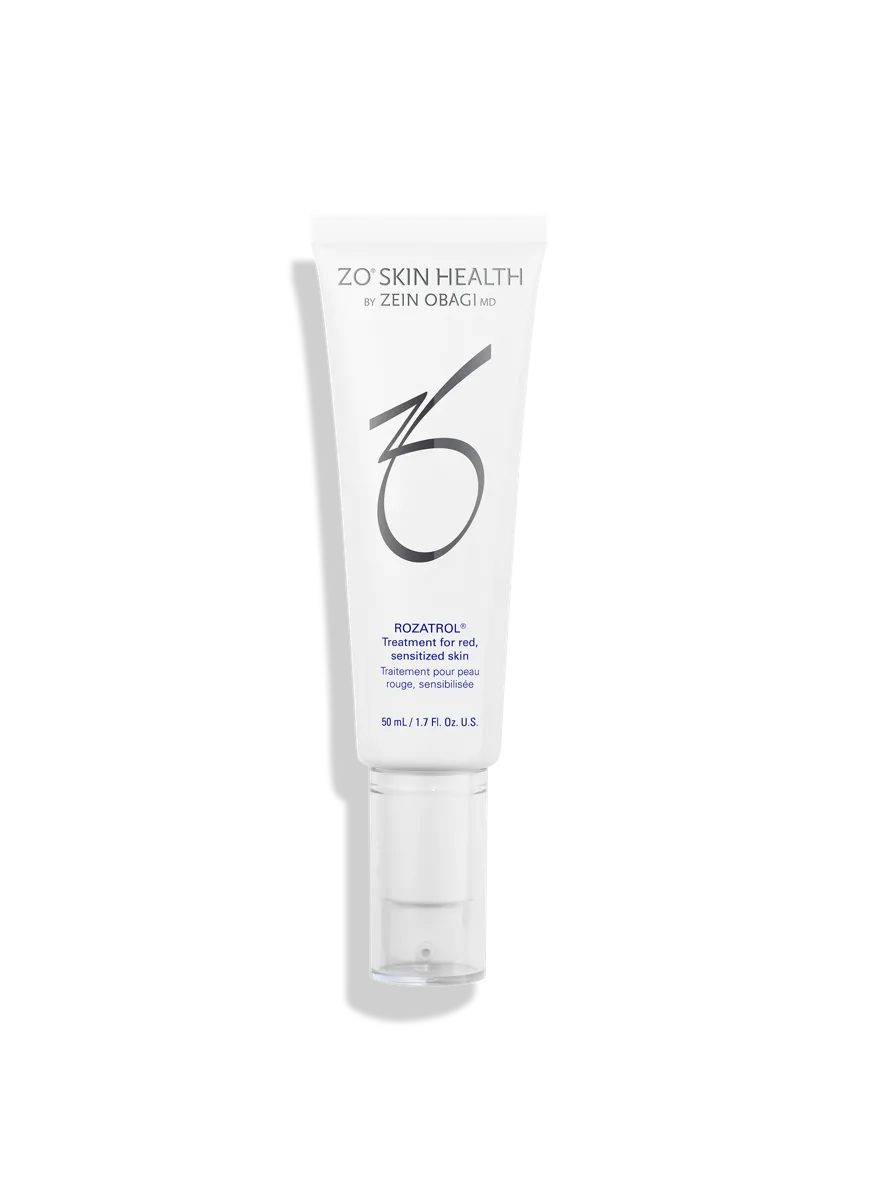
Rozatrol Treatment for Red Sensitized Skin
Rosacea Specialty Pick
 Verified reviewer
Pros & cons.
- +Thoughtful mechanism-first design for reactive and redness-prone skin
- +Palmitoyl glycine and broccoli extract are credible anti-inflammatory actives
- +Stabilized papain offers gentle exfoliation without triggering flares
- +Dual-form panthenol delivers immediate and sustained barrier soothing
- +Velvety non-greasy finish layers well under mineral sunscreen
- +Backed by ZO's own published 8-week redness reduction study
- +Commonly used in dermatology office rosacea protocols
- −Contains fragrance and farnesol in a sensitive skin product
- −Includes alcohol denat, which raises eyebrows for rosacea users
- −Expensive compared to over-the-counter rosacea options
- −Contains milk protein — not suitable for dairy allergies
- −Not a substitute for prescription rosacea treatment
The full review.
Rosacea is one of the hardest categories in skincare to formulate for, because the goal isn’t to add actives — it’s to add just enough actives without triggering the very reactive pathways you’re trying to soothe. Most brands respond by going passive: ceramides, centella, panthenol, call it a rosacea cream. ZO went the other way with Rozatrol. They built a treatment-first product with an actual lipopeptide, an enzymatic exfoliant, a broccoli-derived antioxidant, and a dual-form vitamin B5 system, then ran an internal 8-week study of 22 subjects in which 73% reported visible redness improvement. That number is not independently published, but the decision to conduct the study at all — and to put their name on a specific outcome — is unusual for a rosacea serum in the clinical category, where vague ‘calming’ claims are the norm.
The active that carries the most weight here is palmitoyl glycine. This lipopeptide has in vitro data on modulating inflammatory signaling and has been adopted by several clinical brands specifically for reactive skin applications. It’s not as well-studied as niacinamide or azelaic acid, but the mechanism is plausible and the published data is more substantive than most ‘anti-redness complex’ ingredients. Paired with the broccoli extract — which contains sulforaphane and contributes both antioxidant and NF-κB-inhibiting activity — the anti-redness system here is genuinely thoughtful.
Then there’s the papain. This is the part of the formula that made me stop and think. Enzymatic exfoliation in a rosacea product is a risk on paper, because the last thing reactive skin needs is more turnover pressure. But ZO stabilized the papain inside a carbomer crosspolymer, which slows the enzyme release dramatically, and the payoff is the gentle clearance of dead cell buildup that otherwise makes rosacea skin look rougher and more inflamed than it actually is. The lactic acid that appears further down the INCI provides similar gentle chemical support. This is the non-obvious move that separates Rozatrol from a standard rosacea moisturizer.
The barrier and soothing layer is handled by panthenol and panthenyl triacetate — a dual-form vitamin B5 approach that gives you both immediate and sustained comfort. Sunflower seed oil, glycerin, cetyl alcohol, and dimethicone round out the base, delivering the thin, velvety, non-greasy finish that rosacea patients tend to prefer over heavy lipid creams. The hydrolyzed algin and algin provide film-forming hydration that sits smoothly under mineral sunscreen, which matters because mineral SPF is basically non-negotiable for rosacea management.
Now the complaint that has to be made. The formula contains alcohol denat and fragrance, and the fragrance panel includes farnesol — a known fragrance allergen. In a product marketed explicitly for ‘red sensitized skin,’ these inclusions are hard to defend in 2026. ZO’s counter-argument would probably be that the alcohol denat is present at a low enough level to function as a penetration enhancer rather than a drying solvent, and that the fragrance is below the threshold that causes contact reactions in most users. Both arguments have some merit, but for a rosacea-targeting product at $105 in a dermatology office, ‘tolerable for most users’ is a lower bar than the positioning suggests. Rosacea patients with known fragrance allergies or alcohol sensitivity should absolutely patch test this before committing to daily use, and some will need to choose an alternative entirely.
The performance question is the one that actually matters. Used consistently, Rozatrol does contribute to baseline redness reduction over 6-8 weeks. It’s not a magic wand, and it won’t stop an active flare in its tracks, but users who stay consistent report that the general color and reactivity of their skin softens meaningfully. The texture and finish are good enough to integrate into a morning routine with sunscreen. The post-procedure application — used after gentle laser, IPL, or microneedling — is one of the more credible secondary use cases, because the panthenol and algin base is well-suited to freshly treated skin even if the peptide and exfoliant benefits are more modest in that window.
Value is complicated. At $105 for 1.7 oz, Rozatrol is priced below ZO’s anti-aging serums but above most over-the-counter rosacea products. You can build a rosacea routine around azelaic acid 15% from The Ordinary ($12) plus La Roche-Posay Toleriane ceramide cream ($25) for a fraction of the cost, and that combination has more published evidence behind it than Rozatrol does on any single axis. What Rozatrol buys you is a single elegant treatment step, a specific lipopeptide, and the texture that ZO does better than most competitors. Whether that’s worth the premium depends on whether you want a treatment-first rosacea product or whether you’re happy combining cheaper, more basic options. For patients under dermatologist care who have already tried and outgrown the standard stack, this is a reasonable next step. For first-time rosacea shoppers, start with the basics and move up.
Ingredient analysis.
Full INCI list
Aqua/Water/Eau, Cetyl Alcohol, Glycerin, Helianthus Annuus (Sunflower) Seed Oil, C12-15 Alkyl Benzoate, Palmitoyl Glycine, Neopentyl Glycol Diethylhexanoate, Dimethicone, Panthenol, Lactose, Glyceryl Stearate, PEG-100 Stearate, Potassium Cetyl Phosphate, Brassica Oleracea Italica (Broccoli) Extract, Leontopodium Alpinum Meristem Cell Culture, Lactis Proteinum/Milk Protein/Protéine Du Lait, Carbomer/Papain Crosspolymer, Hydrolyzed Algin, Algin, Magnesium Aluminum Silicate, Xanthan Gum, Caprylyl Glycol, Neopentyl Glycol Diisostearate, Lecithin, PEG-12 Glyceryl Laurate, PEG-35 Castor Oil, Panthenyl Triacetate, Disodium EDTA, 1,2-Hexanediol, Alcohol Denat, Aminomethyl Propanol, Lactic Acid, Citric Acid, Phenoxyethanol, Chlorphenesin, Benzalkonium Chloride, Fragrance/Parfum, Farnesol, Farnesyl Acetate.
Skin match.
The science.
The Science
The ingredient with the strongest evidence base in Rozatrol is palmitoyl glycine, a lipopeptide that has been studied for its effects on inflammatory skin pathways. In vitro research suggests it can modulate NF-κB signaling and reduce markers of cutaneous inflammation, and several clinical skincare brands have adopted it specifically for reactive and rosacea-prone formulations. The evidence base is emerging rather than definitive, with most data coming from in vitro and small open-label studies rather than randomized controlled trials. Broccoli extract contains sulforaphane, which has been studied extensively in dermatology literature for its antioxidant and anti-inflammatory mechanisms — sulforaphane activates the Nrf2 pathway, which upregulates endogenous antioxidant defenses, and topical sulforaphane-containing formulations have shown promising results in limited human studies for UV damage and oxidative stress. Papain is a well-characterized cysteine protease with a long history in topical exfoliating products; its stabilization in a carbomer crosspolymer matrix, as used in Rozatrol, slows enzyme release and improves tolerability on reactive skin. Panthenol's barrier-supporting and anti-inflammatory effects are well-established in dermatology research, with decades of studies showing reduced transepidermal water loss and clinical improvement in irritated or compromised skin. The overall design of Rozatrol reflects a mechanism-aware approach to rosacea, though it's worth noting that ZO's clinical data on the specific formulation comes from an internal 8-week study of 22 subjects rather than peer-reviewed published trials, and the evidence for rosacea management overall still strongly favors prescription treatments like ivermectin, metronidazole, and azelaic acid as first-line.
Dermatologist Perspective
Dermatologists treating rosacea commonly use Rozatrol as an adjunctive product alongside prescription treatment — typically after ivermectin, metronidazole, or azelaic acid has established baseline control, with Rozatrol added to support the maintenance phase. It's also used in the recovery window after IPL, laser genesis, and vascular laser treatments for rosacea, where the panthenol and algin base is well-suited to freshly treated skin. Board-certified dermatologists tend to appreciate the mechanism-first formulation approach but regularly note the fragrance and alcohol denat content as a barrier for a subset of their most sensitive patients. The product is most often recommended for stable rosacea in the maintenance phase rather than active flares, and patients are usually advised to patch test carefully if they have any history of fragrance or alcohol sensitivity. Always used alongside daily mineral sunscreen and consistent trigger management.
Where it fits in your routine.
Apply one to two pumps to clean, dry skin after hydrating toners or essences and before moisturizer. Use morning and night consistently. The data ZO published uses 8 weeks of twice-daily use; shorter timelines reduce results. In the AM, follow with a barrier moisturizer and broad-spectrum mineral SPF 30 or higher. Sunscreen is non-negotiable for rosacea management regardless of which serum you use. If you use a prescription rosacea treatment, apply the prescription first, wait for absorption, then apply Rozatrol. Patch test for 3-5 days on reactive skin before full-face use, and pause during active flares with burning or breakdown.
At $105 for 1.7 oz, Rozatrol costs more than most dedicated rosacea serums. The formula has an elegant texture, but shoppers can build a rosacea routine using azelaic acid, niacinamide, and a ceramide moisturizer for much less. Published evidence for that combination is more robust than for Rozatrol specifically. The $41 travel size at 0.67 oz has worse per-unit value than the full size; buy the full bottle if you commit to Rozatrol. The price is defensible for dermatology patients who want a treatment-first next step under clinical supervision after trying the basics. Rosacea shoppers exploring the category should start with over-the-counter options and prescription adjuncts first.
Rosacea patients with stable disease in the maintenance phase seeking a mechanism-first serum under dermatologist guidance, and patients recovering from vascular laser or IPL treatment for redness. It works best for normal, combination, dry, or sensitive-but-tolerant skin types without fragrance or alcohol sensitivities.
Skip this if you have known fragrance allergies, alcohol sensitivity, or dairy allergies. Patients in active rosacea flares should use barrier repair and prescription topicals until the flare settles. Budget shoppers get similar benefits using over-the-counter azelaic acid, niacinamide, and a ceramide cream.
Product details.
Thin lotion-serum hybrid with a soft, velvety finish that disappears quickly.
Light ZO signature fragrance — the presence of perfume in a product marketed for reactive skin is controversial.
Airless pump bottle in ZO's clinical white and blue colorway.
Lactic acid and papain cause a brief tingle for some users during the first week. Most people feel immediate cooling and smoothing from the panthenol and algin base. Reactive skin needs a 3-5 day patch test on the inner arm or behind the ear before daily facial use.
Roughly 3 months with twice-daily face application from the 1.7 oz bottle.
12 months
All Year
The backstory.
Rozatrol was developed in the early 2010s as ZO's dedicated response to rosacea and redness-prone skin, categories where the brand's more aggressive anti-aging products weren't appropriate. Dr. Obagi's team aimed to create something that could actively treat — not just moisturize around — reactive skin, which is why the formula includes gentle enzymatic exfoliation alongside the anti-redness actives.
About ZO Skin Health
Dr. Zein Obagi founded ZO Skin Health in 2007. It sells mainly through U.S. dermatology and plastic surgery offices. Rozatrol targets rosacea-prone and redness-sensitized skin and appears in dermatology office rosacea management protocols. *Established Brand (5–20 years)*
Common myths.
Exfoliants should always be avoided in rosacea.
Harsh physical scrubs and strong leave-on acids trigger rosacea flares. Gentle enzymatic exfoliation at low levels—like the stabilized papain in Rozatrol—helps by clearing dead cell buildup that makes redness look more pronounced. The key is "gentle."
Rozatrol is a rosacea cure.
No topical product cures rosacea. This chronic inflammatory condition usually requires prescription treatments, trigger management, and supportive skincare. Rozatrol works well in a rosacea routine, but it does not replace prescription options like ivermectin, metronidazole, or azelaic acid.
FAQ.
Is Rozatrol a replacement for prescription rosacea treatment?
No. Prescription options like ivermectin, metronidazole, azelaic acid, and oral medications remain the first-line treatment for active rosacea; your dermatologist manages that. Rozatrol is a supportive product that works alongside medical treatment. It helps reduce baseline redness but is not a substitute.
Why does a rosacea product contain fragrance and alcohol?
This is the formula's most legitimate criticism. ZO has not reformulated to remove them. Rosacea patients with known fragrance or alcohol sensitivity must patch test carefully or choose a different product. The alcohol is low on the INCI, so it works as a penetration enhancer rather than a drying agent, but the presence of fragrance and farnesol in a sensitive-skin product is hard to defend.
How long until I see results?
Panthenol and algin soothe skin on the first application. Redness reduces visibly after 4-6 weeks of twice-daily use. ZO's internal clinical data shows 73% of users reported visible improvement at 8 weeks.
Can I use Rozatrol during a rosacea flare?
When skin burns, stings, or shows visible breakdown during an active flare, it may not tolerate this or any active treatment. Use barrier repair products (ceramides, petrolatum) and prescription topicals until the flare settles, then reintroduce Rozatrol gradually.
Is it safe to use with azelaic acid or metronidazole?
Yes — dermatologists often layer Rozatrol with prescription rosacea treatments. Usually, you apply Rozatrol after the prescription absorbs. Confirm specific layering with your dermatologist, especially when testing initial tolerance.
Can I use Rozatrol in pregnancy?
The formula lacks retinoids, high-level salicylic acid, or hydroquinone. These actives are generally pregnancy-acceptable. Always confirm with your OB or dermatologist before using any new product during pregnancy or breastfeeding.
What if I'm sensitive to milk protein?
Rozatrol has milk protein (Lactis Proteinum) high on the INCI. People with dairy allergies or milk protein contact sensitivities should avoid Rozatrol and use a dairy-free rosacea serum.
What the community says.
"Calms baseline redness over weeks"
"Non-greasy comfortable finish"
"Works under mineral sunscreen"
"Helpful for post-procedure recovery"
"Contains fragrance and alcohol — ironic for a sensitive skin product"
"Expensive for a rosacea serum"
"Some users report mild tingling"
"Not a quick fix for flare-ups"
People also looked at.