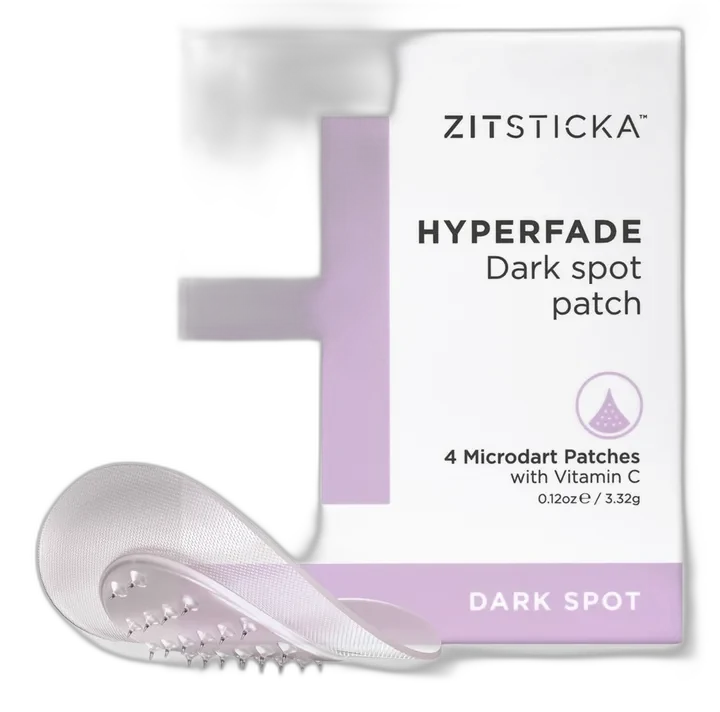
Hyperfade Dark Spot Microdart Patch
PIH Targeted Treatment
 Verified reviewer
Pros & cons.
- +Dissolvable microdart delivery bypasses the stratum corneum barrier
- +Five-mechanism brightening cocktail more comprehensive than typical spot serums
- +Tranexamic acid plus niacinamide combination targets PIH at the inflammation root
- +L-ascorbic acid stable in dry-dart format that solves the oxidation problem
- +Hydrocolloid patch stays put overnight without slipping
- +Fragrance-free, vegan, cruelty-free formulation
- +Targeted application means a box can last 2-3 months
- +Visible fading on fresher spots after 2-3 patches
- −Per-patch cost of $2.83 makes it impractical for widespread hyperpigmentation
- −Not safe during pregnancy due to kojic acid, arbutin, and tranexamic acid
- −Cannot be used on active pimples — only post-inflammatory marks
- −Older or deeper PIH may need 8-12 weeks for visible improvement
- −Adhesive can pull delicate skin if not removed gently
The full review.
Most topical dark-spot treatments face an awkward truth. Brightening ingredients like tranexamic acid, niacinamide, kojic acid, arbutin, and hydroquinone work in a petri dish, but molecules must cross the stratum corneum to reach the melanocyte layer where pigment forms. The stratum corneum evolved to keep things out. Consequently, a large percentage of the active in a $40 brightening serum stops at the surface. This causes the slow-fade-over-six-months experience common with post-acne marks. You apply the cream and wait, but when the spot eventually fades, you cannot tell if the serum or time caused it.
ZitSticka’s Hyperfade patches attempt to skip the surface-barrier problem. Each patch is a hydrocolloid disc with 24 microscopic darts on the underside. These darts use sodium hyaluronate to hold their shape on the patch and dissolve over six hours once pressed into skin. The darts physically penetrate the upper stratum corneum—deep enough to deposit cargo in the layer where brightening actives work, but not deep enough to cause pain or bleeding. This uses the same principle as microneedle drug-delivery research in the pharmaceutical category over the last decade, adapted for cosmetic actives. The technology is real and forms the most defensible part of the product story.
The dart cocktail is the second reason this works. Most dark spot products use one or two brightening pathways, but Hyperfade hits five. Niacinamide blocks melanosome transfer from melanocytes to keratinocytes, a different mechanism than the tyrosinase inhibitors used by most brightening products. Tranexamic acid interrupts the plasmin-driven inflammatory cascade that triggers melanin production after acne heals, which drives post-inflammatory hyperpigmentation. Kojic acid and arbutin both inhibit tyrosinase, the enzyme that produces melanin. L-ascorbic acid adds antioxidant support and a separate brightening pathway via melanin reduction. Stacking five mechanisms attacks pigment from multiple angles, similar to why in-office cosmelan peels and prescription combination treatments outperform single-active monotherapy. L-ascorbic acid is notoriously unstable in aqueous formulations, but in a dry microdart that only meets water when it dissolves into skin, the stability problem disappears. This is elegant formulation thinking.
The application is more pleasant than it sounds. Press the patch onto a clean, dry spot before bed and hold it for 30 seconds. You feel a brief pinprick as the microdarts make contact, then it fades. The patch stays in place overnight. By morning, the darts have fully dissolved and you peel off the empty hydrocolloid base. Skin underneath looks slightly plumped from the hyaluronic acid hydration, and the spot begins to fade over multiple uses. Most users see improvement on fresher marks after two or three patches, while older or deeper hyperpigmentation takes longer (four to eight weeks). Variability matters: a six-month-old PIH spot is harder to address than a three-week-old one, and patches alone may not clear deeply set pigment without daily topicals and sunscreen.
The limitations are clear. First, cost is the biggest issue. Thirty-four dollars for 12 patches is about $2.83 per use, which is steep. If dark spots are widespread, this is not a practical primary treatment; it works better for isolated marks where targeted delivery makes sense. Second, there is a pregnancy contraindication. Kojic acid and arbutin are typically not recommended during pregnancy, and tranexamic acid is generally avoided without medical guidance, so this product is not for pregnant or breastfeeding users. Third, these are not for active pimples—the brand’s Killa patch handles those. Hyperfade is for the dark mark after the pimple heals; using it on inflamed acne risks irritation without addressing the breakout. Finally, the patches require sun protection. UV exposure stimulates the same melanin production these patches suppress, and skipping daily SPF will undo the work.
The product earns its place on a Sephora shelf by addressing a specific problem. Topical brightening serums often disappoint because delivery is the limiting factor, not the ingredient list. Hyperfade fixes the delivery and uses a multi-mechanism active stack. It is one of the few brightening products where you can point to a specific reason it should work better than a comparable cream. Whether the per-patch price is justified depends on your existing brightening routine. If your current routine does not work, this is worth the experiment.
Ingredient analysis.
Full INCI list
Sodium Hyaluronate, Niacinamide, Macadamia Ternifolia Seed Oil, Ascorbic Acid, Arbutin, Kojic Acid, Glycyrrhiza Glabra (Licorice) Root Extract, Tranexamic Acid, Citric Acid, Water/Aqua/Eau.
Skin match.
The science.
The Science
The microdart delivery format here is the most scientifically interesting element. Microneedle drug delivery has accumulated a substantial research base over the past fifteen years, originally driven by transdermal vaccine and insulin delivery research. The principle is that microscopic dissolvable needles — typically 200-800 micrometers in length — can penetrate the stratum corneum without reaching the nerve-rich deeper dermis, allowing actives to be deposited in the viable epidermis where they can engage with their target cells. For cosmetic applications, the relevant target for brightening actives is the melanocyte layer at the basal epidermis, which sits immediately below the stratum corneum and is largely inaccessible to topical creams without enhanced delivery. Studies on dissolving microneedle patches loaded with brightening actives have demonstrated improved active concentrations at the target depth compared to topical control formulations.
The brightening cocktail itself is built on solid mechanistic ground. Tranexamic acid has accumulated a robust body of evidence for melasma and post-inflammatory hyperpigmentation, with both topical and oral formulations showing clinical efficacy in published dermatology trials. Its mechanism — interrupting plasminogen activation in keratinocytes, which downstream reduces prostaglandin and arachidonic acid signaling that triggers melanocyte activity — is particularly well-suited to inflammatory pigmentation. Niacinamide has been shown in multiple studies to reduce melanosome transfer from melanocytes to surrounding keratinocytes, providing a brightening pathway that's mechanistically distinct from tyrosinase inhibition. Kojic acid and arbutin are both tyrosinase inhibitors, with kojic acid working through copper chelation and arbutin through enzyme competition. L-ascorbic acid contributes both antioxidant activity and direct melanin reduction.
The combination of mechanisms is more important than any single ingredient. Multi-pathway approaches to hyperpigmentation are standard in dermatologic practice — combination prescription products like the Kligman formula (hydroquinone, tretinoin, hydrocortisone) work better than any component alone because pigmentation has multiple drivers. Hyperfade is essentially applying that combination logic to an over-the-counter format, and the microdart delivery is what makes the lower-percentage actives effective enough to matter.
Dermatologist Perspective
Dermatologists generally view microdart patch technology as a legitimate and useful delivery format for cosmetic actives, particularly for targeted treatment of small areas where increased local concentration matters. Board-certified dermatologists note that post-inflammatory hyperpigmentation is often more responsive to combination treatments than single actives, and the multi-mechanism cocktail in these patches aligns with that clinical experience. The most common dermatologist caution is the importance of pairing any brightening treatment with strict daily sun protection — without it, even the most aggressive topical regimen will be undone by ongoing UV-stimulated melanin production. Dermatologists also typically advise patients that patches like these are an adjunct to a daily routine, not a replacement for one, and that very stubborn or deep hyperpigmentation may still require in-office procedures or prescription treatments for full clearance.
Where it fits in your routine.
Apply to healed post-acne dark marks, not active pimples. Cleanse skin and pat dry. Residual oil or moisture reduces adhesion. Press the patch firmly over the dark spot for 30 seconds so the microdarts make full contact. Leave on overnight (or at least 2 hours; ideally 6+). Peel the patch off gently in the morning. Apply moisturizer and sunscreen as normal. Use 2-3 times per week per spot until the mark fades. Always use daily broad-spectrum SPF 30+ during treatment — sun exposure counteracts the brightening. Skip retinoids and other strong actives on the patch area that night.
At $34 for 12 patches, each use costs about $2.83. This price is high, but compare it to other PIH treatments. A prescription hydroquinone cream costs less per spot but requires a derm visit and has drawbacks. A standard brightening serum is cheaper per use but lacks the surface-absorption advantages of this format. For persistent PIH that resists creams and serums, the targeted delivery justifies the cost. For widespread or diffuse hyperpigmentation, this is not a practical primary treatment; a daily serum approach works better. Use the patches for stubborn isolated spots where the multi-mechanism cocktail and direct delivery justify the premium.
This works for stubborn post-inflammatory hyperpigmentation that resists traditional brightening serums. It suits people with isolated dark spots from healed acne who want a targeted, evidence-based delivery system. Users must use daily sunscreen as part of the treatment.
Skip these patches if you are pregnant or breastfeeding (kojic acid, arbutin, and tranexamic acid contraindications), have widespread hyperpigmentation that prevents targeted application, or won't wear daily sunscreen — these patches require sunscreen to work. Do not use them for active pimples; use them for healed marks only.
Product details.
Translucent hydrocolloid patch with raised microdart array on the underside
Fragrance-free
Cardboard box with individual sealed sachets — recyclable, hygienic, travel-friendly
The first application tingles mildly as the microdarts touch and dissolve. Most users feel a pinprick sensation that fades within 30 seconds. There is no pain or visible irritation. The darts fully dissolve into the skin after 6 hours.
12 patches per box — apply to individual spots as needed; one box lasts 2-3 months
24 months
All Year
The backstory.
ZitSticka launched in 2018 with the original Killa microdart patch for early-stage pimples, and Hyperfade was the brand's 2020 follow-up applying the same delivery technology to post-inflammatory hyperpigmentation — the dark marks left behind after acne heals. The microdart format originated in transdermal drug delivery research and has been adapted for cosmetic actives over the past decade.
About ZitSticka
Emerging Brand (2–5 years)ZitSticka launched in 2018 with the original Killa microdart pimple patch. It built a following using its self-dissolving hyaluronic acid microdart delivery system. The brand sells at major retailers but is still young, so its specific products lack long-term independent clinical validation.
Common myths.
Dark spot patches are a gimmick; a regular brightening serum works the same.
Topical serums must penetrate the stratum corneum. This limits how much active reaches the melanocyte layer where pigment is produced. Microdart delivery physically bypasses that barrier. This is a different mechanism, not a marketing flourish.
You should use these on active pimples.
These target dark marks after a pimple heals, not active inflammation. ZitSticka's Killa patch treats active pimples. Using Hyperfade on an inflamed zit increases irritation and does not address the underlying acne.
FAQ.
How long do you wear the patch?
Leave it on for at least 2 hours, but 6+ hours or overnight is best. The microdarts take about 6 hours to dissolve fully. Longer contact time increases active delivery.
Does it hurt?
Microdarts cause a slight tingling or pinprick sensation for the first 30 seconds on contact. Most users find this sensation mild and fast-fading. There is no significant pain or visible irritation.
How fast will I see results?
Most users see visible fading on fresher dark spots after 2-3 patches. Older or deeper hyperpigmentation shows significant improvement after 4-8 weeks of consistent use.
Can I use these during pregnancy?
No — doctors typically advise against kojic acid and high-strength hydroquinone derivatives like arbutin during pregnancy. Most people also avoid tranexamic acid during pregnancy without specific medical guidance. Ask your OB about alternatives.
Are these worth $34 for 12 patches?
Each patch costs about $2.83, a high price for skincare. Value depends on your post-acne mark persistence and if cheaper brightening serums failed you. For stubborn PIH that resists topicals, the targeted delivery works.
Do I need to use sunscreen with these?
Sunscreen is non-negotiable when treating hyperpigmentation. UV exposure stimulates melanin production and undoes the work the patches do. Use SPF 30+ daily, ideally a mineral sunscreen on the area you're treating.
Can I use these on dark spots that aren't from acne?
This brightening cocktail works on most hyperpigmentation types. However, the patch format and ingredient profile suit small, isolated spots better than large areas of melasma or sun damage. A serum approach works better for diffuse pigmentation.
What the community says.
"Visible spot fading"
"Stays on overnight reliably"
"Microdarts feel surprisingly painless"
"Targeted use means a box lasts"
"Expensive per-patch cost"
"Adhesive can pull skin"
"Only 12 patches per box"
People also looked at.