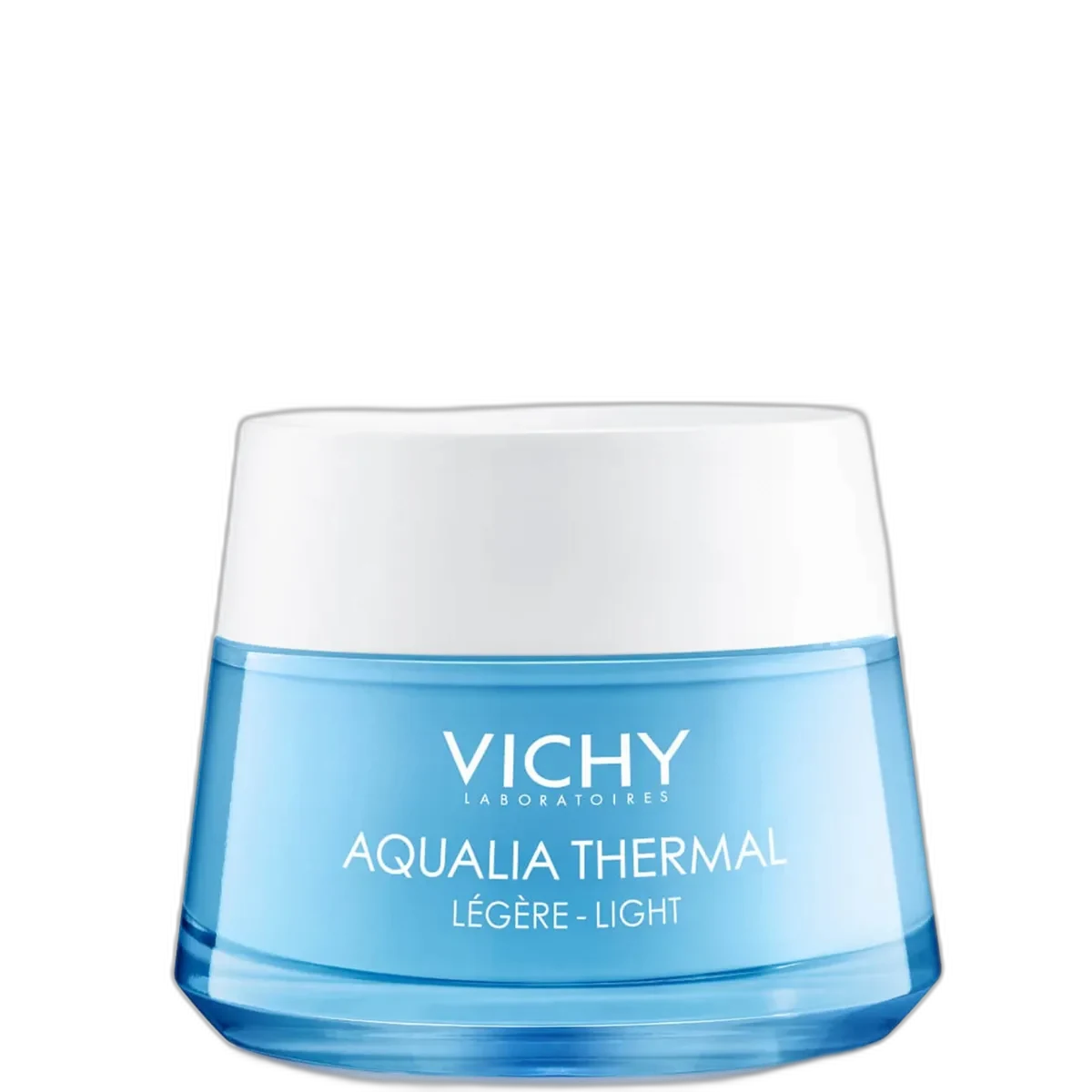
Aqualia Thermal Light Cream
French Pharmacy Hydration Classic
 Verified reviewer
Pros & cons.
- +Four-layer humectant system (glycerin, HA, mannose, sodium PCA) for multi-level hydration
- +Lightweight gel-cream texture absorbs in under a minute without residue
- +Excellent base under makeup and sunscreen with no pilling
- +Silicone-free 2018 reformulation with 97% natural-origin ingredients
- +Vichy volcanic mineralizing thermal water backed by peer-reviewed research
- +Dermatologist-tested and allergy-tested with zero clinical reactions
- +Immediate visible plumping effect on dehydrated skin
- −Contains fragrance despite being marketed in the dermo-cosmetic space
- −Alcohol denat. as the fourth ingredient raises concerns for compromised barriers
- −Jar packaging is less hygienic than pump or tube dispensing
- −Not moisturizing enough for very dry skin — Rich version needed in winter
- −Contains isopropyl palmitate which is rated highly comedogenic
- −Limited US availability compared to European pharmacy markets
The full review.
Vichy has sold skincare from pharmacy counters since 1931, a tenure similar to the French Republic’s current constitution. The Aqualia Thermal line — the brand’s hydration-focused range — has been a European pharmacy staple since roughly 2006. In 2018, a reformulation removed silicones, increased the thermal water concentration to 15%, and reached 97% natural-origin ingredients. The Light Cream targets normal-to-combination skin seeking hydration without heaviness.
The ingredient architecture is thoughtful. Instead of using one humectant in silicone (the pre-2018 method), the reformulated cream uses four hydration mechanisms. Glycerin, second after water, is the primary humectant; it pulls water from the environment into the upper skin layers. Sodium hyaluronate binds moisture deeper in the skin matrix. Mannose, a plant-derived sugar used across the Aqualia Thermal line, adds a third pathway via its multiple hydroxyl water-binding groups. Sodium PCA, part of the skin’s natural moisturizing factor, provides biomimetic hydration that supplements the skin’s native moisture-retention system.
This layered approach is more sophisticated than typical drugstore moisturizers that use only glycerin and dimethicone. Each humectant works at a different level of the stratum corneum, creating a hydration gradient that supports the brand’s 48-hour moisture claim. Whether the 48-hour claim holds is debatable, but the immediate plumping effect is clear — skin looks more hydrated minutes after application.
Texture is the Light Cream’s strongest feature. This gel-cream hybrid spreads like a lightweight lotion, absorbs within thirty to sixty seconds, and leaves no residue. It works well under makeup — no pilling, no greasiness, and no interference with foundation adhesion. This makes it a strong morning moisturizer for product layering. The finish is satin-to-dewy, looking healthy rather than shiny.
Two ingredients stand out: Alcohol denat. is the fourth ingredient, and Parfum/Fragrance is last. For a brand in the dermo-cosmetic space alongside La Roche-Posay and CeraVe — brands that mostly use fragrance-free and alcohol-free formulas — these feel like holdovers from older French pharmacy cosmetics that prioritized light scent and fast absorption.
The alcohol denat. serves a function: it helps create the lightweight, quick-absorbing texture. Removing it would require a full sensory reformulation. The humectant system compensates for any transient drying. The fragrance is light — a clean, fresh, slightly floral note most users find pleasant. However, for those with perioral dermatitis, rosacea, or fragrance contact allergy, these are real concerns that Vichy’s ‘sensitive skin’ positioning should acknowledge more clearly.
Vichy offers a Fragrance-Free Rehydrating Cream in the Aqualia Thermal line to address this. But the Light Cream is the most popular texture, and many consumers buy it without knowing it contains fragrance.
The thermal water has clinical backing. Studies in the Journal of Cosmetic Dermatology in 2020 and 2021 on Vichy’s Minéral 89 serum — which uses the same volcanic mineralizing water — showed improvements in erythema, desquamation, irritation, and skin hydration. The mineral composition (15 minerals including calcium, magnesium, and bicarbonate) provides buffering and barrier-supportive properties that plain water lacks.
Shea butter acts as the emollient, replacing the pre-2018 formula’s dimethicone. It provides enough occlusion to stop humectants from losing moisture to the air in dry environments, without the silicone-slip feeling. The cream feels nourishing without a synthetic film.
At around thirty-two dollars for fifty milliliters, this is mid-range pharmacy pricing — more than CeraVe or Neutrogena, but less than Drunk Elephant or Tatcha. The price is reasonable for the ingredient quality and formulation. The jar packaging is the main practical issue: finger-dipping is less hygienic than a pump or tube and exposes the formula to air and bacteria.
Vichy Aqualia Thermal Light Cream has genuine strengths: a layered hydration system, excellent texture, a silicone-free formula, and clinical research behind its key ingredient. It would score higher if it fully adopted the sensitive-skin positioning of its pharmacy-brand peers. The fragrance and alcohol are not dealbreakers for most, but they are asterisks on an otherwise impressive formula.
Formula
Ingredient analysis.
Full INCI list
Aqua/Water, Glycerin, Caprylic/Capric Triglyceride, Alcohol Denat., Propanediol, Isopropyl Palmitate, Butyrospermum Parkii Butter/Shea Butter, Ammonium Polyacryloyldimethyl Taurate, Zea Mays Starch/Corn Starch, Mannose, Glyceryl Isostearate, Cetearyl Alcohol, Cetearyl Glucoside, Sodium PCA, Sodium Hyaluronate, Sodium Hydroxide, P-Anisic Acid, Caprylyl Glycol, Citric Acid, Acrylates/C10-30 Alkyl Acrylate Crosspolymer, Parfum/Fragrance
Skin match.
The science.
The Science
The Aqualia Thermal line uses Vichy's volcanic mineralizing thermal water, which clinical investigations have studied. A 2021 study in the Journal of Cosmetic Dermatology tested 47 participants using a formulation containing 89% Vichy mineralizing water with hyaluronic acid. After four weeks, erythema resolved in 27.6%, desquamation in 29.8%, irritation in 32%, and dehydration in 35.8% of subjects. A larger 2020 study in the same journal showed improvements in erythema (68.0%), desquamation (83.4%), and irritation (93.3%), with dryness, burning, itching, and stinging scores dropping 63.8-85.2%.
The humectant system combines ingredients with complementary mechanisms. A 2017 study in PMC shows that hyaluronic acid and glycerin deliver 24-hour hydration and barrier improvement — the primary hydration engine used here. Mannose, the formula's distinguishing sugar humectant, uses multiple hydroxyl groups to bind water; research shows it improves skin biomechanical properties through dermal collagen reorganization.
Sodium PCA is part of the skin's natural moisturizing factor (NMF). Its inclusion uses a biomimetic approach to hydration, supplementing the skin's own moisture-retention system instead of imposing an external one. This four-tier humectant architecture (glycerin, hyaluronic acid, mannose, sodium PCA) hydrates multiple stratum corneum levels simultaneously.
References
- 89% Vichy mineralizing water with hyaluronic acid is a well-tolerated adjunct treatment that helps restore skin barrier function — Journal of Cosmetic Dermatology (2021)
- Vichy mineralizing water with hyaluronic acid is effective and well tolerated as an adjunct to the management of various dermatoses — Journal of Cosmetic Dermatology (2020)
- The 24-hour skin hydration and barrier function effects of a hyaluronic 1%, glycerin 5%, and Centella asiatica stem cells extract moisturizing fluid — PMC (2017)
Dermatologist Perspective
European dermatologists frequently recommend the Aqualia Thermal line for patients with dehydrated skin that isn't dry — a clinically important distinction. Board-certified dermatologists note that dehydration (lack of water) and dryness (lack of oil) require different formulations; the Light Cream's humectant-forward design with moderate emollience targets dehydration specifically. Dermatologists like that the 2018 reformulation removed silicones, but some note that alcohol denat. and fragrance limit use for the most reactive patients. For those patients, dermatologists typically suggest the fragrance-free variant or brands like La Roche-Posay or CeraVe.
Where it fits in your routine.
Apply a small amount to a cleansed face and neck, morning and evening. Use it after toner, serum, or essence. Apply sunscreen in the morning. For dehydrated skin, layer it over a hyaluronic acid serum to increase hydration. In dry climates or winter months, use the Aqualia Thermal Rich Cream or layer a facial oil over this cream for more occlusion.
At approximately thirty-two dollars for fifty milliliters, this moisturizer sits in the mid-range pharmacy market. The price reflects the brand's research and the formulation's sophistication—a four-humectant system, proprietary thermal water, and silicone-free base. The per-ounce cost is much higher than drugstore alternatives like CeraVe Moisturizing Cream (around fifteen dollars for sixteen ounces). The value is highest for users needing the lightweight texture and multi-humectant hydration approach, but lowest for those who get similar results from simpler, cheaper formulations.
This formula works best for normal-to-combination skin types with dehydration instead of true dryness. It is also ideal for anyone wanting a lightweight, non-greasy morning moisturizer that sits well under makeup. Fans of French pharmacy skincare seeking a silicone-free option will like the reformulated formula.
People with very dry skin need the Rich version; the Light lacks enough occlusion. Those sensitive to fragrance or alcohol should use the fragrance-free Aqualia Thermal variant. Oily skin types may find the finish too dewy, and those prone to fungal acne should note the isopropyl palmitate in the formula.
Product details.
This lightweight gel-cream hybrid spreads easily and absorbs quickly. It feels more like a lotion than a traditional cream and has a smooth, bouncy consistency. It is distinctly lighter than the Rich version.
Light, clean, slightly floral fragrance. Reviewers call it fresh and spa-like. It is not fragrance-free; people sensitive to fragrance should note this.
Glass jar (50 mL) with screw-top lid. Aqua-blue branding matches the Aqualia Thermal line. It lacks a pump dispenser, the main packaging complaint, so you must dip fingers into the product.
The cream feels fresh and cooling on first application and has a noticeable, mild scent. It absorbs in 30-60 seconds and leaves skin hydrated and slightly dewy. Most users feel no stinging or tingling, but those sensitive to alcohol denat. or fragrance may feel mild warmth.
2-3 months with twice-daily facial application
12 months
spring summer
The backstory.
Vichy's Aqualia Thermal line launched around 2006 as the brand's answer to the growing demand for hydration-focused skincare. The line was reformulated in 2018 to remove silicones and increase the thermal water concentration from 10% to 15%, aligning with the shift toward cleaner formulations. The Light Cream occupies the middle ground in the line — lighter than the Rich Cream but more substantial than the Gel Cream variant — designed for normal-to-combination skin that needs hydration without heaviness.
About Vichy
Legacy Brand (20+ years)Vichy was founded in 1931 by Dr. Prosper Haller in Vichy, France and has been part of L'Oréal's Active Cosmetics Division since 1980. The brand's formulations are built around its proprietary volcanic mineralizing thermal water, sourced from Vichy, France, which has been the subject of multiple peer-reviewed clinical studies. Vichy products are sold exclusively through pharmacies in most European markets.
Common myths.
Thermal water in skincare is marketing — water is water.
Vichy's volcanic mineralizing thermal water has 15 minerals, including calcium, magnesium, and bicarbonate, in a specific composition. Peer-reviewed studies in the Journal of Cosmetic Dermatology (2020, 2021) show that formulations with Vichy mineralizing water improve erythema, irritation, and skin hydration. The mineral composition matters, not the water itself.
Alcohol denat. in a moisturizer dries out skin.
Context matters. In this formula, alcohol denat. is the fourth ingredient. It acts as a solvent and texture enhancer to help the cream absorb quickly. The surrounding humectants (glycerin, hyaluronic acid, mannose) and emollients (shea butter) offset any transient drying effect. However, people with very sensitive or compromised barriers may still want to avoid it.
FAQ.
What is the difference between Vichy Aqualia Thermal Light and Rich?
Both use the same core actives: Vichy mineralizing thermal water, hyaluronic acid, and mannose. The Light Cream has a gel-cream texture that absorbs fast and works best for normal-to-combination skin, especially in warm months. The Rich Cream is thicker and more emollient for dry-to-very-dry skin or cold weather. The Light works better under makeup; the Rich provides more overnight occlusion.
Does Vichy Aqualia Thermal Light Cream contain fragrance?
Yes — Parfum/Fragrance is the last ingredient on the INCI list. The scent is light and fresh, but people with fragrance sensitivities should be aware. Vichy offers a Fragrance-Free Rehydrating Cream in the Aqualia Thermal line as an alternative for those who must avoid fragrance entirely.
Is Vichy Aqualia Thermal Light Cream silicone-free?
Yes — the 2018 reformulation removed all silicones. The previous formula had dimethicone; the current version uses shea butter, caprylic/capric triglyceride, and plant-derived emollients. The formula has 97% natural-origin ingredients.
Can I use Vichy Aqualia Thermal Light Cream under makeup?
Yes — users praise this quality. The lightweight texture absorbs fast and leaves a smooth, non-greasy base that does not pill under foundation or sunscreen. It works well as a morning moisturizer before makeup application.
Why does Vichy Aqualia Thermal contain alcohol denat.?
Alcohol denat. acts as a solvent and helps this formula absorb fast, making the cream feel lightweight instead of heavy. Alcohol denat. dries skin alone, but the humectant system (glycerin, hyaluronic acid, mannose, sodium PCA) and emollients offset this. People with very sensitive or compromised skin barriers may prefer the fragrance-free version or a different moisturizer.
Is Vichy Aqualia Thermal Light Cream good for sensitive skin?
Dermatologists and allergy tests show zero reactions in clinical testing on sensitive skin. But it contains fragrance and alcohol denat., which can irritate some sensitive skin. The formula is hypoallergenic and paraben-free, though reactive skin may prefer the fragrance-free variant.
What the community says.
"Lightweight texture absorbs quickly without residue or greasiness"
"Excellent base under makeup and sunscreen with no pilling"
"Keeps skin hydrated and plump throughout the day"
"Pleasant fresh feeling on application"
"Silicone-free formula since 2018 reformulation"
"Skin feels dewy and comfortable without heaviness"
"Contains fragrance and alcohol denat. despite being marketed for sensitive skin"
"Not moisturizing enough for very dry skin — Rich version needed"
"Jar packaging is less hygienic than a pump or tube"
"Limited US availability compared to European markets"
"Contains isopropyl palmitate which is highly comedogenic"