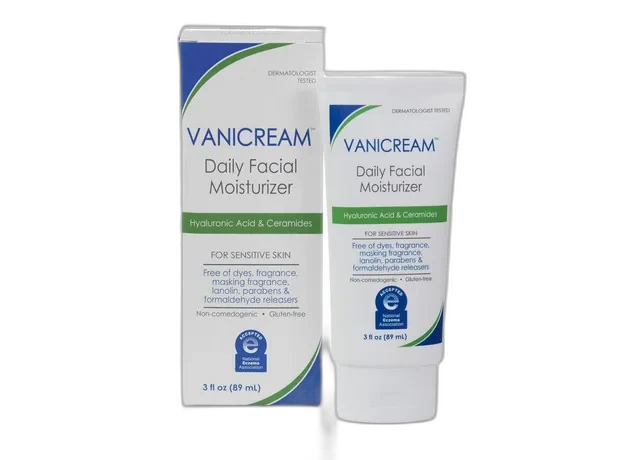
Daily Facial Moisturizer
Sensitive Skin Gold Standard
 Verified reviewer
Pros & cons.
- +Five-ceramide complex provides comprehensive barrier repair matching premium products
- +Zero common irritants — no fragrance, botanicals, essential oils, dyes, or parabens
- +Lightweight texture absorbs quickly and layers beautifully under sunscreen and makeup
- +Fungal acne safe — one of the few ceramide moisturizers compatible with Malassezia
- +Excellent retinol and tretinoin buffer recommended by dermatologists
- +National Eczema Association accepted for compromised and reactive skin
- +Nearly 50-year brand heritage built on pharmacist-dermatologist collaboration
- +Pregnancy safe with no contraindicated ingredients
- −Small 3 oz tube runs out in 5-6 weeks with twice-daily face and neck use
- −Not moisturizing enough for very dry skin or harsh winter conditions as sole product
- −Utilitarian packaging lacks the aesthetic appeal of competing moisturizers
- −Not cruelty-free or vegan certified
- −Limited retail availability compared to mass-market competitors
The full review.
In 1975, two pharmacists in Rochester, Minnesota — home to the Mayo Clinic — started making skincare products because the dermatologists they worked with kept telling them that nothing on the market was gentle enough for their most sensitive patients. Nearly fifty years later, Vanicream is the number-one dermatologist-recommended brand for sensitive skin in America, and the Daily Facial Moisturizer is perhaps the purest expression of their philosophy: give the skin exactly what it needs, and absolutely nothing it doesn’t.
The ingredient list reads like a dermatology textbook’s definition of a well-formulated moisturizer. Water. Squalane. Glycerin. Five ceramides. Hyaluronic acid. Phytosterols. That’s functionally it — the remaining ingredients are emulsifiers, thickeners, and preservatives, all chosen specifically for their low sensitization potential. There are no fragrances, no essential oils, no botanical extracts, no dyes, no parabens, no sulfates. The formula is so stripped of potential irritants that it makes CeraVe look adventurous.
This radical simplicity is the product’s entire identity, and it works. The texture is a lightweight lotion that spreads easily, absorbs within about thirty seconds, and leaves behind a comfortable satin finish with no greasiness, no tackiness, and no residue. It layers beautifully under sunscreen in the morning and feels comforting without being heavy at night. It’s the kind of moisturizer you stop thinking about thirty seconds after applying it — which, for sensitive skin, is the highest possible compliment.
The five-ceramide complex (EOP, NG, NP, AS, AP) is quietly impressive. Most ceramide moisturizers contain one or three ceramides; Vanicream includes five, representing the major classes found in the skin’s natural lipid matrix. Combined with phytosterols (a plant-derived cholesterol analog) and the fatty components of the emulsifier system, the formula approximates the critical lipid ratio — ceramides, cholesterol, and fatty acids — that the skin barrier needs to function properly. A systematic review published in the International Journal of Dermatology confirmed that ceramide-containing moisturizers significantly improve barrier function and reduce transepidermal water loss in compromised skin.
The hyaluronic acid adds a humectant dimension to the barrier-repair strategy. Where the ceramides work to seal and protect, the hyaluronic acid draws water into the upper skin layers, creating a hydration reservoir that the ceramide-reinforced barrier then locks in. It’s a textbook push-pull moisture strategy, executed with a minimum of interference.
For the skincare enthusiast community, Vanicream has become the default recommendation for pairing with active treatments. Retinol users love it as a buffer. Tretinoin users swear by it for managing retinoid dermatitis. People cycling through acids, exfoliants, and vitamin C reach for it as the one product they know won’t add irritation to the mix. Its neutrality is its superpower — it supports whatever else you’re doing without introducing variables.
The limitations are honest and predictable. At 3 fluid ounces, the tube is small for the price, and twice-daily application to face and neck will run through it in about five to six weeks. Very dry skin in cold climates may find it insufficient as a sole moisturizer — it’s a lotion, not a cream, and it lacks the heavy occlusive layer that winter skin sometimes demands. The packaging is functional but aggressively utilitarian — Vanicream has never pretended to be a brand you display on your bathroom shelf for aesthetic reasons.
And there’s the elephant in the room: it’s boring. There’s no hero ingredient with a trendy name. No viral TikTok moment. No celebrity endorsement. No limited-edition flavor. Vanicream doesn’t even have an Instagram presence worth mentioning. In a market where skincare brands compete for attention with increasingly elaborate marketing narratives, Vanicream just quietly makes products that dermatologists trust, patients tolerate, and skin responds well to.
At roughly $16 for 89ml, it’s not the cheapest moisturizer on the shelf, but it’s substantially less expensive than most ceramide moisturizers with this level of formulation quality. When you factor in the near-zero risk of irritation — and therefore the near-zero risk of wasting your money on a product that breaks you out or triggers a reaction — the value proposition is stronger than the sticker price suggests.
This is the moisturizer that dermatologists recommend when everything else has failed. It’s the product that eczema patients discover after a dozen disappointing alternatives. It’s the face cream for people who are tired of their face cream being a problem. And in a market overflowing with promise and marketing, that quiet reliability might be the most radical thing of all.
Ingredient analysis.
Full INCI list
Water, Squalane, Glycerin, Pentylene Glycol, Polyglyceryl-2 Stearate, Glyceryl Stearate, Stearyl Alcohol, Hyaluronic Acid, Ceramide EOP, Ceramide NG, Ceramide NP, Ceramide AS, Ceramide AP, Carnosine, Hydrogenated Lecithin, Phytosterols, Caprylyl Glycol, Polyacrylate Crosspolymer-11, 1,2-Hexanediol
Skin match.
The science.
The Science
The five-ceramide complex follows current stratum corneum lipid biology. Ceramides make up about 50% of the skin barrier's intercellular lipid matrix, and different ceramide classes have distinct structural roles. A 2023 systematic review and meta-analysis in Dermatologic Therapy analyzed randomized controlled trials and found that ceramide-containing moisturizers improved transepidermal water loss (TEWL), skin hydration, and atopic dermatitis clinical severity scores more than non-ceramide moisturizers.
The formula includes phytosterols with the ceramides for a reason. The skin barrier works best when ceramides, cholesterol, and free fatty acids exist in a 3:1:1 molar ratio. Phytosterols are structurally analogous to cholesterol and help recreate this ratio in the topical formulation, which enhances barrier repair more than ceramides alone. Research in the Journal of Investigative Dermatology shows that optimal-ratio lipid mixtures accelerate barrier recovery faster than preparations missing one or more components.
Hyaluronic acid complements the ceramide barrier strategy. Ceramides reduce transepidermal water loss (the outward movement of water), while hyaluronic acid acts as a humectant that pulls water from the dermis into the epidermis to increase hydration from within. A 2011 clinical evaluation in the Journal of Drugs in Dermatology found that hyaluronic acid-based formulations achieved statistically significant improvement in eczema severity by week 2, proving its efficacy in compromised skin conditions.
The formula excludes botanical extracts and essential oils to avoid allergens. Contact dermatitis to fragrance and plant-derived compounds is a common adverse reaction in skincare; prevalence studies show rates of 1-3% in the general population and much higher in atopic individuals.
References
- The Efficacy of Moisturisers Containing Ceramide Compared with Other Moisturisers in the Management of Atopic Dermatitis: A Systematic Literature Review and Meta-Analysis — Dermatologic Therapy (2023)
- A clinical evaluation of the comparable efficacy of hyaluronic acid-based foam and ceramide-containing emulsion cream in the treatment of mild-to-moderate atopic dermatitis — Journal of Drugs in Dermatology (2011)
- Clinical significance of the water retention and barrier function-improving capabilities of ceramide-containing formulations: A qualitative review — Journal of Clinical and Aesthetic Dermatology (2022)
Dermatologist Perspective
Board-certified dermatologists recommend Vanicream Daily Facial Moisturizer as a first-line option for patients with sensitive, reactive, or eczema-prone facial skin. Dermatologists say the formula's strength is its lack of fragrance, botanicals, and common sensitizers, making it a reliable baseline for diagnosing contact dermatitis or managing active flares. Dermatologists often recommend it as a retinoid companion moisturizer because the five-ceramide complex addresses the barrier disruption caused by retinoids. The brand's pharmacy heritage and decades of clinical use give dermatologists confidence in recommending it to sensitive patients.
Where it fits in your routine.
Apply a nickel-sized amount to clean skin morning and evening. In the morning, use after serums but before sunscreen. In the evening, use as the final step or over retinol/treatment products. Use as a retinol buffer by applying a thin layer before and after retinoid products. For very dry skin, layer over a hyaluronic acid serum and add a heavier occlusive at night.
At approximately $16 for 3 fl oz (89ml), Vanicream is a mid-range facial moisturizer. The five-ceramide complex, hyaluronic acid, and phytosterol combination usually costs $30-$50 in the prestige skincare market. The small tube size limits value — using it twice daily means repurchasing every 5-6 weeks. However, the near-zero risk of adverse reactions prevents wasting money on products that fail your skin, providing value that discount moisturizers with longer ingredient lists lack.
People with sensitive, reactive, or eczema-prone facial skin seeking a zero-irritant moisturizer. Retinol and tretinoin users needing a reliable barrier-repair buffer. Those who reacted to other moisturizers (including CeraVe) and need a simpler option. People with fungal acne needing a Malassezia-safe ceramide moisturizer.
Very oily skin types who find even lightweight moisturizers too much. Very dry skin types in cold climates who need a heavy cream or ointment as a primary moisturizer. Anyone who wants thick textures, beautiful packaging, or sensory experiences — Vanicream is functional, not glamorous.
Product details.
This smooth, lightweight lotion spreads easily and absorbs in 30-60 seconds. It has a daily-weight texture that is neither too thick nor too thin. It leaves no pilling, no residue, and no tackiness.
Unscented. It has no fragrance, no masking agents, and no detectable smell.
White squeeze tube with a flip cap. It is functional and hygienic, but not elegant. The opaque tube protects light-sensitive ingredients but hides how much product remains.
Skin feels hydrated and calm seconds after application. It has no tingling, stinging, or adjustment period. Users switching from irritating moisturizers often call the first application a relief. It layers under sunscreen or makeup without pilling.
5-6 weeks with twice-daily face and neck application
12 months
All Year
The backstory.
Vanicream started in 1975 when two Rochester, Minnesota pharmacists — working closely with dermatologists at the Mayo Clinic — decided the commercial skincare market wasn't serving patients with sensitive and reactive skin. Nearly fifty years later, the Daily Facial Moisturizer represents their philosophy refined: maximum therapeutic benefit from minimum ingredients, with nothing included that doesn't serve the skin.
About Vanicream
Legacy Brand (20+ years)Pharmacists at Pharmaceutical Specialties Inc. in Rochester, Minnesota, developed Vanicream in 1975. They worked with dermatologists to make products for sensitive skin patients. Vanicream is the #1 dermatologist-recommended brand for sensitive skin (IQVIA ProVoice Survey, 2024) and has a clinical track record of nearly 50 years.
Common myths.
Cheap, simple moisturizers lack the high-quality ceramides found in expensive barrier-repair creams.
Vanicream's Daily Facial Moisturizer has five ceramides (EOP, NG, NP, AS, AP). These are the same ceramide classes used in premium barrier-repair products that cost three to five times more. Ceramide quality depends on the specific ceramide classes and their delivery system, not the price.
If a moisturizer doesn't have botanical extracts or fancy actives, it's too basic to be effective.
No botanical extracts makes this better for sensitive skin. Plant extracts cause contact dermatitis in many skincare products. Vanicream excludes them because the risk of irritation outweighs any benefit for their target audience — people with reactive, eczema-prone, or compromised skin.
FAQ.
Is Vanicream Daily Facial Moisturizer good for eczema?
Yes — the National Eczema Association accepts this moisturizer. It contains five ceramides that fix the lipid barrier deficiency in eczema-prone skin. The formula lacks common eczema triggers like fragrance, botanical extracts, essential oils, dyes, and parabens. Many dermatologists recommend it as a facial moisturizer for eczema patients.
Can I use Vanicream Daily Facial Moisturizer with retinol?
Yes — many people pair this moisturizer with retinol and tretinoin. The five-ceramide complex and hyaluronic acid buffer retinoid irritation and repair the barrier disruption retinoids cause. Apply it after your retinol product, or use the sandwich method (moisturizer, then retinol, then moisturizer) to buffer more.
Is Vanicream Daily Facial Moisturizer fungal acne safe?
Yes — the ingredient list lacks the fatty acids, esters, and oils that feed Malassezia yeast. This makes it one of the few ceramide moisturizers compatible with fungal acne. The squalane base, ceramides, and hyaluronic acid are all safe for fungal acne-prone skin.
Is Vanicream moisturizer heavy enough for dry skin?
The Daily Facial Moisturizer is a lightweight lotion for normal to moderately dry skin. It lacks enough occlusion for very dry skin or harsh winter conditions. Layer The Daily Facial Moisturizer over a hyaluronic acid serum and follow with a heavier occlusive like Vanicream Moisturizing Cream for more protection.
How does Vanicream Daily Facial Moisturizer compare to CeraVe?
Both contain ceramides and hyaluronic acid. Vanicream's formula is simpler and excludes more potential irritants—it has no dimethicone, no fatty alcohols except stearyl alcohol, and no cholesterol (it uses phytosterols instead). Doctors often recommend Vanicream for patients who react to CeraVe's more complex formulation. It is the next step for sensitive skin that needs ceramide support but cannot tolerate CeraVe.
Is Vanicream Daily Facial Moisturizer pregnancy safe?
Yes — the formula lacks retinoids, salicylic acid, or other ingredients contraindicated during pregnancy. The simple, irritant-free ingredient list makes this one of the safest moisturizer choices for pregnant and breastfeeding individuals. The ceramides, hyaluronic acid, and squalane are all safe during pregnancy.
What the community says.
"Incredibly gentle — causes no irritation even on the most reactive skin"
"Lightweight texture that absorbs quickly without greasiness"
"Works beautifully under makeup and sunscreen"
"Excellent ceramide complex for the price"
"Perfect for layering with retinol and other active treatments"
"Fungal acne safe"
"Small tube size relative to price — runs out quickly with twice-daily face and neck use"
"Not moisturizing enough for very dry skin or harsh winter conditions"
"Boring packaging and minimal aesthetic appeal"
"Some users wish it came in a pump bottle"
"Not widely available in all retail stores"