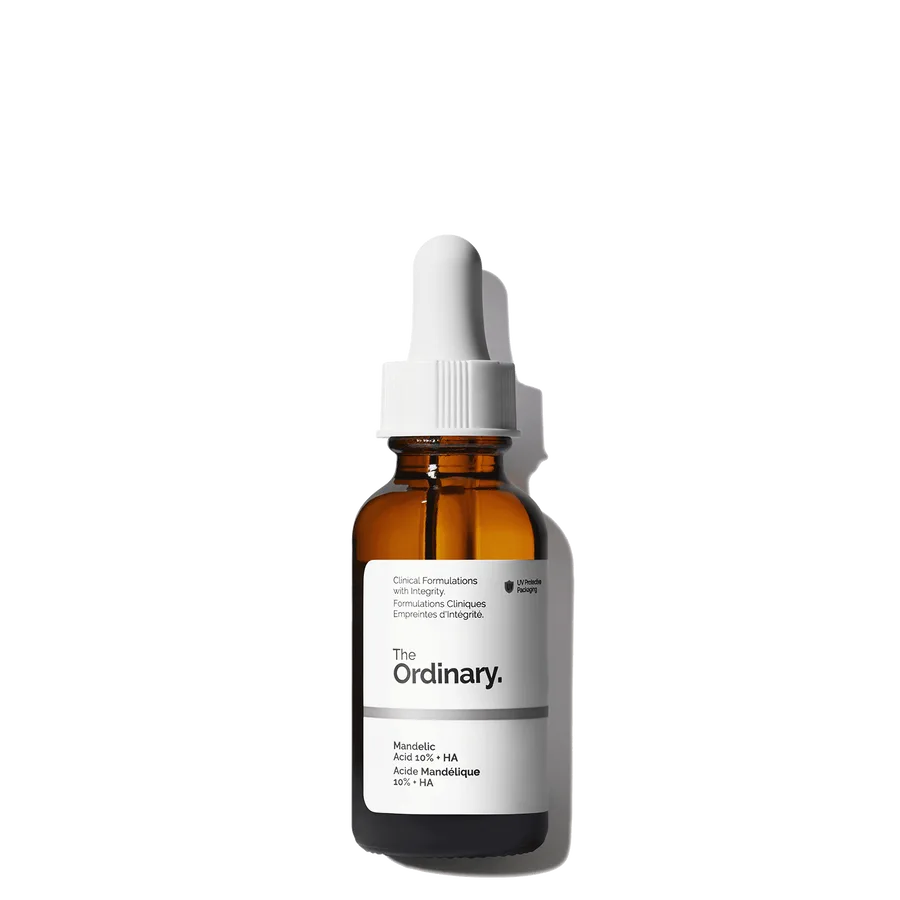
Mandelic Acid 10% + HA
Gentlest AHA Entry Point
 Verified reviewer
Pros & cons.
- +Mandelic acid's large molecular weight provides effective exfoliation with minimal irritation
- +Clinically demonstrated safety for darker skin tones where glycolic acid can worsen hyperpigmentation
- +Crosslinked hyaluronic acid provides sustained hydration during the exfoliation process
- +Exceptionally affordable at .80 for a 30 mL bottle lasting 3-4 months
- +Inherent antibacterial properties make it uniquely effective for acne-prone sensitive skin
- +Clean 13-ingredient formula with no fragrance, oils, or silicones
- +Tasmannia lanceolata extract actively reduces the stinging that acid exfoliation can cause
- +Fungal acne safe with no known Malassezia triggers
- −Oily-water texture feels unusual and takes 15-20 minutes to absorb fully
- −Results develop slowly — months required for significant hyperpigmentation improvement
- −Less potent than glycolic acid for those who can tolerate stronger exfoliation
- −Cannot address deep acne scarring or significant photodamage as a standalone treatment
- −Only available in one 30 mL size with no larger economy option
The full review.
Glycolic acid leads the alpha hydroxy acids. It is the smallest, fastest, and most aggressive AHA, which often leaves sensitive skin red and peeling. Mandelic acid sits at the opposite end. Its story is one number: 152. That is its molecular weight in daltons, nearly double glycolic acid’s 76. In chemistry, size dictates penetration speed, and speed dictates irritation. Because it is larger, mandelic acid is gentler. It is not weaker. It is gentler.
The Ordinary introduced this formulation in 2018. It is now a vital product in their acid lineup because it makes chemical exfoliation possible for people who previously avoided it. The formula is minimal: propanediol is the primary solvent, 10% mandelic acid sits at a pH of 3.5-3.7, crosslinked hyaluronic acid provides hydration, glycerin supports moisture, Tasmannia lanceolata extract offers anti-inflammatory cover, and stabilizers complete the list. Thirteen ingredients total. Nothing is decorative.
The pH matters. For an AHA to exfoliate, it must have a low enough pH to keep a meaningful percentage of the acid in its free (un-ionized) form—the form that penetrates and dissolves bonds between dead skin cells. At pH 3.5-3.7, this formula hits the sweet spot: acidic enough for exfoliation, but not so low that it overwhelms the skin. For context, professional glycolic peels operate at pH 1.5-2.5. This is a nightly-use product, not a clinical procedure, and the pH reflects that.
On the skin, The Ordinary Mandelic Acid 10% + HA feels like an oily water due to the propanediol base. It has a silky slip that spreads easily, followed by a 15-20 minute absorption period where the skin feels slightly tacky. Once a moisturizer goes on top, the tackiness disappears. You may feel a faint, barely perceptible tingle on first use—nothing like glycolic acid’s sting, but a subtle sign the acid is working.
Clinical evidence for mandelic acid is substantial. A 2018 study in Facial Plastic Surgery (Jacobs and Culbertson) tested twice-daily mandelic acid application on 24 patients and found a 25.4% increase in skin elasticity and a 23.8% increase in firmness after four weeks. A 2020 study in the Journal of Cosmetic Dermatology (Dayal, Kalra, Sahu) compared 45% mandelic acid peels to 30% salicylic acid for acne; mandelic acid was equally effective with fewer adverse effects and showed an edge for inflammatory lesions. Research in Dermatologic Surgery (2016) showed mandelic acid-based peels achieved approximately 61% reduction in melasma severity scores and were better tolerated than glycolic acid, especially on darker skin tones.
This last point is clinically significant. Faster-penetrating acids like glycolic can trigger inflammation that worsens hyperpigmentation in Fitzpatrick skin types IV-VI. Mandelic acid’s slower, more uniform penetration reduces this risk, making it one of the safest AHAs for melanin-rich skin. Dermatologists treating diverse populations recognize this, and studies on Indian skin types confirm this safety profile.
Results require patience. After one to two weeks of consistent use, skin texture feels smoother—a change you feel with your fingertips before seeing it in a mirror. By week four to six, dullness lifts and clarity improves. Hyperpigmentation and dark spots fade visibly around the eight-week mark, with continued improvement over three to six months. These are not the instant results of a 30% glycolic peel. You trade speed for safety, which is a requirement for many skin types.
The limitation is the ceiling. At 10% in a leave-on format, mandelic acid improves texture, tone, and mild hyperpigmentation. It will not resolve deep acne scarring, significant photodamage, or stubborn melasma. For those concerns, mandelic acid works as part of a broader strategy—paired with a retinoid on alternate nights, vitamin C in the morning, and diligent sunscreen use.
The inclusion of Sodium Hyaluronate Crosspolymer is a smart choice. Standard hyaluronic acid provides surface hydration but rinses or wears away easily. The crosslinked form creates a mesh-like structure that adheres to the skin longer, providing sustained hydration while the mandelic acid promotes cell turnover. This detail keeps skin comfortable rather than tight by morning.
At .80 for 30 mL, there is little risk in trying this product. It lasts three to four months with nightly use. It works for almost every skin type and has clinical backing. It does what the more aggressive acids in The Ordinary’s lineup cannot: it makes chemical exfoliation feel safe.
Formula
Ingredient analysis.
Full INCI list · pH 3.5-3.7
Propanediol, Aqua (Water), Mandelic Acid, Glycerin, Dimethyl Isosorbide, Sodium Hyaluronate Crosspolymer, Tasmannia Lanceolata Fruit/Leaf Extract, Pentylene Glycol, Polysorbate 20, Sodium Hydroxide, Ethylhexylglycerin, 1,2-Hexanediol, Caprylyl Glycol
Skin match.
The science.
The Science
Mandelic acid is an alpha hydroxy acid from bitter almonds (Prunus amygdalus) with a 152.1 daltons molecular weight. This weight defines its clinical profile: because it is nearly double the molecular weight of glycolic acid (76.0 daltons), mandelic acid penetrates the stratum corneum more slowly and uniformly. This prevents the concentration spikes that cause irritation hotspots.
Jacobs and Culbertson published a study in Facial Plastic Surgery (2018) on mandelic acid's effects on skin viscoelasticity. In 24 patients aged 42-68 using mandelic acid twice daily for four weeks, skin elasticity rose 25.4% and firmness rose 23.8%. Photographic improvement matched objective measurements. These are large changes for a mild AHA concentration over a short treatment period.
For acne, Dayal et al. (Journal of Cosmetic Dermatology, 2020) compared 45% mandelic acid peels to 30% salicylic acid peels over 12 weeks for mild-to-moderate acne vulgaris. Mandelic acid was equally effective overall and worked better for inflammatory lesions with significantly fewer adverse effects. Mandelic acid's antibacterial properties—inhibiting bacterial growth through mechanisms distinct from exfoliation—drive this acne efficacy.
The melasma data is compelling for this product's target audience. Research in Dermatologic Surgery (2016) showed salicylic-mandelic acid peels achieved a ~61% reduction in MASI scores over 12 weeks. The authors concluded the combination was "better tolerated and more suitable for Indian skin" than glycolic acid peels. This slower-penetrating AHA avoids the inflammatory cascade that can worsen hyperpigmentation in melanin-rich skin—a clinical advantage faster acids lack.
References
- Effects of Topical Mandelic Acid Treatment on Facial Skin Viscoelasticity — Facial Plastic Surgery (2018)
- Comparative study of efficacy and safety of 45% mandelic acid versus 30% salicylic acid peels in mild-to-moderate acne vulgaris — Journal of Cosmetic Dermatology (2020)
- Comparative Evaluation of Efficacy and Tolerability of Glycolic Acid, Salicylic Mandelic Acid, and Phytic Acid Combination Peels in Melasma — Dermatologic Surgery (2016)
Dermatologist Perspective
Dermatologists often recommend mandelic acid to patients who find glycolic acid too irritating, or to patients with Fitzpatrick skin types IV-VI where post-inflammatory hyperpigmentation is a concern. Board-certified dermatologists view mandelic acid's larger molecular weight as a clinical feature rather than a limitation. Slower, uniform penetration reduces inflammatory reactions that can worsen the pigmentary conditions being treated. Dermatologists advise starting with twice-weekly evening application and increasing frequency as tolerated, always using SPF 30+ during the day. For patients with both acne and hyperpigmentation, mandelic acid's exfoliating and antibacterial properties make it an efficient single-active choice.
Where it fits in your routine.
Apply 4-5 drops to clean, dry skin in the evening, avoiding the eye area. Allow the serum to absorb for 1-2 minutes, then follow with a hydrating serum (hyaluronic acid works well) and moisturizer. Beginners should start with 2-3 evenings per week, gradually increasing to nightly use over 2-3 weeks. Do not combine with other acids, retinoids, or pure vitamin C in the same routine. Sunscreen SPF 30+ is mandatory every morning — AHA exfoliation increases photosensitivity for up to one week after use. ### Value Assessment At .80 for 30 mL, this is one of the most affordable AHA treatments on the market — and arguably one of the best values in The Ordinary's entire lineup. A bottle lasts 3-4 months with nightly use, putting the annual cost around 3-31. The formula includes not just the 10% mandelic acid but also crosslinked hyaluronic acid, glycerin, and Tasmannia lanceolata extract — supporting ingredients that many competitors at 5-10 times the price omit. The only size available is 30 mL; a larger size would offer even better value for dedicated users. ### Who Should Buy Sensitive skin types who have been unable to tolerate glycolic acid or other faster-penetrating AHAs. Particularly valuable for darker skin tones seeking to address hyperpigmentation without risking inflammatory rebound. Also excellent for AHA beginners and for anyone managing both acne and uneven skin tone simultaneously. ### Who Should Skip If you have already built tolerance to glycolic acid at 7-10% and want the fastest possible exfoliating results, mandelic acid will feel too slow. Also not the right choice for those with a severely compromised skin barrier or active eczema flares — repair the barrier first, then introduce exfoliation.
Product details.
Very faint, barely perceptible chemical note — essentially unscented ***
Dark amber glass dropper bottle with white screw-top cap and integrated glass pipette. Standard The Ordinary minimalist design with clinical white label and black text. The dark glass protects the light-sensitive mandelic acid from degradation. ***
The first application may cause a mild tingling sensation that ends within a minute — much less than glycolic acid at the same concentration. No visible peeling or flaking occurs. The oily-water texture feels unusual if you use traditional serum consistencies. Use 2-3 times per week and build to nightly use over 2-3 weeks.
3-4 months with nightly use of 4-5 drops ***
12 months ***
All Year ***
The backstory.
DECIEM introduced this product in 2018 to fill a specific gap in their acid lineup: an AHA gentle enough for sensitive skin types who found even their lactic acid formulas too intense. Mandelic acid had been well-studied in dermatological literature, particularly for its use on darker skin tones where glycolic acid's faster penetration can trigger post-inflammatory hyperpigmentation. By pairing it with crosslinked hyaluronic acid and Tasmanian pepper berry, The Ordinary created an exfoliant designed to make chemical exfoliation accessible to the widest possible audience.
About The Ordinary
Established Brand (5–20 years)The Ordinary launched under DECIEM in 2016. It disrupted skincare by offering clinical-grade actives at unprecedented price points. Now owned by Estée Lauder Companies, the brand has nearly a decade of consumer trust from ingredient transparency and accessible pricing.
Common myths.
Mandelic acid is just a weaker version of glycolic acid
Mandelic acid is not weaker; it is slower. Its larger molecular weight (152 vs. 76 daltons) causes more gradual, even penetration, which reduces irritation hotspots. Clinical studies show mandelic acid achieves results comparable to glycolic acid for acne and hyperpigmentation but has better tolerability. It also has antibacterial properties that glycolic acid lacks.
You need to feel burning for an acid to be working
Burning means irritation, not efficacy. Mandelic acid at pH 3.5-3.7 works within the effective range for AHA exfoliation. It dissolves intercellular bonds and promotes cell turnover whether you feel it or not. The Tasmannia lanceolata in this formula suppresses stinging without reducing the acid's exfoliating activity.
FAQ.
Is The Ordinary Mandelic Acid 10% + HA good for sensitive skin?
This is a top AHA option for sensitive skin. Mandelic acid has a larger molecular weight (152 daltons vs. glycolic acid's 76), so it penetrates more slowly and evenly to cause less irritation. The formula uses crosslinked hyaluronic acid for hydration and Tasmannia lanceolata extract to soothe irritation. Use it 2-3 nights per week and build up to test your tolerance.
Can The Ordinary Mandelic Acid help with hyperpigmentation?
Yes — mandelic acid is a top AHA for hyperpigmentation. It works well on darker skin tones where fast-penetrating acids like glycolic acid can worsen pigmentation by triggering inflammation. Clinical studies show mandelic acid reduces melasma severity and post-inflammatory hyperpigmentation. Results appear gradually over 2-6 months of consistent use.
How often should I use The Ordinary Mandelic Acid 10%?
Start with 2-3 evenings per week, then move to nightly use over 2-3 weeks. At 10% with a pH of 3.5-3.7, this moderate-strength exfoliant works nightly for most skin types once acclimated. Do not use this with other acids, retinoids, or pure vitamin C.
Can I use Mandelic Acid with retinol?
Do not combine AHAs and retinoids in one routine; this increases irritation risk. Instead, alternate them on different nights. For example, use mandelic acid on Monday, Wednesday, and Friday evenings, and retinol on Tuesday, Thursday, and Saturday. This provides exfoliating and retinoid benefits without overwhelming the skin.
Does The Ordinary Mandelic Acid 10% cause purging?
Some users experience mild purging—small breakouts in typical areas—during the first 2-4 weeks. This is a normal response to AHA-driven cell turnover. Purging resolves within 4-6 weeks. Discontinue use if breakouts persist beyond this, spread to new areas, or worsen significantly.
Is mandelic acid safe for darker skin tones?
Mandelic acid is a safe AHA for darker skin tones. It penetrates slowly and evenly, which reduces the risk of post-inflammatory hyperpigmentation caused by faster acids like glycolic acid. Clinical research supports mandelic acid's safety and efficacy for Indian and darker skin types. Studies show mandelic acid has comparable efficacy to glycolic acid peels with fewer adverse effects.
Why does The Ordinary Mandelic Acid feel oily?
Propanediol is the primary solvent in this formula (listed before water in the INCI). This corn-derived glycol has a slightly oily slip. The product is oil-free; propanediol, not actual oils, creates the oily feel. It absorbs fully within 15-20 minutes and leaves a smooth, non-greasy finish under moisturizer.
What the community says.
"Gentlest AHA option — suitable for sensitive skin that cannot tolerate glycolic acid"
"Noticeable improvement in skin texture and clarity within weeks"
"Effective at fading post-inflammatory hyperpigmentation over time"
"Exceptional value at .80 for a well-formulated exfoliating serum"
"Does not cause visible peeling or flaking like stronger acids"
"Oily, slightly sticky texture takes 15-20 minutes to fully absorb"
"Results develop slowly — requires months for significant hyperpigmentation improvement"
"Less dramatic results than glycolic acid for those who can tolerate stronger exfoliation"
"Some users report no visible improvement, particularly for deeper scarring"
"Initial dryness or tightness during the first week of use"
People also looked at.