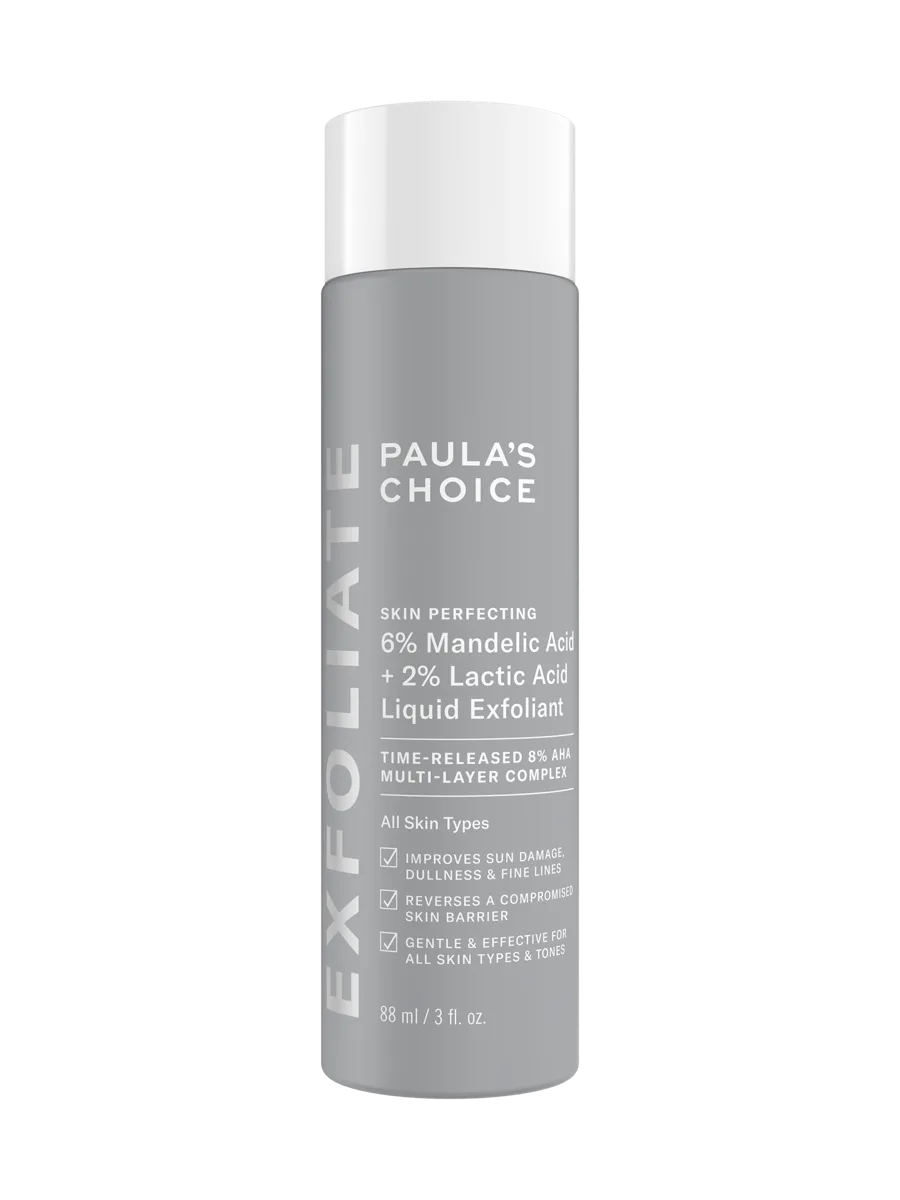
Skin Perfecting 6% Mandelic Acid + 2% Lactic Acid Liquid Exfoliant
Gentle Glow Specialist
 Verified reviewer
Pros & cons.
- +Mandelic acid's large molecular weight makes this exceptionally safe for melanin-rich skin tones
- +Lactic acid adds hydration alongside exfoliation — skin doesn't feel stripped
- +Postbiotic ingredients support microbiome balance during chemical exfoliation
- +4.8-star rating confirms strong user satisfaction across sensitive skin demographics
- +Water-thin liquid absorbs instantly with zero residue or fragrance
- +Pregnancy-safe AHA option unlike salicylic acid alternatives
- +Effective for hyperpigmentation without the PIH risk of stronger AHAs
- −Results are slower than glycolic acid — requires 6-8 weeks of patience for dark spot fading
- −May not be potent enough for advanced photoaging or deep texture concerns
- −Relatively new product (2023) with less long-term market data than the brand's established exfoliants
- −No stinging or tingling may make some users doubt the product is working
The full review.
For years, the chemical exfoliant market used a simple hierarchy: glycolic acid for power, salicylic acid for pores, and everything else as a consolation prize. If your skin couldn’t handle the big two, you only had gentle toners that barely counted as exfoliation. Paula’s Choice identified an underserved group — sensitive skin, rosacea-adjacent types, and melanin-rich skin tones for whom glycolic acid is a hyperpigmentation risk — and built this specifically for them.
Mandelic acid is the AHA family’s quiet achiever. Derived from bitter almonds, it has the largest molecular weight of any common alpha hydroxy acid — roughly twice the size of glycolic acid. This means it crosses the stratum corneum more slowly and evenly. While glycolic acid hits fast and can trigger inflammation, mandelic acid arrives gradually, giving the skin time to process exfoliation without overreacting. For melanin-rich skin, where inflammation triggers melanin overproduction, this difference determines whether you clear dark spots or create new ones.
The 2% lactic acid support is a deliberate choice. Lactic acid is unique among AHAs because it functions as both an exfoliant and a humectant — it is a component of the skin’s natural moisturizing factor. At this low concentration, it does not dramatically increase exfoliation intensity. Instead, it adds hydration that pure mandelic acid formulas lack, keeping the skin comfortable and preventing the dryness acid newcomers dread.
The postbiotic ingredients — Lactobacillus Ferment Lysate and Saccharomyces Lysate — show the forward-thinking formulation that separates this from earlier-generation AHA products. Chemical exfoliation can temporarily disrupt the skin’s microbiome, the bacterial ecosystem involved in skin health, immunity, and barrier function. Including postbiotics to support microbial balance during exfoliation is a newer concept; the evidence base is still developing, but the logic is sound.
The liquid format feels familiar to anyone who uses the brand’s 2% BHA. It has the same water-thin consistency, same instant absorption, and same invisible finish. It has no fragrance, no stinging, and no drama. Apply it after cleansing, and it disappears before you continue your routine. This ease of use is a real advantage — the product creates zero friction, making consistent use more likely.
Consistency is where this design philosophy works. A glycolic acid exfoliant might deliver a more dramatic glow after one use, but it might also force you to skip two days due to redness and irritation. This mandelic-lactic formula is gentle enough for most people to use nightly from the start. This means cumulative exfoliation over a month often matches or exceeds what an irritating glycolic product delivers in fits and starts.
The 4.8-star rating across 660+ reviews shows a clear trend: people who try this love it. The demographic is telling — reviews come from people who struggled with other AHAs, were burned by glycolic acid, or saw dark spots darken instead of fade. For them, this product is permission to exfoliate without fear.
The limitations are predictable. If you want aggressive resurfacing where you feel the acid working or see peeling the next day, this isn’t it. The gentle approach means slower results, typically 6-8 weeks before dark spots show meaningful fading. Users with significant sun damage or deep texture issues may find it insufficient alone. It is a surface brightener and maintenance exfoliant, not a resurfacing powerhouse.
The pricing matches the brand’s other liquid exfoliants at $37 for 3 oz, providing roughly three months of nightly use. For a product formulated for skin types with the fewest options, the value is compelling. No comparable mandelic-lactic AHA on the market has this level of formulation sophistication at this price point.
Formula
Ingredient analysis.
Full INCI list · pH 3.8
Water/Aqua/Eau, 2,3-Butanediol, Mandelic Acid, Lactic Acid, Sodium Hydroxide, Myrica Cerifera (Bayberry) Fruit Extract, Akebia Quinata (Chocolate Vine) Stem Extract, Prunus Lannesiana (Cherry Blossom) Flower Extract, Lactobacillus Ferment Lysate, Saccharomyces Lysate, Achillea Millefolium (Yarrow) Extract, Saccharide Isomerate, Arginine, Hydroxyacetophenone, Butylene Glycol, Sodium Phytate, Pentylene Glycol, Xanthan Gum, Citric Acid, Sodium Citrate, 1,2-Hexanediol, Caprylyl Glycol, Sodium Benzoate
Skin match.
The science.
The Science
Mandelic acid (2-hydroxy-2-phenylacetic acid) has a molecular weight of 152.15 g/mol, while glycolic acid is 76.03 g/mol. This larger size slows skin penetration; in vitro studies show mandelic acid penetrates the stratum corneum approximately 3-4 times slower than glycolic acid. A 1999 study in Dermatologic Surgery found mandelic acid peels improve pigmentary disorders like melasma and post-inflammatory hyperpigmentation with less post-peel erythema and fewer adverse effects than glycolic acid peels.
Lactic acid exfoliates and also stimulates ceramide synthesis in the stratum corneum. Research in the Journal of Investigative Dermatology shows lactic acid enhances barrier function while exfoliating because it is a natural component of the skin's moisturizing factor. This dual mechanism—exfoliation and hydration—works well for sensitive skin formulas.
The postbiotic component uses research on the skin microbiome and barrier health. A 2019 review in the Journal of the European Academy of Dermatology and Venereology documented that ferment lysates modulate skin immune response and support irritation recovery, though this research area is still developing.
The pH of approximately 3.8 provides enough free acid for exfoliation but stays above the threshold for most skin types' significant irritation. Mandelic acid exfoliates effectively at pH 3.0-4.5, placing this formula well within the efficacy range.
References
- The use of mandelic acid as a chemical peel in Fitzpatrick skin types IV-VI — Dermatologic Surgery (1999)
Dermatologist Perspective
Dermatologists increasingly recommend mandelic acid for Fitzpatrick skin types IV-VI, as glycolic acid carries a higher risk of post-inflammatory hyperpigmentation. Board-certified dermatologists note mandelic acid's slower penetration makes it one of the safest AHA options for melanin-rich skin. This formula's lactic acid combination and appropriate pH align with clinical recommendations for gentle, daily-use exfoliation. Dermatologists specializing in skin of color often cite mandelic acid as an effective treatment for melasma and PIH that patients can safely use at home between professional treatments.
Where it fits in your routine.
Apply a thin layer to clean, dry skin at night using a cotton pad or fingertips. Do not rinse. Wait 30 seconds for absorption, then apply serums and moisturizer. Use three times per week initially, then increase to nightly as tolerated. Apply broad-spectrum SPF 30+ every morning. Use on the face, neck, and chest.
At $37 for 3 ounces, this costs the same as the brand's BHA and glycolic AHA liquid exfoliants. One bottle lasts about 3 months with nightly use, so each application costs about $0.40. This fills a market gap for melanin-rich skin and sensitive skin that cannot safely use glycolic acid; few mandelic acid exfoliants reach this quality and price. A mini size lets users test before committing.
This works for melanin-rich skin concerned about hyperpigmentation, sensitive skin that reacts to glycolic acid, or anyone wanting a gentler AHA with proven efficacy for dark spots and uneven texture. It is also an excellent safe exfoliant option for pregnant individuals.
Use this for aggressive, fast-acting resurfacing of deep wrinkles or significant sun damage. This product does not give immediate, dramatic results; it works through gentle, cumulative improvement over weeks.
Product details.
This colorless, water-thin liquid feels nearly identical to the brand's 2% BHA. It absorbs in seconds without residue or tackiness.
No fragrance. Completely scentless.
The clear bottle has a narrow opening, matching the design of the brand's other liquid exfoliants. You can easily see the remaining product level.
This is gentler than most AHA products — many users report no stinging or tingling even on first application. Mandelic acid's larger molecule size ensures slower, more even penetration. Results build gradually instead of delivering an immediate dramatic effect.
3 months with nightly face application
12 months
All Year
The backstory.
Paula's Choice already owned the BHA category with their iconic 2% liquid. This product was developed to serve the consumers who can't use BHA or glycolic acid — those with sensitive skin, rosacea-adjacent conditions, or melanin-rich skin tones prone to hyperpigmentation from acid-induced irritation. The mandelic-lactic combination has roots in professional peels and was adapted here for safe daily home use.
About Paula's Choice
Established Brand (5–20 years)Paula Begoun founded Paula's Choice in 1995. This product is part of the brand's newer generation of exfoliants. It offers a gentler AHA option for sensitive and melanin-rich skin types to complement the iconic 2% BHA Liquid.
Common myths.
Stronger AHAs give better results
Higher concentrations and faster-penetrating acids like glycolic acid work faster but increase irritation and hyperpigmentation risk, especially for darker skin tones. Mandelic acid's gentler, slower approach often yields equivalent long-term results with fewer side effects.
AHAs aren't safe for dark skin tones
AHAs aren't the problem. Aggressive acids cause inflammatory responses that trigger melanin overproduction. Mandelic acid has a large molecule and penetrates slowly, which reduces this risk. This makes Mandelic acid one of the safest AHA choices for Fitzpatrick skin types IV-VI.
FAQ.
Is mandelic acid better than glycolic acid for dark skin?
Yes, for many melanin-rich skin types. Mandelic acid has a larger molecular size, so it penetrates more slowly and evenly. This reduces the inflammation that triggers post-inflammatory hyperpigmentation in darker skin tones. This formula's 6% mandelic acid exfoliates effectively with lower PIH risk than equivalent glycolic acid concentrations.
Can I use this with the Paula's Choice 2% BHA?
Yes, but not simultaneously. Alternate them: use the BHA in the morning for pore clarity and this AHA in the evening for surface brightening and dark spot fading. Using both in one routine provides too much acid exposure for most skin types.
How does this compare to the 8% AHA Gel Exfoliant?
The 8% AHA uses glycolic acid, which acts faster but causes more irritation. This mandelic + lactic formula targets sensitive skin and post-inflammatory hyperpigmentation. The 8% AHA delivers faster results if your skin tolerates glycolic acid. Choose this formula if you have sensitivity or dark spots.
Will this help with acne scars and dark spots?
Yes — mandelic acid has been shown to reduce melanin production, and the combination with lactic acid supports cell turnover to reveal brighter skin underneath. Expect gradual improvement over 6-8 weeks. For deeper scarring, professional treatments may be needed alongside this daily exfoliant.
Is this safe during pregnancy?
Most dermatologists consider Mandelic acid and lactic acid safe during pregnancy. They do not cause the systemic absorption concerns seen with salicylic acid or retinoids. However, always confirm with your OB-GYN before starting any new skincare active during pregnancy.
What the community says.
"Remarkably gentle compared to glycolic acid exfoliants"
"Effective at fading dark spots without causing new ones"
"Great for sensitive skin that can't tolerate stronger AHAs"
"No stinging or burning even on first use"
"Noticeable glow after a few weeks of use"
"Results are slower than glycolic acid — requires patience"
"May not be potent enough for advanced texture or aging concerns"
"Newer product with less long-term data than the brand's BHA"
People also looked at.