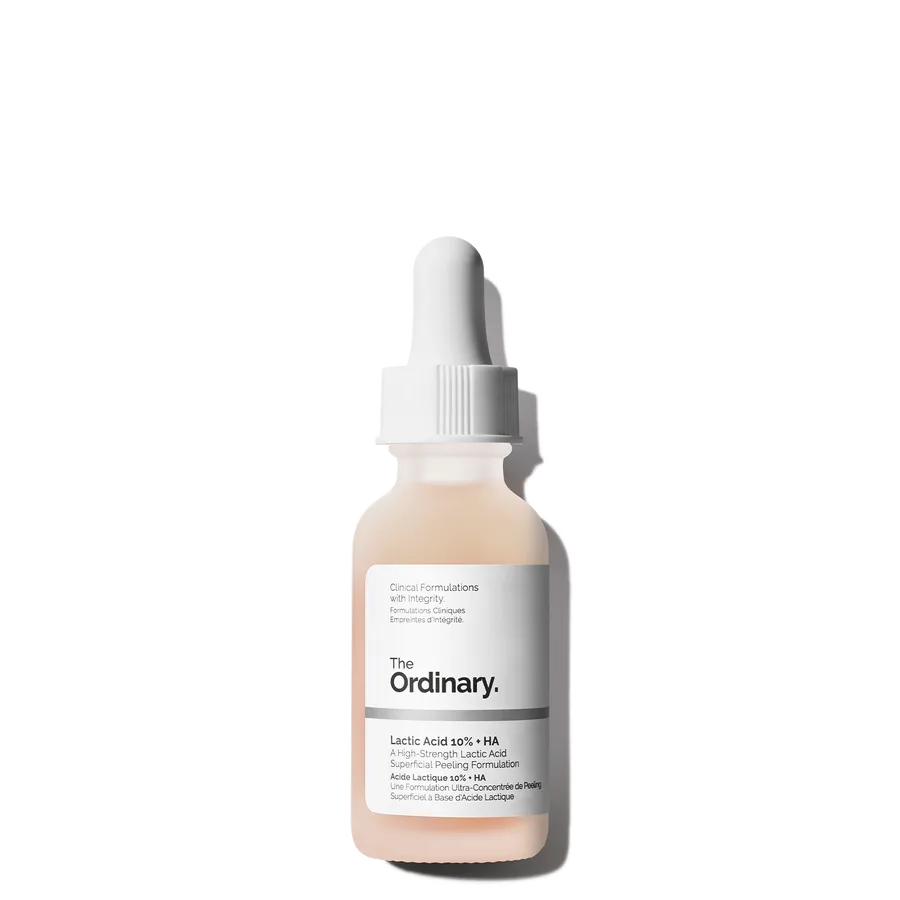
Lactic Acid 10% + HA
The Dry-Skin Exfoliator
 Verified reviewer
Pros & cons.
- +Unique dual-action formula that exfoliates and hydrates simultaneously through lactic acid's humectant properties
- +Triple hydration system with lactic acid, glycerin, and HA crosspolymer prevents drying during exfoliation
- +Tasmannia Lanceolata extract meaningfully reduces stinging without compromising acid efficacy
- +Gentler surface-level exfoliation than glycolic acid while delivering comparable brightening results
- +Exceptional value at $9.20 for a sophisticated AHA serum with built-in irritation control
- +Fragrance-free, oil-free, silicone-free, and fungal acne safe
- −Not suitable for sensitive, rosacea-prone, or barrier-compromised skin despite gentler profile
- −Many users find daily use too frequent and limit to 3-4 times per week
- −No larger size option available — 30ml only, which limits body application
- −Can trigger purging during weeks 1-2 in skin with underlying congestion
- −Requires strict daily sunscreen use due to AHA-induced photosensitivity
The full review.
Lactic acid history predates other chemical exfoliants. Cleopatra reportedly used sour milk for softer, more luminous skin in ancient Egypt. She used lactic acid without knowing the chemistry. The molecule from milk fermentation is the same one in this frosted glass bottle. The mechanism—dissolving bonds between dead skin cells to reveal fresher skin—hasn’t changed in two thousand years. Only the delivery has changed.
The Ordinary’s Lactic Acid 10% + HA uses this ancient ingredient for users who need exfoliation but cannot tolerate the drying effects of glycolic acid. This distinction matters. Glycolic acid, the smallest and most popular AHA, penetrates deeply and exfoliates aggressively. It works for resilient, oily skin but can punish dry skin. Lactic acid is a larger molecule. It works mainly at the skin’s surface, dissolving dead corneocytes without reaching the depths where glycolic acid triggers inflammation in reactive skin. Crucially, lactic acid also functions as a humectant, drawing moisture into the skin while it exfoliates.
This dual action—exfoliation and hydration—sets this formula apart from other AHA products. The Ordinary increases hydration with glycerin listed third in the INCI, indicating a high concentration, and a sodium hyaluronate crosspolymer for sustained water-binding. This creates a three-layered hydration system alongside exfoliation: lactic acid draws moisture in, glycerin holds it at the surface, and the HA crosspolymer provides sustained hydration. You exfoliate and hydrate in one step.
Tasmannia Lanceolata extract—The Ordinary’s signature sensory modifier—reduces the stinging common with 10% lactic acid at a pH of 3.6-3.8. This Tasmanian Pepperberry derivative modulates TRPV1 pain receptors to diminish burning without altering acid activity. Multiple reviewers note this product doesn’t sting even on slightly reactive skin, showing the Pepperberry extract works.
The texture is a lightweight, slightly viscous serum. It applies smoothly and absorbs without the heavy, tacky residue found in some AHA products. The bottle has a faint acidic scent, but nothing is perceptible once applied. Application causes a mild tingling that fades within a minute—noticeable, but rarely uncomfortable.
Results follow the standard AHA timeline but suit dry skin. The first use provides immediate brightening by removing the dullest surface layer. Within one to two weeks, skin tone even out and texture smooths. At four to eight weeks, deeper benefits emerge: faded dark spots, improved post-inflammatory hyperpigmentation, and cumulative luminosity. The skin avoids the desert-dry phase common with glycolic acid. The hydration system protects the moisture barrier during exfoliation.
The formula has clear limits. At 10% lactic acid with a pH near 3.7, this is not for sensitive skin. The Pepperberry extract reduces irritation but does not eliminate it; reactive skin will still react. Many users prefer applying it 3-4 times per week rather than daily to avoid overtaxing the skin. Sunscreen is mandatory with any AHA product. The 30ml bottle is standard for The Ordinary’s serum range but feels small for body use.
At $9.20, the value is clear. You get 10% lactic acid, hyaluronic acid crosspolymer, high glycerin concentration, and Tasmannia Lanceolata modification for less than the price of a sandwich. This formulation would compete at five times the price. For those needing exfoliation without dryness, it is a simple choice.
The Ordinary’s Lactic Acid 10% + HA does not replace glycolic acid; it offers a different path for those who need it. It provides smoother, brighter, more even skin without the moisture tax. Cleopatra would approve, though she might dislike the price.
Ingredient analysis.
Full INCI list · pH 3.7
Aqua (Water), Lactic Acid, Glycerin, Pentylene Glycol, Propanediol, Sodium Hydroxide, Sodium Hyaluronate Crosspolymer, Tasmannia Lanceolata Fruit/Leaf Extract, Acacia Senegal Gum, Xanthan Gum, Isoceteth-20, Trisodium Ethylenediamine Disuccinate, Ethylhexylglycerin, 1,2-Hexanediol, Caprylyl Glycol
Skin match.
The science.
The Science
Lactic acid is an alpha-hydroxy acid, but its molecular size and mechanism differ from glycolic acid. Lactic acid has a molecular weight of 90.08 g/mol, while glycolic acid is 76.03 g/mol. This makes lactic acid penetrate more slowly and act mainly at the stratum corneum surface. This works well for surface concerns like dullness, texture, and mild hyperpigmentation, as superficial exfoliation reduces deep-layer irritation risk.
At pH 3.6-3.8, this formula sits near the lactic acid pKa of 3.86—the pH where exactly 50% of the acid is in its free (protonated) form. Roughly half the lactic acid stays in its active, penetrating form. This formulation choice provides enough free acid for exfoliation without overwhelming the skin's buffering capacity.
Lactic acid is biochemically unique among AHAs because it is a natural moisturizing factor (NMF) component. Lactic acid and its salt, sodium lactate, exist naturally in the stratum corneum as part of the NMF—the hygroscopic molecules that maintain skin hydration. Smith (1996) published a study in the Journal of the American Academy of Dermatology showing that topical lactic acid at cosmetic concentrations increases ceramide synthesis in the stratum corneum. This strengthens the moisture barrier while exfoliating. This dual mechanism—exfoliation and barrier enhancement—is unique to lactic acid and not shared by glycolic acid.
The Tasmannia Lanceolata extract uses polygodial to act as a TRPV1 receptor modulator. These receptors also respond to capsaicin and low-pH acid contact. The extract desensitizes these receptors to reduce stinging and burning without changing the acid's pharmacological activity. Exfoliation continues while perceived irritation drops.
References
- Glycolic acid peel therapy – a current review — Clinical, Cosmetic and Investigational Dermatology (2013)
Dermatologist Perspective
Dermatologists often recommend lactic acid as the preferred AHA for patients with dry or mildly sensitive skin needing chemical exfoliation. Board-certified dermatologists note that lactic acid's larger molecular size creates more superficial exfoliation than glycolic acid, which reduces post-inflammatory hyperpigmentation risk—especially for darker skin tones. Dermatological literature widely cites the molecule's dual function as an exfoliant and humectant as a distinguishing advantage. This specific formulation often serves as a starting point for patients moving from physical to chemical exfoliation, as the Tasmannia Lanceolata extract provides a tolerance advantage many dermatologists appreciate in patient-directed products.
Where it fits in your routine.
Apply a small amount to a clean, dry face at night. Use it every other day, then move to daily use once skin acclimates. Mix it with a hydrating serum or moisturizer to dilute it while building tolerance. Follow with a hydrating serum and moisturizer. Use broad-spectrum SPF 30+ every morning. Do not use with other direct acids, retinoids, or vitamin C in the same routine. Avoid the eye contour and broken or compromised skin.
At $9.20 for 30ml, this serum offers a 10% lactic acid concentration at a properly acidic pH, fortified with glycerin, HA crosspolymer, and Tasmannia Lanceolata anti-irritant — for less than most brands charge for a basic toner. The per-use cost with daily application comes to approximately eight cents. The only value limitation is the absence of a larger size option, which means body application (where this product also excels for KP and texture) requires frequent repurchasing. For facial use alone, a single bottle lasts three to four months, making the cost-per-result ratio exceptional.
This works for dry, normal, or combination skin seeking AHA brightening and texture-refining benefits without the moisture-stripping dryness of glycolic acid. It suits people with dullness, uneven tone, dark spots, or mild hyperpigmentation who find glycolic acid too aggressive.
Avoid this product if you have sensitive, rosacea-prone, or eczema-affected skin. A compromised barrier or active inflammation will likely cause irritation. Glycolic acid works better for deep exfoliation or very oily, resilient skin.
Product details.
This lightweight, slightly viscous serum has a gel-like consistency. It applies smoothly and absorbs quickly without a heavy residue.
Faint, barely perceptible acidic note — essentially unscented
A frosted glass dropper bottle has a white pipette cap, matching The Ordinary's clinical design language.
Expect mild tingling upon application that lasts 30-60 seconds. The Tasmannia Lanceolata extract reduces stinging more than other 10% AHA products. Users with congested skin may experience brief purging during the first 1-2 weeks as trapped debris reaches the surface. Start with every other day and build to daily use. If significant redness or discomfort occurs, dilute with moisturizer or use less often.
3-4 months with daily evening use on face
12 months
All Year
The backstory.
Lactic acid has a fascinating origin story in skincare — it was used by Cleopatra in the form of sour milk baths, making it arguably the oldest chemical exfoliant in human history. The Ordinary's formulation modernizes this ancient ingredient with contemporary delivery technology, including the Tasmannia Lanceolata anti-irritant that makes a 10% concentration feasible for daily use. The product was part of The Ordinary's original 2017 lineup and has remained one of the brand's top sellers, particularly among users who found glycolic acid too aggressive.
About The Ordinary
Established Brand (5–20 years)DECIEM launched The Ordinary in 2016. It is now a top name in affordable, ingredient-focused skincare. The brand does not run proprietary clinical trials on its specific formulations, but it uses well-studied actives at transparent concentrations. This approach earns widespread dermatologist acknowledgment.
FAQ.
Is The Ordinary Lactic Acid 10% too strong for beginners?
Your skin's sensitivity determines the approach. The 10% concentration is a moderate AHA level, and Tasmannia Lanceolata extract reduces stinging. If you are new to chemical exfoliants, use The Ordinary's Lactic Acid 5% + HA first, then move to the 10% once your skin builds tolerance. If you have used mild acids before, apply the 10% every other day.
Can I use The Ordinary Lactic Acid 10% with retinol?
Do not use them in the same routine. Both lactic acid and retinoids increase cell turnover and cause over-exfoliation if combined. Alternate nights—lactic acid one evening, retinoid the next—or use the lactic acid 2-3 times per week on non-retinoid nights.
How is lactic acid different from glycolic acid for exfoliation?
Lactic acid has a larger molecular size than glycolic acid. It exfoliates the skin surface instead of penetrating deeply. This makes it gentler and reduces irritation risk. Lactic acid also works as a humectant, drawing moisture into the skin while exfoliating. These properties make The Ordinary's Lactic Acid 10% ideal for dry or dehydration-prone skin.
Will The Ordinary Lactic Acid cause purging?
It can. AHAs speed up cell turnover, which temporarily brings underlying congestion to the surface during the first 1-2 weeks. This is purging, not a breakout caused by the product. If new breakouts appear only in areas where you typically experience congestion, wait 4-6 weeks before deciding the product isn't working. If breakouts appear in new areas, stop use.
Can I use this lactic acid serum on my body?
Yes. The 10% concentration and hydrating formula work for body concerns like keratosis pilaris, rough texture on arms and legs, and uneven skin tone. Body skin generally tolerates AHAs better than facial skin, but apply sunscreen to treated areas exposed to sun.
What the community says.
"Effectively clears blackheads and congestion without excessive dryness"
"Gentler than glycolic acid with comparable exfoliation results"
"Doesn't sting even on slightly reactive skin thanks to the Pepperberry extract"
"Visible improvement in skin texture and brightness within weeks"
"Excellent value at under $10 for a well-formulated AHA serum"
"Too strong for some users to use daily — many limit use to 1-2 times per week"
"Requires strict sunscreen compliance due to increased photosensitivity"
"Small 30ml bottle size with no larger option available"
"Can cause purging during the first 1-2 weeks in congested skin"
People also looked at.