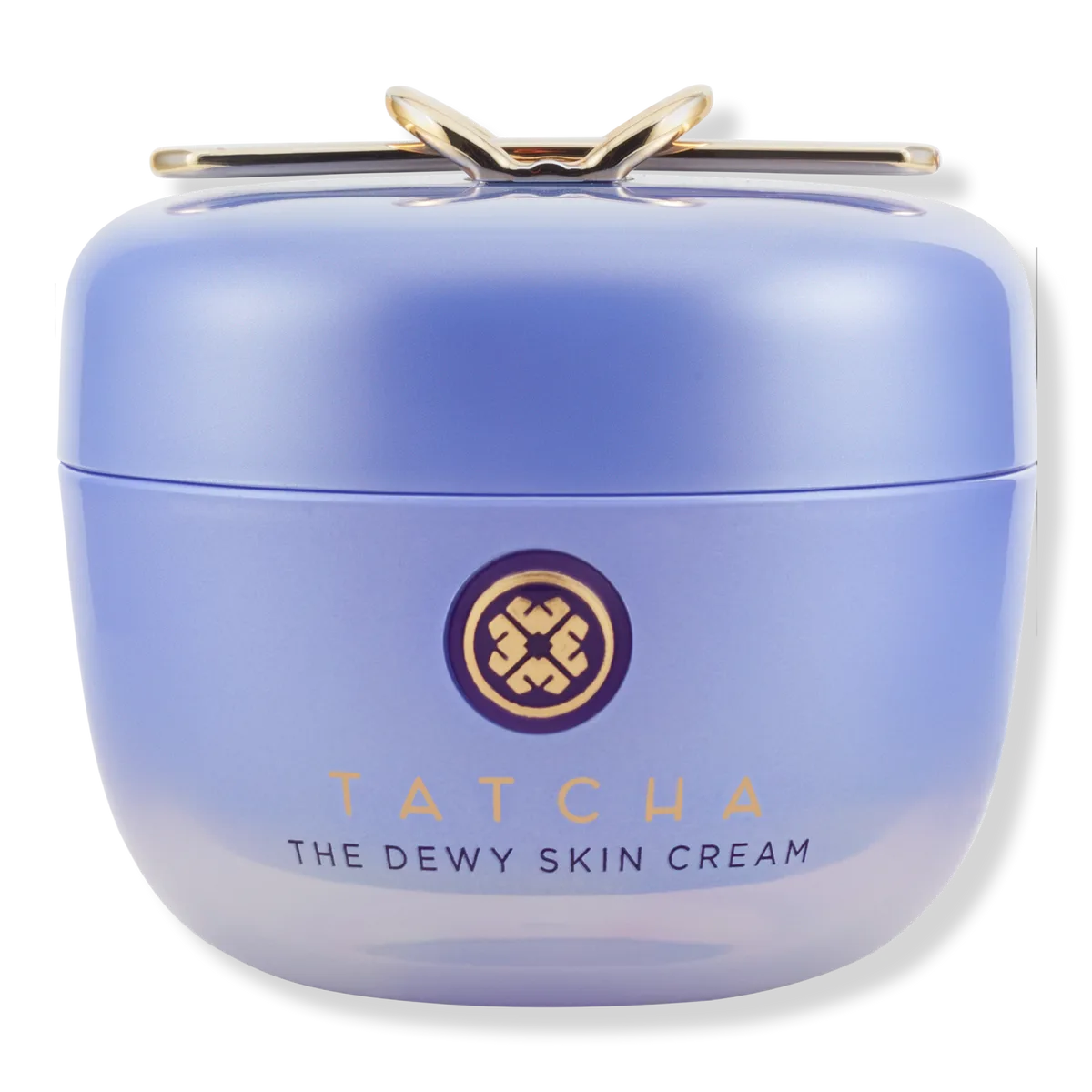
Dewy Skin Cream Plumping & Hydrating Moisturizer
Glass Skin Holy Grail
 Verified reviewer
Pros & cons.
- +Delivers an instantly visible dewy, glass-skin glow that lasts throughout the day
- +Hadasei-3 ferment complex is listed second in the formula — a genuine formulation commitment
- +Rich, whipped texture melts into skin without heaviness or greasiness on dry skin
- +Refillable packaging reduces waste and lowers the cost of repurchasing
- +Keeps dry, dehydrated skin plump and comfortable even in harsh winter conditions
- +Made in Japan at the Tatcha Institute with genuine Japanese formulation philosophy
- −Premium price of $72 for a moisturizer with fundamentally basic active ingredients
- −Contains fragrance and alcohol — unnecessary additions for sensitive skin
- −Far too dewy and rich for oily or combination skin types
- −Not cruelty-free at the parent company level (Unilever ownership)
- −Gold ingredient is present at negligible levels — more marketing than function
- −Open jar packaging can introduce bacteria without careful spatula use
The full review.
Before Tatcha’s Dewy Skin Cream, the Western skincare market treated moisture as a background utility — something your skin needed but nothing to get excited about. The prevailing wisdom was that the interesting products were the actives: the retinols, the acids, the vitamin C serums. Moisturizer was what you put on after the real work was done. Tatcha flipped this hierarchy by making hydration the event itself, borrowing from the Japanese skincare philosophy where moisture is not a supporting player but the entire performance.
The centerpiece of the formula is Hadasei-3, Tatcha’s proprietary fermented complex of Japanese green tea, rice, and Okinawan red algae. It is listed second in the ingredient list — after water and before glycerin — which means it comprises a significant portion of the formula rather than being a token botanical at the bottom of the INCI list. The fermentation process, which uses Saccharomyces yeast, breaks down the plant materials into smaller molecules rich in amino acids, peptides, minerals, and polyphenol derivatives that are theoretically more readily absorbed by the skin than their unfermented counterparts.
Whether Hadasei-3 delivers meaningfully better results than well-formulated glycerin and hyaluronic acid is the central question of this product. The honest answer is: probably not in a way that would show up in a clinical study, but possibly in a way you can feel. Ferment filtrates have documented humectant and antioxidant properties, and the combination of green tea polyphenols, rice bran nutrients, and algae minerals does provide a broader spectrum of skin-supporting compounds than glycerin alone. But the heavy lifting in this cream is done by the same trio of ingredients that powers moisturizers costing a tenth of the price: glycerin, squalane, and sodium hyaluronate.
Texture
The texture is where Tatcha earns its reputation. The Dewy Skin Cream has a whipped, cloud-like consistency that feels genuinely luxurious between your fingers. It melts into the skin with a warmth and richness that cheaper moisturizers rarely achieve. The finish is unambiguously dewy — a visible, luminous sheen that catches the light and makes skin look lit from within. For dry skin types who have been told their entire lives to use heavier creams that feel like spackling paste, this cream is a revelation. It is rich without being heavy, hydrating without being greasy, and dewy without looking oily.
Best for
That dewy finish is also the product’s most polarizing quality. If you have oily or combination skin, the Dewy Skin Cream will almost certainly make you look greasy rather than glowy — especially in warmer months or humid climates. This is not a universal moisturizer. It was designed for dry skin, and it makes that clear with every application. Tatcha’s Water Cream exists specifically for the oily contingent, and trying to make the Dewy Skin Cream work on oily skin is an exercise in fighting the formula.
Common Complaints
The ingredient list includes some questionable additions for a luxury product marketed as gentle. Fragrance is present — listed as Parfum/Fragrance — and while the scent is subtle and pleasant, its inclusion is unnecessary in a product that could easily be fragrance-free. Alcohol appears lower in the list, likely as a solvent for the ferment filtrate rather than a drying agent, but its presence may still concern sensitive skin types. Gold is listed as an ingredient, but at its position in the INCI list, the concentration is negligible — it is a luxury signifier, not a functional active.
Packaging
The refillable packaging deserves genuine praise. The elegant purple glass jar is designed to accept replacement pods at a lower price point, reducing both waste and the cost of repurchasing. This is a meaningful commitment to sustainability that also benefits the consumer financially. The included spatula promotes hygienic dispensing from the open jar format, which is important for a product without strong preservatives.
At $72 for 1.7 ounces, the Dewy Skin Cream asks you to pay a luxury premium for ingredients that are fundamentally accessible. You are paying for the Hadasei-3 ferment, the Japanese formulation heritage, the texture engineering, the packaging, and the ritual experience. These are not trivial — the sensorial quality of the Dewy Skin Cream is genuinely superior to budget moisturizers, and there is real value in a skincare routine that feels like a luxury rather than a chore. But if you are evaluating purely on ingredient efficacy per dollar, the math does not favor Tatcha.
The Dewy Skin Cream does exactly what it promises: it hydrates, it plumps, and it makes dry skin look dewy and alive. It does not claim to reverse aging, fight acne, or transform your skin at a cellular level. It is a moisturizer that has been elevated to an art form, and whether that elevation is worth $72 is a question only you can answer. For dry skin types who value ritual, texture, and glow above all else, it remains one of the most satisfying moisturizers money can buy.
Ingredient analysis.
Full INCI list
Aqua/Water/Eau, Saccharomyces/Camellia Sinensis Leaf/Cladosiphon Okamuranus/Rice Ferment Filtrate, Glycerin, Propanediol, Dimethicone, Squalane, Diisostearyl Malate, Behenyl Alcohol, Myristyl Myristate, Dipentaerythrityl Hexahydroxystearate, Bis-Diglyceryl Polyacyladipate-2, Tridecyl Trimellitate, Chondrus Crispus Extract, Betaphycus Gelatinum Extract, Eisenia Arborea Extract, Oryza Sativa (Rice) Bran Extract, Panax Ginseng Root Extract, Origanum Majorana Leaf Extract, Thymus Serpyllum Extract, Malva Sylvestris (Mallow) Flower Extract, Sodium Hyaluronate, Inositol, Gold, Sericin, Phytosteryl Macadamiate, Butylene Glycol, Beheneth-20, Sorbitan Tristearate, Disodium EDTA, Dimethicone/Vinyl Dimethicone Crosspolymer, Sodium Acrylate/Acryloyldimethyltaurate/Dimethylacrylamide Crosspolymer, Caprylyl/Capryl Glucoside, Sorbitan Isostearate, Ethylhexylglycerin, Parfum/Fragrance, Alcohol, Phenoxyethanol, Mica (CI 77019), Titanium Dioxide (CI 77891)
Skin match.
The science.
The Science
Hadasei-3 complex uses ferment filtrate technology. In this process, Saccharomyces yeast ferments green tea (Camellia sinensis), rice (Oryza sativa), and Okinawan algae (Cladosiphon okamuranus). Fermentation breaks plant cell walls to release smaller-molecule metabolites like amino acids, organic acids, peptides, and vitamins. Research shows ferment filtrates, specifically Saccharomyces ferment lysates, have humectant, antioxidant, and barrier-supporting properties.
This cream's hydration system works on three levels. Glycerin (listed third) is a small-molecule humectant that pulls water from the atmosphere and deeper skin layers into the stratum corneum. Sodium hyaluronate, the low-molecular-weight salt of hyaluronic acid, provides deeper humectant action by holding up to 1000 times its weight in water within the skin matrix. Squalane provides the occlusive seal, a lipid film that prevents transepidermal water loss and preserves humectant effects. This humectant-emollient-occlusive layering is the gold standard for moisturizer formulation.
The green tea in Hadasei-3 delivers EGCG (epigallocatechin gallate), a catechin with documented photoprotective and antioxidant properties. Studies in the Journal of the American Academy of Dermatology show topical EGCG reduces UV-induced erythema and oxidative damage when applied before sun exposure. Fermentation may increase EGCG bioavailability by converting large polyphenol complexes into smaller, more absorbable forms.
Cladosiphon okamuranus (Okinawan mozuku algae) contains fucoidan, a sulfated polysaccharide with documented anti-inflammatory, hydrating, and antioxidant properties. Research in Marine Drugs shows fucoidan can inhibit matrix metalloproteinases (MMPs), the enzymes that degrade collagen in aging skin. It is uncertain if the fucoidan concentration in the fermented complex is high enough to deliver these effects topically.
Dermatologist Perspective
Dermatologists generally see the Dewy Skin Cream as a well-formulated moisturizer with excellent hydrating properties. However, they note that the core ingredients — glycerin, squalane, and hyaluronic acid — appear in cheaper products. Board-certified dermatologists like the ferment filtrate concept but note that clinical evidence for the Hadasei-3 complex relies on brand-sponsored research. Dermatologists typically recommend this product for patients with dry, non-sensitive skin who want a thick skincare experience. The fragrance and alcohol may make it unsuitable for patients with eczema, rosacea, or contact dermatitis.
Where it fits in your routine.
Cleanse, tone, and apply serums, then scoop a pearl-sized amount of the cream with the included spatula. Warm it between your palms for a few seconds, then press—do not rub—into your face and neck. Use morning and night. Apply SPF in the AM. For extra hydration, use a thicker layer as a sleeping mask. The cream works best over water-based serums (hyaluronic acid, essence) that provide a hydration layer for the cream to seal in.
At $72 for 1.7 oz (with a 0.34 oz mini at $20 and refill pods at a lower price), the Dewy Skin Cream is positioned in the luxury tier. The primary active hydrating ingredients — glycerin, squalane, and sodium hyaluronate — are available in effective moisturizers for under $20. The premium reflects the proprietary Hadasei-3 fermented complex, Japanese manufacturing, the packaging, and the brand experience. Tatcha as an established luxury brand (founded 2009, acquired by Unilever for ~$500M) commands pricing based on heritage and positioning. The refillable option modestly reduces the long-term cost. For dry skin types who value ritual and sensorial quality, the experience justifies the premium. For ingredient-focused consumers, the value proposition is weak.
This works for dry to normal skin types who want a ritualistic skincare experience and a moisturizer that shows a dewy glow and lasting hydration. It suits those pursuing a Japanese glass-skin aesthetic who value the sensorial quality of their routine.
Skip this if you have oily or combination skin, if fragrance in skincare causes irritation, if parent-company cruelty-free status matters, or if you prefer clinical-strength actives and ingredient value over sensorial experience.
Product details.
Subtle floral-botanical fragrance. It is noticeable on application but not overwhelming.
Purple glass jar with a gold-accented lid. Includes a small spatula for hygienic use. The jar is refillable; replacement pods cost less, which reduces waste and repurchase cost. Finish dewyglowyvelvety
The cream feels thick, smooth, and hydrating on contact. Skin looks dewy and plumped minutes after application. The slight fragrance is noticeable but fades fast. Dry skin types get immediate relief from tightness. Most users feel no tingling or irritation. The dewy finish is pronounced; those unfamiliar with glass-skin aesthetics may think it looks too shiny.
2-3 months with twice-daily use of a pearl-sized amount
12 months
fall winter
The backstory.
Tatcha's Dewy Skin Cream was inspired by the Japanese concept of 'mochi-hada' — skin as soft and bouncy as a mochi rice cake. It launched around 2018 and quickly became the brand's bestselling product, propelled by its association with the glass-skin trend and celebrity endorsements. The cream was developed at the Tatcha Institute in Tokyo and reflects the Japanese skincare philosophy of building hydration in layers rather than relying on aggressive actives.
About Tatcha
Established Brand (5–20 years)Vicky Tsai founded Tatcha in 2009. The brand formulates all products at the Tatcha Institute in Tokyo. Unilever acquired Tatcha in 2019 for approximately $500 million. Tatcha does not test on animals, but its parent company Unilever is not fully cruelty-free. Tatcha formulations use proprietary fermented complexes and Japanese beauty traditions.
Common myths.
The gold in Tatcha Dewy Skin Cream has anti-aging benefits.
Gold appears near the bottom of the ingredient list, so its concentration is low. Gold nanoparticles show antioxidant properties in studies, but the trace amount in this cream acts as a luxury signifier rather than a functional active. Glycerin, squalane, and hyaluronic acid provide the hydrating benefits.
Japanese skincare works better than Western skincare.
Japanese formulation traditions focus on gentle, layered hydration to support barrier health. However, the active ingredients in Tatcha Dewy Skin Cream (glycerin, squalane, hyaluronic acid) use the same molecules found in Western formulations. The difference lies in the formulation philosophy and the fermented botanical complex, not a different chemistry.
FAQ.
Is Tatcha Dewy Skin Cream good for oily skin?
No — the Dewy Skin Cream uses a thick, emollient texture and dewy finish for dry to normal skin. On oily skin, it feels heavy and creates excess shine. Tatcha's Water Cream is the brand's oil-free, lighter moisturizer for oily and combination skin types.
What is Tatcha Hadasei-3?
Hadasei-3 is Tatcha's proprietary fermented complex of Japanese green tea (antioxidant), rice (brightening), and Okinawan red algae (hydrating). Dual-fermentation breaks these ingredients into smaller, more absorbable molecules. It is the second ingredient in the Dewy Skin Cream, showing a high concentration in the formula.
Can I use Tatcha Dewy Skin Cream as a night cream?
Yes — the thick, hydrating formula works well as a night cream for dry skin. Apply a thicker layer at night to wake up with plump, hydrated skin. For an intensive overnight treatment, layer it over a hyaluronic acid serum. The dewy finish is a non-issue at night, though some skin types may find it too glossy for daytime.
Is Tatcha Dewy Skin Cream worth $72?
Glycerin, squalane, and sodium hyaluronate hydrate skin and cost much less in other moisturizers. With Tatcha, you pay for the proprietary Hadasei-3 fermented complex, the Japanese formulation, the thick texture, and the beautiful packaging. Tatcha delivers if sensorial experience and ritual matter to your skincare routine. Other options offer better ingredient efficacy per dollar.
Is Tatcha cruelty-free?
Tatcha states it does not test on animals. However, Unilever acquired Tatcha in 2019. Unilever is not cruelty-free because some of its other brands test on animals when required by law. Some consumers consider this a dealbreaker if they evaluate cruelty-free status at the parent company level.
What the community says.
"Delivers an instant dewy, glass-skin glow that looks natural and healthy"
"Rich yet non-greasy texture that absorbs well despite its cream density"
"Keeps dry skin hydrated and plump throughout the entire day"
"Beautiful luxurious packaging with refillable option reduces waste"
"Works excellently as a makeup base for a luminous, dewy finish"
"Very expensive at $72 for a moisturizer with fairly basic active ingredients"
"Too rich and dewy for oily or combination skin — can look greasy"
"Contains fragrance and alcohol, which sensitive skin may react to"
"Not cruelty-free at the parent company level (owned by Unilever)"
"The 'dewy' finish can make oily zones shine excessively in warm weather"