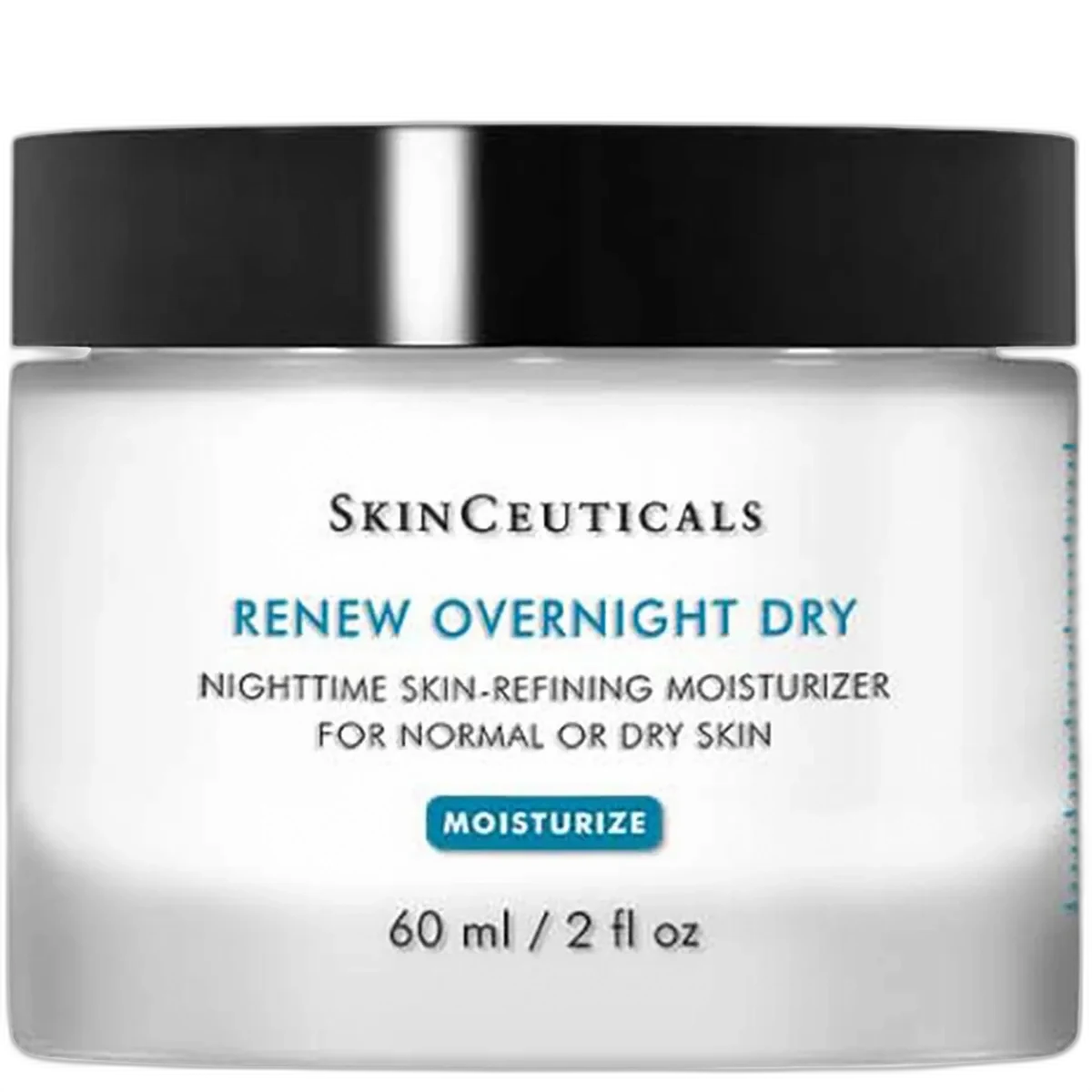
Renew Overnight Dry
Retinol-Alternative for Dry Skin
 Verified reviewer
Pros & cons.
- +10% glycolic acid at pH 3.8 in a dry-skin-friendly cream base
- +Delivers meaningful exfoliation without the stripped feeling of serum-form acids
- +Works as a retinoid alternative for patients who can't tolerate tretinoin
- +Pregnancy-safe when patients need to pause retinoids
- +Includes supporting lactic acid, panthenol, and glycerin for barrier support
- +Visible smoothing and brightening within 2-4 weeks of consistent use
- −$78 for 2.4 oz is premium pricing vs comparable AHA creams
- −Not appropriate for sensitive, rosacea-prone, or reactive skin
- −Can sting on first use during the adjustment period
- −Contains BHT and silicones some users prefer to avoid
- −Not strong enough to double as treatment for oily acne-prone skin
The full review.
Using a 10% glycolic acid serum on dry skin in January causes predictable issues. Skin tightens, cheeks flake, and the nose turns red. By night three, a sixty dollar bottle leaves you wondering if winter-stripped frizz is better than your original dullness. Most high-strength glycolic formulas target oily skin that tolerates naked acid serums and matte finishes. Historically, dry skin users had to use weaker products or lower their standards.
SkinCeuticals built Renew Overnight Dry to solve this. The exfoliating active load is clinical: 10% glycolic acid at pH 3.8, matching the brand’s dermatology-office peel products, plus ammonium lactate for a gentler keratolytic assist. The carrier differentiates it from a serum-form acid. Instead of a thin water-and-propylene-glycol vehicle, the acids sit in an emulsion of glycerin, dimethicone, panthenol, and a thick cream base that replaces a dedicated moisturizer most nights. Dry skin gets the full 10% glycolic benefits—smoother texture, brighter tone, faster turnover, and fewer fine lines—without the usual barrier damage.
How to Use
Application is simple. Clean the face, pat dry, and apply a medium-thick layer as the final PM step. First-time users often feel brief tingling; sensitive skin recognizes this as an acid working. This is normal and usually stops within minutes. The first week often brings slight surface dryness or minor flaking as cell turnover ramps up. By week two, skin usually adjusts. By week four, results appear: smoother texture, more even tone, better makeup application, and the “your skin looks good” feedback that justifies acid products.
Best for
This cream works well in specific scenarios dermatologists see often. It is a legitimate alternative for patients who cannot tolerate retinoids but want anti-aging and texture benefits; the exfoliating and mild brightening effects provide results similar to retinoids without neurocutaneous irritation. It is a go-to for pregnant and nursing patients pausing retinoid routines. It is a staple for winter-dry patients in cold climates where a standard glycolic serum becomes unwearable from October to March. It also pairs with the alternating-night routine many patients use with retinoids: glycolic one night, tretinoin the next, with this cream acting as the glycolic half.
Not ideal for
The limitations are clear. Sensitive and rosacea-prone skin should avoid this; 10% glycolic is a high strength that will irritate reactive skin. At seventy-eight dollars for two-point-four ounces, the price is premium. The Ordinary, Paula’s Choice, and other brands offer cheaper alternatives, though they lack this dry-skin-optimized emulsion base. This is not a replacement for a proper moisturizer for users with very dry or compromised skin; those users often need an occlusive layer or ceramide cream afterward.
Works for
Board-certified dermatologists often recommend this for patients wanting glycolic benefits in a dry-skin-friendly format, retinoid-intolerant users seeking a surface-texture alternative, and pregnant patients needing a temporary tretinoin stand-in. If you fit these profiles, this is a top category option worth the price. If you have sensitive skin, a tight budget, or resilient oily skin, other products work better. This is a positioning matter, not a formula flaw.
Ingredient analysis.
Full INCI list · pH 3.8
Water/Aqua, Glycolic Acid, Pentylene Glycol, Cetearyl Alcohol, Glycerin, Sodium Hydroxide, Ammonium Lactate, PEG-5 Pentaerythrityl Ether, Dimethicone, Glyceryl Stearate, PEG-100 Stearate, Hydrogenated Polyisobutene, Ceteareth-20, Panthenol, Zea Mays (Corn) Kernel Oil, Ascorbic Acid, Phenoxyethanol, Ceteareth-12, Tocopherol, Caprylyl Glycol, Cetyl Palmitate, Cetyl Alcohol, Disodium EDTA, Hordeum Vulgare (Barley) Extract, Stearic Acid, BHT
Skin match.
The science.
The Science
Glycolic acid is the most studied alpha hydroxy acid. Peer-reviewed clinical literature shows it works for photoaging, hyperpigmentation, surface texture, and skin renewal at concentrations of 5% and above. The mechanism is keratolytic: glycolic acid breaks ionic bonds between corneocytes in the stratum corneum, which speeds up desquamation and epidermal turnover. Studies also show it affects dermal glycosaminoglycan production, which helps improve fine lines after 8-12 weeks of use. This 10% concentration sits at the effective limit for over-the-counter cosmetic formulations. A pH of 3.8 delivers the acid in its protonated, active form while remaining tolerable for daily use on non-sensitive skin. Ammonium lactate—the ammonium salt of lactic acid—adds a secondary AHA with a different size and penetration profile. It provides dual humectant and keratolytic effects, especially on dry and keratinized skin. Panthenol and glycerin reinforce the stratum corneum barrier and water-binding capacity to reduce typical acid side effects. This formulation combines a clinical-strength acid with a moisturizing emulsion base, following the dermatology consensus that barrier support and exfoliation should happen together rather than sequentially.
Dermatologist Perspective
Dermatologists often recommend this cream to patients with dry, photoaged, or texturally rough skin who want a high-strength glycolic product they can tolerate nightly. It serves as an alternative for patients who cannot use retinoids due to intolerance, pregnancy, or personal preference but still want results for fine lines, dullness, and uneven tone. Board-certified dermatologists also use it in rotation routines, alternating the glycolic cream and a retinoid on different nights to prevent stacked irritation. Dermatologists steer patients elsewhere if the skin is sensitive, rosacea-prone, or reactive, if the patient is in the immediate post-procedure window, or if a gentler 5-8% glycolic option fits a lower starting tolerance level.
Where it fits in your routine.
Apply to clean, dry skin as your last PM step. Start 2-3 nights weekly, then increase to 3-5 nights weekly as tolerance develops. Use a medium pea-sized amount for face and neck. Avoid the immediate eye area. Do not use retinoids, salicylic acid, or other exfoliants on the same night; alternate them instead. Always use daily broad-spectrum SPF 30 or higher the next morning. If you experience significant burning, persistent redness, or barrier breakdown, use it less often and add a ceramide-heavy moisturizer on alternate nights.
At $78 for 2.4 fluid ounces, this sits in the premium AHA moisturizer category. Using it 3-5 nights per week makes one tube last about three to four months, keeping the per-use cost reasonable for its target users. Lower-priced options like The Ordinary's glycolic toner, Paula's Choice 10% AHA formulations, and various drugstore creams provide similar exfoliation for less. However, these lack the dry-skin-optimized emulsion base that makes this formula tolerable. For dry, retinoid-intolerant, or pregnancy-pause patients needing a dry-skin-friendly 10% glycolic, the price is fair. For oily skin that tolerates serum-form acids, the value is harder to justify.
Dry, photoaged, or rough skin needs a well-tolerated, high-strength glycolic cream for nightly or near-nightly use. This works for patients who cannot use retinoids, those pausing use during pregnancy, and winter-climate users whose glycolic products fail in cold weather.
Sensitive, rosacea-prone, or reactive skin cannot tolerate 10% glycolic at pH 3.8. These skin types need gentler 5-8% formulas or lactic-acid-only options. Oily, resilient skin often works well with the lighter Oily variant or a cheaper direct acid serum. Anyone on a strict budget should try lower-priced AHA alternatives before buying this tier.
Product details.
Rich, smooth cream that spreads easily
Fragrance-free — faint acidic note
White squeeze tube
The product is a thick cream that spreads easily on damp or dry skin. New users often feel a brief tingling sensation from the 10% glycolic acid — this is normal and usually stops within a few minutes. During the first week, expect slight skin-surface redness and mild flaking as cell turnover accelerates. The skin adjusts quickly.
3-4 months with 3-5 nights weekly use
12 months
fall winter
The backstory.
SkinCeuticals developed Renew Overnight as a response to dermatologists asking for a well-tolerated high-strength glycolic option patients could use nightly. The 'Dry' version was specifically engineered with a richer emulsion base for patients whose skin wouldn't handle a serum-form acid — particularly older patients, winter-climate users, and those with naturally dry skin who still wanted meaningful exfoliating results.
About SkinCeuticals
Established Brand (5–20 years)Dr. Sheldon Pinnell's antioxidant research at Duke University founded SkinCeuticals in 1997. SkinCeuticals' exfoliating moisturizers have been dermatology and med-spa staples for nearly two decades.
Common myths.
AHAs can replace retinoids entirely.
Glycolic acid and retinoids use different cellular pathways. Glycolic acid affects surface turnover and barrier hydration, while retinoids remodel dermal collagen over time. They complement each other, but glycolic acid does not substitute for prescription retinoid benefits.
A cream-based acid is less effective than a serum.
Efficacy depends on concentration and pH, not format. This cream uses 10% glycolic acid at pH 3.8, matching many serum-form glycolic products — the cream base adds barrier support without reducing acid activity.
FAQ.
How often should I use this cream?
Use this 2-3 nights a week, then increase to nightly use if your skin tolerates it. Most users use it 3-5 nights per week, alternating with barrier-supportive nights or retinoid use on opposite evenings.
Can I use this with retinol?
Don't use them together — combining 10% glycolic acid with a retinoid increases irritation risk. Most dermatologists recommend alternating: use glycolic on one night and retinoid on another. This approach provides the benefits of both without stacking irritation.
Is this safe during pregnancy?
Glycolic acid and lactic acid are pregnancy-safe at topical cosmetic concentrations. Doctors often recommend this product to pregnant patients who cannot use retinoids. Ask your OB if you have concerns.
How is this different from Renew Overnight Oily?
The Dry version uses a thick cream base with extra glycerin and occlusives for dry or winter skin. The Oily version uses a light emulsion for combination and oily skin. Both deliver 10% glycolic acid at pH 3.8; the carrier base is the only meaningful difference.
Will it cause purging?
Slight flaking and temporary sensitivity are normal during a mild 1-2 week adjustment period. This is not classic purging; the skin is just accelerating its turnover cycle. If you have significant burning, persistent redness, or breakouts after week 2, reduce frequency or stop use.
Do I still need sunscreen?
Yes. AHAs increase sun sensitivity. You must use daily broad-spectrum SPF 30+ with any glycolic product. Skipping it undoes the benefits and worsens sun damage.
Can sensitive skin use this?
Generally no — 10% glycolic at pH 3.8 is strong, and sensitive skin often lacks tolerance. Dermatologists usually recommend gentler 5-8% formulations or lactic-acid-only alternatives for sensitive patients.
What the community says.
"Visible smoothing and brightening within a few weeks"
"Dry-skin-friendly compared to acid serums"
"Good alternative to retinol for sensitive or pregnant users"
"Improves makeup application"
"Expensive for a nightly-use product"
"Can sting on first use"
"Not strong enough for resilient oily skin"
"Not for sensitive or rosacea-prone skin"