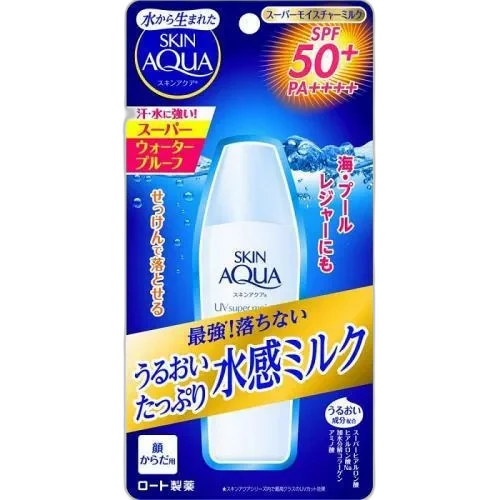
UV Super Moisture Barrier Milk SPF 50+
J-Beauty Sunscreen Standard
 Verified reviewer
Pros & cons.
- +Modern photostable UV filters (Uvinul A Plus, Tinosorb S Lite) deliver better UVA protection than most US drugstore sunscreens
- +True PA++++ rating — highest UVA protection category available
- +Lightweight, semi-matte finish with no white cast on most skin tones
- +Cosmetically elegant enough for daily use under makeup
- +Exceptional value at around $15 even with import costs
- +Fragrance-free and fungal-acne-safe
- −40g tube runs out in 4-6 weeks of proper application
- −Ethanol content can be drying or irritating on sensitive skin
- −Contains octinoxate — not reef-safe for snorkeling or diving
- −Methylparaben present for clean-beauty-averse buyers
- −Requires importing or an Asian beauty retailer for US buyers
The full review.
American buyers often overlook an awkward truth that Asian beauty enthusiasts and dermatology-forward shoppers know: ten-dollar sunscreens from a Tokyo drugstore often provide better UVA protection than twenty-dollar sunscreens from a US drugstore. This gap is regulatory, not commercial. The US Food and Drug Administration classifies sunscreen filters as over-the-counter drugs, requiring pharmaceutical-level approval processes that haven’t changed much since the 1990s. Japan, the EU, and much of Asia treat sunscreen filters as cosmetics. Over the last two decades, those markets approved modern photostable filters — Tinosorb S, Tinosorb M, Uvinul A Plus, Uvinul T 150 — that offer better UVA protection than the older chemical filters used in most American products. This sunscreen uses two of those modern filters, which makes it perform well above its price.
The filter system is the core. Four UV filters work together: zinc oxide acts as the mineral workhorse for broad-spectrum defense, ethylhexyl methoxycinnamate (octinoxate) serves as the primary UVB absorber, Uvinul A Plus (diethylamino hydroxybenzoyl hexyl benzoate) acts as a modern UVA1 filter for the longest wavelengths, and Tinosorb S Lite works as a photostabilizer to prevent chemical filter degradation. This hybrid sunscreen delivers SPF 50+ PA++++ — the highest Japanese protection category — without the grease of high-zinc mineral sunscreens or the photoinstability of old chemical-only formulas.
Cosmetically, the formula meets modern Japanese sunscreen standards. The cyclopentasiloxane and water base provides the silky slip typical of J-beauty products. It applies as a light milky emulsion, spreads easily, and dries to a semi-matte finish in about a minute. It leaves no white cast on most skin tones, no greasy residue, and no heavy fragrance; the scent is neutral. It sits cleanly under makeup without interfering with primer or foundation, offering an advantage over thicker mineral sunscreens.
The hydration claim is modest but accurate. Glycerin, sodium hyaluronate, sodium acetylated hyaluronate, and hydrolyzed collagen create a light humectant layer that prevents the sunscreen from feeling dehydrating during the day. It does not replace a moisturizer — dry skin should still apply it over a cream — but the claim is more than just marketing.
The friction points are small but notable. Ethanol is on the INCI, which is common in Japanese sunscreens to ensure a lightweight feel, but it can dry or irritate reactive skin. Octinoxate is present; reef-conscious buyers should note that octinoxate is flagged by reef-safe regulations. Do not use this sunscreen while snorkeling in Hawaii or the Caribbean. The 40-gram tube is small compared to the required facial SPF dose (roughly one to two grams per application), so one tube lasts only four to six weeks of daily use. Parabens are also present, which matters to some buyers though they have no established safety concerns at cosmetic concentrations.
Within the Skin Aqua lineup, the Super Moisture Milk is the entry-level daily facial sunscreen; gel, essence, and barrier-specific variants exist in the same family with different textures and actives. For those new to Japanese sunscreens, this milk variant is the best starting point: it is cosmetically elegant for daily wear, has strong filters, and is inexpensive. Once you experience a high-quality hybrid Japanese sunscreen, switching back to heavy or underperforming options is difficult.
This product stands out in the affordable daily sunscreen category due to formulation quality rather than marketing. For buyers prioritizing UVA protection, cosmetic elegance, and drugstore pricing — who can easily import it or find it at an Asian beauty retailer — it is an easy recommendation.
Formula
Ingredient analysis.
Full INCI list
Cyclopentasiloxane, Water, Zinc Oxide, Ethylhexyl Methoxycinnamate, BG (Butylene Glycol), Diethylhexyl Succinate, Polymethylsilsesquioxane, Hydrated Silica, Lauryl PEG-9 Polydimethylsiloxyethyl Dimethicone, Lauroyl Lysine, Diethylamino Hydroxybenzoyl Hexyl Benzoate, Glycerin, Sodium Hyaluronate, Hydrogen Dimethicone, Triethoxysilylethyl Polydimethylsiloxyethyl Hexyl Dimethicone, Methylparaben, EDTA-2Na, Sodium Acetylated Hyaluronate, Hydrolyzed Collagen, Arginine, Bis-Ethylhexyl Hydroxydimethoxy Benzylmalonate, Aluminum Hydroxide, Polyglyceryl-2 Triisostearate, Acrylates Copolymer, CI 73360, Phenoxyethanol, Dimethicone, Talc, Ethanol, Iron Oxides, Tin Oxide, Titanium Dioxide, Tocopherol, Mica
Skin match.
The science.
The Science
Japanese hybrid sunscreens beat many American drugstore alternatives because of their filter set. Tinosorb S and Uvinul A Plus — the modern organic UV filters in this formulation — have undergone extensive study in Europe and Asia since the early 2000s. Research in the Journal of the American Academy of Dermatology and Photodermatology, Photoimmunology & Photomedicine shows these newer filters provide broader UVA1 absorption than older chemical filters like avobenzone. This is especially true in the 370-400 nm range, where most American sunscreens show measurable weakness. Additionally, Tinosorb S Lite has documented photostability — it does not degrade under UV exposure — and stabilizes other co-formulated filters, keeping the whole system's protection intact all day.
Japanese sunscreens use the PA (Protection Grade of UVA) rating, measured via the PPD (persistent pigment darkening) method. Research in the British Journal of Dermatology validates PPD as a more reliable UVA1 protection indicator than the EU's UVA-PF calculation. The PA++++ rating — the highest tier — indicates a PPD of 16 or greater. This provides higher UVA protection than most US sunscreens labeled 'broad spectrum,' which follow a looser FDA threshold.
UVA protection matters because UVA radiation drives photoaging, pigmentation, and cumulative skin damage, and it penetrates clouds and glass. Research in Archives of Dermatology shows UVA1 specifically causes long-term collagen degradation and elastin damage. Sunscreens with strong UVA1 coverage are functionally different from sunscreens that only cover UVB and UVA2 well.
The zinc oxide in this hybrid formula adds mineral UVB/UVA defense and filter redundancy that stabilizes the overall system. Combining mineral and chemical filters in one formula provides more robust protection than either approach alone.
Dermatologist Perspective
Dermatologists generally view modern Japanese and European hybrid sunscreens — those using Tinosorb, Uvinul A Plus, and similar filters — as some of the most effective cosmetic sun protection worldwide, especially for UVA1 coverage. This formulation meets the dermatologist definition of an ideal daily sunscreen: cosmetically elegant for consistent wear, broad-spectrum enough to protect against UVB and the full UVA range, and tolerable for daily use without heavy residue. Dermatologists in available markets commonly recommend it, and American dermatologists traveling to Asia or Europe often buy sunscreens in this category for themselves. It is not typically recommended for patients with ethanol-sensitive skin or for reef-protected water activities where octinoxate is restricted.
Where it fits in your routine.
Apply this as the final step of your morning routine after cleansing, serums, and moisturizer. Use two finger-lengths of product for face and neck — roughly 1-2 grams total — to reach the labeled SPF. Let it dry for about a minute before applying makeup. Reapply every 2 hours during prolonged direct sun exposure, or more often if swimming or sweating heavily. Use it year-round, not just in summer. UVA penetrates clouds and glass, so daily use matters on overcast days or when indoors near windows.
At approximately $15 (or less in the Japanese domestic market), this sunscreen is an exceptional value for the UV protection it delivers. Comparable US drugstore sunscreens at SPF 50 cost $15-25 but generally provide weaker UVA coverage due to the older filter sets they're limited to. Imported via Asian beauty retailers, this sunscreen often costs $15-20 with shipping, which still makes it more cost-effective than equivalent-quality products from luxury brands. The small 40g size is the main value drag — proper daily application depletes a tube in about 4-6 weeks — but even accounting for that, the effective cost per month of high-quality daily sun protection is lower than most mid-tier Western alternatives.
This is for users who want UVA protection and cosmetic elegance on a budget. It suits normal, combination, or oily skin and works under makeup. It fits Asian beauty or J-beauty routines for users comfortable importing products.
Ethanol-sensitive users and reactive skin types should patch test carefully; the alcohol content dries skin. Reef-conscious divers and snorkelers should use a reef-safe alternative. Users who cannot easily import products or find Asian beauty retailers may find the logistics frustrating for a sub-$20 product.
Product details.
Light milky emulsion that spreads easily and dries to a semi-matte finish
Fragrance-free
Squeeze tube with screw cap
Absorbs fast without white cast. It has a slight silicone slip during application and settles into a soft semi-matte finish within a minute.
About 4-6 weeks at a proper 2-finger face-and-neck application
12 months
All Year
The backstory.
Skin Aqua launched in Japan as Rohto Mentholatum's affordable daily sunscreen line and became a drugstore staple through the 2010s. The Super Moisture Milk line positioned itself as the everyday facial sunscreen within the broader range, balancing strong UV protection with a moisturizing finish. Rohto itself, founded in 1899, is one of Japan's oldest pharmaceutical companies and operates across eye drops, skincare, and topical medications.
About Skin Aqua
Legacy Brand (20+ years)Rohto Mentholatum, a Japanese pharmaceutical company founded in 1899, makes Skin Aqua. Skin Aqua is one of Japan's best-selling affordable sunscreen lines and uses frequent reformulations to maintain its consistent track record in the Japanese drugstore market.
Common myths.
Japanese sunscreens are the same as US sunscreens
They are not. Japan and the EU approve modern filters like Uvinul A Plus and Tinosorb S, but the US FDA has not approved them for cosmetic sunscreen use. Consequently, Japanese sunscreens often provide better UVA coverage than US sunscreens at similar SPF ratings. This is why US buyers frequently import PA++++ Japanese sunscreens.
SPF 50+ is always better than SPF 30
SPF 50 blocks about 98% of UVB, while SPF 30 blocks about 97%. This difference is small if you apply it correctly. Application amount, reapplication, and broad-spectrum UVA coverage matter more — and this sunscreen excels at those.
FAQ.
Is this sunscreen worth importing from Japan?
Yes, for most users. The Uvinul A Plus and Tinosorb S Lite combination provides better UVA protection than US-approved drugstore sunscreens at comparable SPF. The cosmetic elegance is exceptional for the price. Importing costs raise the base price, but it remains a strong value at $15-20 total.
What does PA++++ mean?
PA++++ is the highest rating on the Japanese PA scale. This scale measures UVA protection using the PPD (persistent pigment darkening) method. Four plus signs mean a PPD of 16 or higher, the highest UVA protection category. This equals roughly EU UVA-PF 16+.
Does it leave a white cast?
No — even though it contains zinc oxide, the zinc is in a micronized form and the formula is balanced with chemical filters to prevent whitening. It's cosmetically elegant on all but the deepest skin tones, where a faint cast may be visible.
Is it safe for sensitive skin?
Mixed. The formula is fragrance-free and uses arginine and hydrolyzed collagen to soothe, but ethanol and octinoxate appear high on the INCI. Both can dry or irritate reactive users. Patch test before full-face use.
Can I reapply over makeup?
Yes, but reapplying a milky sunscreen over makeup is difficult. Dab gently instead of rubbing, or use a Skin Aqua-compatible sunscreen stick or powder for easier midday reapplication.
What the community says.
"Lightweight and cosmetically elegant"
"True broad-spectrum UVA protection"
"Affordable for the SPF quality"
"Small 40g size runs out fast"
"Slight initial drying feel from ethanol"
"Octinoxate content off-putting to reef-safe buyers"
People also looked at.