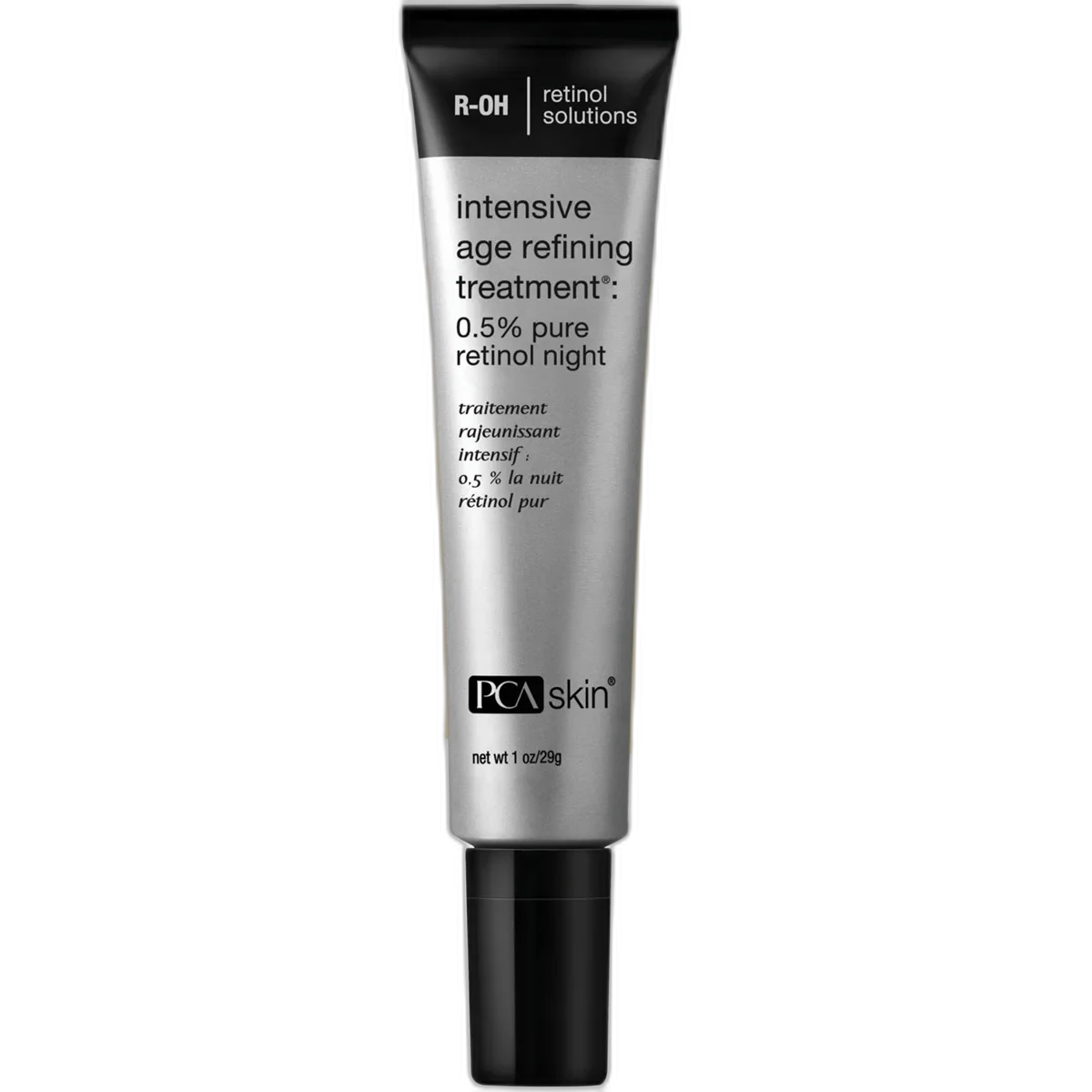
Intensive Age Refining Treatment 0.5% Pure Retinol Night
Award-Winning Retinol
 Verified reviewer
Pros & cons.
- +Patented OmniSome time-release delivers 0.5% retinol gradually over 10 hours
- +Niacinamide at meaningful concentration strengthens barrier and reduces retinol irritation
- +Fragrance-free formula appropriate for sensitized and reactive skin types
- +Two-time NewBeauty Best Retinol Cream award winner
- +Retinol-synergistic peptide amplifies anti-aging effects without increasing irritation
- +Panthenol and glycerin provide hydration support during retinization
- +Professional-grade formulation developed by in-house PhD chemist
- −Premium price of $120 per ounce, though monthly cost is reasonable
- −Initial retinization period may still cause dryness and flaking for some users
- −Not suitable for pregnancy or breastfeeding
- −Tube packaging makes it hard to extract the last portion of product
- −Contains silicones and PEGs that some users prefer to avoid
The full review.
Retinol is dermatology’s most reliable anti-aging active and also its most frustrating. The dose-response curve is well-established: higher concentrations produce more dramatic collagen stimulation, cell turnover, and wrinkle reduction. But that same dose-response curve applies to irritation — redness, peeling, dryness, the full catalog of retinoid dermatitis that makes people quit their retinol before it has a chance to work. PCA Skin’s approach to this paradox was not to lower the dose. It was to change the delivery.
The OmniSome system is the engineering heart of this product. It encapsulates the 0.5% pure retinol in a time-release vehicle that delivers the active gradually over 10 hours rather than in a single burst. The pharmacokinetic logic is straightforward: by avoiding the peak concentration spike that occurs when retinol hits skin all at once, you reduce the inflammatory trigger while maintaining sustained therapeutic levels throughout the night. Think of it as the difference between drinking three espressos at once and sipping coffee throughout the morning — same total caffeine, very different experience.
The 0.5% concentration itself sits in the productive middle of the retinol range. It is strong enough to stimulate meaningful collagen production, accelerate cell turnover, and visibly reduce fine lines — all well-documented effects at this percentage in clinical literature. But it is not the aggressive 1% that even experienced retinol users sometimes struggle with. Combined with time-release delivery, this creates a treatment that punches above its percentage in efficacy while staying below it in irritation.
The supporting formula reads like a retinol tolerance playbook. Niacinamide appears high in the ingredient list — a deliberate pairing, not a marketing add-on. Niacinamide strengthens the skin barrier by stimulating ceramide production, directly countering retinol’s tendency to thin and compromise the stratum corneum. It also provides anti-inflammatory activity that reduces redness, and its own modest contribution to collagen support. Using niacinamide alongside retinol is one of the most evidence-backed combinations in cosmetic dermatology, and PCA Skin has included it at what appears to be a meaningful concentration.
Panthenol — provitamin B5 — adds wound-healing and hydration support. During the retinization period (those first 2-4 weeks when skin adjusts to retinol therapy), panthenol helps maintain the moisture barrier and reduce the flaking and tightness that cause many people to abandon their retinol. It is a practical, clinician-minded inclusion.
Myristoyl nonapeptide-3, a retinol-synergistic peptide, works through a complementary collagen-stimulating pathway. By activating different signaling cascades than retinol itself, the peptide amplifies the anti-aging effect without requiring more retinol — a biochemically elegant approach to getting more results from a tolerable dose.
The texture is clinical-sleek: a lightweight cream that applies smoothly without greasiness and absorbs into a barely-there satin finish. There is no fragrance — a welcome choice for a nighttime treatment on skin that may already be sensitized. The opaque tube packaging protects the light-sensitive retinol from degradation, though some users note difficulty extracting the last of the product from the tube.
In use, the retinization timeline follows predictable patterns but with generally milder symptoms than equivalent non-time-release retinols. Most users report mild dryness and occasional flaking in weeks one and two, resolving by week three or four. Visible brightening and texture improvement typically appear by week four, with more significant fine line reduction becoming apparent by weeks eight to twelve. The sustained release means you are unlikely to wake up with the angry red face that a standard 0.5% retinol can produce on sensitive nights.
The product has earned two NewBeauty Best Retinol Cream awards, which reflects both its efficacy and its tolerability profile — judges tend to favor products that deliver results without the punishment. In esthetics practices, it is commonly recommended as a step up from introductory retinols and as a complement to in-office peel protocols.
At $120 for one ounce, this is a professional-grade investment. A small amount covers the full face, so the tube lasts three to four months with nightly use — bringing the monthly cost to roughly $30-40, which is competitive for professional retinol treatments. You are paying for the OmniSome technology, in-house PhD formulation, and the kind of ingredient engineering that a legacy clinical brand delivers.
The Intensive Age Refining Treatment represents PCA Skin’s engineering philosophy applied to skincare’s most important active: do not just use the ingredient — solve the problem of using it. For anyone who has tried retinol and been defeated by the side effects, or anyone ready to step up from gentler retinoids, this time-release approach offers a smarter path to the results that retinol reliably delivers.
Formula
Texture
The texture is clinical-sleek: a lightweight cream that applies smoothly without greasiness and absorbs into a barely-there satin finish.
Scent
There is no fragrance — a welcome choice for a nighttime treatment on skin that may already be sensitized.
Packaging
The opaque tube packaging protects the light-sensitive retinol from degradation, though some users note difficulty extracting the last of the product from the tube.
Common Praise
The product has earned two NewBeauty Best Retinol Cream awards, which reflects both its efficacy and its tolerability profile — judges tend to favor products that deliver results without the punishment.
How to Use
In use, the retinization timeline follows predictable patterns but with generally milder symptoms than equivalent non-time-release retinols. Most users report mild dryness and occasional flaking in weeks one and two, resolving by week three or four. Visible brightening and texture improvement typically appear by week four, with more significant fine line reduction becoming apparent by weeks eight to twelve. The sustained release means you are unlikely to wake up with the angry red face that a standard 0.5% retinol can produce on sensitive nights.
Best for
For anyone who has tried retinol and been defeated by the side effects, or anyone ready to step up from gentler retinoids, this time-release approach offers a smarter path to the results that retinol reliably delivers.
Works for
In esthetics practices, it is commonly recommended as a step up from introductory retinols and as a complement to in-office peel protocols.
Ingredient analysis.
Full INCI list
Water/Aqua/Eau, Cyclopentasiloxane, Glycerin, Niacinamide, Cetearyl Alcohol, Isosorbide Dicaprylate, Isoamyl Laurate, Glyceryl Stearate, PEG-100 Stearate, Panthenol, PEG-23 Glyceryl Distearate, Dimethicone, Phenoxyethanol, PEG-12 Glyceryl Dimyristate, Polysilicone-11, Retinol, Terminalia Chebula Fruit Extract, Polysorbate 20, Sodium Polyacrylate, Butylene Glycol, Citrus Aurantium Dulcis (Orange) Callus Culture Extract, Phytosterols, Ammonium Acryloyldimethyltaurate/VP Copolymer, Caprylyl Glycol, Xanthan Gum, Ethylhexylglycerin, Hexylene Glycol, Ethylhexyl Stearate, Tocopherol, Tocotrienols, Lecithin, Oryza Sativa (Rice) Bran Wax, Pentylene Glycol, Squalene, Isoamyl Cocoate, Disodium EDTA, Sodium Citrate, Avena Sativa (Oat) Kernel Extract, Trideceth-6, Superoxide Dismutase, Decyl Glucoside, Citric Acid, Potassium Sorbate, Sodium Hyaluronate, Myristoyl Nonapeptide-3
Skin match.
The science.
The Science
Retinol's anti-aging mechanism is well-documented in dermatology. Once applied, skin enzymes convert retinol to retinaldehyde and then to retinoic acid. Retinoic acid binds to nuclear retinoid receptors (RAR and RXR). This activates gene transcription to increase collagen I and III production, accelerate epidermal turnover, reduce matrix metalloproteinase activity (enzymes that break down collagen), and normalize melanocyte function.
A 2007 Archives of Dermatology study shows that topical retinol at 0.4% applied three times weekly for 24 weeks increases procollagen I expression and reduces fine wrinkles in photodamaged skin. This confirms the clinical efficacy of over-the-counter retinol at sub-prescription strengths.
The OmniSome delivery system solves a known pharmacokinetic challenge: conventional retinol application creates a concentration spike at the skin surface that triggers inflammation before the retinol reaches the target depth. Time-release encapsulation flattens this curve. It maintains therapeutic levels longer while keeping peak concentrations below the irritation threshold. This method mirrors pharmaceutical sustained-release formulations used in oral medications for decades.
A study in the Journal of Cosmetic Dermatology shows niacinamide works synergistically with retinol. Niacinamide pre-treatment increases skin tolerance to retinoid therapy by strengthening the ceramide-rich lipid barrier. The retinol + niacinamide combination produces greater improvements in photodamage markers than either ingredient alone.
The myristoyl nonapeptide-3 component uses the retinopeptide approach—peptide signaling to activate collagen pathways that complement the retinoid receptor pathway. While clinical evidence for this specific peptide is less extensive than for retinol, preclinical data supports the theoretical rationale of multi-pathway collagen stimulation.
References
- Retinol and retinyl esters: biochemistry and physiology — Journal of the American Academy of Dermatology (2006)
Dermatologist Perspective
Board-certified dermatologists call retinol the gold standard for topical anti-aging; 0.5% is a clinically meaningful concentration backed by substantial research. Dermatologists often recommend time-release retinol formulations like this one for patients who find standard retinol products irritating, because the sustained delivery profile reduces peak-concentration inflammation while maintaining therapeutic efficacy. Dermatological practice recognizes the niacinamide-retinol combination as synergistic for both tolerability and efficacy. Dermatologists state that consistent SPF use is mandatory when using any retinol product. They recommend a gradual introduction schedule (2-3 nights weekly, increasing over 4-6 weeks) for retinol-naive patients.
Where it fits in your routine.
Apply a pea-sized amount to clean, dry skin at night after your last treatment step but before moisturizer. Use it 2-3 nights per week for the first 2-4 weeks. Increase frequency as tolerated; most users apply it nightly within 4-6 weeks. Avoid the immediate eye area unless a dermatologist directs otherwise. Use a hydrating moisturizer to support the barrier during retinization. Apply broad-spectrum SPF 30+ every morning. Do not use on the same night as AHA/BHA exfoliants or benzoyl peroxide.
At $120 for 1 oz, this treatment costs a competitive amount for professional retinol. A small amount covers the full face, making one tube last 3-4 months of nightly use. This costs roughly $30-40 per month, which matches or beats the cost of many over-the-counter retinol serums when adjusted for duration. The patented OmniSome delivery system, in-house PhD formulation, and ingredient quality justify the premium over basic retinol products. For users who stopped retinol due to irritation, this time-release formula may save money compared to buying products that cause reactions.
Adults targeting fine lines, wrinkles, uneven tone, and skin aging want professional-grade retinol with time-release technology for better tolerance. This works for people who find standard retinol formulations too irritating or for retinol users moving to higher concentrations. It is for ages 30+ with normal to combination skin.
Pregnant or breastfeeding individuals (retinol is contraindicated), retinol-naive users starting at 0.25%, sensitive skin types, or those with active eczema or rosacea flares. This also applies to anyone skipping daily SPF or those seeking a budget-friendly retinol option.
Product details.
Fragrance-free — no detectable scent ***
An opaque tube protects light-sensitive retinol from degradation. The squeeze-tube format uses a screw cap.
First-time retinol users often see mild redness, flaking, or tightness during the first 1-2 weeks (retinization). The time-release system makes this milder than standard retinol products. Use it 2-3 nights per week and increase gradually. Experienced retinol users often tolerate nightly use immediately. ***
3-4 months with nightly use on face ***
12 months ***
All Year ***
The backstory.
PCA Skin developed this treatment to solve the central paradox of retinol: the concentration needed for visible results is often the same concentration that causes intolerable irritation. Their solution was the OmniSome delivery system — a patented encapsulation technology that releases retinol gradually over 10 hours rather than dumping it all at once. The result won NewBeauty's Best Retinol Cream award twice and became a staple recommendation in dermatology offices.
About PCA Skin
Legacy Brand (20+ years)PCA Skin was founded in 1990 and developed by a dermatologist. The brand pioneered the modified Jessner's peel and is the #1 professional chemical peel brand among estheticians. Their retinol treatments use a patented OmniSome delivery system developed in-house for sustained, controlled release.
Common myths.
Higher percentage retinol always means better results
Delivery matters as much as concentration. The OmniSome system in this formula delivers 0.5% retinol deeply and sustainably over 10 hours. This produces better outcomes than a higher percentage retinol that sits on the surface and causes irritation without effective penetration.
You should feel burning or peeling for retinol to work
Irritation is a side effect, not a measure of efficacy. The time-release system in this product delivers retinol's benefits — collagen stimulation, cell turnover, tone improvement — while minimizing the inflammatory response. Effective retinol improves skin without punishment.
FAQ.
How often should I use PCA Skin Intensive Age Refining Treatment?
Use 0.5% retinol 2-3 nights per week to let your skin acclimate. If tolerated after 2-4 weeks, increase use to every other night, then nightly. The OmniSome time-release system makes this more tolerable than standard retinol, but an adjustment period prevents irritation.
Can I use PCA Skin retinol with vitamin C?
Yes, but different times of day works best. Use vitamin C serum in the morning for antioxidant protection and this retinol treatment at night. To use both in one evening routine, apply vitamin C first, wait 15-20 minutes, then apply the retinol — though alternating nights is simpler for sensitive skin.
What is the OmniSome delivery system?
OmniSome is PCA Skin's patented time-release encapsulation technology. It wraps the 0.5% retinol in a vehicle that releases it gradually over 10 hours instead of depositing the whole dose at once. This sustained release keeps retinol active overnight and reduces the irritation spike seen in conventional retinol formulations.
Is PCA Skin retinol safe during pregnancy?
No — retinol (vitamin A derivative) is unsafe during pregnancy or breastfeeding because of potential teratogenic effects. Stop use if you are pregnant or plan to become pregnant. Ask your dermatologist or OB-GYN for pregnancy-safe alternatives.
What is the difference between PCA Skin Age Refining and Clarity Treatment retinol?
Both use 0.5% pure retinol with OmniSome delivery, but they target different concerns. The Age Refining Treatment focuses on anti-aging: fine lines, wrinkles, firmness, and skin rejuvenation. The Clarity Treatment adds ingredients for acne, breakouts, and post-inflammatory hyperpigmentation. Choose based on your primary concern.
Do I need sunscreen with PCA Skin retinol?
Retinol increases photosensitivity because it accelerates cell turnover and thins the outer dead skin layer. Apply broad-spectrum SPF 30 or higher every morning without exception when using this treatment, even on cloudy days. This is required for safety and to maintain the results retinol delivers.
What the community says.
"Visible improvement in fine lines within weeks"
"Time-release system makes it more tolerable than other retinols"
"Skin becomes firmer and more radiant with consistent use"
"Gentle enough for experienced retinol users to use nightly"
"Elegant cream texture that doesn't feel drying"
"Can still cause irritation for sensitive skin types"
"Premium price for a 1 oz tube"
"Some users experience initial retinization period"
"Tube packaging makes it difficult to get the last product out"
People also looked at.