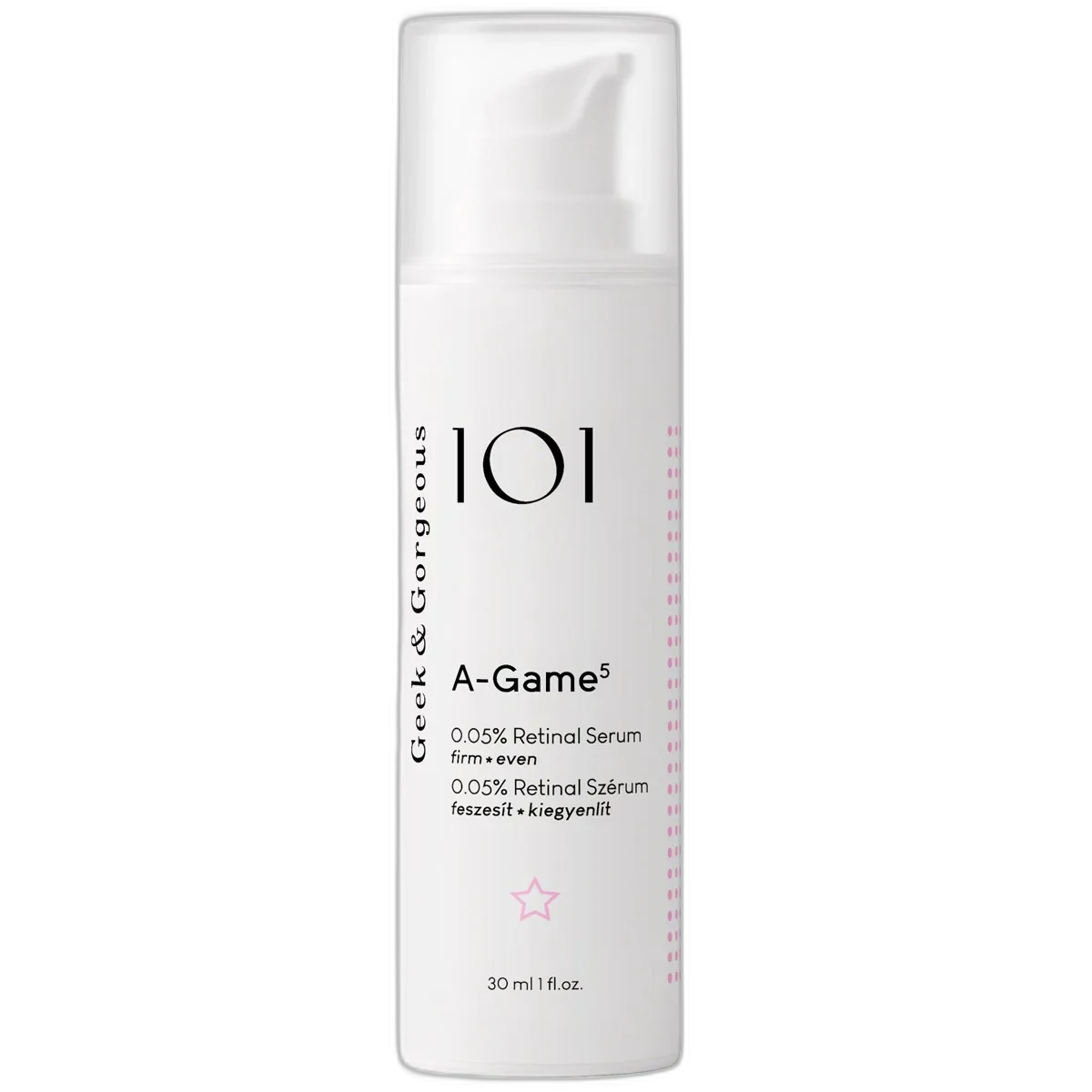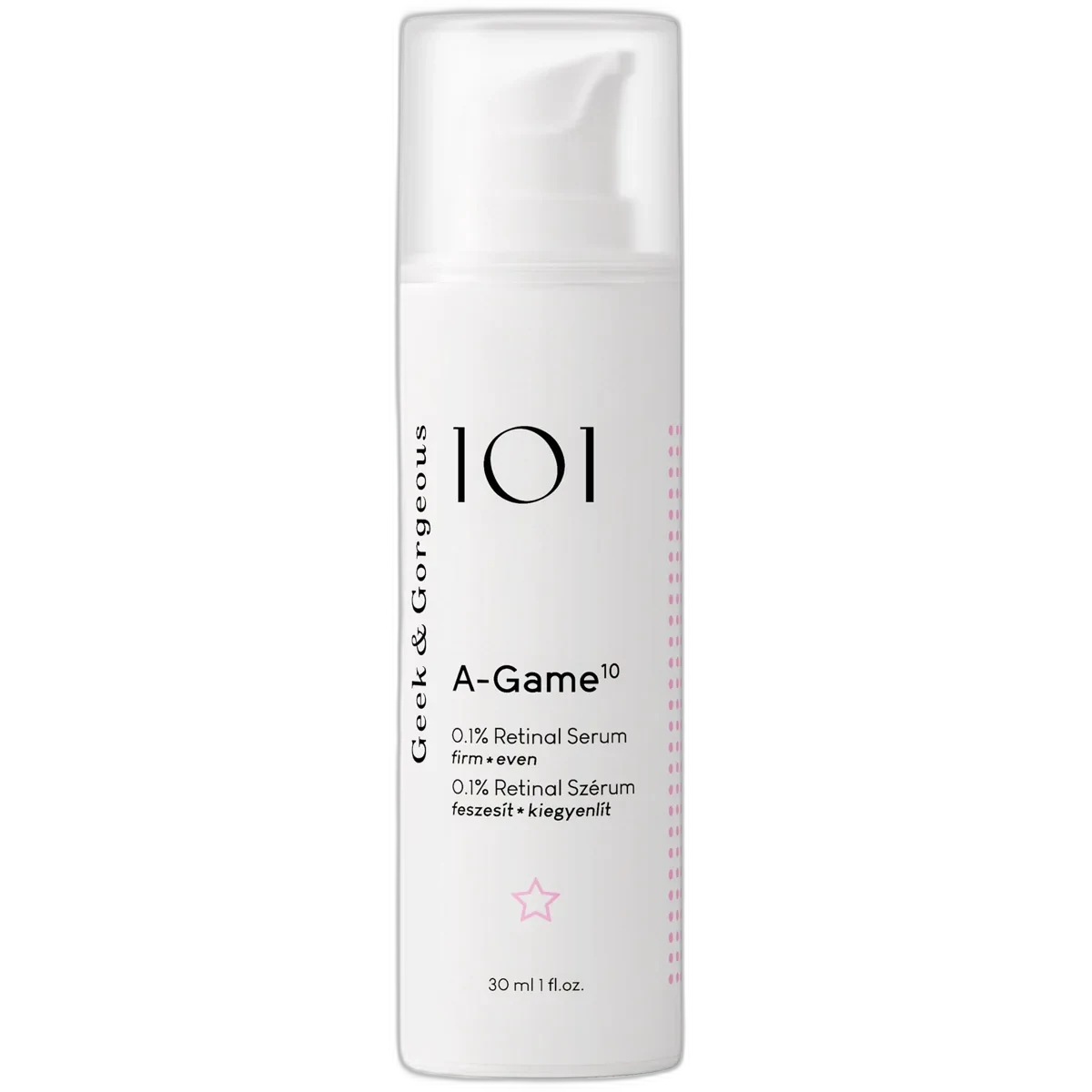
A-Game 10 Retinal Serum
Budget Retinal Holy Grail
 Verified reviewer
Pros & cons.
- +Treatment-level 0.1% retinaldehyde at unprecedented drugstore-tier pricing
- +Thoughtful supporting formula with squalane, shea butter, and vitamin E
- +Airless packaging correctly protects the retinal from light and oxidation
- +Fragrance-free formulation reduces irritation risk
- +Cosmetic-chemist-led brand with transparent formulation choices
- +Clear titration path with lower-strength A-Game 5 for beginners
- −Too strong for retinoid beginners — start with A-Game 5 first
- −Not pregnancy-safe like all retinoids
- −Higher irritation risk than gentler retinol products
- −Shipping time and availability can be limited for US buyers
The full review.
Retinaldehyde raw material is inexpensive. It is easy to source, and stabilizing it with vitamin E in airless packaging uses standard cosmetic chemistry. For twenty years, 0.1% retinal serums cost $60, $80, $100, or $120. This happened because premium brands used high margins, not high production costs. When a Hungarian indie brand founded by cosmetic chemists launched a 0.1% retinal for around $16, it showed pricing honesty rather than a formulation breakthrough. This makes the product interesting.
The formulation is good. 0.1% retinaldehyde is at the high end of over-the-counter retinoid strength. Retinal converts to retinoic acid in one enzymatic step, while retinol requires two. This makes retinal roughly ten times more potent than an equivalent percentage of retinol. A 0.1% retinal has biological activity closer to 1% retinol than 0.1% retinol. This is a serious treatment, not a beginner product. The A-Game line has two strengths—5 (0.05%) and 10 (0.1%)—so users can titrate. The brand’s marketing states most users should start with the lower strength and move to this one after several weeks of comfortable use.
The formula reflects cosmetic-chemist logic. Squalane provides lightweight emollient buffering. Shea butter adds thickness to offset retinal-induced drying. Glycerin provides humectant hydration. Vitamin E acts as an antioxidant to extend retinal’s shelf life and as a complementary skin active. BHT acts as an additional antioxidant to protect the retinal from oxidation, a detail many indie retinoid formulations miss. The opaque airless tube protects the photosensitive retinal. Every formulation decision shows a competent understanding of retinal needs.
The texture is a lotion-serum hybrid. It is thicker than a water-based serum due to the shea and squalane, but lighter than a cream. It spreads well, absorbs to a comfortable finish, and lacks the tacky or drying feel of some retinoid serums. A pea-sized amount covers the entire face. The fragrance-free formulation avoids unnecessary irritation risks during the adaptation period.
Results depend on your starting point. If you have never used vitamin A, this strength will overwhelm unprotected skin. Expect flaking, tingling, redness, and possible breakouts in the first 2-4 weeks. New retinoid users should start with A-Game 5, build to every-other-night use over a few months, then step up to this version. If you use 0.5-1% retinol or prescription tretinoin, moving to this 0.1% retinal is reasonable, though retinal-specific adaptation takes one or two weeks.
The results timeline follows standard retinoid patterns: initial smoothing and acne improvements appear around 4-6 weeks. Visible changes in fine lines, pigmentation, and photoaging require 12-16 weeks of consistent use. Retinoids are long-game products; switching brands frequently undermines them. Use this nightly as tolerated for months, using rest nights only if skin shows irritation. Smoother texture, fewer closed comedones, gradual dark spot fading, and softened fine lines result from sustained use, not magic.
This product has limitations. The high strength is not for retinoid newcomers, though the low price may tempt beginners. Pregnancy and breastfeeding contraindicate all retinoids. Sensitive skin, rosacea-prone skin, and compromised-barrier skin must use 0.1% retinal with caution and likely need gentler options. US buyers face longer shipping times because the brand ships from Europe, which adds days to the wait.
This product has unmatched value-per-dollar in the retinoid category. It is an obvious recommendation for users ready for this strength who want an affordable treatment. For newcomers, A-Game 5 is a better entry point from the same brand at the same price tier. The Geek & Gorgeous retinoid line changed the pricing reality of this category, which matters for budget-conscious long-term skincare routines.
Formula
### PM routine
Ingredient analysis.
Full INCI list
Aqua, Propanediol, Caprylic/Capric Triglyceride, Glycerin, C12-15 Alkyl Benzoate, Isopentyldiol, Butyrospermum Parkii (Shea) Butter, Hydrogenated Vegetable Oil, Glyceryl Stearate Citrate, Squalane, Glyceryl Stearate, Cetearyl Alcohol, Sodium Stearoyl Glutamate, Retinal, BHT, Tocopherol, Acrylates/C10-30 Alkyl Acrylate Crosspolymer, Xanthan Gum, Sodium Hydroxide, Ethylhexylglycerin, Disodium EDTA, Phenoxyethanol
Skin match.
The science.
The Science
Retinaldehyde sits at a specific position in the retinoid conversion pathway that gives it meaningful clinical advantages over retinol. In the skin, topical retinoids work by converting through a series of oxidation steps to retinoic acid (tretinoin), which is the active form that binds to nuclear retinoid receptors. Retinol requires two conversion steps (to retinaldehyde, then to retinoic acid), while retinaldehyde requires only one. Published research supports the general principle that retinaldehyde produces effects comparable to low-concentration tretinoin with less initial irritation than retinol at clinically effective concentrations. Clinical studies on retinaldehyde at concentrations of 0.05-0.1% have shown reductions in photoaging markers, improvements in fine lines, and efficacy in mild acne. The inclusion of tocopherol (vitamin E) and BHT as antioxidants in the formulation is supported by stability literature — retinal is sensitive to oxidation and requires careful packaging and antioxidant support to maintain potency over the product's shelf life. The airless tube packaging is consistent with formulation best practices for photosensitive actives. The supporting ingredients — squalane, shea butter, glycerin — have well-characterized emollient and humectant profiles and serve to buffer the irritation potential of the active rather than contribute independently to anti-aging effects. The formulation reflects evidence-based retinoid delivery rather than novel mechanism claims — which is precisely why it works.
Dermatologist Perspective
Dermatologists consistently recommend retinoids as the single most effective over-the-counter anti-aging ingredient class, with decades of published evidence supporting improvements in photoaging, pigmentation, acne, and skin texture. Board-certified dermatologists often note that retinaldehyde occupies a useful middle ground between retinol and prescription tretinoin — stronger and faster-acting than retinol, gentler and more accessible than prescription strength. For patients who want treatment-level vitamin A without a prescription, dermatologists commonly suggest starting at a lower strength (0.05% retinal or 0.5% retinol) and titrating up over months to avoid adaptation-period irritation. Patients should always pair retinoid use with daily broad-spectrum SPF, as retinoids increase photosensitivity. Dermatologists also typically advise against combining retinoids with benzoyl peroxide or high-strength acids in the same routine to minimize compound irritation.
Where it fits in your routine.
Apply at night after cleansing and any hydrating toner. Use a pea-sized amount for the entire face — more increases irritation without improving results. Start with twice a week for the first 2-3 weeks, then move to every other night, then nightly as tolerated. Follow with a ceramide moisturizer to support the barrier during adaptation. Always apply broad-spectrum SPF 30+ the next morning. Do not combine with benzoyl peroxide, AHA/BHA acids, or high-strength vitamin C in the same routine.
At about $16 for 30 mL, this costs roughly one-quarter to one-sixth of what equivalent 0.1% retinal serums from derm brands typically cost. A 30 mL tube lasts about 3-4 months if you apply a pea-sized amount nightly. Compared to premium retinal serums at $60-120, this formulation matches them on all important variables — active concentration, supporting ingredients, antioxidant stabilization, and packaging — while the brand's direct-to-consumer model enables the lower price. The value proposition has no peer in the retinoid category; we recommend this product because its price is much lower than what the category has trained consumers to expect.
Retinoid-experienced users moving to 0.1% retinal, budget-conscious enthusiasts seeking treatment-level vitamin A without premium markups, users building long-term anti-aging routines, and people targeting photoaging, mild acne, or hyperpigmentation.
Retinoid beginners (start with A-Game 5 first), pregnant or breastfeeding users, sensitive or rosacea-prone skin, users with compromised skin barriers, and anyone not committed to daily SPF use — retinoids increase UV sensitivity and require sun protection.
Product details.
This lightweight lotion-serum hybrid has a soft, comforting finish. It is thicker than a water-based serum but lighter than a cream.
Fragrance-free with only the faint natural scent of the carrier oils.
The bright yellow opaque airless tube dispenser uses an airless pump to protect the retinal from light and oxidation.
Expect mild tingling, dryness, or flaking during the first 2-4 weeks of skin adaptation. Use every third night, then every other night, then nightly as tolerated. Apply only a pea-sized amount to the entire face.
About 3-4 months with nightly use of a pea-sized amount.
6 months
All Year
The backstory.
Geek & Gorgeous was founded in 2020 by cosmetic chemists aiming to strip skincare pricing back to formulation cost. The A-Game line is the brand's retinoid series, with 5 (0.05%) and 10 (0.1%) strengths to let users titrate up. The naming convention references the clinical concentrations rather than obscuring them behind marketing language.
About Geek & Gorgeous
Emerging Brand (2–5 years)Geek & Gorgeous launched in 2020. This Hungarian indie brand was founded by cosmetic chemists to provide high-performing actives at transparent budget pricing. Skincare-enthusiast communities trust the brand for formulation honesty, though Geek & Gorgeous has less independent clinical validation than legacy derm brands.
Common myths.
Retinal and retinol are basically the same thing.
Retinal (retinaldehyde) is one step closer to retinoic acid than retinol in the skin's conversion pathway. This makes it roughly 10 times more potent at equivalent percentages. A 0.1% retinal is closer in strength to a ~1% retinol than to a 0.1% retinol.
Use 0.1% retinal for fast results.
Starting at high strength without titration causes the irritation that makes most users quit retinoids. If you are new to vitamin A, use A-Game 5 (0.05%) or a lower-strength retinol first, then switch to this after 2-3 months.
FAQ.
Is this too strong for a retinoid beginner?
Yes — 0.1% retinal is an advanced-user strength, roughly equal to 1% retinol in potency. If you have never used vitamin A, start with the A-Game 5 (0.05% retinal) or a beginner-level retinol. Switch to this serum once your skin adapts. Using this strength immediately almost always causes unnecessary irritation.
How often should I use it?
Start with twice a week and increase as tolerated. After 2-3 weeks of comfortable twice-weekly use, use it every other night. Well-adapted skin can use it nightly, but it is not required — results come from consistency over months, not frequency.
Can I use it with vitamin C or AHA/BHA acids?
Do not use these in the same routine. Use vitamin C in the morning and this serum at night, or alternate acid exfoliants on non-retinal nights. Combining them in one step increases irritation risk without adding benefit.
Is it pregnancy-safe?
No. All retinoids, including over-the-counter retinal, are contraindicated during pregnancy and breastfeeding due to their mechanism of action and theoretical risk to fetal development. Switch to pregnancy-safe alternatives like niacinamide, bakuchiol, or azelaic acid during pregnancy.
How long until I see results?
Smoothing and acne improvements often show within 4-6 weeks. Reducing fine lines, pigmentation, and photoaging takes 12-16 weeks of consistent use. Treat retinal as a long-term commitment, not a quick fix.
Will it cause purging?
Some users experience an initial breakout phase during the first 2-4 weeks as skin cell turnover accelerates. This differs from an allergic reaction — purging typically involves breakouts in areas where you normally get them and resolves within a few weeks. If breakouts appear in new areas or cause swelling and redness, discontinue use.
Why is it so much cheaper than other retinal serums?
Geek & Gorgeous is a direct-to-consumer brand that spends little on marketing and uses transparent pricing. Retinal formulation costs are not high; most premium retinal serums cost more because of brand positioning. This brand provides the same concentration and supporting ingredients at formulation cost plus a modest margin.
What the community says.
"Extraordinarily affordable for a 0.1% retinal concentration"
"Thoughtful supporting formula with squalane and shea butter"
"Fragrance-free and simple ingredient list"
"Produces visible texture and pigmentation improvements within 2-3 months"
"High strength causes adaptation irritation for newcomers"
"Ships from Europe — longer delivery times for US buyers"
"Opaque packaging good for stability but you can't see remaining product"
People also looked at.