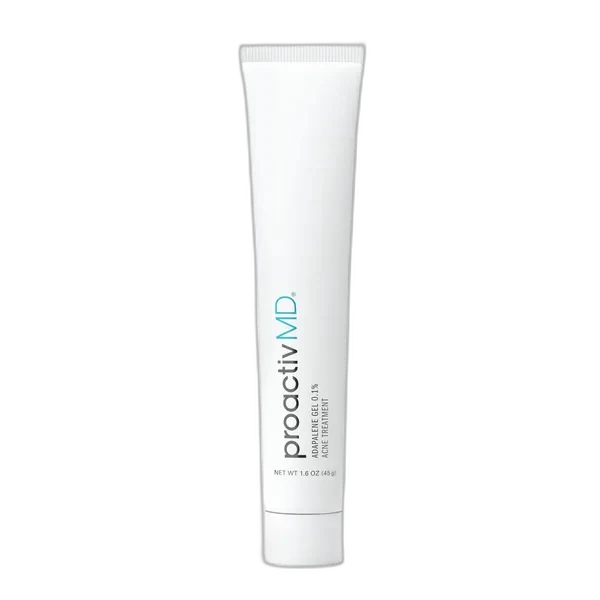
Adapalene Gel 0.1%
Gold Standard OTC Retinoid
 Verified reviewer
Pros & cons.
- +FDA-approved retinoid with 20+ years of clinical research and thousands of trial participants
- +Better per-ounce value than Differin in the 1.6 oz size
- +Paraben-free formulation using phenoxyethanol as preservative
- +Minimal seven-ingredient vehicle with no fragrance, botanicals, or unnecessary additives
- +Addresses both acne and early signs of aging through collagen stimulation
- +FSA/HSA eligible — can be purchased with pre-tax health spending dollars
- +Fungal acne safe formula with no comedogenic concerns
- −Initial 2-6 week purging period temporarily worsens breakouts
- −Causes dryness, peeling, and redness during adjustment — not for the impatient
- −Not potent enough for severe or cystic acne — may need prescription tretinoin
- −Brand's cruelty-free status is ambiguous and not independently certified
- −Takes 8-12 weeks of consistent nightly use to see full results
The full review.
There’s an irony in Proactiv selling adapalene gel. For decades, the brand was the face of consumer acne treatment — the benzoyl peroxide systems hawked by celebrities on late-night television, the brown boxes of three-step kits that arrived discreetly at your door. Proactiv was consumer acne. And now they’re selling a product that’s essentially a pharmaceutical in consumer packaging — an FDA-approved retinoid with two decades of clinical research behind it, identical in formulation to what dermatologists prescribed as Differin for years before it went OTC.
Let’s be direct about what this product is: adapalene 0.1% in a clear gel vehicle. That’s it. That’s the review. The active ingredient has been studied in clinical trials involving thousands of patients. It is the first retinoid approved for over-the-counter acne treatment. It works. The question is not whether adapalene is effective — that’s settled science. The question is whether there’s any reason to buy Proactiv’s version specifically.
The answer, surprisingly, is yes — for practical rather than scientific reasons. Proactiv’s standard size is 1.6 oz (45g), which is the same as Differin’s larger tube but often available at a lower price point. At the time of this review, the Proactiv version retails for approximately $15-20 for the 1.6 oz size, while Differin’s equivalent hovers around $25-30. The formula inside is functionally identical. A 0.5 oz trial size is also available for those who want to test tolerance before committing.
The current formulation uses phenoxyethanol as its preservative, making it paraben-free — a minor but tangible difference from the standard Differin formulation, which still uses methylparaben. For the record, methylparaben at cosmetic use concentrations has an excellent safety profile, but consumers who prefer to avoid parabens have a reason to reach for the Proactiv tube.
The ingredient list is refreshingly minimal. Water, adapalene, a carbomer polymer for gel structure, edetate disodium as a chelating agent, poloxamer 182 as a surfactant, propylene glycol for solubility, the preservative, and sodium hydroxide for pH adjustment. That’s seven inactive ingredients serving purely functional roles. There is nothing in this formula that doesn’t need to be there. No botanicals, no fragrance, no marketing ingredients. It’s a drug delivery vehicle, and it behaves like one.
Adapalene works by selectively binding to retinoic acid receptors — specifically RAR-beta and RAR-gamma — in the skin. This receptor selectivity is what makes it more tolerable than tretinoin while maintaining strong efficacy for acne. It normalizes the keratinocyte lifecycle in the hair follicle, preventing the formation of microcomedones — the invisible precursors to every blackhead, whitehead, and inflamed pimple. By stopping acne at this earliest stage, adapalene doesn’t just treat existing breakouts; it prevents new ones from forming.
A pivotal multi-center trial comparing adapalene 0.1% gel to tretinoin 0.025% gel demonstrated that adapalene achieved a 48% reduction in inflammatory lesions versus 38% for tretinoin, with significantly fewer side effects. A separate open-label study of 2,545 patients found that 89% showed improvement over twelve weeks, with 69% reporting satisfaction. This is not an ingredient that needs marketing claims to support it — the clinical data speaks for itself.
The user experience follows a predictable arc that every dermatologist has described to every acne patient who’s ever sat in their office. Weeks one through four: the purge. Existing clogged pores are accelerated to the surface, and your skin may temporarily look worse before it looks better. This is not the product failing — it’s the product working on a backlog. Dryness, peeling, and mild redness are standard. Start every other night. Use a generous moisturizer. Do not panic.
Weeks four through eight: the purge subsides. Fewer new breakouts appear. The skin begins to look calmer, smoother, and more even. Weeks eight through twelve and beyond: this is where the investment pays off. Skin is meaningfully clearer, texture is refined, and post-inflammatory marks begin to fade. Adapalene also stimulates collagen production, making it one of the rare products that addresses both acne and early signs of aging simultaneously.
The honest limitation is that adapalene 0.1% is not prescription-strength tretinoin. For severe, cystic, or treatment-resistant acne, you may need the higher potency that only a prescription can provide. Adapalene at this concentration is best suited for mild to moderate acne — the most common type, and the type most people are dealing with when they browse the skincare aisle.
The other limitation is the adjustment period itself. Six weeks of your skin looking worse while you trust a process you can’t see is psychologically difficult. Many users abandon adapalene during the purge, leaving negative reviews that reflect impatience rather than product failure. The reviews for this product — and every adapalene product — split along this line: those who pushed through the purge are overwhelmingly positive, those who didn’t are understandably frustrated.
Packaging
Packaging is clinical and functional. A white squeeze tube with teal branding that looks exactly like what it is: a pharmaceutical product. No luxury touches, no Instagram aesthetic. This is fine. You’re not buying this for the shelf appeal.
At $15-20 for a 1.6 oz tube that lasts three to four months, the value is exceptional. You’re getting an FDA-approved retinoid — the same active ingredient that cost a dermatologist visit and a prescription co-pay before 2016 — for roughly five dollars a month. It’s FSA/HSA eligible, meaning you can use pre-tax health spending dollars on it.
The Proactiv name on the label may carry associations with infomercial marketing and celebrity endorsements that feel at odds with the serious pharmaceutical science inside this tube. But the product itself doesn’t care about branding. It’s adapalene. It works the way adapalene has always worked. If you’re choosing between this and Differin, check the price on the day you’re shopping and buy whichever is cheaper. The molecules inside don’t know whose name is on the box.
Ingredient analysis.
Full INCI list
Active: Adapalene 0.1%. Inactive: Carbomer Homopolymer Type C, Edetate Disodium, Poloxamer 182, Propylene Glycol, Phenoxyethanol, Purified Water, Sodium Hydroxide
Skin match.
The science.
The Science
Adapalene is a third-generation synthetic retinoid with selective affinity for RAR-beta and RAR-gamma receptors, making it more targeted and better tolerated than first-generation retinoids like tretinoin. Its mechanism centers on normalizing follicular epithelial cell differentiation and keratinization — preventing the abnormal cell cohesion that creates microcomedones, the precursors to all acne lesions.
A multi-center randomized trial by Shalita et al. (Journal of the American Academy of Dermatology, 1996) compared adapalene 0.1% gel to tretinoin 0.025% gel over 12 weeks, finding adapalene achieved a 48% reduction in inflammatory lesions versus 38% for tretinoin, with superior tolerability — fewer patients experienced burning, pruritus, and scaling. Notably, adapalene showed faster onset of action, with significant inflammatory lesion reduction by week one (32% vs 17%).
Dosik et al. (Journal of Drugs in Dermatology, 2010) published results from two placebo-controlled, multicenter, randomized double-blind studies involving 2,141 subjects, demonstrating that adapalene 0.1% was significantly more effective than vehicle for total, inflammatory, and non-inflammatory acne lesions. A large open-label study of 2,545 patients (Journal of Cutaneous Medicine and Surgery, 2002) confirmed that 89% showed improvement over 12 weeks.
Beyond acne, adapalene stimulates collagen production through retinoid receptor-mediated gene transcription. A 2025 study in the Indian Journal of Dermatology confirmed visible wrinkle improvement from the fourth month of adapalene cream use, supporting its dual utility for acne and photoaging. Adapalene is also uniquely photostable among retinoids, meaning it does not degrade with UV exposure — though sunscreen remains essential because retinoids increase photosensitivity through accelerated cell turnover.
References
- A comparison of the efficacy and safety of adapalene gel 0.1% and tretinoin gel 0.025% in the treatment of acne vulgaris — Journal of the American Academy of Dermatology (1996)
- Adapalene 0.1% lotion in the treatment of acne vulgaris: results from two placebo-controlled, multicenter, randomized double-blind, clinical studies — Journal of Drugs in Dermatology (2010)
- Adapalene gel 0.1% is effective and well tolerated in acne patients in a dermatology practice setting — Journal of Cutaneous Medicine and Surgery (2002)
Dermatologist Perspective
Board-certified dermatologists consider adapalene 0.1% a first-line treatment for mild-to-moderate acne, and it is one of the most commonly recommended OTC products by dermatology professionals. Dermatologists emphasize the importance of setting patient expectations around the initial purging phase and the 12-week minimum commitment required to evaluate efficacy. Clinical guidance consistently recommends starting with every-other-night application, buffering with moisturizer to manage irritation, and mandatory daily sunscreen use. For patients who don't respond adequately to OTC adapalene after 12 weeks, dermatologists typically escalate to prescription-strength tretinoin or combination therapy.
Guidance
Where it fits in your routine.
Apply a pea-sized amount to clean, dry skin every evening. Wait 5-10 minutes after washing your face before application; damp skin increases irritation. Spread a thin, even layer over the entire acne-prone area instead of just individual spots. Follow with a non-comedogenic moisturizer. Use it every other night for the first 2-4 weeks, then use nightly as tolerated. Use SPF 30+ every morning. Expect the initial purge; it is temporary and necessary.
At roughly $15-20 for the 1.6 oz (45g) tube, this offers top value in the skincare aisle. One pea-sized nightly application makes the tube last 3-4 months, costing about $4-5 per month. A 0.5 oz trial size ($10-12) exists for testing tolerance. The Proactiv version often saves 30-40% over Differin's $25-30 price for the same 1.6 oz size and identical active ingredient. It is also FSA/HSA eligible. Few skincare products provide this much clinically proven efficacy for the price.
This works for anyone with mild-to-moderate acne — blackheads, whiteheads, inflammatory papules and pustules — seeking the most evidence-backed OTC treatment. It also suits adults wanting acne control and anti-aging benefits from one budget-priced product.
Avoid this if you cannot wait 8-12 weeks for results or tolerate initial purging and dryness. People with severe cystic acne need a dermatologist for prescription-strength options. This is not safe during pregnancy or breastfeeding.
Product details.
Clear, lightweight gel that absorbs quickly with no visible residue
Unscented — has no added fragrance and a faint medicinal note that vanishes immediately
White pharmaceutical squeeze tube with blue/teal Proactiv branding. It comes in 0.5 oz (15g) and 1.6 oz (45g) sizes. The design is functional and clinical.
The gel applies smoothly and absorbs within one minute. You will see no immediate results because adapalene works by slowly normalizing cell turnover. A purging phase is common and normal during the first 2-4 weeks: existing clogged pores move to the surface, which temporarily worsens breakouts. Dryness, flaking, and mild redness are expected. This phase passes; do not stop using the product during it.
3-4 months with nightly use (1.6 oz size, pea-sized application)
24 months
All Year
The backstory.
Adapalene was originally prescription-only, developed by Galderma and sold as Differin. In July 2016, the FDA approved adapalene 0.1% for over-the-counter sale — the first new OTC acne active in decades. Proactiv, already the dominant name in acne treatment, launched their version in May 2017 as part of the ProactivMD system, bringing their infomercial-era brand credibility to a legitimately clinical active.
About Proactiv
Legacy Brand (20+ years)Stanford dermatologists Dr. Katie Rodan and Dr. Kathy Fields developed Proactiv in 1995. The brand treats millions of acne patients and added this OTC adapalene gel to the ProactivMD system in 2017. Taro Pharmaceutical Industries owns the brand now.
Common myths.
Adapalene purging means the product makes your acne worse
Purging happens when adapalene accelerates the lifecycle of existing clogged pores, pushing them to the surface faster. This shows the product works. True purging lasts 2-6 weeks and occurs in your usual breakout areas. If irritation appears in new areas or lasts beyond 8 weeks, you have a genuine reaction.
Store-brand adapalene is less effective than Differin
Adapalene 0.1% is adapalene 0.1% no matter the brand name. The active ingredient, concentration, and vehicle formulation are the same in Proactiv, Differin, and generic versions. Clinical efficacy is identical.
FAQ.
Is Proactiv Adapalene Gel the same as Differin?
They work the same. Both use adapalene 0.1% in nearly identical gel vehicles. Proactiv's current formulation is paraben-free, using phenoxyethanol instead of methylparaben, and the 1.6 oz size often has better per-ounce value than Differin.
How long does the adapalene purge last?
Purging lasts 2-6 weeks. This phase pushes pre-existing clogged pores to the surface, which temporarily increases breakouts. This shows the product works. Most users see improvement by weeks 4-8 and significant clearing by week 12.
Can I use adapalene with benzoyl peroxide?
Yes, but use them at different times — adapalene at night and benzoyl peroxide in the morning. Adapalene is stable among retinoids and does not degrade when used with benzoyl peroxide, but applying them together increases irritation on sensitive skin.
Is Proactiv Adapalene Gel good for anti-aging?
Yes — adapalene is a retinoid that increases collagen and speeds cell turnover, treating acne and providing anti-aging benefits. A 2025 study shows visible wrinkle improvement starting the fourth month of adapalene use. It is one of the few OTC products that treats both acne and aging at once.
Can I use adapalene every night?
Yes, eventually. Use it every other night for the first 2-4 weeks so your skin adjusts. Increase to nightly use as tolerated. Apply to completely dry skin and follow with a moisturizer to manage dryness and irritation.
What the community says.
"Clears acne effectively, including cystic and hormonal breakouts"
"Works as well as prescription retinoids for mild-to-moderate acne"
"Better value per ounce than Differin in the 1.6 oz size"
"Clear gel absorbs well without residue or greasiness"
"Helps fade dark spots and post-acne marks over time"
"Initial purging period of 2-6 weeks where acne temporarily worsens"
"Causes dryness, peeling, and flaking during the adjustment period"
"Takes 2-3 months of consistent use to see meaningful results"
"Can cause significant redness and irritation when first starting"
"Less potent than prescription-strength tretinoin for severe acne"
People also looked at.