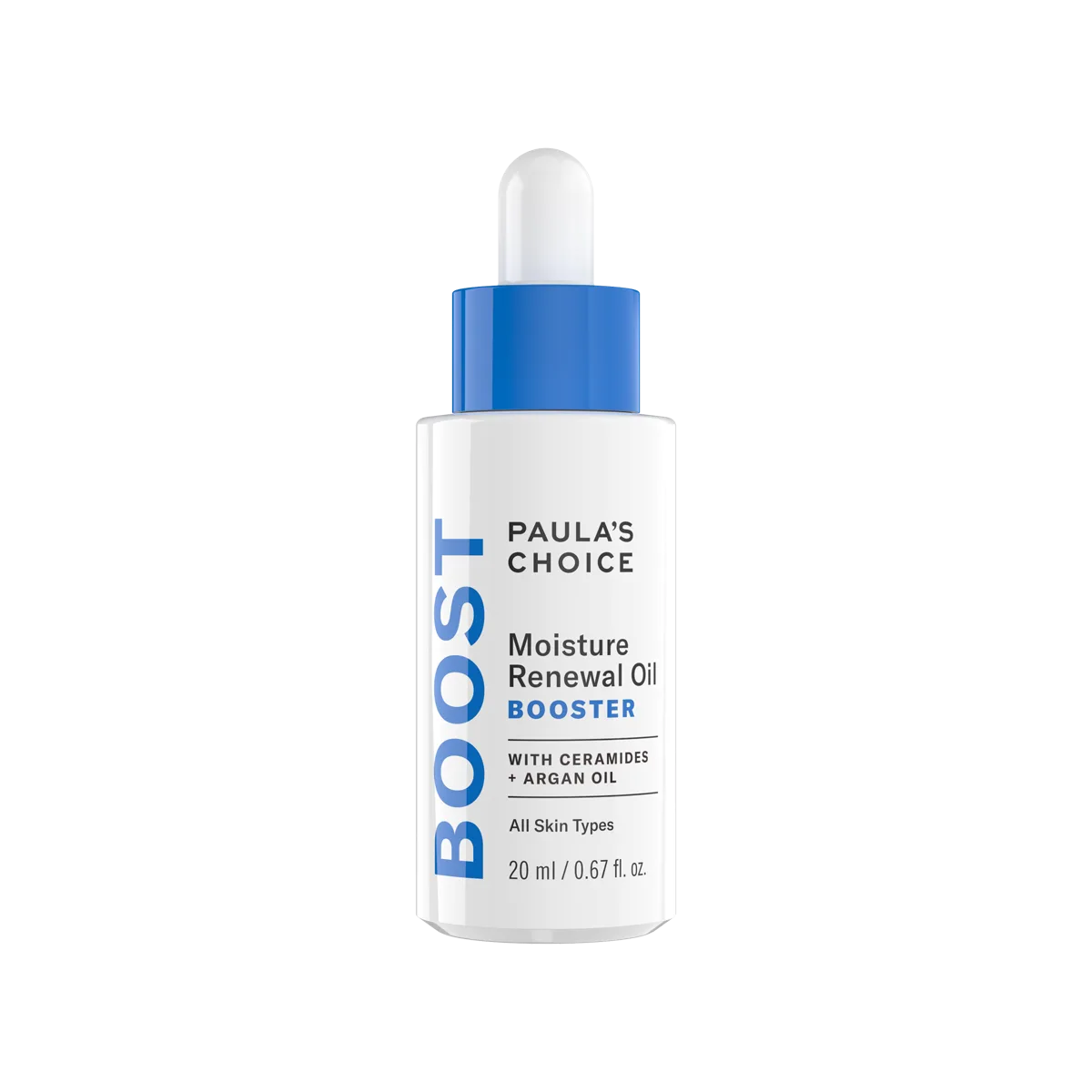
Moisture Renewal Oil Booster
Barrier-Repair Oil Blend
 Verified reviewer
Pros & cons.
- +Ceramide NS and cholesterol provide genuine barrier-repair benefits beyond simple emolliency
- +GLA-rich borage and evening primrose oils deliver documented anti-inflammatory action
- +Completely fragrance-free with zero essential oils — exceptionally rare for a facial oil
- +Lightweight absorption from the jojoba-led blend leaves dewy finish without greasiness
- +Only 11 ingredients with zero fillers, preservatives, or emulsifiers
- +Versatile use — alone, mixed into moisturizer, or blended into foundation
- +Excellent companion for retinoid users needing barrier support
- −At $39 for 0.67 oz, the price per ounce is steep for a jojoba-oil-led blend
- −Can feel greasy on oily or combination skin if more than 2-3 drops are used
- −No active anti-aging ingredients despite the 'renewal' marketing language
- −Short 6-month PAO requires timely use to avoid oxidation
- −May pill under makeup if not fully absorbed before foundation application
The full review.
Most facial oils irritate skin. This isn’t because oils are bad, but because the category uses essential oils, fragrant plant extracts, and aromatic compounds that damage sensitized skin. Paula Begoun built an oil booster with zero fragrant ingredients—a simple solution few brands follow.
The ingredient list focuses on fatty acids. Jojoba oil leads because its structure mimics human sebum. It is a liquid wax ester, not an oil, so it integrates into the skin’s lipid matrix instead of sitting on top. Safflower oil and sunflower oil follow, both high in linoleic acid. This choice matters: linoleic acid-dominant oils support ceramide production and cause less congestion than oleic acid-dominant oils.
The GLA content is key. Borage seed oil provides roughly 24% gamma-linolenic acid, the highest known plant source, paired with evening primrose oil. GLA is a precursor to anti-inflammatory prostaglandins. Topical GLA helps inflammatory skin conditions like eczema and dermatitis. This calming effect is gradual, manifesting over weeks as GLA integrates into cell membrane phospholipids. For chronically red, irritated dry skin, the effect is cumulative.
The real innovation lies in the final two ingredients. Ceramide NS and cholesterol are skin-identical lipids. Together with the fatty acids from the nine plant oils, they recreate the three essential components of the stratum corneum’s lipid barrier. Most facial oils only provide fatty acids; this one provides the complete structural toolkit.
The texture is lighter than a nine-oil blend usually feels. Two to three drops spread easily and absorb within minutes, leaving a dewy sheen rather than a greasy film. Jojoba oil helps this absorption because the skin recognizes its structure as similar to sebum. Mixed into a moisturizer, the oil adds richness without significantly changing the product’s consistency.
The experience is defined by what is missing. There is no scent—no lavender, rosehip, bergamot, or “natural botanical aroma.” This is rare for a facial oil and helps those with sensitive skin. The texture is also neutral: no warming or tingling, just the comfort of well-formulated emolliency.
Results follow a pattern. The immediate effect is cosmetic: skin looks dewier, feels softer, and has subtle luminosity. Within the first week, the tightness common in dry skin types recedes. By two to four weeks, barrier-repair benefits compound: less redness, less reactive sensitivity, and less low-grade inflammation.
The price is a factor. Thirty-nine dollars for 0.67 ounces of a product primarily composed of jojoba oil is a premium. Pure jojoba oil costs much less and provides a similar emollient effect. You pay for the curation: the specific GLA-rich oils, the ceramide and cholesterol, and the zero fragrance guarantee. The value depends on whether you prioritize formulation intelligence over raw ingredients.
Using two to three drops twice daily makes the bottle last roughly two to three months. The six-month PAO means you should use it within that window. The per-day cost is about sixty to seventy cents, though the small bottle size is notable.
This product suits dry and normal skin types wanting more than simple emolliency. The barrier-repair lipids, anti-inflammatory GLA oils, and lack of sensitizing ingredients make it a scientifically grounded facial oil. It does not work like a vitamin C serum or a retinol; it works quietly, and you notice its absence when you stop using it.
Ingredient analysis.
Full INCI list
Simmondsia Chinensis (Jojoba) Seed Oil, Carthamus Tinctorius (Safflower) Seed Oil, Prunus Armeniaca (Apricot) Kernel Oil, Helianthus Annuus (Sunflower) Seed Oil, Vaccinium Macrocarpon (Cranberry) Seed Oil, Argania Spinosa Kernel Oil, Borago Officinalis (Borage) Seed Oil, Oenothera Biennis (Evening Primrose) Oil, Echium Plantagineum Seed Oil, Ceramide NS, Cholesterol
Skin match.
The science.
The Science
The barrier-repair rationale behind this formula rests on established lipid biochemistry. The stratum corneum's extracellular lipid matrix is composed of approximately 50% ceramides, 25% cholesterol, and 15% free fatty acids arranged in lamellar bilayers. Research by Holleran et al. published in the Journal of Clinical Investigation demonstrated that topical application of any single lipid class alone is insufficient for optimal barrier repair — all three components must be present in appropriate ratios for the lamellar structure to reform correctly.
This formula addresses all three: ceramide NS provides the ceramide component, cholesterol is included directly, and the nine plant oils supply a diverse fatty acid profile. The emphasis on linoleic acid-rich oils is particularly relevant, as research by Letawe et al. in Clinical and Experimental Dermatology found that sebum from acne-prone individuals has significantly lower linoleic acid content, and topical application of linoleic acid can normalize sebum composition.
The GLA-rich oils represent another evidence-based choice. A systematic review by Timoszuk et al. in the International Journal of Molecular Sciences (2018) detailed gamma-linolenic acid's role as a precursor to dihomo-gamma-linolenic acid (DGLA), which produces anti-inflammatory prostaglandins (PGE1) through the cyclooxygenase pathway. Topical GLA application has shown benefits in clinical trials for atopic dermatitis, with improvements in skin barrier function, hydration, and reduction of inflammatory markers.
Dermatologist Perspective
Board-certified dermatologists recognize the importance of replenishing all three components of the lipid barrier — ceramides, cholesterol, and fatty acids — for effective barrier repair. Dermatologists frequently recommend ceramide-containing products for patients with compromised barriers from conditions like eczema, rosacea, and retinoid-induced irritation. The fragrance-free and essential-oil-free formulation aligns with dermatological recommendations to avoid potential sensitizers in products for reactive skin. Dermatologists note that while this oil provides excellent emolliency and barrier support, it should complement rather than replace a complete moisturizer in a treatment regimen.
Where it fits in your routine.
Press 2-3 drops into skin after water-based serums and before moisturizer. For a simpler routine, mix drops into your moisturizer first. You can also mix it into liquid foundation for a dewy finish. Apply to slightly damp skin to improve absorption. Use morning and evening, or evening only if skin is oily. It also works on cuticles, dry patches, and hair flyaways.
At $39 for 0.67 oz ($58/oz), this facial oil is a premium product. Only one size exists, so you cannot buy in bulk for better value. Twice-daily use lasts 2-3 months, making the daily cost about $0.45-$0.65. The ceramide and cholesterol additions justify a higher price than commodity plant oils, but the premium is debatable since jojoba oil — the lead ingredient — costs under $15 per ounce for high-quality versions. The brand's 30-year credibility and the thoughtful curation of the oil blend explain the rest.
Dry and normal skin types want a scientifically grounded facial oil that repairs the barrier. It works well for sensitive or rosacea-prone skin that reacts to essential oils in most facial oil products. It also works for retinoid users who need an emollient barrier-support layer.
Oily skin types find facial oils too heavy. Budget-conscious consumers prefer a ceramide moisturizer that provides the same barrier-repair lipids at a lower per-use cost. This is also not suitable for those with fungal acne concerns.
Product details.
Lightweight, silky oil that absorbs within a few minutes. Not viscous or heavy — flows easily from the dropper. Leaves a soft, dewy sheen without the greasy residue of heavier facial oils.
This is fragrance-free with no essential oils and has no scent. The plant oil blend is neutral.
Small glass bottle uses a pipette dropper in Paula's Choice minimalist design. The dropper dispenses 2-3 drops per application precisely. The clean, clinical aesthetic matches the brand's packaging approach.
The first application gives immediate results — skin looks dewier and feels softer within minutes. The oil sinks in faster than most users expect, leaving a luminous sheen instead of a greasy film. Dry skin types feel relief from tightness near-instantly.
2-3 months with once or twice daily use of 2-3 drops
6 months
fall winter
The backstory.
Paula Begoun formulated this oil at a time when the 'clean beauty' movement was flooding the market with essential-oil-laden facial oils that smelled beautiful but irritated sensitive skin. Her response was characteristically contrarian: a fragrance-free, essential-oil-free blend built around the science of barrier repair rather than the aesthetics of botanical aromatherapy.
About Paula's Choice
Legacy Brand (20+ years)Consumer advocate Paula Begoun, the 'Cosmetics Cop,' founded Paula's Choice in 1995. The brand builds its reputation on fragrance-free, evidence-based formulations. Paula's Choice is Leaping Bunny certified and dermatologists widely recommend it for its transparent, research-driven approach.
Common myths.
Facial oils clog pores and cause acne.
Linoleic acid-rich oils (safflower, sunflower, evening primrose) dominate this blend and reduce comedogenicity. Research shows acne-prone skin often lacks linoleic acid; applying linoleic acid-dominant oils helps normalize sebum composition. Oily skin types should still use this sparingly.
A facial oil can replace moisturizer.
Oils provide emolliency and occlusion but don't deliver the humectants (like hyaluronic acid or glycerin) that pull moisture into the skin. This booster works best when layered with or mixed into a water-based moisturizer — the moisturizer hydrates, and the oil seals that hydration in.
FAQ.
Can I use this oil if I have oily or acne-prone skin?
This oil works best for dry and normal skin. Linoleic acid-dominant oils (safflower, sunflower) usually tolerate acne-prone skin well, but the thick blend feels heavy on oily skin. To try it, mix 1-2 drops into a lightweight moisturizer and use only at night.
Should I apply this before or after moisturizer?
Both methods work. Apply 2-3 drops before moisturizer to let the oil absorb, then seal with cream. Or mix drops into your moisturizer for one step. Apply before sunscreen in the morning; the oil does not interfere with SPF protection.
Does this oil contain any essential oils or fragrance?
No — this is one of the few facial oils on the market with zero essential oils, zero fragrance, and zero aromatic plant extracts. The blend uses only functional plant oils, ceramide, and cholesterol. It has no discernible scent.
Why does this contain ceramide and cholesterol in an oil?
Ceramide NS and cholesterol are two of the three essential components of the skin's natural lipid barrier; the nine plant oils provide the third, fatty acids. This formula includes all three to rebuild the barrier structure that prevents moisture loss, not just add moisture. It is barrier repair in an oil format.
Can I use this with retinol or tretinoin?
Yes — many users use this oil to buffer retinoid irritation. Apply your retinol first, wait a few minutes, then add 2-3 drops of this oil to create an emollient, barrier-supporting layer. The ceramide and cholesterol content helps retinol-compromised skin barriers. ---
What the community says.
"Adds moisture and glow without causing breakouts for most users"
"Absorbs well for an oil — lightweight and non-greasy in small amounts"
"Soothes redness and calms rosacea-prone skin noticeably"
"Works beautifully mixed into moisturizer or foundation for a dewy finish"
"Multi-purpose for face, cuticles, dry patches, and flyaway hair"
"Truly fragrance-free with zero essential oils — rare for a facial oil"
"Expensive at $39 for only 0.67 oz when the base is largely jojoba oil"
"Can feel greasy on oily or combination skin if more than 2-3 drops are used"
"Some users notice no visible difference after extended use"
"May pill under makeup if not fully absorbed before foundation application"
"No active anti-aging ingredients despite 'renewal' in the name"
People also looked at.