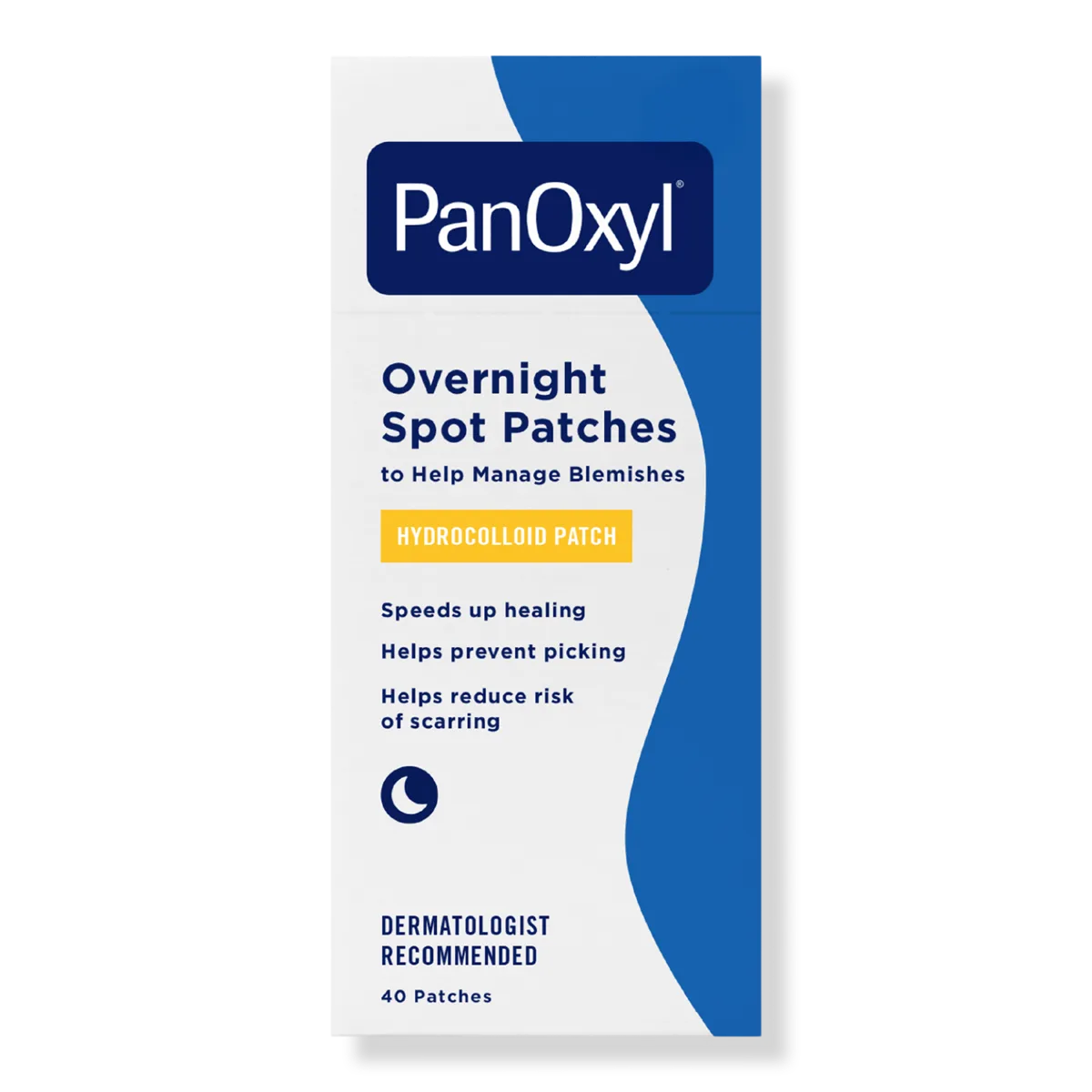
PM Overnight Spot Patches
Overnight Acne Fighter
 Verified reviewer
Pros & cons.
- +Thicker hydrocolloid construction absorbs more fluid than many thinner competitors
- +Dual patch sizes (9mm and 12mm) accommodate different blemish sizes in one box
- +Completely drug-free — no risk of bleaching pillowcases or irritating sensitive skin
- +Strong overnight adhesion that holds through sleep without curling at edges
- +Clean formulation free from fragrance, parabens, sulfates, dyes, and latex
- +Vegan and HSA/FSA eligible for budget-conscious acne management
- +Backed by a legacy acne brand with over 50 years of dermatologist trust
- −Ineffective on deep cystic acne that sits below the skin surface
- −Slightly more expensive per patch than basic generic hydrocolloid options
- −Contains t-butyl alcohol which may concern ingredient-conscious consumers despite trace amounts
- −Can leave mild adhesive residue on oily skin types after removal
- −Requires completely clean, dry skin for proper adhesion — not compatible with layered routines
The full review.
PanOxyl built its reputation on benzoyl peroxide. For over fifty years, the brand has used that tingly, bleach-your-towels acne approach that dermatologists recommend because it works. When PanOxyl launched its PM Overnight Spot Patches in October 2020, they contained no benzoyl peroxide, no salicylic acid, and no active medication. They use hydrocolloid technology to absorb fluid and create a clean healing environment while you sleep.
This was a calculated move. The pimple patch market exploded, driven by K-beauty brands that introduced Western consumers to the ritual of peeling off a patch to see extracted gunk. PanOxyl entered a crowded field but brought the implicit trust of a legacy acne brand. When PanOxyl names a product, dermatologists pay attention.
The patches have a straightforward construction. The hydrocolloid matrix—built from carbomer polymers and polyacrylate crosspolymer-6—creates an absorbent film. This film adheres to clean skin and draws moisture and sebaceous material from the blemish through osmotic pressure. Glycerin within the matrix maintains hydration at the wound site, preventing the dry-and-crack cycle that slows healing and increases post-inflammatory hyperpigmentation risk. Dimethicone helps the adhesive seal stay put through a full night of movement.
Thickness sets these apart from other hydrocolloid options. PanOxyl made these patches slightly thicker than the industry standard. This is not a gimmick; thicker hydrocolloid material has greater absorption capacity, so each patch pulls more fluid before reaching saturation. If a patch turns white in the center but leaves the surrounding area inflamed, that is a saturation problem. These patches address it.
The dual-size format is practical. Each box contains both 9mm and 12mm patches, so you do not stretch a small patch over a large blemish or waste a big patch on a tiny spot. Having options in one box is convenient for breakouts containing both small whiteheads and larger inflamed papules.
Application follows standard pimple-patch protocol: cleanse, dry thoroughly, apply directly to the blemish, and sleep. Dry skin is essential—residual moisture, serum, or moisturizer between the patch and skin compromises the adhesive bond and reduces hydrocolloid contact with the blemish. Apply the patch first, then moisturize around it.
Performance on surface-level blemishes is reliable. Whiteheads and recently popped pimples respond best, showing reduced size and redness by morning. The patch turns opaque white as it absorbs, which is informative. One night often suffices for blemishes ready to drain. Stubborn spots may need two or three consecutive nights of fresh patches.
These patches hit a ceiling with deep cystic acne, which is a limitation of all hydrocolloid patches. Cysts sit far beneath the skin surface, beyond the reach of topical osmotic absorption. For painful, nodular breakouts, these patches protect the surface from picking but do not address underlying inflammation. That requires a dermatologist and a different class of treatment.
The ingredient list is minimal. There is no fragrance, no parabens, no sulfates, and no dyes. The patches are vegan and latex-free. For a product sitting on potentially broken skin for eight hours, this formulation matters. Nothing in the INCI list should raise flags for sensitive or reactive skin types.
At roughly $9.59 for 40 patches—about 24 cents per patch—these sit in the affordable middle of the pimple patch market. Generic hydrocolloid dots are cheaper, but the thicker construction and dual-size format justify the premium. The 80-count box offers better per-unit value for frequent users.
The experience is unglamorous. There is no tingling sensation and no fancy active ingredient to research. You stick it on, sleep, and wake up to a smaller blemish. The lack of drama is the point. Sometimes the most effective treatment is protecting a wound from the environment and your fingers while your skin heals itself.
PanOxyl earned its reputation with aggressive acne-fighting chemistry. These patches prove the brand understands that sometimes restraint is the better approach.
Ingredient analysis.
Full INCI list
Carbomer Homopolymer Type C, Carbomer Interpolymer Type A, Decyl Glucoside, Dimethicone, Dioctyl Sodium Sulfosuccinate, Glycerin, Palmitic Acid, Polyacrylate Crosspolymer-6, Polyoxyl 40 Stearate, Propanediol, Purified Water, Silica, Sodium Chloride, Sodium Citrate, Sodium Hydroxide, Sodium Laurylglucosides Hydroxypropylsulfonate, Sorbitan Stearate, Stearic Acid, T-Butyl Alcohol, Xanthan Gum
Skin match.
The science.
The Science
Hydrocolloid technology started in wound care, not skincare. Clinicians originally used hydrocolloid dressings for chronic wounds like pressure ulcers and surgical sites to create a moist wound healing environment. George Winter pioneered this concept in 1962, showing wounds heal faster when hydrated instead of exposed to air.
These patches work through osmotic absorption. The carbomer and polyacrylate crosspolymer-6 matrix uses hydrophilic polymers that swell when they touch wound exudate, pulling fluid from the blemish into the patch material. This does two things: it physically removes inflammatory fluid and maintains a sealed microenvironment to prevent secondary bacterial colonization.
A 2006 randomized double-blind study in the Journal of Cosmetic Dermatology (Lee et al.) showed that hydrocolloid dressings on acne lesions reduced overall acne severity and inflammation more than controls over three to seven days. The study also noted improvements in redness, oiliness, and sebum levels.
Research from the 2024 American Academy of Dermatology meeting showed that hydrocolloid patches improved popped pimple appearance scores on Days 1 and 4 during a 14-day randomized controlled trial. Benefits included better smoothness, less crusting, less erythema, and reduced size.
The glycerin component acts as a humectant within the matrix to support the moist healing environment, while dimethicone provides an occlusive secondary barrier. This combination absorbs excess fluid and prevents transepidermal water loss from the surrounding skin, avoiding the over-drying common with topical acne medications.
The evidence base for hydrocolloid patches in acne specifically—rather than general wound care—is still developing. Most clinical evidence comes from broader wound healing literature, though acne-specific studies are increasing as the category grows.
References
- A pilot study on efficacy treatment of acne vulgaris using a new method: results of a randomized double-blind trial with Acne Dressing — Journal of Cosmetic Dermatology (2006)
- The Science Behind a Viral Trend: Demonstrating Safety and Efficacy of Hydrocolloid Patch for Facial Acne — Journal of the American Academy of Dermatology (2024)
- Narrative Review of the Use of Hydrocolloids in Dermatology: Applications and Benefits — Journal of Clinical Medicine (2025)
Dermatologist Perspective
Dermatologists often recommend hydrocolloid patches as a practical addition to acne treatment, especially for patients who pick or squeeze blemishes—behaviors that increase scarring risk. Board-certified dermatologists note that patches do not replace prescription acne treatments, but they protect active lesions and reduce post-inflammatory hyperpigmentation. Because these patches are drug-free, they are a safe option for pregnant patients, people with sensitive skin, and those using potent topical treatments who need a non-irritating spot treatment. Dermatologists also find that the occlusive environment enhances the skin's natural wound-healing cascade without the irritation caused by benzoyl peroxide or retinoid spot treatments.
Where it fits in your routine.
Cleanse your face and pat it dry; adhesion requires a dry surface. Pick the right patch size for your blemish. Peel the patch from the backing sheet and press it onto the blemish for a few seconds to seal. Apply skincare products around the patches, not underneath. Leave the patches on for 6-8 hours overnight. Peel them off gently from the edge in the morning. A white patch shows it absorbed fluid. Cleanse the area and apply a fresh patch the next night if needed.
At $9.59 for 40 patches, PanOxyl costs about 24 cents per patch — a competitive price in the branded pimple patch market. The 80-count box provides better per-unit value for regular breakouts. Generic hydrocolloid dots cost as little as 10-15 cents per patch, so PanOxyl's thicker construction, dual-size format, and brand backing command a modest premium. This premium is small, and the thicker patches absorb more effectively. For a legacy acne brand, the pricing is fair, not aspirational — this is a drugstore product priced like a drugstore product, unlike brands in this category that charge luxury prices for identical technology.
This works for anyone with occasional surface-level breakouts seeking an effective, non-irritating overnight treatment. It suits skin-pickers needing a physical barrier against squeezing, and people wanting a drug-free acne option that does not interact with existing prescription treatments.
Hydrocolloid patches do not address the root cause of deep cystic acne, blackheads, or closed comedones. They also fail if you do not apply them to clean, bare skin, as the patches need direct contact to work.
Product details.
Thin, flexible hydrocolloid film. It is slightly thicker than many competitors. The film is clear and nearly invisible on skin.
No scent — completely fragrance-free.
Flat peel-apart sheets feature individual patches in rows. Boxes come in 20-count, 40-count, and 80-count sizes. Each sheet uses a mix of 9mm and 12mm patches.
Apply to a clean, dry blemish. The patch turns white within a few hours as it absorbs fluid. The adhesive stays put during sleep but peels off gently in the morning. It has no tingling, stinging, or adjustment period.
40 patches last 2-4 weeks, depending on breakout frequency and patches used per night.
24 months
All Year
The backstory.
When Crown Laboratories acquired PanOxyl in 2018, the brand was known almost exclusively for its benzoyl peroxide washes. The PM Overnight Spot Patches, launched in October 2020, represented PanOxyl's first move into the then-booming pimple patch category — leveraging the brand's acne credibility to compete in a space dominated by K-beauty newcomers.
About PanOxyl
Legacy Brand (20+ years)PanOxyl has been a dermatologist-recommended acne brand for over 50 years. It is the #1 dermatologist-recommended benzoyl peroxide brand in the U.S. Crown Laboratories now owns the brand, which has expanded from benzoyl peroxide washes into complementary acne care products.
Common myths.
Hydrocolloid patches treat acne by killing bacteria.
Hydrocolloid patches lack antibacterial agents. They absorb wound exudate and create a sealed, moist environment to speed skin repair. This physical barrier also stops external bacteria from entering the blemish.
Pop a pimple before applying a patch for it to work.
These patches work on popped and unpopped surface-level blemishes. Applying them to an intact whitehead lets the hydrocolloid draw fluid through the skin surface without the infection risk of manual extraction.
FAQ.
Do PanOxyl PM Overnight Spot Patches contain benzoyl peroxide?
No — PanOxyl is famous for benzoyl peroxide, but these patches contain no medication. They use hydrocolloid technology to absorb fluid and protect blemishes. They won't bleach your pillowcase or cause the dryness benzoyl peroxide causes.
Can I wear PanOxyl patches during the day?
The patches are clear and thin enough for daytime wear under makeup, despite being marketed for overnight use. They work best with 6-8 hours of uninterrupted sleep for maximum absorption.
Will PanOxyl patches work on cystic acne?
Hydrocolloid patches are most effective on surface-level blemishes that have come to a head. Deep cystic acne sits too far beneath the skin for the hydrocolloid to effectively draw out fluid. For cystic breakouts, consult a dermatologist about targeted treatments like cortisone injections.
How long should I leave PanOxyl patches on?
Apply to clean, dry skin before bed and leave on for 6-8 hours. The patch turns white as it absorbs fluid, showing it works. Remove in the morning, cleanse the area, and apply a fresh patch the next night if the blemish hasn't fully resolved.
Can I use PanOxyl patches with retinol or other acne treatments?
Do not apply active treatments like retinol, benzoyl peroxide, or salicylic acid underneath the patch — the occlusive seal can intensify irritation. Apply these treatments to surrounding skin only, or use them on alternate nights from the patches.
Are PanOxyl patches safe during pregnancy?
Yes. These patches contain no active medications; they are drug-free hydrocolloid dressings. The ingredient list lacks retinoids, salicylic acid, and other pregnancy-restricted compounds. This makes them a safe spot treatment option during pregnancy.
What the community says.
"Effectively draws out pus and reduces pimple size overnight"
"Thicker than many competitors for better absorption"
"Stays on well throughout the night"
"Good variety with two patch sizes included"
"Affordable and widely available at drugstores"
"Does not work well on deep cystic acne"
"Slightly more expensive than some generic hydrocolloid patches"
"Can leave adhesive residue on some skin types"
"Not effective on closed comedones or blackheads"
People also looked at.