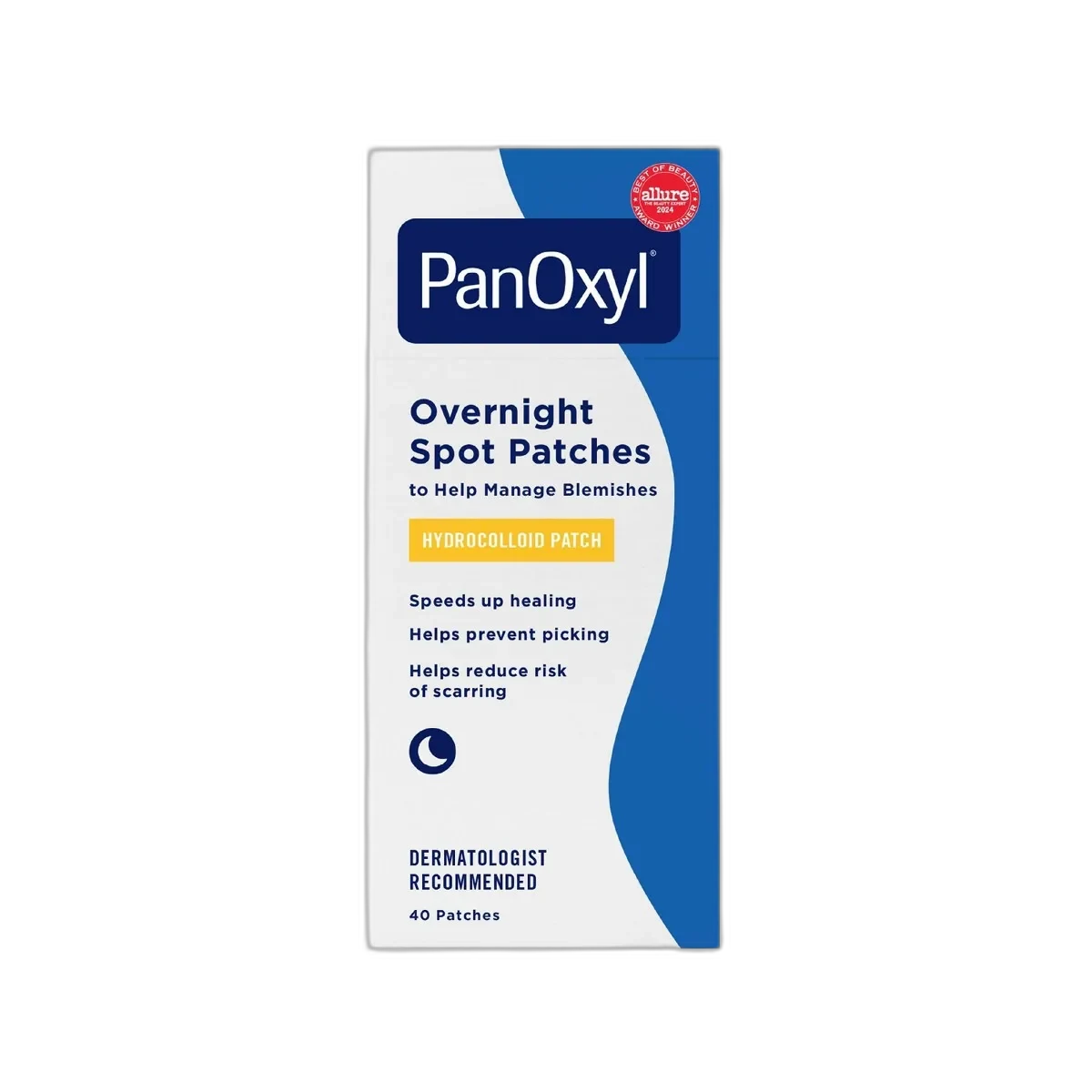
Acne Patches
Derm-Brand Acne Patch
 Verified reviewer
Pros & cons.
- +Backed by PanOxyl's 50+ year dermatological heritage and dermatologist-recommended brand status
- +Clean, non-medicated formula that is fragrance-free, vegan, and gentle for all skin types
- +Effectively absorbs pus and fluid from surface-level blemishes overnight with visible results
- +Prevents picking behavior — arguably the most valuable function for reducing scarring risk
- +Competitive pricing at approximately $0.24 per patch in the 40-count box
- +HSA/FSA eligible for zero out-of-pocket cost with flexible spending accounts
- +Part of a three-product patch system covering overnight, daytime, and post-acne stages
- −Contains no active ingredients despite the PanOxyl brand association with benzoyl peroxide
- −Thicker and more visible on skin than competing patches like Hero Cosmetics Mighty Patch
- −Adhesion may be inconsistent — patches can lift at edges during sleep for some users
- −Limited to two sizes (9mm and 12mm) with no extra-large option for bigger blemishes
- −Ineffective on deep cystic acne that has not come to a head
The full review.
About PanOxyl
Established Brand (50+ years)
How to Use
Each box has two sizes — 9mm for smaller blemishes and 12mm for larger ones — on peel-off sheets for easy application. Cleanse your skin, dry the target area, press a patch on, sleep, and remove it in the morning.
Who Should Buy
If you pick at your skin — which research shows many acne sufferers do — the behavioral intervention alone justifies PanOxyl.
Texture
The patches are thicker than the market-leading Mighty Patch from Hero Cosmetics.
Scent
Fragrance-free.
Packaging
Each box has two sizes — 9mm for smaller blemishes and 12mm for larger ones — on peel-off sheets for easy application.
Common Praise
The patches draw visible material from a ready-to-drain whitehead overnight.
Common Complaints
These sit more noticeably on the skin than ultra-thin competitors, so they work poorly for daytime wear or video calls. Some users report PanOxyl’s patches lift at the edges more than Mighty Patch or COSRX alternatives.
Best for
Overnight blemish management.
Works for
Surface-level whiteheads with visible pus.
Not ideal for
Deeper cystic acne below the skin surface. Daytime wear or video calls.
PM routine
Cleanse your skin, dry the target area, press a patch on, sleep, and remove it in the morning.
Ingredient analysis.
Full INCI list
Carbomer Homopolymer Type C, Carbomer Interpolymer Type A, Decyl Glucoside, Dimethicone, Dioctyl Sodium Sulfosuccinate, Glycerin, Palmitic Acid, Polyacrylate Crosspolymer-6, Polyoxyl 40 Stearate, Propanediol, Purified Water, Silica, Sodium Chloride, Sodium Citrate, Sodium Hydroxide, Sodium Laurylglucosides Hydroxypropylsulfonate, Sorbitan Stearate, Stearic Acid, T-Butyl Alcohol, Xanthan Gum
Skin match.
The science.
The Science
Hydrocolloid dressings have been used in wound care since the 1980s, and their application to acne treatment leverages the same well-established moist wound healing principles. The hydrocolloid matrix — typically composed of carboxymethylcellulose, pectin, or gelatin bound in a polyurethane film — absorbs wound exudate while maintaining an optimal moisture level at the wound surface.
A 2006 study by Thomas and Loveless in the Journal of Wound Care confirmed that hydrocolloid dressings promote wound healing by maintaining a moist environment that facilitates cell migration and reduces scab formation. This same principle applies to acne lesions — by keeping the blemish covered in a controlled-moisture environment, the patch reduces inflammation and supports faster resolution without the crust formation that leads to picking and scarring.
The physical barrier function of the patches has behavioral implications supported by dermatological research. A 2020 study published in the Journal of Clinical and Aesthetic Dermatology examined excoriation disorder (skin picking) in acne patients and found that physical barriers significantly reduced picking behavior. While the study focused on more severe picking disorders, the principle extends to casual picking: if you cannot touch the blemish, you cannot make it worse.
Regarding the absorption mechanism, hydrocolloid technology works through osmotic pressure gradients. The sodium carboxymethylcellulose in the dressing creates a concentration gradient that draws aqueous wound fluid (containing pus, bacteria, and inflammatory mediators) from the blemish into the patch matrix. The visible whitening of the patch represents the hydrocolloid gel absorbing and retaining this fluid.
References
- Hydrocolloid dressings in the management of acute wounds: a review of the literature — Journal of Wound Care (2006)
- Skin Picking Disorder and Acne: Prevalence and Impact on Quality of Life — Journal of Clinical and Aesthetic Dermatology (2020)
Dermatologist Perspective
Dermatologists generally view hydrocolloid acne patches as a useful adjunctive tool in acne management — particularly for patients who struggle with picking behaviors that worsen scarring and post-inflammatory hyperpigmentation. Board-certified dermatologists note that these patches are not a substitute for comprehensive acne treatment (retinoids, benzoyl peroxide, prescription medications) but serve a valuable role in managing individual active blemishes. The non-medicated nature of PanOxyl's overnight patches means they do not interfere with other topical acne treatments applied to surrounding skin. Dermatologists would typically recommend these for surface-level whiteheads and pustules rather than deep cystic lesions, and would advise patients that the patches treat individual blemishes rather than preventing future breakouts.
Where it fits in your routine.
Cleanse your face and pat the blemish area dry. Any moisture or product prevents adhesion. Pick the right patch size (9mm for small blemishes, 12mm for larger ones). Peel the patch from the sheet and press it onto the blemish for 5-10 seconds. Leave it on for 6-8 hours overnight. In the morning, peel the patch off gently from one edge. The patch turns white after it absorbs fluid. Cleanse the area and use a fresh patch the next night if needed. Do not apply over active serums, oils, or moisturizers.
At about $9.59 for 40 patches (~$0.24 per patch), PanOxyl has competitive mid-range pricing for acne patches. The 80-count box at ~$14.99 (~$0.19 per patch) offers better value for regular users. COSRX patches cost much less in bulk (~$0.05 per patch), while Hero Cosmetics Mighty Patch costs slightly more (~$0.33 per patch). HSA/FSA eligibility removes the cost for consumers with flexible spending accounts. The brand credibility, clean formulation, and pricing provide fair value.
This works for anyone with active surface-level breakouts seeking a simple, non-medicated overnight blemish management approach. It helps skin-pickers by providing a physical barrier to break the habit. It suits sensitive skin types that react to medicated spot treatments and anyone wanting a clean, fragrance-free option from a dermatologist-recommended brand.
People with deep cystic acne get limited benefit because hydrocolloid patches cannot draw material from below the skin surface. For active treatment ingredients, use PanOxyl's Daytime Invisible Patches (salicylic acid) or microdart alternatives. COSRX patches cost a fraction per unit for budget-focused consumers.
Product details.
Thin, flexible hydrocolloid patches have a slightly tacky adhesive backing. They include two sizes: 9mm (small) and 12mm (large). The patches are clear and semi-transparent when applied, but turn white as they absorb fluid.
Completely unscented — no fragrance of any kind.
A flat sealed pouch sits inside a cardboard box. Peel-off sheets arrange the patches for easy application. Boxes come in 20-count, 40-count, and 80-count sizes.
Press the patch onto clean, dry skin. It causes no tingling, burning, or sensation; the patch just sits on the skin. By morning, the patch turns opaque white in the center, showing it absorbed fluid. Removing the patch reveals a flatter, less inflamed blemish in most cases.
20-40 days based on breakout frequency; use one patch per blemish per night
24 months
All Year
The backstory.
PanOxyl's entry into the acne patch market in October 2020 marked the brand's expansion beyond its core benzoyl peroxide wash identity under new owner Crown Laboratories. The timing was strategic — the hydrocolloid patch market was exploding thanks to Hero Cosmetics' Mighty Patch, and PanOxyl's dermatological heritage gave it instant credibility in the space. The launch proved successful enough that PanOxyl followed with two additional patch variants targeting different stages of the acne lifecycle.
About PanOxyl
Legacy Brand (20+ years)PanOxyl started in the early 1970s at Stiefel Laboratories as a dermatologist-recommended benzoyl peroxide brand. Crown Laboratories acquired the brand in 2018. PanOxyl has over 50 years of dermatological heritage and is the #1 dermatologist-recommended benzoyl peroxide brand in the U.S. The patches line launched in 2020 to expand beyond the core wash products.
FAQ.
Do PanOxyl Acne Patches contain benzoyl peroxide?
No. Despite PanOxyl being known as a benzoyl peroxide brand, the PM Overnight Spot Patches contain no active drug ingredients. They are hydrocolloid patches that work by absorbing pus and fluid and protecting blemishes. PanOxyl's separate Daytime Invisible Patches contain salicylic acid, but the overnight patches are non-medicated.
How do PanOxyl patches compare to Mighty Patch?
Both are hydrocolloid patches at similar prices (~$0.24/patch for PanOxyl 40ct vs ~$0.33/patch for Mighty Patch 36ct). PanOxyl patches are thicker, which can increase absorption but makes them more visible. Some users say Mighty Patch adheres better overnight. PanOxyl has a dermatological brand heritage and a three-product patch system.
Can you wear PanOxyl patches during the day?
The PM Overnight Spot Patches work at night; they are thicker and more visible than daytime versions. PanOxyl sells separate Daytime Invisible Patches that are ultra-thin, work under makeup, and use salicylic acid for daytime treatment.
How long should you leave PanOxyl patches on?
Apply to clean, dry skin at bedtime and leave on for 6-8 hours overnight. The patch turns white as it absorbs fluid, which shows it works. Remove in the morning, cleanse the area gently, and apply a fresh patch the following night if the blemish has not fully resolved.
Do PanOxyl patches work on cystic acne?
Hydrocolloid patches work best on whiteheads and surface-level pimples with visible pus. For deep cystic acne below the skin surface, these patches have limited effectiveness because they cannot absorb surface fluid. PanOxyl's patches may reduce inflammation and protect cystic lesions from picking, but they do not drain deep cysts.
What the community says.
"Effectively draws out pus and fluid overnight with visible whitening of the patch"
"Prevents picking and touching which helps reduce scarring risk"
"Good value at approximately 24 cents per patch for the 40-count box"
"Fragrance-free and gentle enough for sensitive acne-prone skin"
"HSA/FSA eligible which adds purchasing flexibility"
"Adhesion can be inconsistent — some users report patches peeling off during sleep"
"Slightly thicker and more visible than some competitor patches like Mighty Patch"
"Does not contain active ingredients (no benzoyl peroxide despite the PanOxyl brand name)"
"Less effective on deep cystic acne that has not come to a head"
"Patch sizes limited to 9mm and 12mm — no extra-large option for bigger blemishes"
People also looked at.