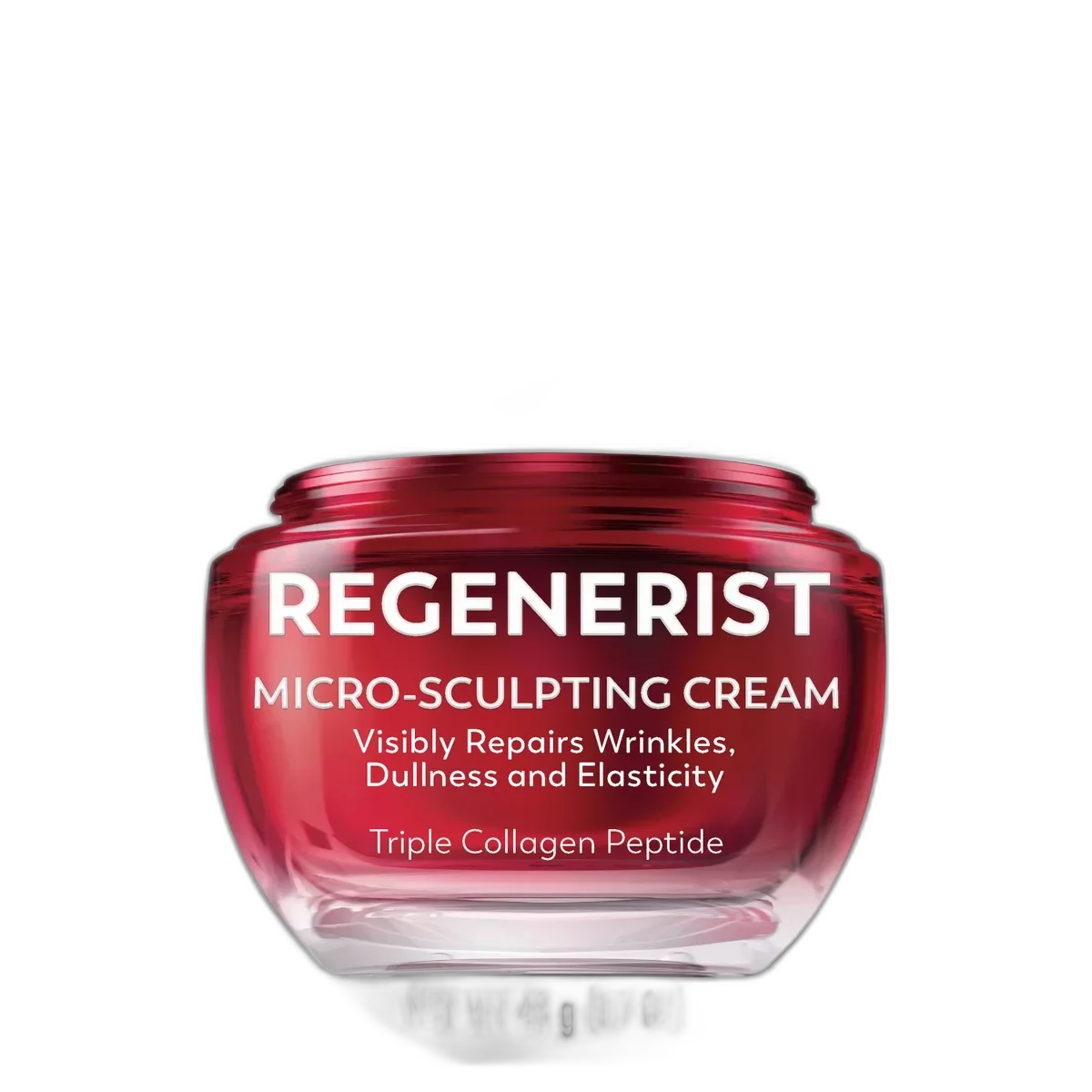
Regenerist Micro-Sculpting Cream
The Red Jar Icon
 Verified reviewer
Pros & cons.
- +Clinically studied Matrixyl peptide and niacinamide deliver measurable anti-aging results
- +Outperformed prestige creams costing up to $440 in independent blind testing
- +Velvety silky texture that feels significantly more luxurious than its price
- +Hyaluronic acid provides immediate plumping and visible fine-line reduction
- +Versatile enough for both daytime wear under makeup and nighttime use
- +Green tea and vitamin E provide solid antioxidant defense
- +Nearly two decades of real-world performance data across 70,000+ reviews
- −Contains isopropyl isostearate with a comedogenicity rating of 4-5 out of 5
- −Three parabens as preservatives will deter ingredient-conscious consumers
- −Synthetic fragrance can trigger reactions in sensitized individuals
- −Jar packaging degrades peptide and antioxidant ingredients over time
- −Can feel tacky before fully absorbing especially in humid conditions
- −Over 40 ingredients is a complex formula that increases sensitization risk
The full review.
One billion jars. Consider that scale. Olay’s Regenerist Micro-Sculpting Cream has sold over a billion units globally since its launch. In the United States, one jar sells every twelve seconds. These are Coca-Cola numbers. Like Coca-Cola, the question is not whether people like it, but if the formula inside the iconic packaging justifies the scale.
The answer is mostly yes. The formula uses three actives with strong evidence: niacinamide for barrier repair and brightening, palmitoyl pentapeptide-4 (Matrixyl) for collagen signaling, and sodium hyaluronate for deep hydration. These are not trends; they are workhorse molecules with decades of published research. Niacinamide sits fourth on the INCI list. Its concentration likely delivers documented benefits: reduced transepidermal water loss, inhibited melanosome transfer, and improved skin elasticity. Matrixyl is at trace concentrations typical for signaling peptides, but peer-reviewed studies show it stimulates collagen I, III, and IV production.
The texture builds emotional loyalty for The Red Jar. It is velvety but not heavy, thick but not greasy—a rare cream that feels more expensive than its price. It melts into skin with a silky, primer-like slip and absorbs within one or two minutes, leaving a satin finish and subtle luminosity. It creates a smooth canvas under makeup. At night, it provides enough moisture for most skin types without the pillow-transfer issues of heavier creams.
The billion-jar story gets complicated here. The ingredient list has over forty entries, including choices a 2026 formulation would avoid. Isopropyl isostearate, a synthetic emollient with a comedogenicity rating of four to five out of five, is fifth. This is a red flag for acne-prone skin, and reviewer reports of breakouts match this. Three parabens—ethyl, methyl, and propyl—act as preservatives. This is functional but increasingly unpopular. The fragrance is present enough to trigger reactions in sensitized individuals.
These are not dealbreakers for everyone. If your skin is not acne-prone, paraben-sensitive, or fragrance-reactive, these ingredients work fine. Major regulatory bodies approve these paraben concentrations. The fragrance is within normal ranges. Isopropyl isostearate creates the texture that drives the user experience. But for sensitive users, The Red Jar will disappoint.
The value proposition earns the accolades. When Good Housekeeping Institute ran blind tests against ten prestige moisturizers—including one costing four hundred forty dollars—the Micro-Sculpting Cream won. At twenty-five dollars for a jar lasting two to three months, you can buy roughly eighteen jars for the price of that one prestige competitor and get better measured results from each. This is a laboratory finding from an independent testing organization, not marketing.
The jar packaging is a valid criticism. Scooping cream from an open jar introduces bacteria and exposes air-sensitive ingredients—peptides, antioxidants, vitamin E—to oxidative degradation. A pump or tube preserves ingredient integrity better. However, the red jar is so iconic that changing it is a branding decision, not a formulation one. Olay has decided the brand equity in that jar shape outweighs the packaging flaws.
The ingredient list is evolving for the 2026 reformulation featuring a new Triple Collagen Peptide; both versions may coexist during the transition. The core philosophy—effective anti-aging actives at a democratic price—remains.
The Micro-Sculpting Cream is not perfect. It is not the cleanest formula or the most elegant ingredient list. It is not for everyone. But it has spent nearly two decades proving effective anti-aging skincare does not need to cost a hundred dollars. The research and testing behind it are more rigorous than most luxury brands. The Red Jar is a phenomenon because it works.
Ingredient analysis.
Full INCI list
Water, Glycerin, Isohexadecane, Niacinamide, Isopropyl Isostearate, Aluminum Starch Octenylsuccinate, Nylon-12, Dimethicone, Panthenol, Tocopheryl Acetate, Sodium Hyaluronate, Palmitoyl Pentapeptide-4, Camellia Sinensis Leaf Extract, Aloe Barbadensis Leaf Juice, Allantoin, Stearyl Alcohol, Polyethylene, Cetyl Alcohol, Sodium Acrylates Copolymer, Behenyl Alcohol, Benzyl Alcohol, Acrylamide/Sodium Acryloyldimethyltaurate Copolymer, Dimethiconol, Sodium PEG-7 Olive Oil Carboxylate, Peucedanum Graveolens (Dill) Extract, PEG-100 Stearate, Stearic Acid, Disodium EDTA, Cetearyl Glucoside, Cetearyl Alcohol, Citric Acid, C12-13 Pareth-3, Laureth-7, C13-14 Isoparaffin, Sodium Hydroxide, Caprylic/Capric Triglyceride, Ethylparaben, Methylparaben, Propylparaben, Fragrance, Titanium Dioxide, Mica
Skin match.
The science.
The Science
Matrixyl peptide (palmitoyl pentapeptide-4) drives this formula. It mimics the KTTKS pentapeptide sequence — a type I procollagen fragment — to signal fibroblasts to increase extracellular matrix component production. A 2005 study by Robinson et al. in the International Journal of Cosmetic Science shows that topical Matrixyl reduces wrinkle depth and volume significantly compared to placebo, matching retinol's effects without the irritation (International Journal of Cosmetic Science, 2005). A later study by Lintner et al. shows Matrixyl stimulates production of collagen I, III, and IV, plus fibronectin and glycosaminoglycans, triggering several parts of the skin's structural repair machinery at once.
Niacinamide uses different mechanisms. Bissett et al. showed in a 2005 study in the Journal of Cosmetic Dermatology that topical niacinamide improves fine lines, hyperpigmentation, skin texture, and red blotchiness in aging facial skin (Journal of Cosmetic Dermatology, 2005). Niacinamide also strengthens the barrier by increasing ceramide and free fatty acid production in the stratum corneum, which supports the hydration from the sodium hyaluronate.
The Good Housekeeping Institute testing provides quasi-clinical data. Their lab evaluation measured hydration, firmness, and wrinkle reduction over time, finding the Micro-Sculpting Cream outperformed ten prestige competitors in a blinded protocol. This independent testing corroborates the ingredient-level evidence, even without peer-reviewed publication.
References
- Topical niacinamide reduces yellowing, wrinkling, red blotchiness, and hyperpigmented spots in aging facial skin — Journal of Cosmetic Dermatology (2005)
- Palmitoyl pentapeptide-4 anti-wrinkle peptide study — International Journal of Cosmetic Science (2005)
Dermatologist Perspective
Dermatologists recognize the Regenerist Micro-Sculpting Cream as a top OTC anti-aging moisturizer in drugstores. Board-certified dermatologists often recommend it as an accessible first step for patients who want anti-aging skincare but avoid prescription treatments. The niacinamide-peptide combination offers a gentle way to stimulate collagen production without retinoid-related irritation. However, dermatologists note that acne-prone patients should watch the isopropyl isostearate content, and those sensitive to fragrance or parabens should use the fragrance-free version. Dermatologists say that while this cream provides anti-aging benefits, users need daily broad-spectrum sunscreen for optimal results.
Where it fits in your routine.
Apply a dime-sized amount to a clean face and neck after serums or treatments. Massage upward until absorbed. Use morning and evening. In the AM, wait one to two minutes for full absorption before applying sunscreen; the silky finish works well under makeup. At night, this is the final step for most skin types. For anti-aging, layer over a retinol serum in the PM. The niacinamide in this cream buffers retinol irritation.
The value is exceptional. At $24.99 for 1.7 ounces, this cream uses the same active ingredient categories — peptides, niacinamide, hyaluronic acid — as prestige products costing ten to twenty times more. Independent testing shows it outperforms products at much higher price points. The jar lasts about two to three months with twice-daily use, making the daily cost roughly thirty cents. A fragrance-free version costs the same for those who want the actives without the scent. The jar packaging is the only value concern, as it may cause ingredient degradation before you finish the product.
Normal, dry, or combination skin types seeking proven anti-aging results at a drugstore price. This works for those who value clinical evidence over marketing hype and want a moisturizer that hydrates and treats aging. The iconic Red Jar is an excellent starting point for people new to anti-aging skincare.
Acne-prone individuals must be cautious because isopropyl isostearate is highly comedogenic. People sensitive to fragrance or parabens should use the fragrance-free version or other products. The 40+ ingredient formula does not suit those who prefer minimal ingredient lists or clean beauty formulations.
Product details.
This lightweight, thick cream has a velvety, whipped consistency. It melts into skin with a silky, primer-like slip.
The original version has a subtle floral fragrance. Users disagree on it; some like it, while others call it too chemical. A fragrance-free version is sold separately.
The iconic red jar has a screw-top lid and is known as 'The Red Jar' in beauty circles. Opaque plastic features white and gold Olay branding. A recyclable jar version exists.
The cream has a silky feel despite its drugstore price. Skin feels soft and plumped immediately. A slight tackiness lasts a few minutes before full absorption. Most users feel no tingling or irritation.
2-3 months with twice-daily use on face and neck
12 months
All Year
The backstory.
When Olay launched the Regenerist line in 2003, the beauty industry was still operating on the assumption that effective anti-aging products had to cost a fortune. The Micro-Sculpting Cream, introduced around 2007, challenged that directly — and when Good Housekeeping Institute testing showed it outperforming prestige creams costing up to $440, it became a cultural phenomenon. The Red Jar has since become shorthand for the idea that good skincare does not require a luxury budget.
About Olay
Legacy Brand (20+ years)Olay launched in 1952 and Procter & Gamble acquired it in 1985. The Regenerist Micro-Sculpting Cream has 60+ beauty awards, the Good Housekeeping Seal, and over one billion jars sold globally. P&G's internal testing shows it outperforms prestige creams costing up to $440.
Common myths.
Expensive anti-aging creams always outperform drugstore products.
Good Housekeeping Institute blind-tested the Micro-Sculpting Cream against ten prestige moisturizers and found it outperformed products costing up to $440. Price correlates with packaging, marketing, and brand positioning — not necessarily with formulation quality or efficacy.
Parabens in skincare are dangerous and users avoid them.
The parabens in this formula (ethyl-, methyl-, propylparaben) work as preservatives and have decades of use. The FDA, EU, and CIR Expert Panel approve them at cosmetic concentrations. However, they cause contact dermatitis in sensitized individuals. People with known paraben sensitivity should use the fragrance-free version or an alternative product.
FAQ.
Is Olay Regenerist Micro-Sculpting Cream worth it?
This drugstore anti-aging moisturizer offers high value. The niacinamide, Matrixyl peptide, and hyaluronic acid trio has clinical backing, and Good Housekeeping testing showed it beats prestige creams costing hundreds more. Fragrance, parabens, and comedogenic ingredients mean it may not suit all skin types.
Does Olay Regenerist Micro-Sculpting Cream contain parabens?
Yes, the original formula uses ethylparaben, methylparaben, and propylparaben as preservatives. These are approved at cosmetic concentrations but cause contact dermatitis in sensitized individuals. If parabens are a concern, use the fragrance-free version, which has a modified preservative system.
Can Olay Regenerist Micro-Sculpting Cream cause breakouts?
It contains isopropyl isostearate, which has a high comedogenicity rating (4-5 out of 5). Users with acne-prone skin must patch test carefully. Multiple reviewers report breakouts, likely caused by this ingredient and the heavy emollient base.
Is there a fragrance-free version of the Micro-Sculpting Cream?
Olay offers the Regenerist Micro-Sculpting Cream in a fragrance-free version. It has the same active ingredients but lacks added fragrance. This version works better for sensitive skin and people who prefer unscented products.
How does the Olay Regenerist Micro-Sculpting Cream compare to La Mer?
Good Housekeeping Institute blind tests show this cream outperforms multiple prestige moisturizers. Luxury products often have better textures and packaging, but their active ingredient profiles are frequently comparable. This cream's niacinamide-peptide-HA combination is well-studied and effective for its price.
Can I use Olay Regenerist Micro-Sculpting Cream with retinol?
Yes, this cream pairs well with retinol. The niacinamide and panthenol help buffer retinol irritation, while the hyaluronic acid and glycerin provide hydration to counteract retinol-induced dryness. Apply retinol first, let it absorb, then follow with this cream.
Was the Olay Regenerist Micro-Sculpting Cream reformulated in 2026?
Olay launched a reformulation in January 2026 with a new Triple Collagen Peptide as the main active. The updated version uses the iconic red jar packaging but has an evolved ingredient list. Both formulations can exist on shelves during the transition.
What the community says.
"Excellent hydration without feeling greasy absorbs quickly and leaves skin soft"
"Noticeably firmer smoother skin visible within the first two weeks"
"Lightweight silky texture that layers beautifully under makeup"
"Results comparable to prestige creams at a fraction of the price"
"Visibly improves skin brightness and reduces redness over time"
"Rich enough for nighttime use yet light enough for daytime wear"
"Can feel tacky or sticky for some users especially at night"
"Some users report breakouts or allergic reactions likely from fragrance or parabens"
"Formula changes over the years have frustrated loyal long-time users"
"Original scented version has a strong chemical fragrance smell"
"Can pill under makeup if not given adequate absorption time"
"Contains highly comedogenic isopropyl isostearate"