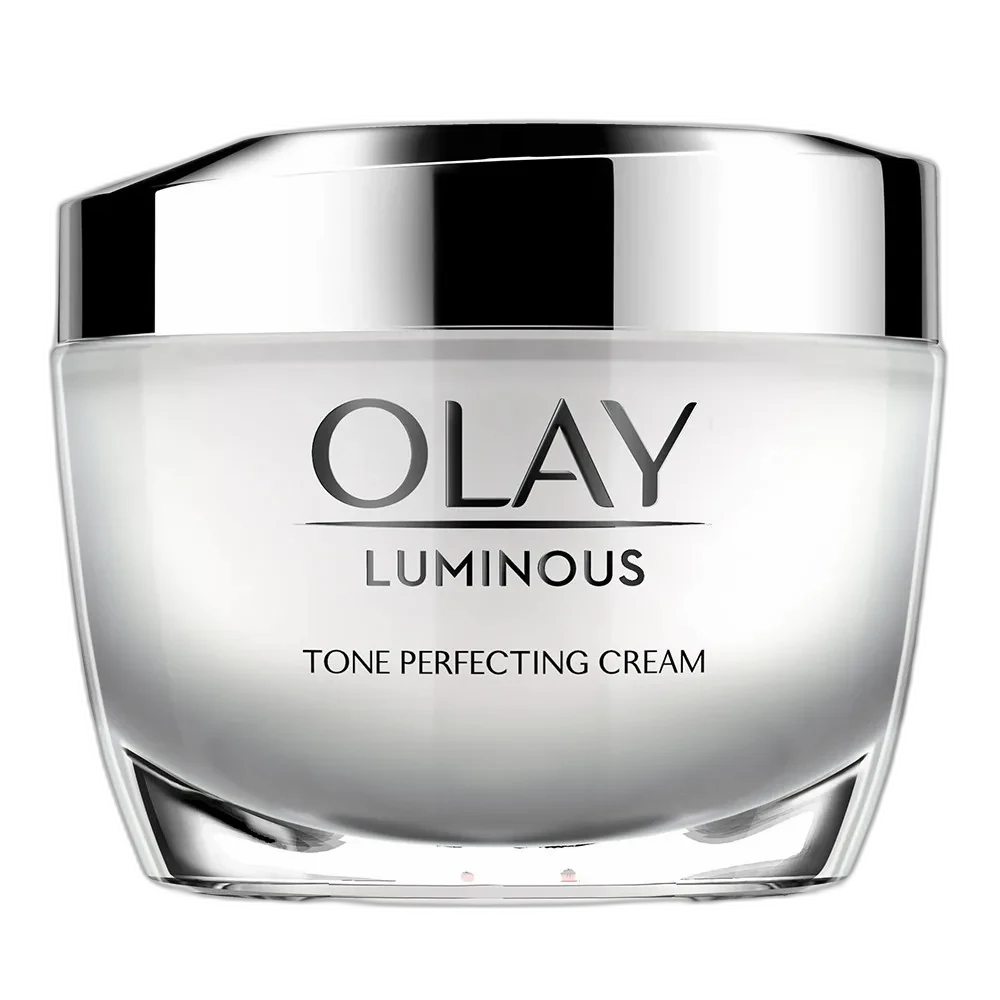
Luminous Tone Perfecting Cream
Drugstore Brightening Staple
 Verified reviewer
Pros & cons.
- +Niacinamide plus N-acetyl glucosamine combination backed by peer-reviewed clinical trials
- +Silky fast-absorbing texture that works beautifully as a makeup base
- +Subtle luminous finish without looking greasy or overly dewy
- +Panthenol and allantoin provide soothing support for the brightening actives
- +Accessible drugstore pricing for clinically studied active ingredients
- +Stable vitamin C derivative adds supplementary antioxidant protection
- +Over a decade of market presence confirming real-world tolerability
- −Contains DMDM hydantoin a formaldehyde-releasing preservative that concerns many consumers
- −Jar packaging exposes antioxidants to air and introduces bacteria with each use
- −Not moisturizing enough for dry skin types without layering additional hydration
- −Can pill when layered under water-based sunscreens or foundations
- −Contains synthetic dyes that serve no functional purpose in the formula
- −Dark spot fading requires 8-12 weeks which tests user patience
The full review.
Most drugstore brightening creams are built on hope and marketing. This one is built on a patent. The Olay Luminous Tone Perfecting Cream launched in 2014 carrying something genuinely unusual for a product at this price point: a hero ingredient combination — niacinamide plus N-acetyl glucosamine — that had already been validated in peer-reviewed clinical trials funded by Olay’s parent company, Procter & Gamble. That is not a common pedigree for anything sitting next to the toothpaste at Walgreens.
The science here is worth understanding because it explains why this formula works differently from a generic niacinamide moisturizer. Niacinamide, at the estimated three percent concentration in this product, inhibits the transfer of melanosomes — the pigment-carrying packets — from melanocytes to the surrounding skin cells. It does not stop pigment production; it intercepts delivery. Acetyl glucosamine attacks from a different angle entirely, inhibiting the glycosylation of tyrosinase, the enzyme that catalyzes melanin production. Two mechanisms, one jar. The published research on this combination, including a randomized double-blind trial in the British Journal of Dermatology, showed statistically significant reduction in facial hyperpigmentation compared to niacinamide alone.
On the skin, this cream is immediately pleasant. The silicone-heavy base gives it a silky, almost primer-like slip that absorbs within seconds. There is no greasiness, no tackiness, no heavy feeling. It vanishes into the skin and leaves behind a subtle satin finish with just a hint of luminosity — enough to look like your skin is having a good day, not enough to look like you applied a highlighter. For anyone who wears makeup daily, this is a genuinely good base layer.
The hydration level is moderate. Glycerin provides the humectant backbone, and the silicone matrix creates a light occlusive layer, but this is not a cream that will satisfy genuinely dry skin on its own. Normal and combination skin types will find the moisture level just right. Dry skin will need reinforcement — a hydrating serum underneath or a richer cream on top.
Results take time, and managing expectations matters here. The skin feels smoother and looks subtly brighter within the first week, but meaningful dark spot reduction is an eight-to-twelve-week commitment at minimum. This is consistent with the clinical trial timelines. Melanin turnover is slow, and any product promising faster results from topical niacinamide is not being honest with you. Users who abandon this cream after three weeks and declare it ineffective are not giving the actives enough cell cycles to demonstrate their effect.
Now, the ingredient list has some entries that will make modern skincare consumers pause. DMDM hydantoin — a formaldehyde-releasing preservative — sits at position fifteen. After the 2021 class-action lawsuits targeting formaldehyde donors in personal care products, this ingredient has become a significant concern for many buyers, even though the concentrations used fall within established safety limits. Iodopropynyl butylcarbamate, another preservative, and synthetic dyes (Yellow 5 and Red 40) round out a preservative and additive profile that feels more 2014 than 2026. The fragrance is present but restrained — a light, clean scent that dissipates quickly.
The jar packaging is a functional misstep. Scooping cream with your fingers introduces bacteria with every use, and the antioxidant ingredients — sodium ascorbyl phosphate and tocopheryl acetate — degrade faster when repeatedly exposed to air. An airless pump would have been a meaningful upgrade, and at this price point, it is an upgrade that competitors have already made.
Value-wise, this sits in a reasonable middle ground. At approximately twenty to twenty-five dollars for 1.7 ounces, you are paying for clinically studied actives at meaningful concentrations, which is more than many drugstore moisturizers can claim. The silicone-rich texture means a little goes a long way, stretching the jar to roughly two to three months of twice-daily use. It is not the cheapest brightening option on the shelf, but the research backing justifies a modest premium.
The honest limitation is that this cream does not try to do everything. It is a brightening moisturizer with moderate hydration, not a comprehensive anti-aging treatment. There are no retinoids, no peptides targeting collagen synthesis, no ceramides rebuilding the barrier. If hyperpigmentation is your primary concern and your skin tolerates fragrance and formaldehyde donors, the niacinamide-glucosamine combination here is one of the most evidence-backed options available without a prescription. If your concerns are broader, this cream is one step in a multi-product routine, not the whole routine.
For a product that has been on the market for over a decade, the Luminous Tone Perfecting Cream has aged reasonably well. The core actives remain relevant, the texture holds up against modern formulations, and the price has stayed accessible. The preservative profile is the area that most urgently needs a reformulation, and the jar packaging deserves an upgrade. But the science underneath the lid — that niacinamide-glucosamine synergy — is still sound, and still doing what Procter & Gamble’s research said it would.
Formula
Ingredient analysis.
Full INCI list
Water, Cyclopentasiloxane, Glycerin, Niacinamide, Aluminum Starch Octenylsuccinate, Acetyl Glucosamine, Dimethicone, Dimethicone Crosspolymer, Panthenol, Polyethylene, Polyacrylamide, C13-14 Isoparaffin, Tocopheryl Acetate, Titanium Dioxide, DMDM Hydantoin, Allantoin, Carnosine, Laureth-4, Laureth-7, Fragrance, Dimethiconol, Acrylates/C10-30 Alkyl Acrylate Crosspolymer, Sodium Ascorbyl Phosphate, Sodium PEG-7 Olive Oil Carboxylate, Disodium EDTA, Butylene Glycol, Propylene Glycol, Iodopropynyl Butylcarbamate, Camellia Sinensis Leaf Extract, Aloe Barbadensis Leaf Extract, Yellow 5 (CI 19140), Red 40 (CI 16035)
Skin match.
The science.
The Science
This formula uses a niacinamide and N-acetyl glucosamine combination to attack hyperpigmentation through two mechanisms. In a 2002 study in the British Journal of Dermatology, Hakozaki et al. showed niacinamide reduces cutaneous pigmentation by inhibiting melanosome transfer—the movement of melanin-containing packets from melanocytes to surrounding keratinocytes (British Journal of Dermatology, 2002). Separately, Bissett et al. showed in 2007 that topical N-acetyl glucosamine reduces facial hyperpigmentation by inhibiting the glycosylation of tyrosinase, the rate-limiting enzyme in melanin synthesis (Journal of Cosmetic Dermatology, 2007).
Combining these two ingredients produces more pigment reduction than either alone. Kimball et al. published a randomized, double-blind, vehicle-controlled trial in the British Journal of Dermatology in 2010. They found moisturizers with both niacinamide and N-acetyl glucosamine produced statistically significant improvements in facial hyperpigmentation compared to vehicle alone, with effects visible by eight weeks (British Journal of Dermatology, 2010). This study validates the combination used in this Olay formula.
The sodium ascorbyl phosphate adds brightening via a third mechanism: inhibiting melanin synthesis by interacting with copper ions at the tyrosinase active site. However, its low position in the INCI list suggests a concentration too low for independent clinical outcomes. It likely provides antioxidant protection rather than active brightening.
One limitation: the niacinamide-glucosamine research is solid, but the studies used concentrations that may differ from this product. Olay does not disclose exact percentages. INCI positioning suggests approximately three percent niacinamide and two percent glucosamine—within the studied ranges but at the lower end.
References
- The effect of niacinamide on reducing cutaneous pigmentation and suppression of melanosome transfer — British Journal of Dermatology (2002)
- Reduction in the appearance of facial hyperpigmentation by topical N-acetyl glucosamine — Journal of Cosmetic Dermatology (2007)
- Reduction in the appearance of facial hyperpigmentation after use of moisturizers with a combination of topical niacinamide and N-acetyl glucosamine: results of a randomized, double-blind, vehicle-controlled trial — British Journal of Dermatology (2010)
Dermatologist Perspective
Dermatologists often recommend niacinamide-based brightening products as first-line OTC options for patients with mild to moderate hyperpigmentation who avoid or cannot use prescription hydroquinone. The niacinamide-glucosamine combination in this formula uses the mechanism-based approach board-certified dermatologists favor—targeting multiple steps in the pigmentation pathway instead of one active. Dermatologists note this cream is pregnancy-safe, which helps patients with melasma during pregnancy who cannot use retinoids or hydroquinone. However, dermatologists emphasize that no brightening product works without daily broad-spectrum sunscreen use.
Where it fits in your routine.
Apply a pea-sized amount to a clean, dry face and neck after serums or treatments. Massage upward until absorbed; this silicone-based formula absorbs in seconds. Use morning and evening. In the morning, always follow with broad-spectrum SPF 30 or higher—brightening actives fail without sun protection. To prevent pilling under makeup, wait two to three minutes for absorption before applying sunscreen or foundation.
At roughly $20-25 for 1.7 ounces, this cream fits well in the drugstore brightening category. The value comes from the clinically validated niacinamide-glucosamine combination; you pay for actives with published research, not just marketing. The thick silicone base makes it economical, lasting two to three months per jar. However, the jar packaging degrades antioxidant ingredients over time, reducing the value of those components as the product ages. A trial size (0.5 oz) is available to test before committing.
This cream works for normal to combination skin with dark spots, uneven tone, or post-inflammatory hyperpigmentation. It offers clinical brightening at a drugstore price. It is a lightweight moisturizer that also works as a smooth makeup base.
Dry skin types needing thick hydration, people sensitive to fragrance or formaldehyde-releasing preservatives, and users preferring clean or minimal ingredient lists fit this. For severe melasma or deep hyperpigmentation, prescription options work faster and show more dramatic results.
Product details.
It has a light, clean, slightly floral fragrance that fades fast after application.
White pearlescent screw-top jar with Olay Luminous branding. The open-jar format hurts ingredient stability — the vitamin C derivative and antioxidants need airless packaging. Finish satinglowylightweight
The cream has a silky slip, absorbs in seconds, and leaves skin smooth and subtly luminous. It causes no tingling, purging, or adjustment period. Brightening effects build gradually over weeks.
2-3 months with twice-daily use on face and neck
12 months
All Year
The backstory.
The Luminous line launched in 2014 as Olay's answer to the growing demand for brightening products outside of the prescription hydroquinone category. The formula is built on proprietary P&G research into the synergy between niacinamide and N-acetyl glucosamine — a combination the company studied for years before bringing it to market at a drugstore price point.
About Olay
Legacy Brand (20+ years)Olay launched in 1952 and P&G acquired it in 1985. P&G funded peer-reviewed research on the niacinamide and N-acetyl glucosamine combination in this formula, which appears in the British Journal of Dermatology.
Common myths.
Prescription hydroquinone fades dark spots meaningfully.
Clinical studies show the niacinamide and acetyl glucosamine combination in this cream reduces hyperpigmentation using a different mechanism than hydroquinone. Results take longer (8-12 weeks vs 4-8 weeks), but this approach avoids the rebound hyperpigmentation risk associated with hydroquinone.
DMDM hydantoin in skincare is dangerous because it releases formaldehyde.
DMDM hydantoin releases trace amounts of formaldehyde to act as an antimicrobial. At cosmetic concentrations, it stays within safety limits set by the CIR Expert Panel and FDA. People with known formaldehyde sensitivity should avoid products containing this preservative.
FAQ.
Is Olay Luminous Tone Perfecting Cream safe for sensitive skin?
This cream contains fragrance and DMDM hydantoin, which can cause reactions in sensitive individuals. Niacinamide and panthenol are generally well-tolerated, but those with reactive or easily irritated skin should patch test first or choose a fragrance-free alternative.
Can I use Olay Luminous Tone Perfecting Cream with retinol?
Yes, this cream pairs well with retinol. The niacinamide in the formula helps reduce retinol irritation by strengthening the skin barrier. Apply retinol first, let it absorb, then layer this cream on top as your moisturizing step.
Does Olay Luminous Tone Perfecting Cream contain formaldehyde?
The cream contains DMDM hydantoin, a formaldehyde-releasing preservative. It releases trace amounts of formaldehyde to stop microbial growth. The concentration stays within FDA-approved safety limits, but people with known formaldehyde allergies should avoid this product.
Is Olay Luminous Tone Perfecting Cream moisturizing enough for dry skin?
This cream works best for normal to combination skin. The glycerin and silicone base provides moderate hydration, but users with dry skin often find it insufficient alone and may need to layer a thicker cream or facial oil on top.
How long does it take to see results from Olay Luminous Tone Perfecting Cream?
Skin feels smoother and looks slightly more luminous in the first week. Meaningful dark spot fading requires 8-12 weeks of consistent twice-daily use. Use sunscreen during this period; UV exposure undoes brightening progress.
Why does Olay Luminous Tone Perfecting Cream pill under makeup?
The silicone-heavy formula can pill when used with water-based foundations or sunscreens. For best results, let the cream absorb for 2-3 minutes before applying sunscreen or makeup. Ensure layered products share a similar base (silicone with silicone).
What the community says.
"Effectively fades dark spots and age spots with consistent use over 8+ weeks"
"Lightweight fast-absorbing texture that works well under makeup"
"Leaves skin feeling soft smooth and subtly glowing"
"Provides a luminous finish without looking greasy or shiny"
"Good value for a niacinamide-based brightening cream at drugstore pricing"
"Pleasant non-overwhelming scent"
"Results for dark spot fading are slow and require months of patience"
"Can pill or ball up when layered under certain makeup or sunscreen"
"Contains DMDM hydantoin which is a formaldehyde-releasing preservative"
"Not moisturizing enough for dry skin types when used alone"
"Jar packaging exposes product to air and bacteria with each use"