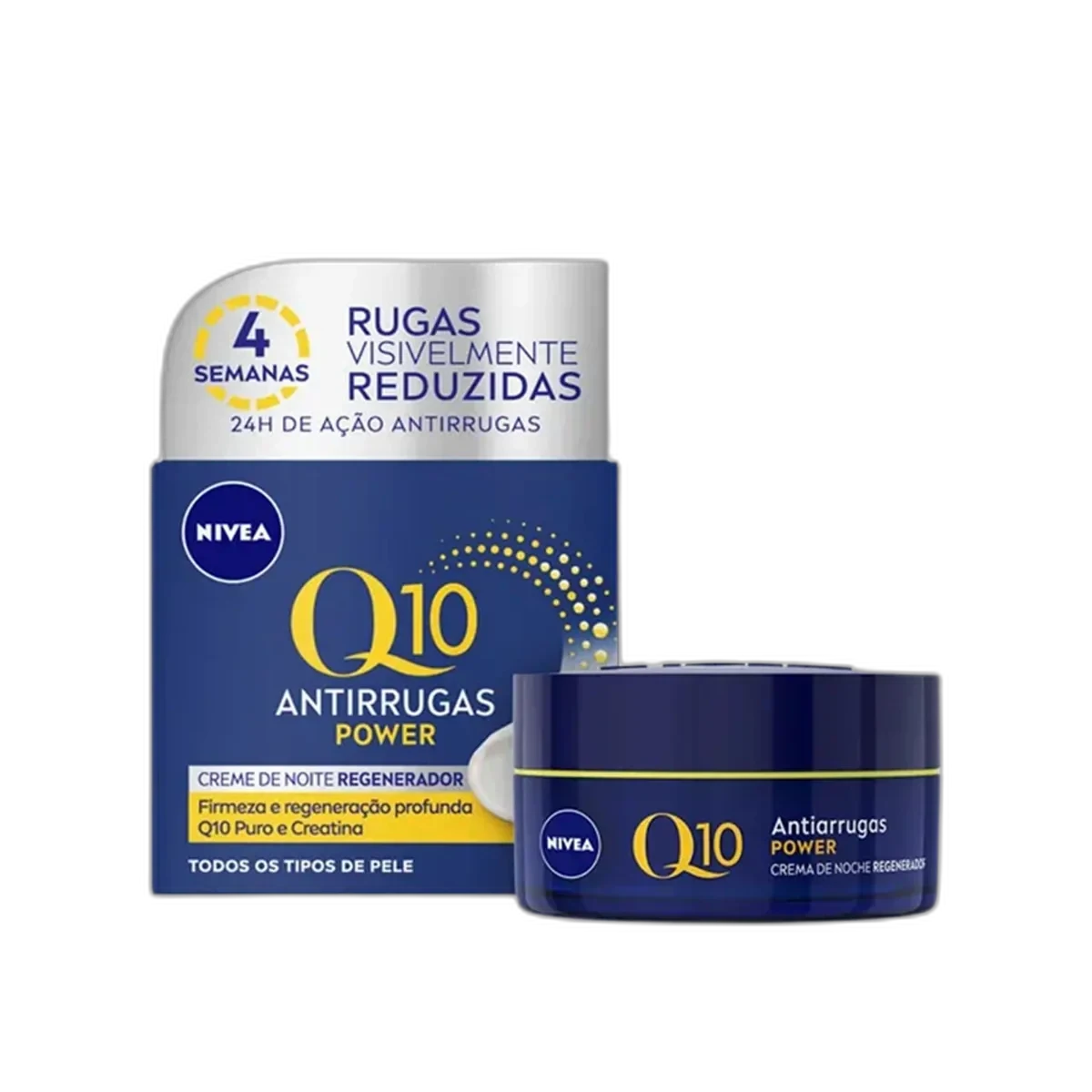
Q10 Anti-Wrinkle Power Firming Night Cream
Anti-Aging Pioneer
 Verified reviewer
Pros & cons.
- +Backed by 25+ years and 40+ published studies of dedicated Beiersdorf Q10 research
- +Dual Q10 and creatine actives work through complementary anti-aging pathways
- +Richly moisturizing overnight — skin is noticeably softer and plumper by morning
- +Macadamia oil provides palmitoleic acid that declines with age, a thoughtful formulation choice
- +Exceptional value at ~$13 compared to premium anti-aging night creams
- +Silicone-free and paraben-free formula with proven soothing panthenol
- +Pleasant mild scent that doesn't transfer to pillowcases
- −Ten identified fragrance allergens make this unsuitable for fragrance-sensitive skin
- −Jar packaging exposes air-sensitive CoQ10 to degradation with each use
- −Contains lanolin alcohol — a common contact allergen in mature-skin demographics
- −Too rich and heavy for oily or acne-prone skin types
- −Anti-wrinkle effects are modest on deep established wrinkles
The full review.
Before CoQ10 appeared in everything from eye creams to sheet masks, most people only found the molecule in supplements. In 1998, Beiersdorf researchers realized this mitochondrial antioxidant, which declines in skin as we age, could be replenished topically. This insight launched the Nivea Q10 range and changed anti-aging skincare.
Twenty-seven years later, the Q10 Anti-Wrinkle Power Firming Night Cream evolves that original insight. This product isn’t chasing trends or adding trendy ingredients to a generic base. Instead, over 40 published studies, 60,000+ study participants, and a team of approximately 50 scientists have spent 25 years optimizing Q10 in topical formulations.
The formula works as a deliberate overnight treatment. Glycerin leads the humectants to ensure hydration during the 7-8 hours the cream sits on your skin. Shea butter and macadamia nut oil create a thick emollient layer. Macadamia is a smart choice because it is naturally high in palmitoleic acid, a fatty acid skin produces less of as we age. Panthenol supports barrier repair. Finally, the signature duo—ubiquinone (CoQ10) and creatine—uses complementary cellular energy pathways to support overnight skin repair.
The creatine deserves more attention. While Q10 gets the credit, creatine has its own published evidence. A 2011 study by Beiersdorf researchers in the Journal of Cosmetic Dermatology showed that creatine penetrated the dermis from a similar formulation and produced measurable anti-wrinkle and anti-sagging effects in six weeks. The study found creatine stimulated collagen synthesis at both the gene and protein level, complementing Q10’s antioxidant and energy-boosting activity.
Texture
The texture is a classic night cream—thick, dense, and enveloping. It is thicker than most day creams but lighter than a traditional cold cream. The cream melts into the skin within minutes, leaving a dewy-satin finish without feeling like a mask. By morning, skin feels softer, plumper, and more hydrated. This overnight transformation is one of the product’s most praised qualities.
Scent
The scent is a mild, creamy fragrance that dissipates quickly and does not transfer to pillowcases. However, the INCI list shows the tradeoff: 10 identified fragrance allergens are present. Linalool, limonene, citronellol, geraniol, benzyl salicylate, and hexyl cinnamal are among them. This is a non-issue for most, but a dealbreaker for those with fragrance sensitivities, contact dermatitis, or reactive skin.
Packaging
The jar packaging is a weakness. Dipping fingers into a jar containing antioxidants like CoQ10—which degrade when exposed to air and contaminants—is poor for stability and hygiene. A pump or tube would better protect the active ingredients and efficacy throughout the shelf life. Here, Nivea’s traditional packaging aesthetic conflicts with its formulation science.
Lanolin alcohol is another ingredient to note. It is an effective emollient but also a common contact allergen. Including it in a product for mature skin—a demographic more likely to have developed sensitizations—is an avoidable formulation choice.
Best for
This night cream works on fine lines, early wrinkles, dullness, and dehydration. For most people in this category, the overnight hydration and Q10-creatine collagen support produce visible results within a month of consistent use. It does not eliminate deep, established wrinkles or significant sagging. The published research shows improvement, not elimination, so manage expectations.
Works for
The value is high. At roughly $13 for 50ml, this night cream has more published research behind it than products costing five to ten times more. Beiersdorf’s investment in Q10 science—using peer-reviewed studies rather than marketing surveys—gives this product credibility most drugstore anti-aging creams lack. When a luxury brand charges $85 for a night cream with a proprietary peptide complex backed by only one in-house study, $13 of published science is often the smarter buy.
Ingredient analysis.
Full INCI list
Aqua, Glycerin, Ethylhexyl Cocoate, Methylpropanediol, Cetyl Alcohol, Hydrogenated Coco-Glycerides, Stearyl Alcohol, Butylene Glycol, Caprylic/Capric Triglyceride, Butyrospermum Parkii Butter, Glyceryl Stearate Citrate, Macadamia Ternifolia Seed Oil, Ubiquinone, Creatine, 1-Methylhydantoin-2-Imide, Panthenol, Lanolin Alcohol, Tridecyl Stearate, Tridecyl Trimellitate, Dipentaerythrityl Hexacaprylate/Hexacaprate, Sodium Carbomer, Ethylhexylglycerin, Phenoxyethanol, Trisodium EDTA, Limonene, Linalool, Citronellol, Hydroxyisohexyl 3-Cyclohexene Carboxaldehyde, Alpha-Isomethyl Ionone, Geraniol, Benzyl Salicylate, Hexyl Cinnamal, Benzyl Alcohol, Parfum
Skin match.
The science.
The Science
This night cream uses two complementary cellular energy boosters: Coenzyme Q10 (ubiquinone) and creatine.
CoQ10 is a lipophilic antioxidant that drives mitochondrial electron transport and ATP production. Skin Q10 levels drop with age. Prahl et al. documented this in Biofactors (2008), finding that aging skin becomes 'functionally anaerobic' as mitochondrial efficiency falls. Their research shows topical CoQ10 rapidly improves skin mitochondrial function in vivo. A 2024 review by Lain et al. in the Journal of Clinical & Aesthetic Dermatology analyzed 36 publications and concluded that topical CoQ10 replenishes cellular levels, reduces oxidative stress, and decreases wrinkle depth and skin roughness.
Knott et al. (Biofactors, 2015) confirmed that Q10 from topical formulations penetrates the stratum corneum into the viable epidermis. There, it provides measurable antioxidative effects, proving CoQ10 reaches its target tissue from a cream.
Creatine works through a different mechanism. Peirano et al. published findings in the Journal of Cosmetic Dermatology (2011) showing that creatine penetrated the dermis from a face-care formulation. In 43 subjects over 6 weeks, it reduced crow's feet wrinkles, under-eye wrinkles, and cheek sagging. The study confirmed that creatine stimulated collagen synthesis at both the gene and protein level—a structural anti-aging effect that complements Q10's energy-metabolic approach.
These two ingredients create a dual-pathway anti-aging strategy: Q10 restores mitochondrial energy production and provides antioxidant protection, while creatine boosts cellular energy reserves and stimulates collagen production. This specific, research-validated combination is not a generic one-ingredient approach; Beiersdorf has refined it for more than two decades.
References
- The Role of Coenzyme Q10 in Skin Aging and Opportunities for Topical Intervention: A Review — Journal of Clinical & Aesthetic Dermatology (2024)
- Aging skin is functionally anaerobic: importance of coenzyme Q10 for anti aging skin care — Biofactors (2008)
- Topical treatment with coenzyme Q10-containing formulas improves skin's Q10 level and provides antioxidative effects — Biofactors (2015)
- Dermal penetration of creatine from a face-care formulation is linked to effective antiwrinkle and antisagging efficacy — Journal of Cosmetic Dermatology (2011)
Dermatologist Perspective
Dermatologists recognize CoQ10 as a topical antioxidant with more evidence than many trendy anti-aging ingredients. Board-certified dermatologists would note that the Q10-creatine combination in this formula targets cellular energy metabolism—a documented factor in skin aging—instead of relying only on surface-level hydration. The night cream timing matches circadian research showing skin repair processes peak during sleep. However, dermatologists treating patients with sensitive or atopic skin would flag the extensive fragrance allergen profile and lanolin alcohol content as potential sensitization risks, especially for the mature-skin demographic this product targets.
Where it fits in your routine.
Apply every evening as the final step of your nighttime routine. After cleansing and applying serums, warm a cherry-sized dollop between your fingertips. Press and smooth it over the face and neck using upward motions. Avoid the immediate eye area; use a dedicated eye cream there. For best results, use a small spatula to scoop product from the jar instead of fingers. This minimizes contamination and air exposure to the Q10.
At about $13.49 for 50ml, this night cream has high research-to-price value. The Q10-creatine combination has more peer-reviewed publications than many $80-150 luxury night creams. Using one jar nightly for 2-3 months costs roughly $5-7 per month for a clinically validated anti-aging treatment. Because this is primarily a European product, US availability varies. Import pricing can push costs to $20+, which remains good value but lowers the competitive advantage.
Men and women aged mid-30s and older with normal to dry skin want a research-backed anti-aging night cream without luxury prices. This works well for those seeing early fine lines, dullness, and loss of firmness who want prevention without overspending.
The extensive allergen profile concerns anyone with fragrance sensitivities, lanolin allergies, or reactive skin. The thick texture is also too heavy for overnight use on oily or acne-prone skin.
Product details.
This thick cream feels substantial on the skin but absorbs fast for a night cream. It is less heavy than a traditional cold cream; it is a dense, nourishing emulsion that melts into the skin within a few minutes.
The fragrance is light and mild, with a creamy Nivea-adjacent profile. It dissipates within minutes of application and does not transfer to pillowcases.
Dark blue glass-style jar with metallic gold accents and a screw-top lid. It uses the signature Nivea blue and prominent Q10 branding. The 50ml size comes in a jar. This format exposes the product to air and fingers during use—a common criticism for formulas with antioxidants like Q10.
The first use provides noticeable moisture overnight; skin feels softer and more hydrated by morning. The cream feels smooth during application but is not heavy. There is no tingling, purging, or adjustment period. Anti-wrinkle benefits build over weeks of consistent use.
2-3 months with nightly face and neck application
12 months
All Year
The backstory.
In 1998, Beiersdorf's researchers made a connection that would reshape drugstore anti-aging: Coenzyme Q10, already known as a cellular energy molecule, could be applied topically to replenish skin levels that decline with age. The result was the Nivea Q10 range — the first mass-market skincare line built around this antioxidant. Over 25 years and 60,000+ study participants later, the night cream remains the cornerstone of a range that proved accessible anti-aging skincare doesn't require luxury prices.
About Nivea
Legacy Brand (20+ years)Beiersdorf AG founded Nivea in 1911 in Hamburg, Germany. Beiersdorf brought CoQ10 skincare to the mass market in 1998. Since then, the company has spent over 25 years researching Q10 using approximately 50 scientists, 60,000+ study participants, and 40+ scientific publications.
Common myths.
CoQ10 can't penetrate the skin effectively from a topical cream.
Multiple studies, including Beiersdorf's published research in Biofactors (Knott et al., 2015), show that topical Q10 formulations increase CoQ10 levels in the stratum corneum and deeper viable skin layers. Ubiquinone is lipophilic, so it works well in oil-in-water emulsions like this night cream.
Drugstore anti-aging creams lack the performance of expensive luxury alternatives.
Beiersdorf spent 25 years studying Q10 for this cream. This research exceeds what many luxury brands invest in their whole product lines. Published evidence shows the Q10 and creatine combination reduces wrinkles and stimulates collagen, outperforming many $100+ night creams.
FAQ.
Does Nivea Q10 Night Cream actually reduce wrinkles?
Clinical evidence shows topical CoQ10 reduces wrinkle depth and improves skin energy metabolism — Beiersdorf has published over 40 studies on this. The creatine in this formula adds collagen-stimulating activity, which a 6-week clinical trial validated. Results show most on fine lines and early signs of aging; deep established wrinkles improve but do not disappear.
At what age should you start using Nivea Q10 Night Cream?
Skin Q10 levels decline in your mid-20s and drop significantly by age 30. Using this as a preventive measure in your late 20s or early 30s matches the formula's science. However, the thick texture and anti-wrinkle actives suit ages 35 and up when fine lines show more.
Can you use Nivea Q10 Night Cream with retinol?
Yes — the thick, emollient base of this cream uses shea butter and macadamia oil to buffer retinol irritation. Apply your retinol serum first, wait a few minutes for absorption, then layer this night cream on top. The glycerin and occlusive ingredients counteract retinol's drying effects.
Is Nivea Q10 Night Cream fragrance-free?
No — the formula contains parfum and 10 identified fragrance allergens including linalool, limonene, and citronellol. The scent is mild and most users tolerate it, but people with fragrance sensitivities or contact dermatitis should avoid this product.
Why is the Nivea Q10 Night Cream in a jar instead of a tube?
The jar format is a traditional choice that allows for a thicker cream. The downside is that antioxidants like CoQ10 degrade with repeated air exposure. Use a small spatula instead of fingers to maintain hygiene and minimize oxidation of the active ingredients.
What the community says.
"Deeply moisturizing overnight — skin feels soft and plumped in the morning"
"Good value for an anti-aging night cream compared to premium alternatives"
"Rich texture that absorbs well without feeling heavy or greasy"
"Noticeable reduction in fine lines with consistent nightly use"
"Pleasant mild scent that doesn't linger on the pillow"
"Skin looks less dull and more radiant after regular use"
"Contains fragrance and multiple fragrance allergens unsuitable for reactive skin"
"Jar packaging is unhygienic and exposes the formula to air degradation"
"Anti-wrinkle claims are overstated for deeper established wrinkles"
"Can feel too heavy for oily or combination skin types"
"Contains lanolin alcohol which is a potential allergen"