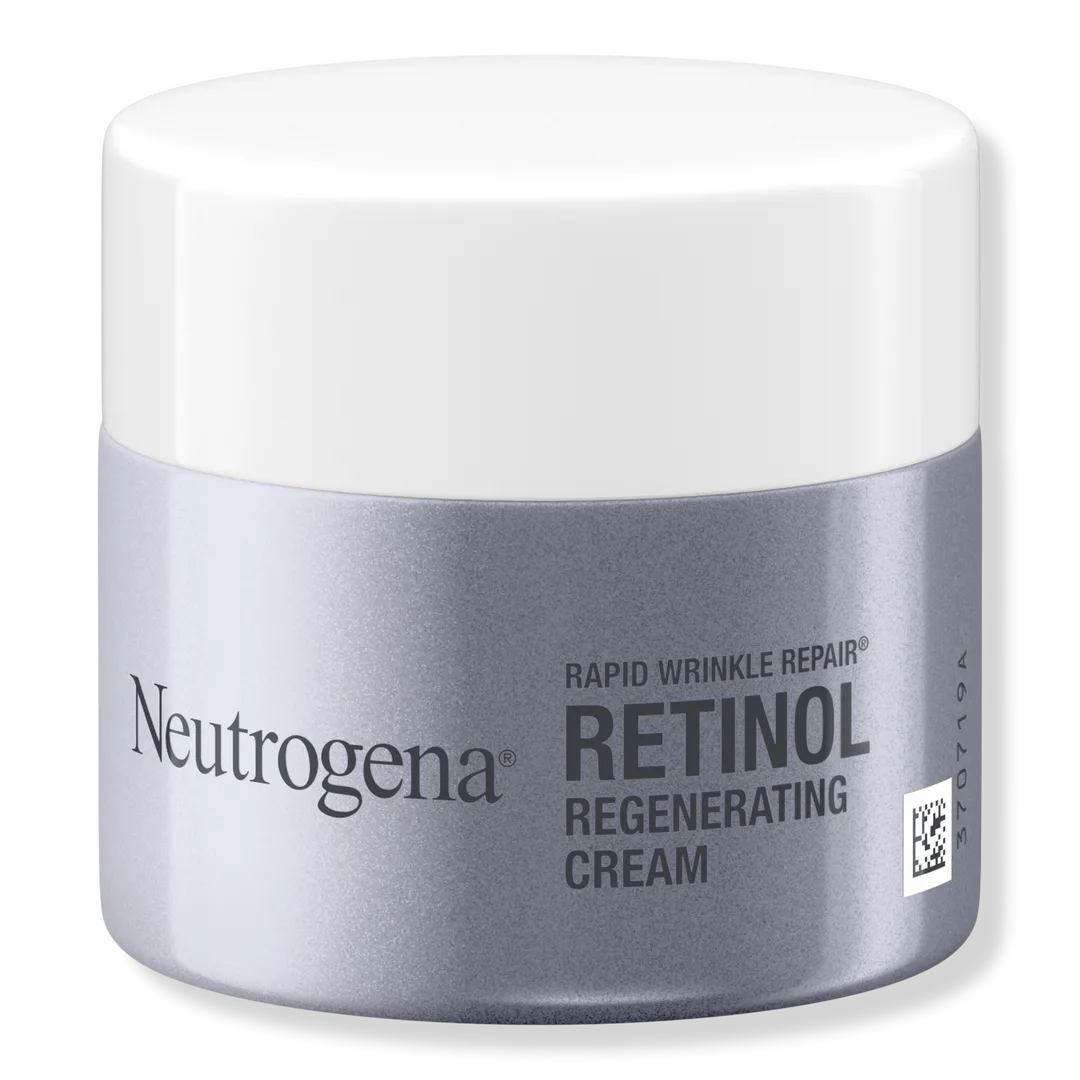
Rapid Wrinkle Repair Retinol Cream
Drugstore Retinol Pioneer
 Verified reviewer
Pros & cons.
- +Accelerated Retinol SA technology with myrtle leaf booster enhances retinol bioactivity beyond standard delivery
- +Sodium hyaluronate and glycerin provide essential hydration to counteract retinol-induced dryness
- +Absorbs remarkably quickly for a thick cream — 15 seconds to a smooth, non-greasy satin finish
- +Over 20,000 user reviews documenting visible fine line and dark spot improvement
- +Available in both original and fragrance-free versions at the same price point
- +Backed by 25+ years of Neutrogena's OTC retinol formulation expertise
- +Strong value at ~$30 compared to prestige retinol creams at $60-150+
- −Jar packaging exposes retinol to air and light with each opening, degrading the active ingredient over time
- −Retinization period causes unavoidable dryness, flaking, and possible stinging for 2-4 weeks
- −Retinol concentration is undisclosed — users cannot gauge the potency level
- −Original version has an overpowering floral fragrance — the fragrance-free version is strongly preferred
- −Not safe for use during pregnancy or breastfeeding
The full review.
Neutrogena didn’t just jump on the retinol bandwagon. They built the bandwagon. Over twenty-five years ago, before retinol was a TikTok talking point or a Sephora shelf staple, Neutrogena developed the first stabilized over-the-counter retinol product in the United States. The Rapid Wrinkle Repair Retinol Cream, launched in 2011, represents the brand’s evolution of that foundational technology into what is now one of the most purchased anti-aging creams at the drugstore tier.
The formula centers on what Neutrogena calls Accelerated Retinol SA technology. The ‘SA’ stands for Sustained Action — a delivery system that releases retinol gradually into the skin rather than dumping it all at once. This is paired with Hydrolyzed Myrtus Communis Leaf Extract, a myrtle leaf derivative that Neutrogena claims enhances retinol’s bioactivity, reportedly doubling its effectiveness compared to retinol alone. The brand doesn’t disclose the retinol concentration, which frustrates ingredient-list scrutinizers, but the clinical approach here isn’t about raw concentration — it’s about optimizing how much of the retinol actually gets used by the skin.
This is a meaningful distinction that gets lost in the consumer obsession with percentages. A lower concentration of retinol delivered effectively through a sustained-action system may outperform a higher concentration that dumps onto the skin surface, irritates, and gets washed away before it can work. Whether Neutrogena’s specific technology achieves this as claimed is backed by their internal testing rather than published independent studies, but the formulation logic is sound.
The cream itself is thick and rich — almost surprisingly so for a brand associated with lightweight, oil-free formulations. But it absorbs remarkably fast, settling into the skin within about fifteen seconds and leaving a smooth, satin finish without greasiness. The silicone base (dimethicone, cyclopentasiloxane, dimethicone crosspolymer) is responsible for both the luxurious texture and the quick absorption. A pearl-sized amount covers the entire face and neck, which means the 1.7-ounce jar lasts two to three months of nightly use.
Sodium hyaluronate and glycerin provide the hydrating support that any retinol product needs. Retinol accelerates cell turnover, which can leave the surface dry and vulnerable. The HA draws moisture in; the glycerin holds it there; the silicone base seals it. It’s a three-layer hydration strategy that makes this cream tolerable for most skin types during the retinization period.
And the retinization period is real. Let’s not sugarcoat it. During the first two to four weeks, your skin will likely flake, feel tight, possibly sting, and look temporarily worse before it looks better. This happens with every retinol product at a meaningful concentration — it’s the skin adjusting to accelerated turnover. The sustained-action delivery is designed to minimize this, and users report that the adjustment is milder than with some competing products, but it still happens. If you’ve never used retinol before, start every other night and buffer with a moisturizer until your skin acclimates.
The jar packaging deserves the criticism it receives. Retinol is photosensitive and air-sensitive. Every time you unscrew that lid, you’re exposing the product to both degradation triggers. The top layer of cream absorbs the damage first, potentially losing potency before you use it. A pump or an airless tube would solve this entirely, and it’s puzzling that Neutrogena hasn’t made the switch given that the technology exists and many of their own products use tubes. This is the single biggest formulation-adjacent flaw in an otherwise thoughtfully constructed product.
The fragrance-free version deserves an explicit recommendation over the original. The formulations are identical except for the absence of fragrance, and fragrance in a retinol product is like putting sprinkles on a medical device — it’s unnecessary and introduces irritation risk in a product that already challenges the skin. The original version’s floral scent is strong enough to be the second most common complaint in reviews, after the retinization dryness. Just get the fragrance-free version.
Results, when they arrive, are well-documented across over twenty thousand user reviews. Fine lines visibly smooth within one to two weeks. Skin tone evens out over four to eight weeks. The full collagen-building benefits — the real structural anti-aging — develop over three months or more. This tracks precisely with the scientific timeline for topical retinol efficacy. There are no shortcuts, and any product claiming faster results than this is either lying or using a different active.
At roughly thirty dollars for the standard size, this undercuts prestige retinol products by a factor of two to five. You can spend ninety dollars on a beautifully packaged retinol from a luxury brand that contains the same active ingredient in a different vehicle, or you can spend thirty dollars on a product developed by the company that invented stabilized OTC retinol. The luxury brand’s packaging will probably be better (tube or pump), which is genuinely worth something for retinol stability. But the active technology? Neutrogena’s twenty-five-year head start shows.
The bottom line is straightforward. If you want effective retinol at a drugstore price and you’re willing to weather the adjustment period, this is one of the most proven options available. Get the fragrance-free version. Store it in a cool, dark place. Use it consistently at night with sunscreen every morning. And give it twelve weeks before you judge the results. The science behind retinol is not in question. The only question is whether you’ll stick with it long enough to see what it can do.
Ingredient analysis.
Full INCI list
Water, Pentaerythrityl Tetraethylhexanoate, Glycerin, Dimethicone, PPG-15 Stearyl Ether, Stearyl Alcohol, Cetearyl Alcohol, Butylene Glycol, Glyceryl Behenate, Ceteareth-20, Isohexadecane, Dimethicone Crosspolymer, Cyclopentasiloxane, Cellulose, Sodium Polyacrylate, Phenoxyethanol, Caprylyl Glycol, Sodium Acryloyldimethyltaurate/VP Crosspolymer, Polyacrylamide, C13-14 Isoparaffin, Chlorphenesin, Polysorbate 20, Hydrolyzed Myrtus Communis Leaf Extract, Retinol, BHT, Sodium Hyaluronate, Disodium EDTA, Sodium Hydroxide, Laureth-7, Ascorbic Acid
Skin match.
The science.
The Science
Retinol has one of the most well-established anti-aging mechanisms in dermatology. Once applied topically, skin enzymes convert retinol in two steps: first to retinaldehyde, then to retinoic acid. This biologically active form binds to retinoic acid receptors (RARs) in keratinocytes and fibroblasts. This activation stimulates cell turnover, increases collagen type I and III synthesis, inhibits matrix metalloproteinases (MMPs) that break down collagen, and normalizes melanin distribution to improve hyperpigmentation.
A 2007 study by Kafi et al. in the Archives of Dermatology showed that 0.4% retinol applied topically for 24 weeks significantly improved naturally aged skin. This included increased glycosaminoglycan and procollagen expression in the dermis. The study proved that OTC retinol concentrations—not just prescription retinoic acid—change the structure of aging skin.
Neutrogena's Retinol SA technology solves topical retinol delivery limits. The sustained-action system uses emollients to regulate retinol release into the skin over time instead of delivering the full dose at once. Neutrogena's internal testing reports Hydrolyzed Myrtus Communis Leaf Extract increases retinol's biological activity at the cellular level as a bioavailability enhancer. While independent peer-reviewed validation of this specific botanical-retinol synergy is limited, using bioenhancers to improve active ingredient penetration is a standard concept in pharmaceutical formulation science.
The sodium hyaluronate in the formula provides immediate hydration and long-term skin barrier support during retinization. Research in the Journal of Drugs in Dermatology shows that pairing retinol with hydrating ingredients like hyaluronic acid reduces the incidence and severity of retinol-induced irritation. This improves treatment adherence, the most important factor in retinol outcomes.
References
- Improvement of naturally aged skin with vitamin A (retinol) — Archives of Dermatology (2007)
Dermatologist Perspective
Dermatologists rank retinol among the most effective OTC anti-aging ingredients, and this product appears often on dermatologist-curated recommendation lists. Board-certified dermatologists note that Neutrogena's sustained-action delivery system may reduce irritation compared to immediate-release retinol formulations, which helps retinol beginners. Dermatologists recommend using retinol at night because UV light degrades it and increases photosensitivity. They also recommend pairing it with broad-spectrum sunscreen every morning. For patients with significant retinization symptoms, dermatologists often advise the 'sandwich method': moisturizer, then retinol, then moisturizer, to buffer the active without losing efficacy.
Guidance
Where it fits in your routine.
Apply a pearl-sized amount to clean, dry skin at night. Wait 20-30 minutes after cleansing so skin is fully dry; applying retinol to damp skin increases penetration and irritation risk. Press gently into the face and neck, but avoid the eye area (use a dedicated eye cream with retinol if desired). Use a moisturizer if your skin feels dry. Retinol beginners: use every other night for 2 weeks, then move to nightly as tolerated. Always apply broad-spectrum sunscreen SPF 30+ every morning because retinol increases photosensitivity.
At about $29 for 1.7 oz, this offers high value in the drugstore retinol category. One jar lasts 2-3 months of nightly use, making the per-application cost less than fifty cents. Prestige brands use the same retinol active ingredient but cost $60-150+ for similar or smaller sizes. The 0.5 oz travel size at ~$16 lets users test the formula before buying the full size. The jar packaging reduces value because air exposure may make the retinol near the bottom more potent than the retinol near the top after weeks.
This works for anyone targeting fine lines, wrinkles, dark spots, or uneven skin tone with a proven anti-aging active at a drugstore price. It suits retinol beginners wanting a sustained-action delivery system and budget-conscious consumers wanting clinical-quality retinol technology without the prestige markup.
Skip this if you have very sensitive skin, active rosacea, or a compromised skin barrier — the retinization period will likely exceed your skin's tolerance. It is not safe for pregnant or breastfeeding individuals. Choose alternatives if jar packaging concerns you regarding retinol stability.
Product details.
Thick cream with a silky consistency spreads easily despite its density. It absorbs in about 15 seconds and leaves no heavy or greasy residue.
The fragrance-free version has no scent. The original version has a noticeable floral fragrance that some users find overpowering.
Dark purple/plum glass jar with a metallic screw-top lid, 1.7 oz. A 0.5 oz travel size exists. Skincare enthusiasts and dermatologists criticize the jar format. Each opening exposes retinol to air and light, which degrades the active ingredient over time. A pump or tube preserves retinol stability better.
The cream feels thick on first application but absorbs quickly. Skin feels smoother and more hydrated immediately. During the first 2-4 weeks (the retinization period), expect dryness, flaking, and possible mild stinging — this is normal as the skin adjusts to retinol. These side effects typically subside by week 4-6 as the skin builds tolerance.
2-3 months with nightly application of a pearl-sized amount to face and neck
12 months
All Year
The backstory.
Neutrogena pioneered the first stabilized OTC retinol in the United States over 25 years ago, long before retinol became a mainstream skincare buzzword. The Rapid Wrinkle Repair line, launched in 2011, represented the brand's evolution of that expertise into a dedicated anti-aging range. The Accelerated Retinol SA technology — combining sustained-action delivery with a myrtle leaf retinol booster — was developed to deliver clinical-grade results without prescription-level irritation. The product has since been reformulated to remove microplastics and offered in a fragrance-free variant in response to consumer feedback.
About Neutrogena
Legacy Brand (20+ years)Neutrogena was founded in 1930 and developed the first stabilized OTC retinol in the United States over 25 years ago. The brand is the #1 dermatologist-recommended skincare brand in the US, and the Rapid Wrinkle Repair line, launched in 2011, has accumulated over 20,000 user reviews across retailers.
Common myths.
Drugstore retinol products lack the strength to produce real anti-aging results.
Retinol concentration does not alone determine efficacy; delivery systems and bioavailability matter equally. Neutrogena's Retinol SA technology increases retinol activity using sustained delivery and a botanical booster. The product has over 20,000 user reviews showing visible results. Clinical evidence for OTC retinol at appropriate formulations is robust.
Retinol thins the skin and makes it more fragile.
Retinol first speeds up skin cell turnover, which can feel like thinning. Over time, retinol increases dermal thickness by stimulating collagen and elastin production. The skin becomes structurally stronger, not weaker — but you must use sunscreen consistently because retinol increases photosensitivity.
FAQ.
How long does it take to see results from Neutrogena Rapid Wrinkle Repair?
Fine lines smooth within 1-2 weeks. Dark spots and uneven tone improve around 4-8 weeks. Full anti-aging benefits — including collagen-building effects and wrinkle reduction — take 12+ weeks of consistent nightly use. Expect dryness and flaking during the first 2-4 weeks as your skin adjusts to retinol.
Can I use this retinol cream every night?
New retinol users should start every other night for the first 2 weeks, then increase to nightly use as skin tolerance builds. The Retinol SA sustained-action technology minimizes irritation, but an adjustment period still occurs. If dryness or irritation persists, use it every other night or buffer by applying a moisturizer before the retinol.
Should I use the original or fragrance-free version?
Most users should use the fragrance-free version. The formulations are identical, but the fragrance-free version removes one potential source of irritation. Reviewers often complain about the original version's floral scent, and fragrance provides no skincare benefit. Choose the fragrance-free version unless you prefer a scented product.
Does the jar packaging affect the retinol's effectiveness?
Yes — retinol degrades in air and light. Jar packaging exposes the product to both every time you open it. The product near the surface degrades fastest. To minimize this, close the jar tightly after each use, store in a cool dark place, and use the product within 2-3 months of opening. A pump or tube format preserves retinol better; this is a valid packaging criticism.
Can I use this with vitamin C serum?
Yes — use vitamin C in the morning and this retinol cream at night. Both are potent anti-aging actives that work via different mechanisms: vitamin C provides antioxidant protection and brightening by day, while retinol stimulates cell turnover and collagen production overnight. Using them at different times prevents irritation from combining acids.
Is this safe to use during pregnancy?
No — retinol is a vitamin A derivative. Doctors generally advise against topical retinoids during pregnancy and breastfeeding because of potential risks. Ask your OB-GYN or dermatologist for pregnancy-safe anti-aging alternatives. Bakuchiol is a common plant-based alternative.
Community
What the community says.
"Visibly smooths fine lines within 1-2 weeks of consistent use"
"Skin feels noticeably softer, plumper, and more hydrated"
"Absorbs quickly without leaving a greasy or heavy residue"
"Dark spots and uneven tone improve with continued use over weeks"
"Strong value compared to prestige retinol products at 2-5x the price"
"A pearl-sized amount covers the entire face and neck efficiently"
"Causes dryness, flaking, and peeling during the first 2-4 weeks of use"
"Can sting or burn on sensitive or compromised skin"
"Jar packaging exposes retinol to air and light, degrading the active over time"
"Original version has an overpowering floral fragrance"
"Retinol concentration is not disclosed — users can't gauge potency"
People also looked at.