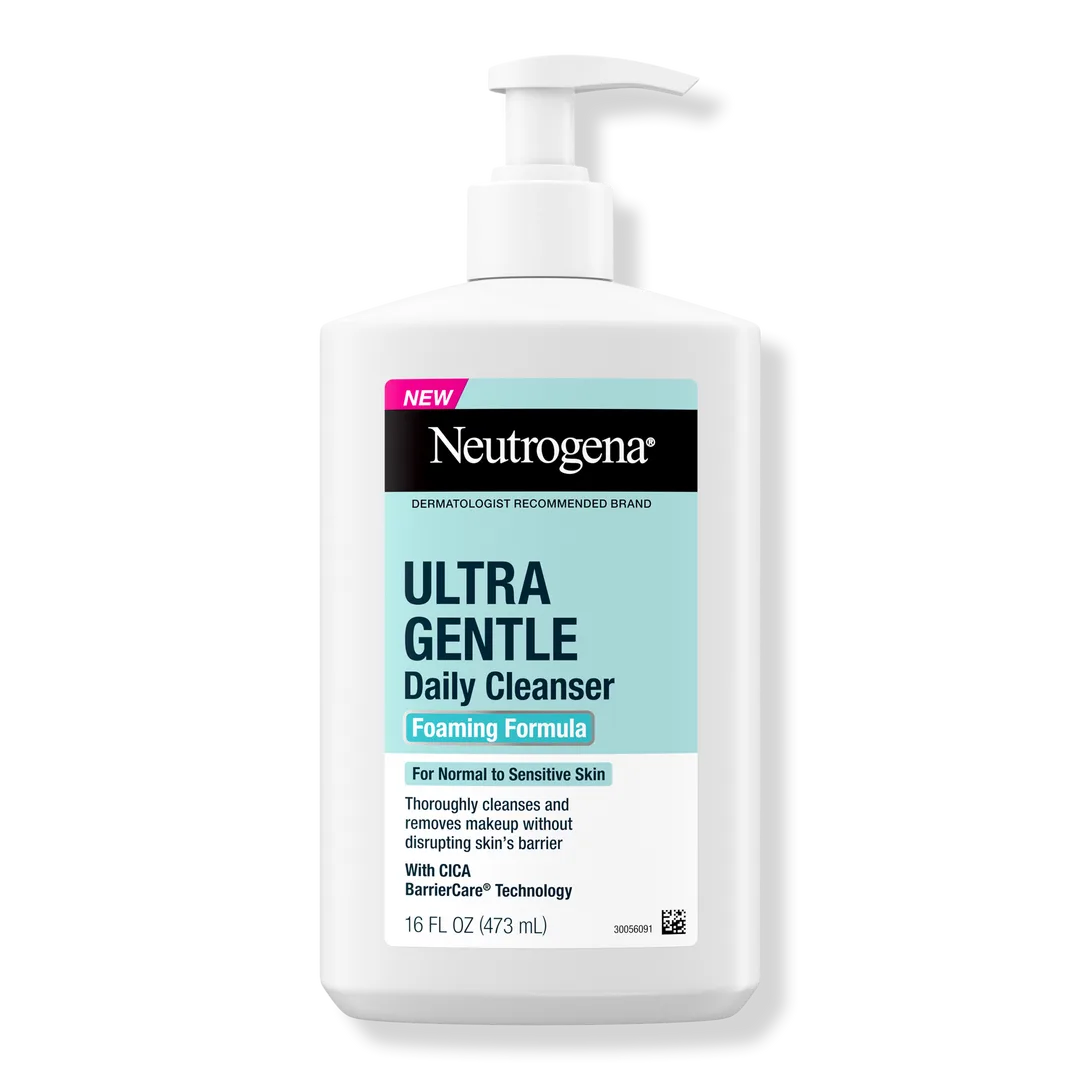
Gentle Daily Cleanser
Sensitive Skin Workhorse
 Verified reviewer
Pros & cons.
- +Clinically validated HMP polymer technology reduces surfactant irritation below non-foaming cleanser levels
- +Sulfate-free five-surfactant system cleans effectively without stripping the skin barrier
- +Glycerin as the second ingredient provides meaningful hydration during the cleansing step
- +National Eczema Association Seal of Acceptance for eczema and atopic dermatitis-prone skin
- +Completely fragrance-free, oil-free, and silicone-free — minimal irritation triggers
- +Fungal acne safe with zero malassezia-feeding ingredients
- +Exceptional value at under $1 per ounce for a clinically tested gentle cleanser
- +Reformulated with centella asiatica extract for additional barrier-soothing benefit
- −Light foam may feel unsatisfying for those accustomed to rich, sulfate-based lathers
- −Struggles to remove heavy, waterproof, or long-wear makeup without double cleansing
- −Recent reformulation changed consistency — some loyal users find the new version more watery
- −Pump dispenser on larger bottles has scattered reliability complaints
- −Low concentration of centella asiatica — listed deep in the ingredient list
The full review.
For years, the skincare community assumed foam strips the skin. The logic seemed sound: sulfate-based cleansers foam and leave skin tight, while non-foaming cleansers like Cetaphil leave skin comfortable. People equated foam with damage. This reasoning was wrong.
Neutrogena used polymer science and a published clinical trial to disprove this in 2012. They created the Ultra Gentle Daily Cleanser. In a double-blind study of 40 women with sensitive skin conditions including eczema, atopic dermatitis, and rosacea, this foaming cleanser caused less irritation than the non-foaming cleanser it was tested against. Irritation rates were five percent at weeks one and three, compared to twenty percent and ten percent for the non-foaming alternative. The foam was not the problem; the surfactant system was.
The technology uses potassium acrylates copolymer, a hydrophobically modified polymer. The mechanism is simple. The polymer wraps around the surfactant micelles—the molecular clusters that grab dirt and oil—and prevents them from penetrating the stratum corneum. It puts the surfactants on a leash. They clean the skin surface but cannot reach deep enough to disrupt the lipid barrier. You get foam, a fresh feeling, and cleansing efficacy without barrier damage.
The surfactant system follows this same logic. Cocamidopropyl betaine is the primary cleanser, an amphoteric surfactant from coconut oil mild enough for baby products. Lauryl glucoside is a non-ionic, plant-derived surfactant from the gentlest class. Disodium lauroamphodiacetate, another amphoteric surfactant, adds mildness. Sodium lauroyl sarcosinate completes the system as an amino acid-based surfactant that cleans well with low irritation potential. Five surfactants, zero sulfates, one polymer leash.
The recent reformulation added centella asiatica extract. Its position deep in the ingredient list suggests a low concentration, but even trace amounts of centella’s triterpenoid saponins provide anti-inflammatory benefits during cleansing when skin is most vulnerable.
Glycerin is second on the ingredient list, which is high for a cleanser. Most cleansers place humectants much lower. This means you get a meaningful dose of hydration with every wash. The glycerin draws moisture to the skin surface while surfactants remove debris, leaving skin more hydrated than before the wash.
The texture is a clear, lightweight gel-liquid that produces a soft, understated foam. It feels different than the explosive lather of sulfate-based face washes—quieter and subtler. It rinses clean without residue, leaving skin balanced. It is not tight or greasy. It feels like nothing, which is what a cleanser should do.
There is no scent. The fragrance-free formulation is total. For those whose morning face wash triggers reactive skin, this lack of scent is important.
The limitations are real. This cleanser does not remove heavy makeup. Light foundation, daily sunscreen, and standard makeup wash off easily, but waterproof mascara and long-wear formulas require an oil cleanser or micellar water first. The gentle surfactant system prioritizes the skin barrier over aggressive dissolution. This is a good trade-off for daily use, but heavy makeup wearers need a two-step approach.
Some users noticed the reformulated version is slightly more watery than the original. The pump dispenser on larger bottles has occasional reliability complaints. These minor packaging issues do not affect performance but matter when comparing bottles.
The value is excellent. At roughly twelve dollars for twelve ounces—less than seventy-five cents per ounce—it is one of the most affordable clinically validated gentle cleansers. The twelve-ounce bottle lasts three to four months with twice-daily use. The sixteen-ounce bottle lasts nearly five months. For a product with a published peer-reviewed study, the National Eczema Association Seal of Acceptance, and more dermatologist recommendations than any other skincare brand in the country, the price is remarkably low.
The Neutrogena Gentle Daily Cleanser is not an exciting routine step. But dermatologists know the best cleanser is the one you barely notice. This cleanser disappears into your routine so that serums, treatments, and sunscreen work on skin that is not already compromised.
Formula
Texture
The texture is a clear, lightweight gel-liquid that produces a soft, understated foam. It feels different than the explosive lather of sulfate-based face washes—quieter and subtler. It rinses clean without residue, leaving skin balanced. It is not tight or greasy. It feels like nothing, which is what a cleanser should do.
Scent
There is no scent. The fragrance-free formulation is total. For those whose morning face wash triggers reactive skin, this lack of scent is important.
Packaging
Some users noticed the reformulated version is slightly more watery than the original. The pump dispenser on larger bottles has occasional reliability complaints. These minor packaging issues do not affect performance but matter when comparing bottles.
Common Complaints
The limitations are real. This cleanser does not remove heavy makeup. Light foundation, daily sunscreen, and standard makeup wash off easily, but waterproof mascara and long-wear formulas require an oil cleanser or micellar water first. The gentle surfactant system prioritizes the skin barrier over aggressive dissolution. This is a good trade-off for daily use, but heavy makeup wearers need a two-step approach.
Pairs Well With
The Neutrogena Gentle Daily Cleanser is not an exciting routine step. But dermatologists know the best cleanser is the one you barely notice. This cleanser disappears into your routine so that serums, treatments, and sunscreen work on skin that is not already compromised.
Best for
The value is excellent. At roughly twelve dollars for twelve ounces—less than seventy-five cents per ounce—it is one of the most affordable clinically validated gentle cleansers. The twelve-ounce bottle lasts three to four months with twice-daily use. The sixteen-ounce bottle lasts nearly five months. For a product with a published peer-reviewed study, the National Eczema Association Seal of Acceptance, and more dermatologist recommendations than any other skincare brand in the country, the price is remarkably low.
Ingredient analysis.
Full INCI list · pH 5.5
Water, Glycerin, Cocamidopropyl Betaine, Lauryl Glucoside, Potassium Acrylates Copolymer, Centella Asiatica Extract, Butylene Glycol, Caprylyl Glycol, Ethylhexylglycerin, PEG-120 Methyl Glucose Dioleate, Disodium Lauroamphodiacetate, Sodium Lauroyl Sarcosinate, Potassium Sorbate, Sodium Hydroxide, Citric Acid
Skin match.
The science.
The Science
The Neutrogena Gentle Daily Cleanser uses hydrophobically modified polymer (HMP) technology, a subject of a randomized, double-blind clinical study in the Journal of Cosmetic Dermatology (Draelos et al., 2013). The study tested 40 women with sensitive skin conditions — including atopic dermatitis, eczema, acne, and rosacea — comparing the Neutrogena Gentle Daily Cleanser containing cocamidopropyl betaine, lauryl glucoside, and potassium acrylates copolymer against a commercial non-foaming cleanser for three weeks. The HMP-containing cleanser caused significantly less irritation (5% at weeks 1 and 3) than the non-foaming control (20% and 10%). Clinicians rated the test cleanser as equally or more effective at improving skin symptoms.
This result stems from the physical interaction between the HMP polymer and surfactant micelles. Hydrophobically modified polymers have hydrophobic segments that insert into the surfactant micelle structure, increasing micelle size and lowering the concentration of free surfactant monomers. These free monomers cause surfactant-induced irritation by penetrating the stratum corneum lipid bilayers and extracting structural lipids, which compromises barrier function. By sequestering monomers within polymer-bound micelles, the HMP technology maintains cleansing efficacy (the micelles still capture soil and sebum) while reducing barrier disruption.
The surfactant system uses four mild surfactant classes — amphoteric (cocamidopropyl betaine, disodium lauroamphodiacetate), non-ionic (lauryl glucoside), and amino acid-based (sodium lauroyl sarcosinate) — instead of one surfactant at a high concentration. A safety review of cocamidopropyl betaine in Toxicological Research (Kim et al., 2024) confirmed its safety for cosmetic use, noting no genotoxicity or carcinogenicity at use levels.
References
- Hydrophobically modified polymers can minimize skin irritation potential caused by surfactant-based cleansers — Journal of Cosmetic Dermatology (2013)
- Safety assessment of cocamidopropyl betaine, a cosmetic ingredient — Toxicological Research (2024)
- Irritant and sensitizing potential of eight surfactants commonly used in skin cleansers: an evaluation of 105 patients — Dermatitis (2010)
Dermatologist Perspective
Dermatologists often recommend this cleanser for patients with reactive skin, especially during retinoid therapy when the skin barrier is under stress. Board-certified dermatologists note that the multi-surfactant, sulfate-free system with HMP polymer technology is an evidence-based approach to gentle cleansing — it keeps the foam experience many patients prefer without the barrier disruption they want to avoid. The National Eczema Association Seal of Acceptance independently validates that this product meets strict standards for use on compromised skin.
Where it fits in your routine.
Wet your face with lukewarm water. Put a small amount (roughly a quarter-sized pump) in your hands, work it into a gentle foam, and massage it onto your face in circular motions for 30-60 seconds. Rinse well with lukewarm water and pat dry. Use morning and evening. For heavy makeup removal, use an oil cleanser or micellar water first and use this as the second cleanse.
At about $12 for 12 ounces — under $1 per ounce — the Neutrogena Gentle Daily Cleanser provides high value for a clinically validated, dermatologist-recommended gentle cleanser. Sizes range from 6 oz travel-friendly bottles to 16 oz pump bottles. One 12 oz bottle lasts 3-4 months using it twice daily, making the daily cost roughly 10 cents. Because the Neutrogena Gentle Daily Cleanser has a National Eczema Association seal and a published clinical study, the price removes financial barriers to gentle cleansing.
This cleanser works for sensitive, reactive, eczema-prone, or rosacea-prone skin. It is also an ideal companion cleanser during retinoid therapy, post-procedure recovery, or any period when the skin barrier needs protection. It provides a foam experience without sulfate-level irritation.
If you need a heavy-duty makeup remover as your only cleanser, skip this; the product prioritizes gentleness over aggressive dissolution. Skip this if you prefer thick, luxurious lathers — this foam is subtle and understated.
Product details.
A clear to slightly translucent lightweight gel-liquid foams softly when rubbed between wet hands. It is a watery-gel consistency rather than thick or creamy and rinses clean without residue.
Fragrance-free and has no detectable scent. Some users with very sensitive noses report a faint, clean-product smell that most people cannot perceive.
Translucent plastic bottle with pump dispenser (16 oz) or squeeze bottle with flip-top cap (12 oz and smaller). The packaging is simple, functional drugstore style. The 16 oz pump format works well on bathroom countertops.
The cleanser feels gentle on first use. It lathers into a light foam, lacking the thick lather of sulfate-based cleansers, which takes adjustment. Skin feels clean after rinsing without tightness, dryness, or a squeaky feeling. There is no tingling, stinging, or adjustment period. Users switching from harsher cleansers notice the difference immediately.
3-4 months using twice daily on the face only (12 fl oz bottle); 4-5 months for the 16 fl oz bottle
12 months
All Year
The backstory.
Launched in 2012 as a replacement for the older Neutrogena Extra Gentle Cleanser, the Ultra Gentle Daily Cleanser was Neutrogena's direct response to the growing perception that foaming cleansers were inherently harsher than non-foaming alternatives like Cetaphil. The brand invested in HMP polymer technology and a published clinical study to prove that a foaming cleanser could match or beat the mildness of non-foaming options. The product was reformulated around 2023-2024 with the addition of Centella asiatica extract and BarrierCare Technology branding, reflecting the broader industry shift toward barrier-centric skincare.
About Neutrogena
Legacy Brand (20+ years)Neutrogena launched in 1930 and is the number-one dermatologist-recommended skincare brand in the United States. The Ultra Gentle line uses proprietary hydrophobically modified polymer technology. A published clinical study shows this technology reduces irritation compared to non-foaming alternatives.
Common myths.
Foaming cleansers are harsher than non-foaming ones and sensitive skin avoids them.
A published double-blind clinical study on 40 women with sensitive skin conditions shows this foaming cleanser causes less irritation (5% at weeks 1 and 3) than a leading non-foaming cleanser (20% and 10% respectively). Foam is a textural preference, not a sign of harshness — it depends on the surfactant system and formulation technology.
If a cleanser lacks a thick lather, it does not clean properly.
This cleanser makes a light, soft foam instead of a thick lather. The multi-surfactant system removes dirt, oil, and daily sunscreen without heavy foam. High lather often shows higher concentrations of aggressive surfactants that strip the skin barrier.
Drugstore cleansers use cheaper, more irritating surfactants than prestige brands.
This formula uses five mild surfactants in a blended system and a patented HMP polymer, which a peer-reviewed clinical study examined. The ingredient architecture is more thoughtful than many prestige cleansers costing three to five times the price.
FAQ.
Is Neutrogena Gentle Daily Cleanser good for eczema?
Yes — it has the National Eczema Association Seal of Acceptance and underwent clinical testing on patients with eczema and atopic dermatitis. The sulfate-free, fragrance-free formula uses HMP polymer technology to reduce surfactant penetration into the skin barrier, making it one of the safest cleanser choices for eczema-prone skin.
Can I use Neutrogena Gentle Daily Cleanser with retinol?
This cleanser pairs well with retinoid treatments. The gentle, non-stripping surfactant system protects your skin barrier when retinoids cause dryness and sensitivity. Using a harsh product while using retinol causes most retinoid irritation.
Does Neutrogena Gentle Daily Cleanser remove makeup?
It removes daily makeup, light foundation, and standard sunscreen. Use an oil cleanser or micellar water first for heavy, waterproof, or long-wear makeup in a double-cleansing routine — the gentle surfactant system favors skin comfort over aggressive makeup dissolution.
Is this cleanser sulfate-free?
Yes — it has no SLS (sodium lauryl sulfate) or SLES (sodium laureth sulfate). Cocamidopropyl betaine, lauryl glucoside, disodium lauroamphodiacetate, and sodium lauroyl sarcosinate provide the cleansing. These surfactant classes are milder and clean effectively without the stripping potential of sulfates.
Is Neutrogena Gentle Daily Cleanser safe during pregnancy?
Yes — this cleanser has no retinoids, salicylic acid, or ingredients flagged during pregnancy. The fragrance-free, minimal formula uses well-tolerated surfactants. This makes it a safe cleanser choice for expecting mothers, scoring high on pregnancy safety assessments.
Is this cleanser fungal acne safe?
Yes — the formula lacks fatty acids, esters, polysorbates, or fermented ingredients that feed malassezia yeast. Independent fungal acne safety databases show zero triggers in this cleanser. It is safe for people with fungal acne or pityrosporum folliculitis.
What the community says.
"Does not strip or leave skin feeling tight after washing"
"Effectively removes daily makeup and sunscreen without irritation"
"Truly fragrance-free with no detectable scent"
"Leaves skin feeling soft, clean, and balanced"
"Affordable and widely available at every drugstore"
"Excellent for eczema-prone and rosacea-prone skin"
"Recent reformulation changed the consistency — some find it more watery"
"Light foam may not feel satisfying to those used to rich lathers"
"Struggles with heavy or waterproof makeup removal"
"Pump dispenser on larger bottles can be finicky"
"Some users report mild eye stinging if product gets in eyes"
People also looked at.