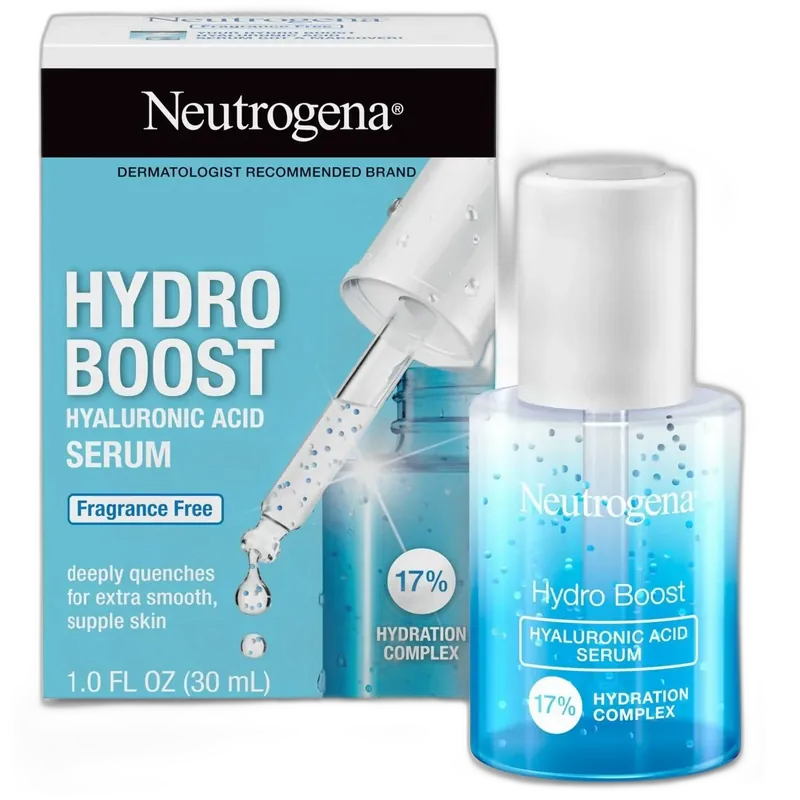
Hydro Boost Hyaluronic Acid Serum
Drugstore Hydration MVP
 Verified reviewer
Pros & cons.
- +Dual-weight hyaluronic acid system hydrates at multiple skin depths simultaneously
- +Aquaxyl complex boosts the skin's own moisture reserves beyond just topical hydration
- +Absorbs in seconds with zero sticky or greasy residue on any skin type
- +Fragrance-free, hypoallergenic formula with extremely low irritation risk for sensitive skin
- +Panthenol and trehalose provide barrier-strengthening benefits beyond simple hydration
- +Layers flawlessly under any moisturizer, sunscreen, or makeup without pilling
- +Endorsed by board-certified dermatologists as a top-tier HA serum despite drugstore pricing
- −Must be followed with a moisturizer — provides no occlusive seal for the hydration it delivers
- −One-ounce bottle looks and feels small relative to the price despite lasting 2-3 months
- −Contains yeast extract which may be a concern for fungal acne-prone skin
- −Slight blue tint can be off-putting to those expecting a clear serum
- −Not cruelty-free as Neutrogena sells in markets requiring animal testing
The full review.
About Neutrogena
Neutrogena’s legacy as a brand deserves mention without turning this into a press release. Founded in 1930, acquired by Johnson and Johnson in 1994, now under Kenvue — this is a company with decades of dermatological research infrastructure behind it. The Hydro Boost line, launched in 2014-2015, has had nearly a decade of real-world testing and reformulation. You’re buying a refined product from a brand that has the clinical resources to validate its claims, not a startup that put HA in a pretty bottle and hired influencers.
Myth
The headline claim is a ‘17% Hydration Complex,’ which sounds like marketing until you examine what’s actually in it.
Reality
The formula uses two molecular weights of hyaluronic acid — sodium hyaluronate, the standard high molecular weight form that sits on the skin’s surface and forms a moisture-retaining film, and hydrolyzed hyaluronic acid, a fragmented version small enough to penetrate into the upper layers of the epidermis. This isn’t a novel concept in high-end skincare, but it’s genuinely uncommon at the twenty-dollar price point. Most drugstore HA serums give you one weight and call it a day.
But the real formulation story is the supporting cast. Glycerin sits at position two on the INCI list — a high concentration of the most reliable, best-studied humectant in skincare. Panthenol, vitamin B5, follows closely, adding barrier-strengthening and anti-inflammatory properties. Then comes the Aquaxyl complex: xylitylglucoside, anhydroxylitol, and xylitol. This is a patented plant sugar-derived system that doesn’t just add moisture — it optimizes the skin’s own water reserves by boosting natural moisturizing factors and stimulating barrier lipid synthesis. It’s the kind of ingredient that gets formulators excited and consumers usually never hear about because the marketing department has already decided ‘hyaluronic acid’ is the only word that sells.
Trehalose rounds out the hydration strategy as a sugar humectant with a specific talent: it stabilizes cell membranes under desiccation stress. In practical terms, this means it helps skin cells maintain their integrity when environmental conditions are trying to dry them out. Together, these ingredients create a hydration system that works at multiple levels — attracting water, holding water, and helping skin cells survive when water is scarce.
How to Use
Apply to damp skin, follow with a moisturizer, and the system works as designed.
Who Should Buy
The texture makes it genuinely versatile across skin types, which is unusual for a hydrating product. Oily skin types can use it without feeling weighed down. Dry skin types get meaningful hydration (though they’ll absolutely need a moisturizer on top — more on that in a moment). Sensitive skin gets a formula that’s fragrance-free, hypoallergenic, paraben-free, and contains soothing panthenol. The ingredient list is refreshingly short at 27 ingredients, with nothing that screams ‘why is this in a hydrating serum?‘
Texture
On the skin, this serum feels like slightly thickened water with a barely perceptible blue tint. The tint comes from ultramarines and mica — cosmetic colorants that disappear completely on application. There’s something honest about how this product behaves: it goes on, it absorbs in seconds, and it gets out of the way. No sticky residue, no tacky film, no extended dry-down time. Your skin just feels immediately softer and slightly plumper, ready for the next step.
Scent
Not mentioned.
Packaging
The one-ounce bottle at twenty dollars gives some people pause, and that’s fair. It looks small on the shelf. But 4-5 drops per application means it lasts two to three months — the per-use cost works out to roughly fifteen to twenty cents, which is genuinely cheap for a targeted treatment step. Most prestige HA serums delivering comparable multi-weight technology cost forty to seventy dollars for the same amount.
Best Season
Not mentioned.
Common Praise
The Dr. Dray endorsement carries weight here. When a board-certified dermatologist with a massive following names a twenty-dollar drugstore serum as her number-one hyaluronic acid product, that’s notable — especially given the universe of expensive HA serums she could have chosen. It reflects what the ingredient list already tells you: this formula is doing the right things at the right concentrations.
Common Complaints
The critical limitation — and it’s one that catches people — is that this is a humectant-based serum, not a moisturizer. It attracts and holds water, but it doesn’t seal it in. Without an occlusive or emollient layer on top, especially in dry environments or during winter, you may actually feel drier as the HA draws moisture from your skin rather than the air. This isn’t a flaw in the product; it’s how the chemistry works.
Pairs Well With
Not mentioned.
Conflicts With
Not mentioned.
Best for
Not mentioned.
Works for
Not mentioned.
Not ideal for
Not mentioned.
AM routine
Not mentioned.
PM routine
Not mentioned.
Ingredient analysis.
Full INCI list
Water, Glycerin, Butylene Glycol, Panthenol, Pentylene Glycol, Phenoxyethanol, Chlorphenesin, Acrylates/C10-30 Alkyl Acrylate Crosspolymer, Trehalose, Xylitylglucoside, Sodium Hyaluronate, Anhydroxylitol, Disodium EDTA, Sodium Hydroxide, Yeast Extract, Xylitol, Hydrolyzed Hyaluronic Acid, Carrageenan, Caprylyl Glycol, Agar, Potassium Chloride, Xanthan Gum, Benzoic Acid, Dehydroacetic Acid, Ultramarines, Titanium Dioxide, Mica
Skin match.
The science.
The Science
This serum uses a dual-weight hyaluronic acid approach based on research regarding molecular weight and skin penetration. A 2015 study in the Journal of Drugs in Dermatology shows low molecular weight hyaluronic acid fragments penetrate the stratum corneum better than standard high molecular weight HA. These fragments hydrate deeper epidermal layers, while larger molecules form a moisture-retaining barrier on the surface. This dual approach smooths the surface immediately and provides sustained deeper hydration.
The Aquaxyl complex (xylitylglucoside, anhydroxylitol, and xylitol) has clinical testing showing it increases the skin's own hyaluronic acid and chondroitin sulfate levels. This teaches skin to hold more moisture instead of relying only on topically applied humectants. Research on the Aquaxyl complex shows improved transepidermal water loss and corneometry measurements, which means reduced moisture escape and increased water content in the stratum corneum.
Panthenol does more than moisturize. Research in the Journal of Dermatological Treatment shows panthenol improves stratum corneum hydration, reduces transepidermal water loss, and maintains skin softness and elasticity. In this formula, panthenol works with the HA system to strengthen the skin barrier that retains the moisture the humectants attract.
Trehalose provides cellular protection during dehydration. This disaccharide stabilizes cell membrane lipid bilayers under water stress, a mechanism first studied in extremophile organisms. In skin, Trehalose improves cellular resilience during environmental dehydration, complementing the moisture-attracting function of the other humectants in the formula.
Dermatologist Perspective
Dermatologists often recommend hyaluronic acid serums to hydrate patients of all skin types, and this formula is a common drugstore choice. Board-certified dermatologists note that the multi-weight HA approach, Aquaxyl complex, and panthenol create a more complete hydration system than most single-ingredient HA serums. Dermatologists advise applying this to damp skin and following with a moisturizer to seal in hydration. This step is vital for patients in dry climates or those using drying treatments like retinoids or benzoyl peroxide. The hypoallergenic, fragrance-free formula is a regular recommendation for post-procedure skin and patients with a compromised skin barrier.
Where it fits in your routine.
Apply 4-5 drops to freshly cleansed, damp skin. Damp skin provides the hyaluronic acid an immediate water source. Pat gently onto the face and neck. Wait 30 seconds for absorption, then apply your moisturizer immediately to seal in hydration. Use morning and evening. In dry climates or heated indoor environments, mist your face lightly before application so the HA has enough ambient moisture to draw from.
At approximately $20 for 1 fl oz, this serum offers good value. The per-use cost is roughly 15-20 cents over its 2-3 month lifespan. The dual-weight HA system, Aquaxyl complex, panthenol, and trehalose use technology found in $40-70 serums. The only available size is the 1 fl oz bottle; a larger economy option would increase value. The cost-per-benefit ratio is strong for consumers on retinoid regimens or in dry climates who need daily hydration support.
This serum helps anyone with dehydrated, dull, or tight-feeling skin, regardless of skin type. It works well for sensitive skin types needing simple hydration, and for users of drying treatments like retinoids who need reliable hydration at a reasonable price.
Skip this if you want an all-in-one hydrator and moisturizer — you need a moisturizer on top for it to work. Avoid this if you have fungal acne, as the yeast extract may trigger Malassezia-sensitive skin.
Product details.
This watery gel is lightweight and has a slight blue tint. It absorbs fast and leaves no sticky or greasy residue.
Fragrance-free with no discernible scent.
A 1 fl oz recyclable glass bottle uses a dropper applicator and features Hydro Boost blue and white branding. It includes an outer cardboard box.
The serum feels like slightly thickened water on first application; it spreads easily and absorbs in seconds. Skin feels smoother and plumper immediately. There is no adjustment period, tingling, or irritation. The blue tint disappears completely upon application. Results are cumulative and improve over the first few weeks of consistent use.
2-3 months with twice-daily application of 4-5 drops
12 months
All Year
The backstory.
The Hydro Boost line launched in 2014-2015 as Neutrogena's answer to the K-beauty-driven hyaluronic acid boom, proving that effective hydration technology didn't require a luxury price tag. This serum variant, introduced around 2020, concentrated the line's hydration philosophy into a targeted treatment format with the proprietary 17% Hydration Complex — a response to consumers wanting a dedicated HA step in their routine rather than relying on their moisturizer alone.
About Neutrogena
Legacy Brand (20+ years)Neutrogena launched in 1930 and is a top dermatologist-recommended drugstore brand in the United States. The Hydro Boost line, released in 2014-2015, is a bestselling hydration range at mass retail, supported by Kenvue's clinical research infrastructure.
Common myths.
Hyaluronic acid pulls moisture out of your skin in dry climates.
This formula addresses that concern using a dual-weight system and humectants like glycerin and trehalose. High molecular weight HA forms a surface film to retain moisture, while the Aquaxyl complex optimizes the skin's water reserves. Apply to damp skin and seal with a moisturizer to prevent any reverse-draw effect.
All hyaluronic acid serums are basically the same.
Molecular weight is critical. This serum uses high and low molecular weight HA to hydrate different skin depths. It also uses the Aquaxyl complex to boost the skin's moisture-retaining capacity. This approach differs from single-weight HA serums that only hydrate the surface.
FAQ.
Is Neutrogena Hydro Boost Hyaluronic Acid Serum good for oily skin?
Yes — the oil-free, lightweight formula absorbs fast and leaves no grease. Its water-based gel texture works for oily skin that needs hydration. The dual-weight HA system helps dehydrated oily skin by stopping moisture loss without adding excess oil.
Can I use this serum with retinol?
This serum's gentle, hydrating formula works well with retinol products. Apply the Hydro Boost serum to damp skin first, then layer retinol on top. The panthenol and hyaluronic acid buffer retinol dryness and irritation, while the Aquaxyl complex supports barrier function.
Why does this serum have a blue tint?
Ultramarines, titanium dioxide, and mica at the end of the ingredient list provide the blue color. These cosmetic colorants give the serum its signature Hydro Boost appearance. The tint disappears on application and does not affect the formula's performance or leave color on skin.
Do I still need moisturizer after using this serum?
Yes, especially for dry skin. This serum uses humectants to attract and hold water, but lacks occlusive ingredients to seal moisture. Applying a moisturizer — specifically one with ceramides or dimethicone — locks in hydration and maximizes the serum's effectiveness.
How does the Hydro Boost serum compare to the Hydro Boost Water Gel?
The serum is a concentrated hydration treatment for layering, while the Water Gel is a standalone lightweight moisturizer. The serum has higher concentrations of the dual-weight hyaluronic acid system and Aquaxyl complex, making it the more targeted hydration step. Many users use both — the serum first, then the Water Gel as their moisturizer.
Is this serum safe for sensitive skin?
Yes — it is hypoallergenic, fragrance-free, and dermatologist-tested with a minimal ingredient list. The formula lacks common irritants like alcohol, essential oils, and fragrances. Panthenol and trehalose in the formula soothe and protect reactive skin.
Should I apply this serum to damp or dry skin?
Apply to damp skin. Hyaluronic acid draws moisture toward itself; damp skin provides an immediate water source. After cleansing, pat your face until slightly damp, apply 4-5 drops of serum, then use moisturizer to seal it in.
What the community says.
"Lightweight texture absorbs quickly with no sticky residue"
"Effective hydration that lasts throughout the day"
"Works well under makeup and moisturizer"
"Fragrance-free and gentle enough for sensitive skin"
"Skin feels noticeably softer and plumper after use"
"Great value for a multi-weight HA serum at drugstore pricing"
"Not hydrating enough on its own for very dry skin without a moisturizer on top"
"Small 1 oz bottle feels expensive relative to size"
"Slight blue tint can be unexpected"
"Some users feel the reformulated version is less effective than the original Hydro Boost serum"
People also looked at.