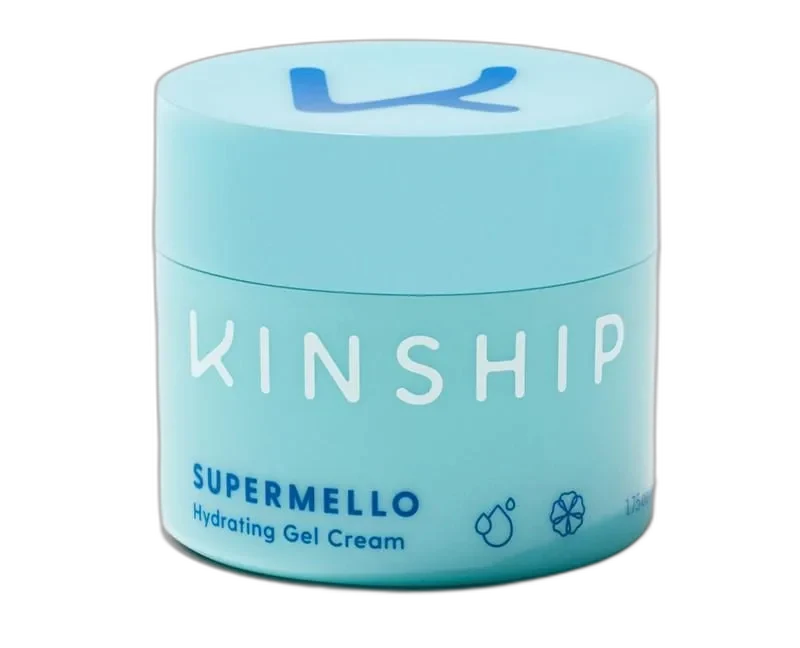
Supermello Hyaluronic Gel Cream Moisturizer
Sensitive Skin Softie
 Verified reviewer
Pros & cons.
- +National Eczema Association accepted formula
- +Fragrance-free, alcohol-free, and essential oil free
- +Humectant stack of glycerin, HA, sodium lactate, and sodium PCA
- +Cooling gel cream texture that calms reactive skin fast
- +Lightweight enough for combination skin but supportive for dry
- +Kinbiome postbiotic complex supports barrier tolerance
- +Leaping Bunny certified and vegan
- −Contains coconut oil and isopropyl palmitate, problematic for acne-prone users
- −Jar packaging is not ideal for the vitamin C ester and postbiotic
- −1.75 oz jar feels small at $38
- −Not rich enough as a standalone for very dry winter skin
- −Brand is young and clinical validation rests on ingredient-level research
The full review.
The National Eczema Association seal usually appears on medical-looking products: plain tubes, white boxes, and names like Restorative Barrier Cream. Kinship’s Supermello Hyaluronic Gel Cream Moisturizer looks different. It uses a beach-towel-colored recyclable jar, a marshmallow-themed name, and targets millennial and Gen Z clean beauty shoppers. Still, the seal is real. Kinship submitted this moisturizer and passed the organization’s formula testing.
This context changes how you evaluate the formula. The ingredient list starts with aloe vera juice instead of water. This choice cools reactive skin and adds a thin polysaccharide film for hydration. Glycerin is the second humectant. Further down, sodium hyaluronate, sodium lactate, and sodium PCA create a more thorough humectant stack than most gel creams. Mango seed butter, squalane, cocoa seed butter, and caprylic capric triglyceride provide enough emollients for a full moisturizer rather than a watery gel. Lactobacillus ferment, Kinship’s Kinbiome complex, sits in the middle to support barrier tolerance. The formula also includes a small dose of tetrahexyldecyl ascorbate, a stable oil-soluble vitamin C ester, which works well for a daytime moisturizer.
On the skin, this moisturizer feels right on reactive, dehydrated, or flaky skin. The gel cream whips out of the jar, cools on contact, and melts into a soft finish. Combination skin can wear it under sunscreen without grease, and moderately dry skin can use it morning and night. The fragrance-free base helps those with rosacea, eczema, or post-acid sensitivity. Because it lacks alcohol, essential oils, and fragrance, it is an easy clean beauty recommendation for reactive skin. Within one week, surface flakiness improves, dry patches soften, and routine comfort increases.
The formulation has caveats. Two ingredients are notable. Coconut oil is low on the list but can trigger acne in users sensitive to high-fatty-acid occlusives. Isopropyl palmitate sits higher and has a historical comedogenicity rating that may clog skin. Acne-prone users or those with fungal acne should patch-test this first. The jar packaging is another drawback. A gel cream containing a vitamin C ester and a live postbiotic ferment works better in airless packaging; the recyclable jar is an aesthetic choice that may compromise formulation integrity over time. The 1.75 oz size also makes the price per month feel higher than the $38 sticker; the 3.3 oz option has better value.
This moisturizer suits sensitive, dry, or eczema-prone skin looking for clean beauty with substance. It works well for retinoid users needing a barrier-supportive gel cream to buffer actives, and for rosacea-prone users avoiding fragrance and essential oils. It is not for acne-prone skin prone to clogs, nor is it the cheapest option for basic gel hydration. Within its category, Supermello is a credible sensitive-skin moisturizer under $40, matching the Eczema Association seal.
Ingredient analysis.
Full INCI list
Aloe Barbadensis Leaf Juice, Water (Aqua), Glycerin, Isopropyl Palmitate, Mangifera Indica (Mango) Seed Butter, Sodium Acrylates Copolymer, Cocos Nucifera (Coconut) Oil, Squalane, Caprylic/Capric Triglyceride, Althaea Officinalis Root Extract, Lecithin, Cocos Nucifera (Coconut) Liquid Endosperm, Lactobacillus Ferment, Sodium Hyaluronate, Theobroma Cacao (Cocoa) Seed Butter, Tetrahexyldecyl Ascorbate, Citrullus Lanatus (Watermelon) Fruit Extract, Lens Esculenta (Lentil) Fruit Extract, Helianthus Annuus (Sunflower) Seed Oil, Pyrus Malus (Apple) Fruit Extract, Vanilla Planifolia Fruit Extract, Calophyllum Inophyllum Seed Oil, Tocopherol, Phytic Acid, Sodium Lactate, Sodium PCA, Citric Acid, Tapioca Starch, Phenoxyethanol, Ethylhexylglycerin, Potassium Sorbate, Sodium Benzoate.
Skin match.
The science.
The Science
This product uses ingredients with strong or emerging evidence for barrier and hydration support. Glycerin is a top-studied humectant in cosmetic dermatology; decades of peer-reviewed work show it improves stratum corneum hydration and barrier repair. Sodium hyaluronate, sodium lactate, and sodium PCA are natural moisturizing factor components with published support for surface hydration and transepidermal water loss reduction. Aloe vera anchors this formula and has a mixed but generally favorable evidence base, as several controlled studies show modest anti-inflammatory and hydrating effects on mildly irritated skin. The emerging ingredient is lactobacillus ferment, a postbiotic that has grown in dermatology research over the last five years. Published work in Journal of Investigative Dermatology and Experimental Dermatology associates topical fermentates with improved barrier function and lower perceived surface sensitivity, though the evidence is younger than classic humectants. The product also contains tetrahexyldecyl ascorbate, a stable oil-soluble vitamin C ester with in vitro data supporting antioxidant activity and a weaker but real case for pigmentation modulation at higher concentrations. All marketing claims are supported, though the Kinbiome positioning relies most on emerging rather than established literature.
Dermatologist Perspective
Dermatologists often recommend products with National Eczema Association acceptance for patients with flare-up histories, and Supermello is one of the few clean beauty brand products with that seal. Board-certified dermatologists note the fragrance-free, alcohol-free base makes this moisturizer a reasonable daily option for rosacea-prone, eczema-prone, and post-procedure skin types; they frequently suggest it as a buffering step for patients starting topical retinoid therapy. Dermatologists usually add that coconut oil and isopropyl palmitate make it a less ideal choice for clog-prone and fungal-acne-prone skin, so patient selection matters. It is also commonly suggested for adults seeking a clean beauty alternative to classic pharmacy gel creams that maintains tolerability on reactive skin.
Where it fits in your routine.
Apply to clean, damp skin after serums and before sunscreen in the morning, and after serums at night. Use a pea to nickel-sized amount for the face and neck. Tap gently instead of rubbing to keep preceding layers intact. For very dry skin or cold climates, layer a facial oil or heavier cream on top at night. Acne-prone users should patch-test on a small section of the jawline for two weeks before full face application. Seal the jar tightly after each use to preserve the vitamin C ester and postbiotic ingredients.
At $38 for 1.75 oz, this moisturizer sits in the mid-tier of clean beauty gel creams, above drugstore options like CeraVe but below luxury sensitive-skin formulations. The monthly cost works for daily full-face use, and the 3.3 oz tube size saves money for regular users. The value is comparable to similar sensitive-skin moisturizers from First Aid Beauty or Krave, not class-leading. The National Eczema Association acceptance justifies the price over less-validated clean beauty gel creams; for readers wanting a fragrance-free formulation with a postbiotic angle, the cost is defensible.
This fragrance-free clean beauty gel cream works as a daily moisturizer for sensitive, dry, eczema-prone, or rosacea-prone skin in the twenties through fifties. It also works well for users on retinoid routines who want a cushioned, barrier-supportive buffering step.
Acne-prone or fungal-acne-prone skin, because it contains coconut oil and isopropyl palmitate. Very dry winter skin that needs a thick occlusive cream instead of a gel cream. Budget shoppers who can find a larger pharmacy gel cream at a lower price per ounce.
Product details.
All Year Certifications National Eczema Association AcceptedLeaping Bunny
The backstory.
Supermello was one of the products that put Kinship on the sensitive-skin map shortly after its 2019 launch. It was built around the Kinbiome pre-probiotic complex the brand developed in-house, and it was submitted for and received National Eczema Association acceptance, which is unusual for a clean beauty brand that is not primarily positioned as medical.
About Kinship
Emerging Brand (2–5 years)Kinship was founded in 2019 with a clean beauty and sustainable packaging focus and has been accepted by the National Eczema Association for several products including Supermello. The brand is young but has meaningful retail distribution at Ulta, Anthropologie, and Credo.
Common myths.
Aloe-first formulas lack the viscosity to moisturize dry skin.
An aloe-first base contains high water content, but this product balances it with mango and cocoa seed butter, squalane, and a humectant stack. This allows it to work as a full moisturizer even on dry, flaky skin.
A clean beauty label ensures a product is fungal-acne safe or acne-safe.
This cream meets mainstream clean standards but uses coconut oil and isopropyl palmitate. These ingredients do not work for everyone with acne-prone or fungal-acne-prone skin. Clean and acne-safe are different questions.
FAQ.
Is Supermello suitable for acne-prone skin?
Most combination and normal skin types can use it safely. However, coconut oil and isopropyl palmitate can clog follicles in some acne-prone users. Patch-test on the jawline for two weeks before full-face use.
Is this moisturizer safe for eczema?
Yes. Supermello is accepted by the National Eczema Association, and the fragrance-free, alcohol-free formula with Kinbiome postbiotic support is generally well tolerated by eczema-prone skin.
Can I use it under sunscreen?
Yes, and most users apply it this way. The gel cream absorbs fast enough for a mineral SPF to sit cleanly on top. Wait one minute between steps to stop pilling with heavier mineral sunscreens.
Does it sting around the eyes?
No, this fragrance-free formula does not sting. Most users apply it up to the orbital bone without irritation, but it is not a dedicated eye cream.
Is it heavy enough for very dry skin in winter?
It works for moderately dry skin. For severely dry or mature skin in cold climates, layer a facial oil or a heavier cream on top at night. As a daytime moisturizer under sunscreen, it is usually enough.
Is Supermello pregnancy-safe?
Yes. The formula lacks retinoids, salicylic acid, and other ingredients most obstetricians flag during pregnancy or breastfeeding.
How long does the jar last?
The 1.75 oz jar lasts most users 2 to 3 months when used daily on the face and neck. The 3.3 oz tube has better per-unit value for committed users.
Community
What the community says.
"Cools on contact and calms reactive skin"
"Lightweight enough for combination skin but supportive for dry"
"Fragrance-free and safe for reactive users"
"Plumps hydrated finish without tackiness"
"Contains coconut oil and isopropyl palmitate, problematic for acne-prone users"
"Jar packaging is not ideal for the vitamin C ester"
"Runs out faster than expected at the 1.75 oz size"