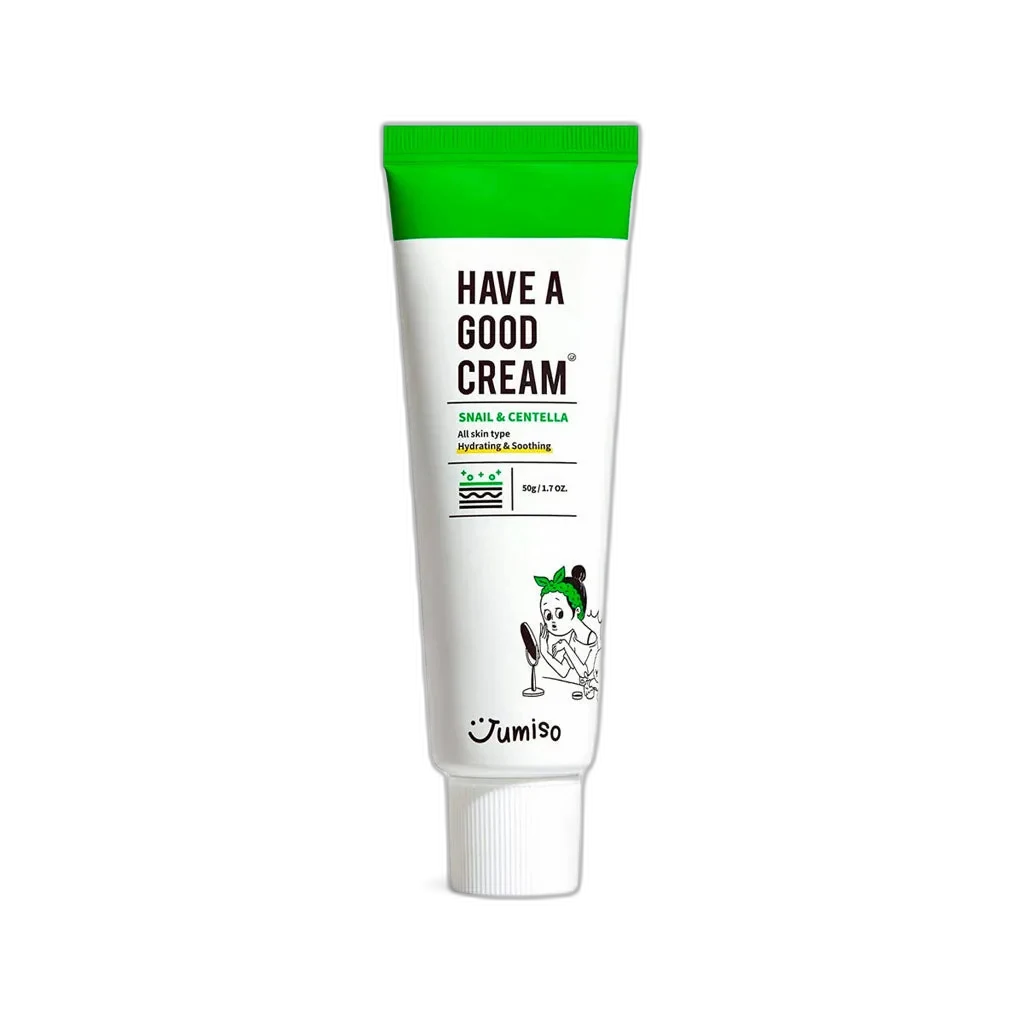
Have a Good Cream Snail & Centella
K-Beauty Soothing Bargain
 Verified reviewer
Pros & cons.
- +Centella asiatica extract at 1.05% — well above the typical efficacy threshold
- +Includes isolated triterpenes (asiaticoside, madecassic acid, asiatic acid) for enhanced centella delivery
- +Lightweight, fast-absorbing texture without the sliminess of pure snail mucin products
- +Squalane-based emollient system provides barrier support without heavy greasiness
- +Exceptionally affordable for the quality of active ingredients included
- +Cruelty-free formulation with no synthetic fragrance added
- +Contains panthenol and beta-glucan for additional soothing and barrier support
- −Snail secretion filtrate sits lower in the ingredient list than the product name suggests
- −Contains botanical fragrance (lemon myrtle oil) and menthyl lactate that may irritate very reactive skin
- −Jar packaging exposes active ingredients to air and potential contamination with each use
- −May not provide sufficient moisture for very dry skin types in cold weather
- −Limited availability — may be harder to find in physical retail outside of K-beauty specialty stores
The full review.
There’s a particular kind of product that thrives on misdirection — not deceptive misdirection, but the kind where the flashiest ingredient on the label isn’t actually the formula’s strongest card. Jumiso’s Have a Good Cream Snail & Centella puts snail mucin right in the name, knowing it’ll catch your eye in a crowded K-beauty aisle. But the real story here is the centella asiatica extract sitting at 1.05% — roughly ten times the concentration typically needed for efficacy — quietly doing the heavy lifting while the snail gets all the credit.
The formula reads like a greatest-hits compilation of soothing Korean skincare philosophy. Centella asiatica extract provides the calming foundation, and Jumiso didn’t stop there — they’ve also included the isolated triterpenes asiaticoside, madecassic acid, and asiatic acid as separate line items in the INCI list. This means you’re getting both the full-spectrum extract and its most researched active compounds, a layered approach to centella delivery that not every cica cream bothers with.
Snail secretion filtrate does make an appearance, though it sits further down the ingredient list than the name might lead you to expect. It contributes glycoproteins and natural allantoin that complement the centella’s repair work, but anyone buying this purely for snail mucin benefits might want to temper their expectations. Think of it as a supporting actor delivering a solid performance rather than stealing every scene.
The emollient base is where the formulation shows real thought. Squalane sits high in the ingredient list as the primary lipid, providing barrier support without the heaviness of petrolatum or the potential pore-clogging concerns of some plant oils. Jojoba and macadamia oils add fatty acid diversity, while dimethicone and cyclopentasiloxane create that smooth, fast-absorbing glide that makes the cream feel surprisingly lightweight for its moisture payload. Sodium hyaluronate pulls water into the skin from underneath, and panthenol reinforces the whole calming narrative.
On the skin, this cream has a pleasant white, medium-weight texture that melts down to almost nothing within seconds. There’s none of the trademark snail-mucin sliminess that polarizes K-beauty forums. Instead, it feels like a well-behaved moisturizer that happens to contain snail mucin — smooth, slightly dewy, and genuinely fast-absorbing. A mild cooling sensation from the menthyl lactate announces itself briefly on application, which most users will find refreshing but the truly menthol-sensitive should note.
The scent is worth addressing honestly. Backhousia citriodora leaf oil — lemon myrtle — gives this cream a faint herbal-citrus character that’s pleasant but undeniably present. It’s not the synthetic fragrance bomb that ingredient purists fear most, but it’s not fragrance-free either. For the majority of sensitive skin types, this botanical concentration won’t cause problems. For the small subset who react to any essential oil, it’s a consideration.
Performance-wise, this cream excels at the soothing and calming claims it makes. Redness from over-exfoliation, post-shaving irritation, or seasonal sensitivity transitions all respond well to the centella-heavy formula. Hydration is adequate for normal to slightly dry skin types, though genuinely dry skin in winter may find this needs backup from a richer occlusive layer on top. The texture-smoothing benefits from the snail mucin are subtle and cumulative — expect gradual improvement in skin softness and plumpness over several weeks rather than an overnight transformation.
Where this cream earns genuine respect is in the value equation. At around fourteen dollars for 50 grams, you’re getting a centella concentration that rivals products costing three to four times as much, plus a thoughtful supporting cast of squalane, hyaluronic acid, panthenol, and beta-glucan. Jumiso isn’t a legacy brand with decades of clinical research behind it — they launched in 2016 and are still building their scientific credibility. But the ingredient list speaks for itself, and sometimes the formulation doesn’t need a famous name on the jar to work.
The jar packaging is the most notable practical drawback. Antioxidant-rich and biologically active ingredients like snail mucin and centella extract are better served by airless pump packaging that limits air and light exposure. A screw-top jar invites oxidation with every use. Using a clean spatula and storing the product away from direct sunlight will help preserve efficacy.
For the skincare newcomer trying to build a simple, effective routine without spending excessively, this cream occupies a sweet spot. It’s soothing enough for post-procedure or sensitized skin, hydrating enough for daily use, and priced accessibly enough that trying it doesn’t feel like a gamble. It won’t replace a dedicated snail mucin essence or a clinical-grade cica treatment, but it combines elements of both into a single, uncomplicated step that delivers honest results.
About Jumiso
Jumiso launched in 2016 and are still building their scientific credibility.
Texture
On the skin, this cream has a pleasant white, medium-weight texture that melts down to almost nothing within seconds. There’s none of the trademark snail-mucin sliminess that polarizes K-beauty forums. Instead, it feels like a well-behaved moisturizer that happens to contain snail mucin — smooth, slightly dewy, and genuinely fast-absorbing.
Scent
The scent is worth addressing honestly. Backhousia citriodora leaf oil — lemon myrtle — gives this cream a faint herbal-citrus character that’s pleasant but undeniably present. It’s not the synthetic fragrance bomb that ingredient purists fear most, but it’s not fragrance-free either. For the majority of sensitive skin types, this botanical concentration won’t cause problems. For the small subset who react to any essential oil, it’s a consideration.
Packaging
The jar packaging is the most notable practical drawback. Antioxidant-rich and biologically active ingredients like snail mucin and centella extract are better served by airless pump packaging that limits air and light exposure. A screw-top jar invites oxidation with every use. Using a clean spatula and storing the product away from direct sunlight will help preserve efficacy.
Best for
For the skincare newcomer trying to build a simple, effective routine without spending excessively, this cream occupies a sweet spot. It’s soothing enough for post-procedure or sensitized skin, hydrating enough for daily use, and priced accessibly enough that trying it doesn’t feel like a gamble. It won’t replace a dedicated snail mucin essence or a clinical-grade cica treatment, but it combines elements of both into a single, uncomplicated step that delivers honest results.
Works for
Performance-wise, this cream excels at the soothing and calming claims it makes. Redness from over-exfoliation, post-shaving irritation, or seasonal sensitivity transitions all respond well to the centella-heavy formula. Hydration is adequate for normal to slightly dry skin types, though genuinely dry skin in winter may find this needs backup from a richer occlusive layer on top. The texture-smoothing benefits from the snail mucin are subtle and cumulative — expect gradual improvement in skin softness and plumpness over several weeks rather than an overnight transformation.
Ingredient analysis.
Full INCI list
Water, Cetyl Ethylhexanoate, Butylene Glycol, Glycerin, Squalane, Centella Asiatica Extract, Bacillus Ferment, 1,2-Hexanediol, Dicaprylyl Carbonate, Cetearyl Alcohol, Cetearyl Olivate, Dimethicone, Trehalose, Arachidyl Alcohol, Sorbitan Olivate, Arginine, Carbomer, Cyclopentasiloxane, Panthenol, Caprylyl Glycol, Behenyl Alcohol, Hydrogenated Lecithin, Polysilicone-11, Arachidyl Glucoside, Ethylhexylglycerin, Simmondsia Chinensis (Jojoba) Seed Oil, Macadamia Ternifolia Seed Oil, Allantoin, Sodium Hyaluronate, Mentha Haplocalix Extract, Snail Secretion Filtrate, Menthyl Lactate, Disodium EDTA, Backhousia Citriodora Leaf Oil, Phenoxyethanol, Asiaticoside, Madecassic Acid, Asiatic Acid, Beta-Glucan
Skin match.
The science.
The Science
This formula uses 1.05% centella asiatica extract. It includes isolated triterpenes — asiaticoside, madecassic acid, and asiatic acid — so the cream delivers centella's most-studied active compounds as both part of the extract matrix and as standalone ingredients. Research in the Journal of Ethnopharmacology shows these triterpenes stimulate collagen I and III synthesis via TGF-beta/Smad signaling and suppress NF-kB-mediated inflammatory pathways. A 2020 clinical study used an extract with 51% madecassoside and 38% asiaticoside and showed significantly faster resolution of post-procedure erythema than placebo.
Dermatological investigations have studied Snail secretion filtrate (from Cryptomphalus aspersa). A 2013 study in the Journal of Drugs in Dermatology found that topical SCA (secretion of Cryptomphalus aspersa) improved photoaging signs like skin roughness, fine lines, and transepidermal water loss. The secretion has a natural complex of glycosaminoglycans, allantoin, and glycolic acid that supports epidermal renewal.
The mechanism makes this formula interesting. Centella's triterpenes work in the dermis to stimulate matrix protein production and reduce inflammation, while snail mucin's glycoprotein complex works on the epidermal surface to improve hydration and texture. Squalane — a saturated, stable form of the skin's own squalene — creates an occlusive environment that keeps both actives on the skin surface longer. Beta-glucan provides immunomodulatory support, and sodium hyaluronate offers hygroscopic hydration.
References
- The Effects of Filtrate of the Secretion of the Cryptomphalus Aspersa on Photoaged Skin — Journal of Drugs in Dermatology (2013)
- Efficacy and Safety of a New Cosmeceutical Regimen Based on the Combination of Snail Secretion Filtrate and Snail Egg Extract to Improve Signs of Skin Aging — Journal of Clinical and Aesthetic Dermatology (2020)
Dermatologist Perspective
Dermatologists often recommend centella asiatica-based products for sensitized or post-procedure skin; this cream's above-average centella concentration makes it a solid option for that use. Board-certified dermatologists note that combining centella extract with isolated triterpenes delivers the plant's active compounds more completely than extract alone. Snail secretion filtrate adds wound-healing support recognized in clinical literature, though dermatologists note centella has the stronger evidence base. This formulation meets the basic needs of patients seeking an affordable daily moisturizer for low-grade irritation and barrier function — though patients with documented fragrance sensitivities may need to discuss the botanical fragrance ingredient.
Where it fits in your routine.
Cleanse skin and apply toners or serums first, then scoop a pea-sized amount with a clean spatula. Warm the product between fingertips and press it into the face and neck without tugging. Let it absorb for one minute before applying sunscreen in the morning. Use morning and night. For extra barrier support on dry or irritated days, layer a thin second application over affected areas.
At about $14 for 50 grams, this cream offers clear value. The 1.05% centella asiatica concentration plus isolated triterpenes costs more in many standalone cica products. Squalane, hyaluronic acid, panthenol, and beta-glucan complete a formula that performs like a product at twice the price. Jumiso is an emerging brand without the clinical pedigree of legacy K-beauty names, so you don't pay for decades of research heritage—but the ingredient list provides substance over branding. The 50-gram jar lasts roughly two to three months with twice-daily use.
People with sensitive, dry, or normal skin want an affordable daily moisturizer that soothes and supports barrier repair. This cream works for K-beauty newcomers who want a simple, effective routine instead of complex multi-step steps, and for anyone recovering from over-exfoliation or seasonal skin sensitivity.
People with very oily skin who want oil-free, gel-based moisturizers should use this. Anyone with confirmed sensitivities to botanical essential oils or menthol derivatives should avoid it, as the lemon myrtle oil and menthyl lactate can trigger reactions even at low concentrations.
Product details.
White, medium-weight cream that melts into a lightweight, slightly dewy finish. It glides smoothly and lacks the sliminess found in some snail mucin products.
Lemon myrtle oil gives a faint herbal-citrus scent. Menthyl lactate provides a subtle cooling sensation. The scent is noticeable on application but not overpowering.
The product comes in a compact white jar with a screw-top lid. Jar packaging has typical hygiene concerns; use a spatula to avoid dipping fingers directly into the product.
Menthyl lactate causes a mild cooling sensation on first application; this is normal and lasts under a minute. The cream absorbs fast and leaves no sticky residue. Skin feels soothed and plumped immediately. No adjustment period or purging occurs.
2-3 months with twice-daily face application
12 months
All Year
The backstory.
Jumiso developed this cream as a gateway product for K-beauty newcomers looking for a straightforward soothing moisturizer without the complexity of a 10-step routine. The 'Have a Good' line name reflects the brand's ethos of accessible, uncomplicated skincare built on proven ingredients rather than trendy formulation gimmicks.
About Jumiso
Emerging Brand (2–5 years)Jumiso launched in 2016 via South Korea's Hana Company. It builds a following with affordable, ingredient-focused formulations. The brand has a growing international presence but lacks independent clinical validation for its specific products.
Common myths.
Snail mucin products leave skin slimy and sticky.
This cream blends snail secretion filtrate into an emollient base with squalane and silicones. It has a smooth, non-sticky finish. The mucin levels hydrate without creating a slime texture.
Centella asiatica (cica) products are only for people with damaged or irritated skin.
centella calms irritation, but the asiaticoside and madecassic acid in this formula also support collagen synthesis and barrier maintenance — healthy skin types use these benefits for preventive care.
FAQ.
Is Jumiso Have a Good Cream suitable for oily skin?
This squalane-and-oil-based formula targets dry to normal skin. The texture feels heavy on oily skin during the day, but works well as a nighttime moisturizer. It absorbs fast, though oily skin types may prefer a gel-cream format.
Does Jumiso Have a Good Cream actually contain enough snail mucin to be effective?
Snail secretion filtrate is lower on the ingredient list than the centella extract, which suggests a lower concentration. The centella asiatica extract at 1.05% provides the main soothing and repair benefits, while snail mucin adds hydration and smooths texture.
Can I use Jumiso Have a Good Cream with retinol?
Yes — this cream's centella extract and panthenol work well with retinol. Apply retinol first, let it absorb, then layer this cream on top. The soothing and barrier-supportive ingredients buffer retinol-related dryness and irritation.
Is Jumiso Have a Good Cream fragrance-free?
Not entirely. Backhousia Citriodora Leaf Oil (lemon myrtle oil) gives it a subtle herbal-citrus scent, and menthyl lactate provides a mild cooling sensation. It lacks synthetic fragrance, but these botanical ingredients irritate very reactive skin.
Is Jumiso cruelty-free and vegan?
Jumiso is a cruelty-free brand that does not test on animals. This product is not vegan because it contains snail secretion filtrate, an animal-derived ingredient. Check other Jumiso product lines for a vegan alternative.
How does the centella in this cream compare to pure cica serums?
This cream contains 1.05% centella and isolated triterpenes (asiaticoside, madecassic acid, asiatic acid), a higher concentration than many dedicated cica products. Because it is a moisturizer rather than a treatment, the centella works inside an emollient matrix instead of as a standalone active.
Community
What the community says.
"Lightweight texture that absorbs quickly"
"Effective soothing for irritated skin"
"Pleasant cooling sensation without heaviness"
"Affordable price point for quality K-beauty"
"Leaves skin soft and hydrated without greasiness"
"May not be moisturizing enough for very dry skin"
"Contains botanical fragrance which some sensitive skin may react to"
"Snail mucin listed low in the ingredient list"
"Cooling sensation from menthyl lactate can be irritating for some"