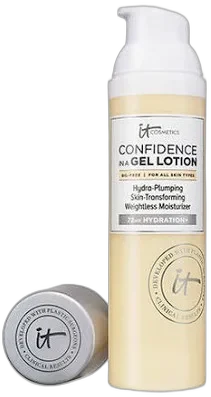
Confidence in a Gel Lotion Lightweight Moisturizer
Makeup-Friendly Peptide Gel
 Verified reviewer
Pros & cons.
- +Weightless gel-cream texture absorbs cleanly with no greasy residue
- +Matrixyl 3000 peptide complex delivers gradual firming support
- +Prominent niacinamide helps with oil balance and pore appearance
- +Silicone-smoothed finish makes it an excellent makeup base
- +Ceramide NP and colloidal oatmeal support the skin barrier
- +Lighter price point than Confidence in a Cream
- −Contains added fragrance, a risk for reactive skin
- −Jar packaging compromises long-term peptide stability
- −Not hydrating enough for dry or winter-stressed skin
- −Not safe for fungal-acne-prone skin despite oil-free claim
- −Silicone-heavy finish isn't for everyone
The full review.
For years after Confidence in a Cream launched, a familiar pattern showed up in the review sections: ‘I love this but my face is too oily for it,’ and ‘Great in winter but I can’t wear it in summer,’ and ‘I want the peptides in something lighter.’ The Confidence in a Gel Lotion is the answer to all of those reviews. Released in 2019, it takes the Matrixyl 3000 peptide complex that made the original famous and transplants it into a completely different base — one built around dimethicone, polysilicone-11, and prominent niacinamide, with the shea butter stripped out entirely. It’s rare for a brand to rework a hero product this thoughtfully instead of just slapping ‘lightweight’ on a marketing insert, and the formulation choices here actually deliver on the promise.
The texture tells you most of what you need to know on first use. It spreads like a soft whipped gel and absorbs within a minute into a smooth, slightly blurred surface. There’s no greasy afterfeel, no heaviness, no tacky residue. Foundation applied on top doesn’t pill or grab, which is not something you can say about every moisturizer on the market — it’s one of the genuine technical achievements of the formula, and it’s what will make or break this product for many people. If you wear makeup, the silicone-smoothed finish is a real functional benefit, not just a sensory flourish.
What keeps this from being just a pretty primer, though, is the ingredient stack underneath. Niacinamide sits remarkably high on the INCI list — higher than in most peptide moisturizers — and that choice is meaningful. Niacinamide at meaningful percentages supports ceramide synthesis, helps regulate sebum, and gradually improves the appearance of pores, all of which align with the combination and oily skin types this formula is clearly targeting. The Matrixyl 3000 peptide pair carries over from Confidence in a Cream, so you still get gradual firming support over the 8-12 week horizon that peptide complexes typically need. Ceramide NP and colloidal oatmeal round out the barrier-and-calming story, and sodium hyaluronate handles the humectant hydration that compensates for the absence of a heavy occlusive layer.
The silicone-heavy base is worth understanding honestly. Dimethicone and polysilicone-11 are what create the smooth finish and the makeup-compatible feel, and they also form a light breathable film that helps reduce transepidermal water loss without adding weight. This is good technology, not a cheap shortcut, but it does mean the formula is not suitable for fungal acne (Malassezia) sensitive skin, and it’s not as barrier-repairing in a deep-dryness sense as the original Confidence in a Cream. If your skin is genuinely parched, this isn’t your moisturizer. It’s built for the combination-skin customer who wants weightless hydration plus real actives, not for the dry-skin customer who wants to be swaddled in lipids.
Some of the same criticisms that apply to Confidence in a Cream apply here too. The formula contains added fragrance — lighter than the original, but still present, and still a risk factor for fragrance-reactive skin. The jar packaging is the same story: peptides and niacinamide are reasonably stable but benefit from air-protected containers, and opening a jar twice a day for months on end is not ideal for long-term potency. For a product released in 2019, when airless pump packaging had already become standard for peptide formulas, this is a miss. It’s not a dealbreaker, but it’s the kind of detail that separates a good mass-market product from a great one.
On value: at $44 for 60ml, this is slightly cheaper than Confidence in a Cream, and the lighter base means a pump-worth goes a very long way. A jar typically lasts 3-4 months with twice-daily use, which puts the monthly cost in reasonable territory for what you get. It’s not drugstore pricing, but for a makeup-friendly peptide moisturizer with prominent niacinamide and ceramide support, the value story is more convincing than the original cream’s. Who should buy it: combination and oily skin that wants peptide-driven firming and sebum-smoothing without the weight; makeup wearers who need a moisturizer that plays well with foundation; anyone shopping the Confidence franchise but finding the original cream too rich. Who should skip: dry or winter-compromised skin, fragrance-sensitive skin, and fungal-acne sufferers who need silicone-light formulations.
Who Should Buy
combination and oily skin that wants peptide-driven firming and sebum-smoothing without the weight; makeup wearers who need a moisturizer that plays well with foundation; anyone shopping the Confidence franchise but finding the original cream too rich.
Who Should Skip
dry or winter-compromised skin, fragrance-sensitive skin, and fungal-acne sufferers who need silicone-light formulations.
Texture
It spreads like a soft whipped gel and absorbs within a minute into a smooth, slightly blurred surface. There’s no greasy afterfeel, no heaviness, no tacky residue.
Scent
The formula contains added fragrance — lighter than the original, but still present, and still a risk factor for fragrance-reactive skin.
Pairs Well With
Foundation
Conflicts With
Fungal acne (Malassezia) sensitive skin.
Best for
combination and oily skin that wants peptide-driven firming and sebum-smoothing without the weight; makeup wearers who need a moisturizer that plays well with foundation; anyone shopping the Confidence franchise but finding the original cream too rich.
Works for
combination and oily skin that wants peptide-driven firming and sebum-smoothing without the weight; makeup wearers who need a moisturizer that plays well with foundation; anyone shopping the Confidence franchise but finding the original cream too rich.
Not ideal for
dry or winter-compromised skin, fragrance-sensitive skin, and fungal-acne sufferers who need silicone-light formulations.
AM routine
Apply after cleansing and serums, before sunscreen and makeup.
PM routine
Apply after cleansing and serums.
Ingredient analysis.
Full INCI list
Water, Dimethicone, Glycerin, Butylene Glycol, Isononyl Isononanoate, Isopropyl Isostearate, Niacinamide, Ammonium Acryloyldimethyltaurate/VP Copolymer, PEG-10 Dimethicone, Polysilicone-11, Phenoxyethanol, Fragrance, Aluminum Starch Octenylsuccinate, Disodium EDTA, Panthenol, Caprylyl Glycol, Ethylhexylglycerin, Hexylene Glycol, Xanthan Gum, Sodium Hyaluronate, Hydrolyzed Collagen, Ceramide NP, Palmitoyl Tripeptide-1, Palmitoyl Tetrapeptide-7, Tocopheryl Acetate, Colloidal Oatmeal, Camellia Sinensis Leaf Extract, Citric Acid, Sodium Hydroxide
Skin match.
The science.
The Science
Two actives drive this formula: niacinamide and the Matrixyl 3000 peptide complex. Research shows topical niacinamide at 2% to 5% improves barrier function, sebum regulation, pore appearance, and pigmentation over 8-12 weeks of consistent use. Niacinamide's high position on the INCI list suggests a meaningful percentage; for a combination-skin moisturizer, this matters more than any peptide or humectant. The Matrixyl 3000 peptide combination (palmitoyl tripeptide-1 and palmitoyl tetrapeptide-7) is a well-studied matrikine peptide system. Published trials show it supports fibroblast activity and influences extracellular matrix composition over 8-12 weeks of consistent use. Ceramide NP and colloidal oatmeal have established research for barrier support and anti-inflammatory effects, while hyaluronic acid provides humectant hydration through a well-characterized mechanism. The silicone-based occlusion strategy defines the delivery system. Dimethicone and polysilicone-11 form a thin, breathable film that reduces transepidermal water loss without the grease of traditional lipid occlusives. This film-forming effect also creates the visible blurring that gives the product its makeup-primer reputation. This combination works for a specific use case: keeping humectants and peptides on combination or oily complexions that reject heavier emollient bases. The science is thinner regarding retinyl-ester territory—this formula lacks one, which fits its designed base.
Dermatologist Perspective
Dermatologists view niacinamide- and peptide-based moisturizers like this one as reasonable for combination or oily skin patients seeking anti-aging support without emollient-heavy greasiness. The niacinamide-plus-ceramide backbone is a common pairing for barrier support and sebum regulation, and the colloidal oatmeal addition aligns with dermatologist suggestions for reactive or sensitized skin. Patients typically tolerate the silicone-based finish well in clinical settings, as it can reduce friction and irritation on skin that reacts to thicker creams. Board-certified dermatologists often caution that fragranced products require care on sensitive or rosacea-prone skin, making the added fragrance in this formula a consideration for those patients. For combination-skin patients wanting a lightweight, peptide-supported moisturizer that works under makeup, this formula fits a dermatologist-recommended routine.
Where it fits in your routine.
Apply a pea-sized amount to clean skin after serums every morning and evening. Massage gently into the face and neck with light upward strokes. Let it absorb for one full minute before applying SPF or foundation; this wait ensures the smooth, non-pilling finish the formula is known for. Layer it under a thicker cream in winter or on dry days if skin needs more. At night, use it as the final hydration step; if skin is very dry, add a facial oil on top to increase comfort without compromising the peptide contact. Store the jar closed and away from heat to preserve active stability.
At $44 for 60ml, Confidence in a Gel Lotion costs less than the original Confidence in a Cream. It has more niacinamide and the same peptide complex. For makeup wearers and combination-skin customers, the value is high—this one jar works as a moisturizer, primer-adjacent finish, and gentle anti-aging product, lasting three to four months with twice-daily use. It costs more than drugstore peptide options, but compares well to other makeup-friendly peptide moisturizers in the $40-60 range. The fragrance-and-jar combination prevents it from being best-in-class value, but the package is fair for the intended audience.
Combination and oily skin types want peptide-anchored anti-aging in a weightless format. It works well for makeup wearers needing a moisturizer that sits well under foundation. This works year-round for most skin types except the driest.
Dry or winter-compromised skin lacks enough moisture from this alone. Fragrance-sensitive skin needs an unscented peptide moisturizer. Fungal-acne-prone skin must avoid the silicone-and-ester base.
Product details.
spring summer
The backstory.
Released in 2019 as IT Cosmetics' answer to customers who loved the peptide complex in Confidence in a Cream but found the shea butter base too heavy, especially in warm weather and on combination skin. The gel lotion was also explicitly positioned as makeup-compatible, tying into IT Cosmetics' color cosmetics DNA.
About IT Cosmetics
Established Brand (5–20 years)Jamie Kern Lima launched IT Cosmetics in 2008 with input from dermatologists and plastic surgeons. L'Oréal acquired the brand in 2016. The brand's skincare lineup grows steadily, using the Confidence franchise as its anchor anti-aging range.
Common myths.
It's oil-free, so it's safe for acne-prone and fungal-acne-prone skin.
The formula uses isopropyl isostearate and fatty alcohols, which can cause comedones in some users. The peptide and oat additions mean it is not fungal-acne safe.
FAQ.
How is this different from Confidence in a Cream?
Same peptide complex, lighter base. Confidence in a Cream is a thick shea butter whipped cream for dry skin. The Gel Lotion uses a silicone-smoothed gel-cream base instead of emollients and has more niacinamide, which works better for combination and oily skin.
Can I use this under makeup?
Yes, and this is a main selling point. The dimethicone and polysilicone-11 finish creates a smooth, slightly blurring surface. Foundation glides over it without pilling. Let it absorb for one full minute before applying makeup.
Is this moisturizer oil-free?
The product is oil-free and lacks plant oils, but uses silicone emollients and fatty esters that feel occlusive on skin. It is not greasy, but it is not suitable for fungal acne-prone skin.
Is it hydrating enough on its own?
It works for combination and oily skin. Dry or winter skin users need a heavier moisturizer or a hydrating serum underneath. This formula provides weightlessness, not maximum occlusion.
Does it contain fragrance?
Yes. Like Confidence in a Cream, this contains added fragrance. If you have fragrance sensitivity, skip this — an unscented peptide moisturizer works better.
Can I use this with retinol?
Yes. The niacinamide, peptides, and ceramide support all work with retinol and help buffer the barrier during retinol adjustment. Apply the retinol first, wait one minute, then layer this on top.
What the community says.
"Weightless lightweight texture"
"Makeup applies beautifully on top"
"Non-greasy finish for oily skin"
"Visible pore-smoothing"
"Doesn't pill"
"Still contains fragrance"
"Heavily silicone-based finish"
"Not hydrating enough for dry winter skin"
"Smaller jar size than Confidence in a Cream"