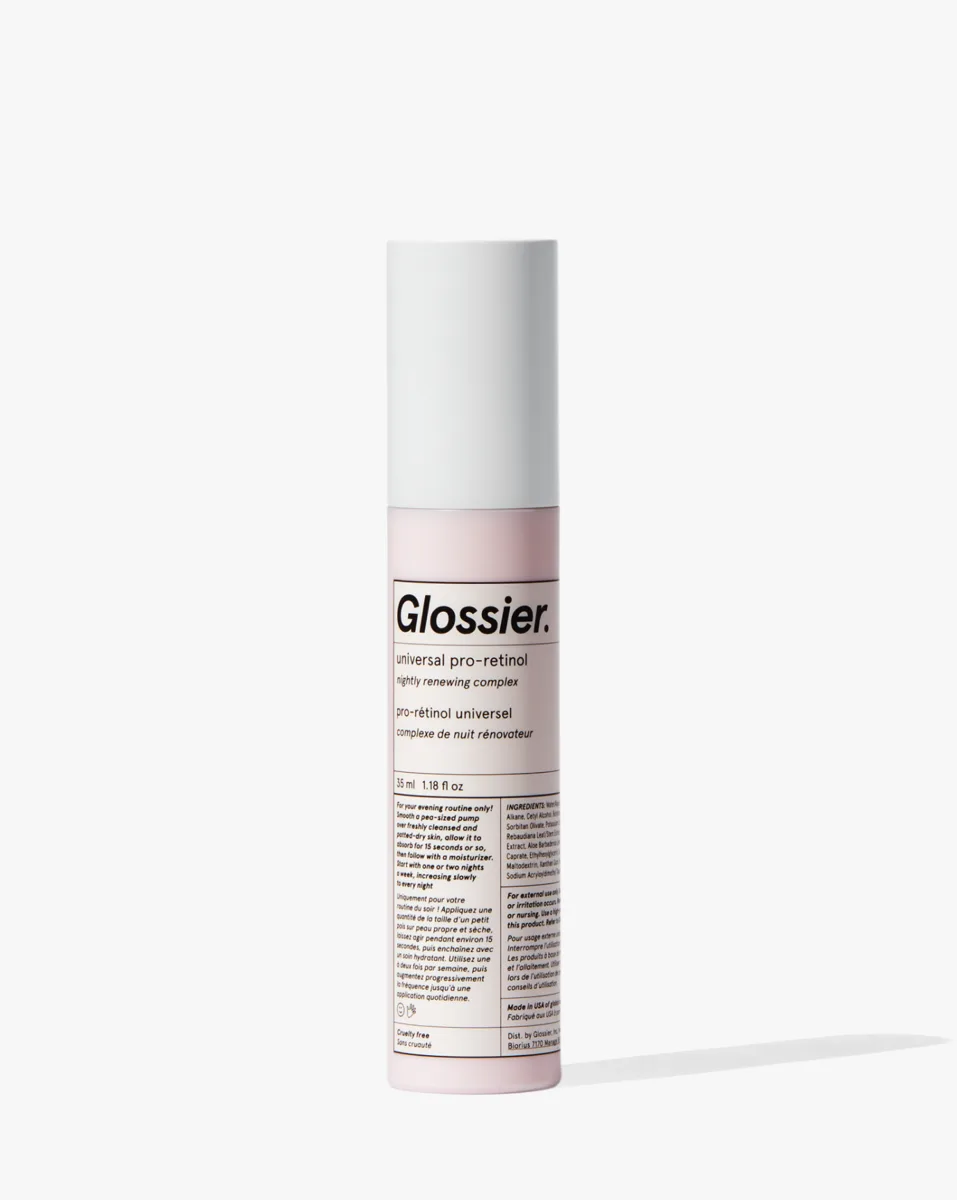
Retinol Pro 0.5 Universal
Beginner-Friendly Retinoid
 Verified reviewer
Pros & cons.
- +Zero irritation — genuinely usable nightly from day one without a build-up period
- +Rich cream texture doubles as a moisturizer eliminating an extra step
- +Fragrance-free, silicone-free, and vegan with clean ethical credentials
- +Pump packaging properly protects the light-sensitive retinoid
- +Visible brightening and texture improvement within two weeks
- +Leaping Bunny certified cruelty-free
- −Retinyl sunflowerseedate is the weakest retinoid class — significantly less potent than pure retinol
- −No published peer-reviewed research on this specific retinol ester
- −At $40 the price is high for a gentle retinol ester with modest potency
- −Rich texture is too heavy for oily skin types
- −Experienced retinoid users will find the results too subtle and slow
- −The 0.5% concentration is misleading — it's not comparable to 0.5% pure retinol
The full review.
Glossier launched its first retinoid in August 2021, long after the retinol conversation peaked. The Ordinary democratized pure retinol at low prices. Paula’s Choice made clinical-strength retinol accessible. Prescription tretinoin moved into the DTC space via telehealth. When Glossier arrived four years after the trend peaked, it needed a unique angle for a crowded market.
That angle is gentleness. The Universal Pro-Retinol contains no retinol. Instead, it uses retinyl sunflowerseedate—a proprietary retinol ester where retinol chemically bonds to sunflower seed-derived fatty acids. If retinoid potency were a spice rack, prescription tretinoin is the ghost pepper, pure retinol is a jalapeño, retinal (retinaldehyde) is a serrano, and retinyl sunflowerseedate is a bell pepper. They belong to the same family but have different intensities.
Retinoids work by converting to retinoic acid, the active form that communicates with skin cells to accelerate turnover, boost collagen, and fade pigmentation. Pure retinol requires one conversion step. Retinal requires one. Retinyl esters like this one require two. Each step loses more ingredient to enzymatic inefficiency, meaning less active ingredient reaches skin cells. A 0.5% retinyl ester delivers much less active retinoic acid than a 0.5% pure retinol product. The percentages are not equivalent.
Glossier made this choice deliberately for its audience. The Universal Pro-Retinol targets people who know retinol works for anti-aging but fear peeling and purging. For these users, the product delivers zero irritation, zero adjustment period, and gentle results.
The texture matches this approach. This thick, cushiony cream feels more like a night moisturizer than a clinical retinoid treatment. Shea butter, glycerin, sodium hyaluronate, and emollient esters make the formula so hydrating that most users skip a separate moisturizer. It is comfortable, soothing, and unlikely to shock the skin.
Results arrive slowly. Within two weeks, most users see brighter, smoother skin. By four-to-eight weeks, dark spots may fade and texture may refine. However, deeper anti-aging benefits—meaningful wrinkle reduction, visible collagen stimulation, and significant pore refinement—require months of consistent use and may never match the speed of a pure retinol product.
The fragrance-free, silicone-free, vegan formula is a smart choice for sensitive, retinoid-naïve skin. These attributes reduce irritation variables, making it easier to attribute skin changes to the retinoid rather than a fragrance or silicone reaction.
The pump packaging suits a retinoid. Light and air degrade retinol and its esters, so a jar would be a formulation liability. The opaque pump bottle protects the active ingredient and controls the dose. This is a technical decision that fits the Glossier design aesthetic.
Price is the main issue. At forty dollars for 1.18 ounces of a retinyl ester—the weakest retinoid class—the value is debatable. The Ordinary offers 0.5% and 1% pure retinol in squalane for much less. Paula’s Choice sells clinical-strength retinol with peptides for similar prices. Even gentle products using retinal (retinaldehyde), which is one step closer to active, have competitive prices. You pay a Glossier brand premium for comfort over potency.
However, the retinoid you actually use is better than a strong one you stop using because of peeling. Compliance is vital in skincare. A gentle, zero-irritation retinoid used every night for six months outperforms a potent retinol abandoned after two weeks of flaking. Glossier prioritized this behavior, even if a formulation scientist might prefer retinal.
This works for beginners, sensitive skin, and the retinoid-anxious. It is a starter bike with training wheels. Most users will eventually outgrow it and want more potency. But as an on-ramp to the retinoid world, it is one of the smoothest options.
Ingredient analysis.
Full INCI list
Water/Aqua/Eau, Glycerin, Propanediol, Cetyl Ethylhexanoate, C13-15 Alkane, Cetyl Alcohol, Butyrospermum Parkii (Shea) Butter, Cetearyl Olivate, Coconut Alkanes, Sorbitan Olivate, Potassium Cetyl Phosphate, Betaine, Retinyl Sunflowerseedate, Stevia Rebaudiana Leaf/Stem Extract, Ophiopogon Japonicus Root Extract, Camellia Oleifera Leaf Extract, Aloe Barbadensis Leaf Juice, Sodium Hyaluronate, Tocopherol, Coco-Caprylate/Caprate, Ethylhexylglycerin, Glycol Stearate, Glyceryl Stearate, Caprylic/Capric Triglyceride, Maltodextrin, Xanthan Gum, Benzoic Acid, Sodium Hydroxide, Carbomer, Sodium Acrylate/Sodium Acryloyldimethyl Taurate Copolymer, Trisodium Ethylenediamine Disuccinate
Skin match.
The science.
The Science
All topical retinoids share one endpoint: they convert to all-trans retinoic acid (tretinoin). This molecule binds to nuclear retinoic acid receptors (RARs and RXRs) to regulate gene expression for cell differentiation, proliferation, and collagen synthesis. Retinoid types differ based on how many enzymatic conversion steps separate them from this active form.
Retinyl sunflowerseedate, the active in this formula, is a retinyl ester—retinol esterified with sunflower seed-derived fatty acids. Cutaneous esterases must first hydrolyze this ester to free retinol, then retinol dehydrogenases oxidize it to retinal, and finally retinal dehydrogenases oxidize it to retinoic acid. Because each conversion step is enzymatically rate-limited, the skin processes only a set amount per unit time. This creates a slow, sustained release of active retinoic acid at concentrations much lower than direct retinol application.
Comparative studies on retinoid potency consistently rank retinyl esters as the least effective class for clinical skin changes. Kafi et al. (2007) in the Archives of Dermatology showed that 0.4% retinol improved fine wrinkles and roughness in a randomized controlled trial. However, studies on retinyl palmitate (the most-studied retinyl ester) at similar concentrations show more modest, slower-onset effects. No published peer-reviewed studies exist specifically for retinyl sunflowerseedate; its efficacy comes from the retinyl ester class.
The supporting ingredients—glycerin, sodium hyaluronate, shea butter, and vitamin E—have practical functions. Glycerin and HA maintain hydration during accelerated cell turnover. Shea butter provides an occlusive barrier that may reduce transepidermal water loss caused by retinoid use. Vitamin E (tocopherol) stabilizes the retinol ester against photodegradation and lipid peroxidation, extending the formula's potency over its shelf life.
Glossier's brand-funded consumer study (59 participants, not peer-reviewed) reported that 100% of participants saw more radiant and smoother-looking skin, and 81% observed faded dark spots after four weeks. These results are positive but reflect subjective self-assessment from a small, non-controlled sample; they are not clinical evidence of the retinoid's efficacy compared to established alternatives.
Dermatologist Perspective
Dermatologists generally categorize retinyl esters as the gentlest but least effective retinoid class, best for patients who cannot tolerate any retinoid irritation. Board-certified dermatologists would recommend this product for absolute retinoid beginners, patients with highly reactive skin, or as a first step before moving to pure retinol or retinal. However, dermatologists would note that patients seeking meaningful anti-aging outcomes—wrinkle reduction, significant collagen stimulation, melasma management—will eventually need stronger retinoid forms. The "pro-retinol" terminology describes a retinol precursor, but it may create unrealistic expectations about the product's potency relative to actual retinol products.
Where it fits in your routine.
Apply two to three pumps to clean, dry skin every evening as your nighttime treatment. The thick cream texture means you can skip a separate moisturizer — for very dry skin, add a hydrating serum underneath. Do not use on the same nights as AHA/BHA exfoliants or benzoyl peroxide until your skin adjusts (usually 4-6 weeks). Always apply sunscreen SPF 50 the next morning — retinoids increase photosensitivity regardless of potency. Most skin types can use it nightly from day one.
At $40 for 1.18 ounces ($33.90/oz), this retinyl ester costs a premium. Retinyl esters are the least potent retinoid class. The Ordinary's Retinol 0.5% in Squalane provides a much stronger retinoid for about one-sixth the price. Paula's Choice Clinical 1% Retinol Treatment gives four times the retinoid potency for similar money. This product offers comfort and a risk-free start, not potency per dollar. The zero-irritation experience has value for users who failed with stronger retinoids or fear starting. However, those seeking retinoid efficacy per dollar will find better options.
This works for first-time retinoid users, people with sensitive skin who failed with stronger retinoids, and anyone adding vitamin A without irritation risk. It also suits younger users (late twenties to early thirties) focused on prevention rather than reversal.
Retinoid users who already tolerate pure retinol or retinal will find this a step backward. Oily skin types needing a lighter formula. People wanting maximum retinoid potency for their money. And anyone seeking published research for the specific active ingredient.
Product details.
Thick, buttery cream that feels more like a moisturizer than a typical retinol serum. It is dense and cushiony with a slightly occlusive quality. It spreads easily and absorbs within 30-60 seconds.
Fragrance-free. No essential oils. Botanical extracts leave a faint neutral scent that disappears on application.
White pump bottle with Glossier's signature minimal design. The opaque pump protects the retinoid from light and air, which works better than jar packaging for light-sensitive ingredients. It is hygienic and travel-friendly.
The first application feels like a thick night cream instead of a retinoid treatment. The cream is thick but comfortable; it causes no stinging, tightness, or retinol tingle. Skin looks subtly brighter within a few days. Texture feels smoother by the end of the first week. This formula is gentle—even first-time retinoid users can typically use this nightly from day one without building up frequency.
10-12 weeks with nightly face application
12 months
All Year
The backstory.
Universal Pro-Retinol launched in August 2021 as Glossier's first-ever retinoid, arriving years after competitors had established their retinol lines. The delay was intentional — Glossier wanted to create a retinoid gentle enough for their community, which skews younger and more retinoid-hesitant than clinical skincare audiences. The result prioritized zero irritation over maximum potency, a trade-off that defines the product.
About Glossier
Emily Weiss founded Glossier in 2014, and the brand entered Sephora retail in 2023. *Established Brand (5–20 years)*. It is Leaping Bunny certified cruelty-free. The Universal Pro-Retinol is the brand's first retinoid, which uses a proprietary retinol ester (retinyl sunflowerseedate) instead of pure retinol. A brand-funded consumer study supports its claims, not independent peer-reviewed research.
Common myths.
All retinoids cause peeling, redness, and a 'retinol uglies' adjustment period.
Retinoid side effect severity depends on type and concentration. Retinyl esters like the sunflowerseedate in this formula are the gentlest class. They need two enzymatic conversion steps to become active retinoic acid, so the skin sees much lower concentrations of the active form at once. Most users of this product report zero adjustment period.
A 0.5% pro-retinol is equivalent to 0.5% pure retinol.
Not even close. 'Pro-retinol' is a marketing term for retinol esters. These are less potent than pure retinol. The 0.5% is the ester concentration, not the active retinol released after conversion. After the two-step enzymatic process, the skin receives a fraction of 0.5% effective retinol. Products with 0.3% pure retinol likely deliver more active ingredient than this formula.
FAQ.
What type of retinoid is in the Glossier Universal Pro-Retinol?
It contains 0.5% retinyl sunflowerseedate, a proprietary retinol ester that binds retinol to sunflower seed fatty acids. This falls into the same category as retinyl palmitate, the gentlest retinoid class. The molecule undergoes two enzymatic conversions in the skin to become active retinoic acid. This process makes it gentler but less potent than pure retinol, retinal, or prescription tretinoin.
Can I use the Glossier Universal Pro-Retinol every night?
Yes — this gentle retinol ester works for nightly use from the first application. Pure retinol products require gradual introduction, starting at 2-3 nights per week, but most users tolerate this formula nightly without irritation. If you feel sensitivity, use it every other night.
Is the Glossier Universal Pro-Retinol effective for wrinkles?
retinyl sunflowerseedate provides anti-aging benefits over time because all retinoid forms convert to retinoic acid. Low conversion efficiency means results are slower and more subtle than pure retinol or retinal products. Stronger retinoids reduce wrinkles faster. This product works for brightening, texture smoothing, and prevention rather than wrinkle reversal.
Do I need a separate moisturizer with the Glossier Pro-Retinol?
Most skin types do not need more. The thick texture with glycerin, shea butter, and hyaluronic acid provides enough moisture for a nighttime routine. Dry skin types can apply a hydrating serum underneath, but the product works as both a treatment and moisturizer.
What the community says.
"Extremely gentle — no irritation, peeling, or redness even on first use"
"Noticeably brighter and smoother skin within one to two weeks"
"Rich cream texture provides moisture and treatment in one step"
"Perfect beginner retinoid for retinol-nervous users"
"Fragrance-free, silicone-free, and vegan"
"Pump packaging protects the retinoid from light and air"
"Rich texture is too heavy for oily and combination skin types"
"Retinyl sunflowerseedate is weaker than pure retinol — results come slower"
"Price increased from $35 to $40 since launch"
"No published research on the specific retinoid ester used"
"Only one size available"
"Not suitable for experienced retinoid users seeking stronger results"
People also looked at.