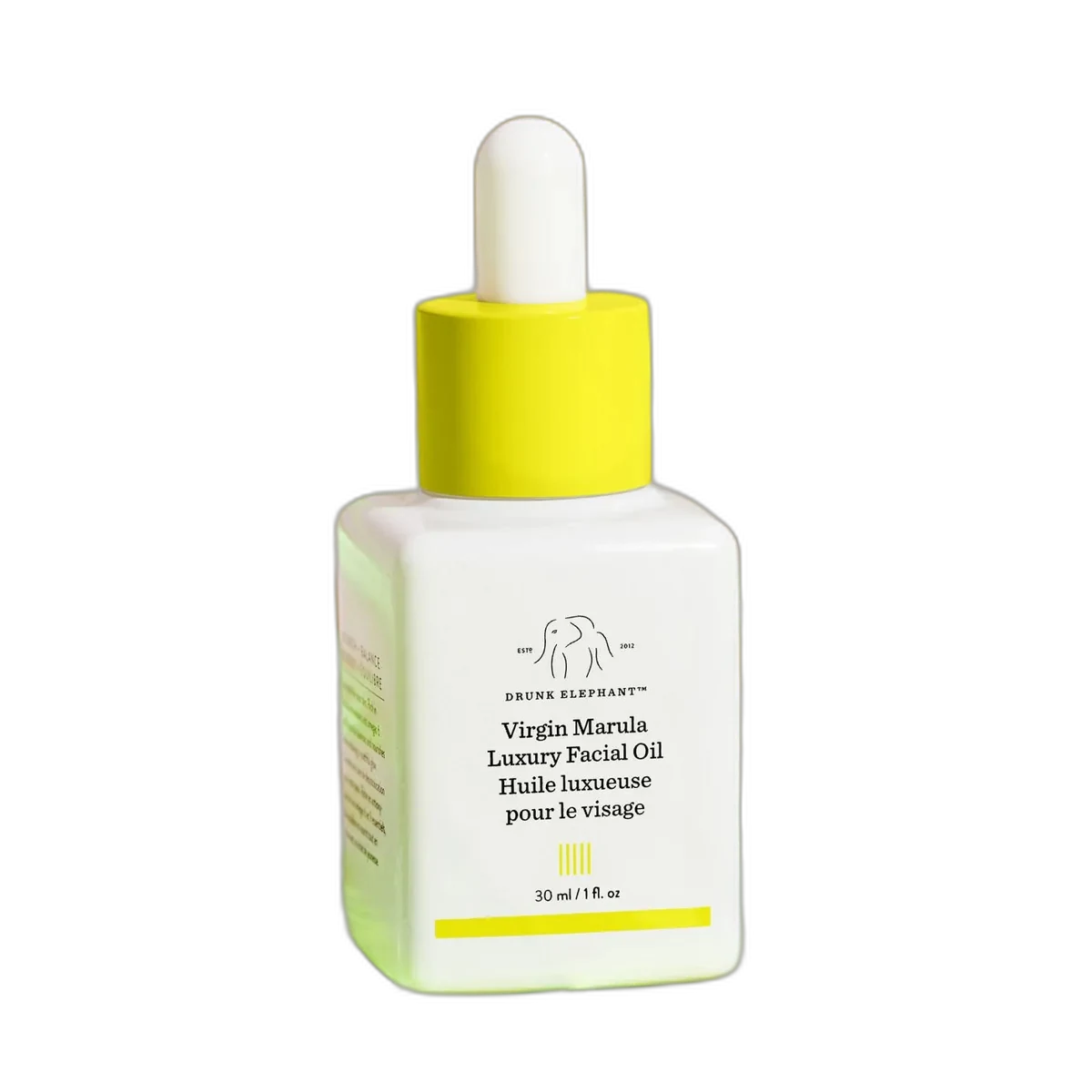
Virgin Marula Luxury Facial Oil
Luxury Minimalist Cult Favorite
 Verified reviewer
Pros & cons.
- +Absorbs remarkably fast for a facial oil without heavy greasy residue
- +Single-ingredient purity with no additives, preservatives, or fragrance
- +Immediate softness and luminous glow visible from first application
- +Lightweight fluid texture defies typical facial oil heaviness
- +Effective fine line plumping through deep oleic acid moisturization
- +Excellent for sensitive skin with zero potential irritants in the formula
- +Opaque packaging protects preservative-free oil from light degradation
- +Pregnancy-safe and suitable for the most reactive skin types
- −Wildly overpriced at $72 for a single ingredient available for under $15 elsewhere
- −High oleic acid content makes it comedogenic for acne-prone skin
- −Not fungal acne safe due to oleic acid feeding Malassezia yeast
- −No active treatment ingredients beyond basic moisturization and antioxidants
- −Too heavy and shiny for oily skin types even at just 2-3 drops
- −Small 30 mL bottle size feels inadequate at the luxury price point
The full review.
Before Drunk Elephant became an $845 million Shiseido acquisition, before its rainbow packaging became an Instagram aesthetic, and before brands listed “free-from” credentials, Tiffany Masterson dealt with skin issues in Houston. Her story is well-known, but marula oil was her turning point. Virgin Marula was one of her six 2013 launch products and remains the line’s spiritual anchor.
The product is simple: 100% cold-pressed, unrefined Sclerocarya Birrea Seed Oil. It has no supporting actives, no preservatives, and no fragrance, essential oils, or stabilizers. It is just marula fruit oil in a bottle. While the industry often equates complexity with sophistication, this product relies on a single ingredient.
For the right skin type, it works. The oil has a lightweight, fluid texture. Unlike many plant oils that feel heavy or tacky, marula absorbs within minutes, leaving a luminous, satin finish instead of a greasy slick. The texture is so light you might check the bottle to ensure it is an oil and not a serum. Two to three drops suffice; the dropper dispenses precisely, so a little goes a long way.
The moisturizing performance is real. Marula oil’s fatty acid profile—mostly oleic acid at 69-78%—mirrors the lipids in the skin’s outer layer, allowing it to integrate rather than sit on top. A 2015 clinical study in the Journal of Ethnopharmacology confirmed marula oil provides moisturizing and hydrating effects on dry skin, with occlusive effects that prevent transepidermal water loss. Naturally occurring tocopherols and tocotrienols (vitamin E) provide antioxidant support, protecting the skin and the oil from oxidative degradation.
Dry and normal skin types see effects almost immediately. Skin feels softer, looks more luminous, and dehydrated fine lines appear plumped. After weeks of consistent use, the barrier-strengthening effects show: chronically dry skin holds moisture better, and winter tightness or flaking fades. It is an effective moisturizer that does what it promises.
The price requires an honest look. Virgin Marula Luxury Facial Oil costs $72 for 30 mL. The ingredient list is one line. You can find the same ingredient—100% Sclerocarya Birrea Seed Oil—from budget brands for roughly one-seventh of the price. Drunk Elephant claims their sourcing, pressing, and quality control justify the premium, and there may be small differences in freshness, antioxidant preservation, or oleic acid consistency. However, the tree determines marula oil’s core composition, and quality cold-pressed marula oil from any reputable source has a similar fatty acid profile.
At $72, you pay for the Drunk Elephant experience: the opaque glass bottle that prevents light degradation, the dropper, the packaging, and the brand’s reputation for ingredient purity. Whether these factors justify a seven-fold markup over the same INCI list is a personal choice, not a skincare one.
The product’s limitations come from its ingredient. Oleic acid is excellent for dry skin but has a comedogenic rating of 3-4 out of 5. Acne-prone and oily skin types often report clogged pores and breakouts. It is not fungal acne safe, as high oleic acid content feeds Malassezia yeast. Because it contains one ingredient, there is no active treatment beyond moisturization and antioxidant protection. It does not provide the brightening of vitamin C, the cell turnover of retinol, or the barrier repair of ceramides. It is a moisturizing oil.
For dry to normal skin needing minimalist moisturization and willing to pay luxury prices for single-ingredient purity, Virgin Marula delivers. The texture, absorption, and glow are high quality. It has performed this way since 2013, surviving a decade of trends and reformulations within the Drunk Elephant line. However, this oil looks remarkably similar to others once you look past the label.
Ingredient analysis.
Full INCI list
Sclerocarya Birrea Seed Oil
Skin match.
The science.
The Science
Virgin Marula relies on the well-studied Sclerocarya birrea seed oil. A 2015 clinical study in the Journal of Ethnopharmacology (Komane et al.) tested marula oil on 20 healthy adult female volunteers. It found the oil is non-irritating (p < 0.001), provides significant moisturizing and hydrating properties on xerotic skin (p < 0.001), and shows measurable occlusive effects on normal skin (p < 0.001). The oil's fatty acid profile—69% oleic acid, 15.3% palmitic acid, 9.2% linoleic acid—matches the epidermis's natural lipid composition.
The high oleic acid content is both a strength and a limitation. Oleic acid is an established emollient that integrates into the stratum corneum's intercellular lipid matrix. It also acts as a penetration enhancer, a property noted in a 2018 review in the International Journal of Molecular Sciences on plant oils and skin barrier function. This penetration enhancement causes the oil's rapid absorption and can disrupt barrier function in some people, especially those with acne-prone skin or compromised barriers.
A 2020 study in the Journal of Ethnopharmacology showed oleic acid's anti-inflammatory properties in a mouse model, with effects similar to dexamethasone in irritant contact dermatitis. This supports reports that marula oil calms inflamed, dry skin.
Naturally occurring tocopherols and tocotrienols provide antioxidant protection. Some in vitro studies show tocotrienols are more potent antioxidants than tocopherols. However, cold-pressed marula oil does not standardize or disclose the concentrations of these compounds, so we cannot know if they reach therapeutically relevant levels on the skin. The antioxidant activity exists, but it is a bonus rather than the primary mechanism of action.
References
- Safety and efficacy of Sclerocarya birrea (A.Rich.) Hochst (Marula) oil: A clinical perspective — Journal of Ethnopharmacology (2015)
- Anti-Inflammatory and Skin Barrier Repair Effects of Topical Application of Some Plant Oils — International Journal of Molecular Sciences (2018)
- Oleic acid exhibits an expressive anti-inflammatory effect in croton oil-induced irritant contact dermatitis without the occurrence of toxicological effects in mice — Journal of Ethnopharmacology (2020)
Dermatologist Perspective
Dermatologists view marula oil as an effective emollient for normal and dry skin. Its oleic acid-dominant profile provides occlusive moisturization that helps reduce transepidermal water loss. Board-certified dermatologists often note that single-ingredient plant oils are low-risk for sensitive and reactive skin because they lack preservatives, fragrances, or actives that trigger sensitization. However, dermatologists caution that high-oleic-acid oils may be comedogenic and are not for acne-prone skin. They routinely recommend linoleic acid-rich alternatives for patients with oily or breakout-prone skin.
Where it fits in your routine.
Press 2-3 drops into clean palms and press into skin after all water-based serums and moisturizers. The oil acts as an occlusive seal to lock in hydration. In the morning, wait one minute for absorption before applying sunscreen. At night, layer over active treatments like retinol to buffer irritation. Mix 1-2 drops into your moisturizer for a lighter, less dewy application.
At $72 for 30 mL ($2.40 per mL), Virgin Marula is among the most expensive single-ingredient facial oils available. The same INCI — 100% Sclerocarya Birrea Seed Oil — costs about $10-15 per 30 mL from budget brands. The premium price comes from Drunk Elephant's sourcing, light-protective packaging, and brand positioning, not formulation complexity. A 15 mL midi size costs $42 and offers only slightly better per-mL value. If users find the Drunk Elephant version superior in freshness or results compared to other marula oil, the price works. For most, the math does not work.
Dry to normal skin types want a minimalist, single-ingredient facial oil that absorbs fast and gives an immediate glow. It works for sensitive skin that reacts to complex formulations and for anyone prioritizing ingredient purity over price-per-ingredient value.
Oily or acne-prone skin, people with fungal acne, budget-conscious shoppers avoiding the markup on identical single-ingredient marula oils, and users seeking active anti-aging or brightening ingredients beyond basic moisturization.
Product details.
fall winter Certifications Leaping Bunny (cruelty-free)PETA certified cruelty-freeSephora CleanDermatologist-tested
The backstory.
Virgin Marula was one of Drunk Elephant's founding products in 2013, born from Tiffany Masterson's personal experience with marula oil as part of her 'skin went crazy' journey that led to the brand's creation. The oil became the brand's signature ingredient, appearing across the product line and becoming a symbol of the clean-beauty-meets-efficacy philosophy that drove Drunk Elephant's meteoric rise to an $845 million acquisition.
About Drunk Elephant
Established Brand (5–20 years)Tiffany Masterson founded Drunk Elephant in 2012, making it one of Sephora's fastest-growing brands. Shiseido acquired the brand in 2019 for $845 million. Drunk Elephant uses a 'Suspicious 6'-free philosophy and has Leaping Bunny certification, but its formulations rely on clean-beauty marketing instead of independent clinical research.
Common myths.
Drunk Elephant's sourcing makes this marula oil different from cheaper marula oils.
Drunk Elephant uses cold-pressed, unrefined marula oil, but the Sclerocarya birrea tree determines the fatty acid profile and antioxidant content of marula oil. Suppliers vary in quality, but 100% marula oil from reputable sources has the same core composition regardless of brand.
Facial oils clog pores and cause breakouts for everyone
Pore-clogging potential depends on an oil's fatty acid profile. Marula oil has high oleic acid (69-78%), which carries a higher comedogenic risk, but many dry and normal skin types tolerate it well. The issue depends on skin type, not universal rules.
FAQ.
Is Drunk Elephant Virgin Marula Oil worth $72?
That depends on what you're paying for. The formula is 100% Sclerocarya Birrea Seed Oil — the same single ingredient available from other brands at a fraction of the price. What you're paying for with Drunk Elephant is the brand's sourcing standards (cold-pressed, unrefined), the opaque light-protective packaging, and the aesthetic. If marula oil works for your skin, budget alternatives with the same INCI list deliver comparable results.
Myth
Reality
How to Use
Apply 2-3 drops as the final step after all water-based serums and moisturizers, both morning and night. The oil acts as a seal to lock in everything applied underneath. In the morning, allow a minute for absorption before applying sunscreen. You can also mix 1-2 drops into your moisturizer for a lighter application.
Who Should Buy
Best for
Works for
Not ideal for
AM routine
PM routine
Common Praise
Common Complaints
Pairs Well With
Conflicts With
Texture
Scent
Packaging
Best Season
About Drunk Elephant
Does Drunk Elephant Marula Oil help with wrinkles?
The oil plumps fine lines immediately via deep moisturization. Dry, dehydrated skin shows lines more clearly, and the oleic acid in marula oil fills that moisture deficit. It lacks retinoids or peptides to address wrinkles at a cellular level. It is a hydration-driven improvement, not a structural anti-aging treatment.
Can I use Drunk Elephant Marula Oil on acne-prone skin?
Use caution. Marula oil contains 69-78% oleic acid, which has a comedogenic rating of 3-4 out of 5. Some acne-prone people tolerate it, but others get breakouts and clogged pores. Acne-prone skin types should choose facial oils high in linoleic acid instead of oleic acid.
Is Drunk Elephant Marula Oil safe during pregnancy?
Yes. This single-ingredient product contains only 100% marula oil. It has no retinoids, chemical actives, or ingredients of concern during pregnancy. It is one of the safest skincare products for pregnant and breastfeeding individuals.
How long does the 30 mL bottle last?
Using 2-3 drops twice daily on the face and neck, the 30 mL bottle lasts about 3-4 months. A 15 mL midi size costs $42 and lasts roughly 6-8 weeks.
Community
What the community says.
"Absorbs quickly without heavy greasy residue"
"Deeply moisturizing and leaves skin soft and plump"
"Single-ingredient simplicity appeals to minimalists"
"Visibly plumps fine lines with consistent use"
"No fragrance or irritants making it ideal for sensitive skin"
"Layers beautifully under makeup and with other skincare"
"Extremely overpriced at $72 for a single-ingredient oil available much cheaper elsewhere"
"Too oily and heavy for oily or combination skin types"
"No discernible difference from budget marula oil alternatives"
"Small 30 mL bottle runs out quickly at the price point"
"Can cause breakouts and clogged pores in acne-prone skin"
People also looked at.