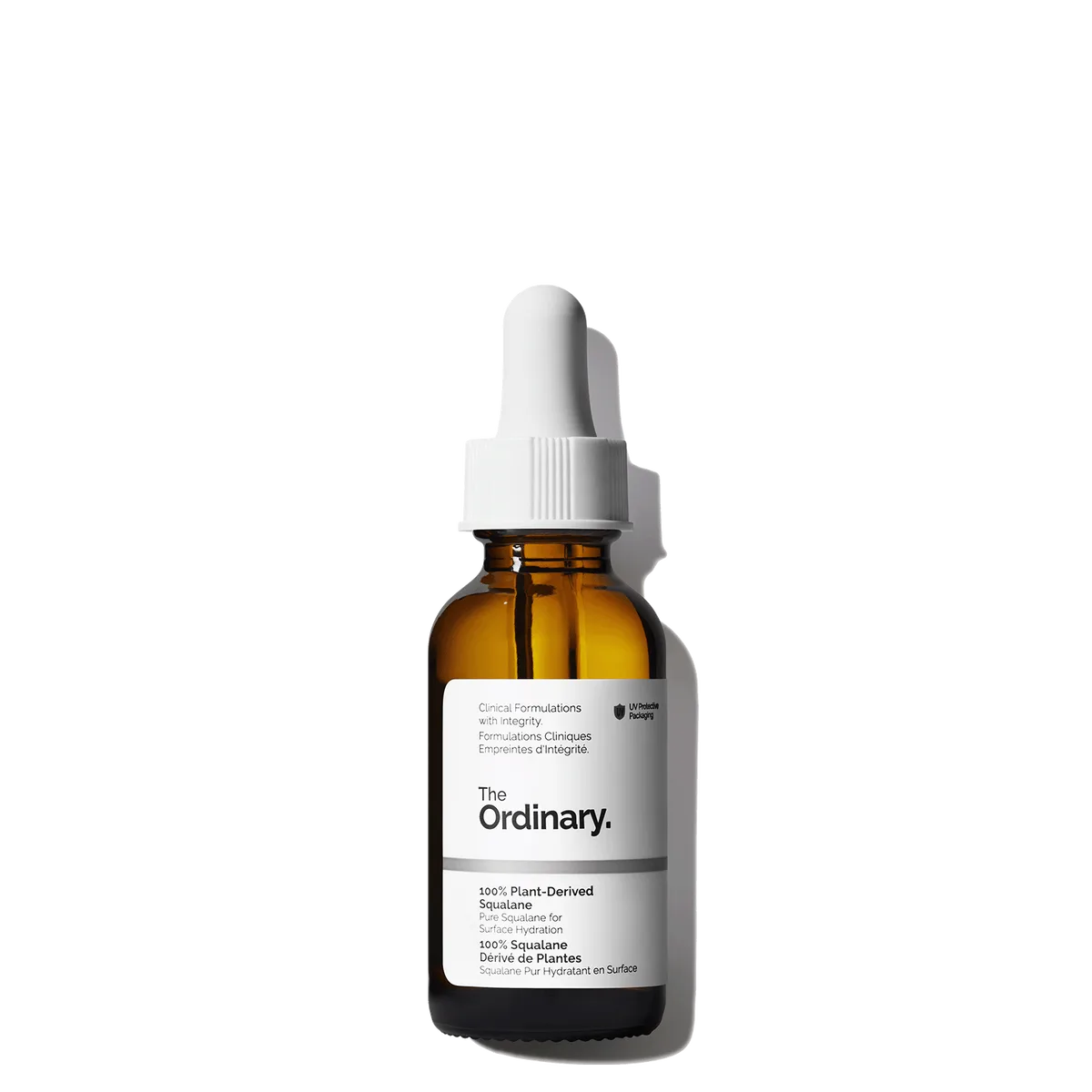
100% Plant-Derived Squalane
Universal Skin Staple
 Verified reviewer
Pros & cons.
- +Skin-identical lipid that mimics natural sebum composition for maximum compatibility
- +Fungal acne safe — sugarcane-derived with no trace fatty acid impurities
- +Completely odorless with zero irritants, allergens, or sensitizers
- +Lightweight absorption without the heavy, greasy feel of traditional face oils
- +Excellent buffering agent over retinoids and other irritating active treatments
- +Versatile multi-use product for face, hair, lips, cuticles, and body
- +ECOCERT approved and USDA Certified Bio-based for quality assurance
- +Outstanding value at $10.40 compared to $25-40 competitors
- −Not hydrating on its own — must be layered over humectant serums to be effective
- −Can leave visible sheen or oily appearance if too much is applied
- −Some users report pilling when layered under certain foundations or sunscreens
- −Short 6-month PAO compared to most skincare products
- −Single-ingredient simplicity means no targeted active benefits beyond barrier support
The full review.
Single-ingredient products have a quiet elegance. No stabilizers, emulsifiers, fragrance, or preservatives—just squalane derived from sugarcane, bottled in Toronto, at a near-charitable price. The Ordinary’s 100% Plant-Derived Squalane makes skincare straightforward.
Squalane science starts with your body. Squalene—the unsaturated precursor—is a major lipid in human sebum, making up roughly 12% of the oily mixture that keeps skin supple, protected, and functioning as a proper barrier. Squalene production peaks in your teens and twenties, then declines. The drop is noticeable by your thirties and significant by your forties. Topical squalane acts as replenishment therapy—replacing what biology removes.
The plant-derived source matters. Traditional squalane came from shark liver oil, which is ethically problematic and increasingly regulated. This product uses squalane derived from sugarcane fermentation to produce a cleaner, higher-purity molecule. Sourcing also affects performance: sugarcane-derived squalane has fewer trace fatty acid impurities than olive-derived alternatives. This makes it safe for those prone to fungal acne, a distinction olive-sourced squalane products cannot always claim.
On the skin, this oil feels like nothing. While the argan oil in The Ordinary’s lineup has weight, squalane is light. A few drops spread across the face and absorb within a minute or two, leaving a subtle healthy sheen instead of an oily film. It has no scent—not even the faint botanical notes found in most plant oils. It is skincare at its most functional.
The mechanism is simple. Squalane works as an emollient and lightweight occlusive. It fills gaps between corneocytes in the stratum corneum, smoothing the skin surface and reducing microscopic cracks where moisture escapes. A clinical study on a squalane-containing serum showed statistically significant TEWL reductions of 2.61, 3.39, and 3.76 g/h/m² at 7, 14, and 28 days respectively—meaning the barrier gets stronger with consistent use.
Recent research shows squalane is not merely passive. A 2025 study in Molecules found that squalane counteracted UVA-induced inhibition of collagen biosynthesis in human dermal fibroblasts and showed anti-inflammatory activity by reducing NF-kB and COX-2 expression. This suggests squalane does more than lock in moisture; it supports skin repair mechanisms during environmental assault.
This product is highly versatile. It works as a final step over hydrating serums to lock in water that hyaluronic acid draws to the skin surface. It buffers dryness and irritation from retinoids without interfering with their activity. You can mix it into foundation for a more luminous look, or use it on dry cuticles, cracked lips, and frizzy hair ends. Because it is odorless and non-reactive, it works with almost every other product in a routine.
However, squalane is not a moisturizer in the common sense. It does not add water to the skin; it prevents water from leaving. Applying squalane to dry, dehydrated skin without a hydrating product underneath seals in dryness. To use it correctly, layer a humectant first (hyaluronic acid or a glycerin-based serum), then apply squalane to trap it. Correct layering yields impressive results; incorrect layering makes the product seem overrated.
The packaging is standard Ordinary—functional, minimal, and unglamorous. Amber glass protects the oil from light, though squalane is more photo-stable than its precursor, squalene. The dropper dispenses a reasonable amount, though it can get slightly messy on the bottle neck after repeated use.
At $10.40 for 30 mL, the price follows The Ordinary’s disruptive philosophy. Comparable plant-derived squalane oils from premium brands cost $25-40 for the same volume and single ingredient. ECOCERT approval and USDA Bio-based certification provide third-party quality verification that most competitors at this price point lack.
The six-month PAO is worth noting—shorter than many skincare products, though squalane’s hydrogenated structure is inherently more stable than unsaturated oils. Wiping the dropper neck clean after use helps prevent the slight gumminess some users report over time.
This product does not announce itself. It does not tingle, glow, foam, or transform on contact. It does not photograph well for social media. It is, literally, the oil your skin already makes, delivered from a sugarcane plant instead of your sebaceous glands. For people whose skin produces less than it needs, that biological relevance is the point.
Ingredient analysis.
Full INCI list
Squalane
Skin match.
The science.
The Science
Squalane is biologically relevant. Human sebum contains about 12% squalene, its unsaturated precursor, so exogenous squalane is one of the most skin-compatible lipids in topical skincare. Hydrogenation converts squalene to squalane by removing the double bonds that make squalene oxidize. This produces a shelf-stable molecule with identical emollient properties.
A review by Huang et al. in Molecules (2009) documented squalene and squalane as efficient singlet oxygen quenchers and lipid peroxidation inhibitors. The review noted squalene is a large part of the skin surface lipid film and protects deeper skin layers from UV-induced oxidative damage.
Recent research expands on squalane's active properties. A 2025 study in Molecules on human dermal fibroblasts found that squalane at 0.005-0.015% concentrations counteracted UVA-induced inhibition of collagen biosynthesis. That study also showed squalane stimulated fibroblast migration—relevant to wound healing—and showed anti-inflammatory activity by counteracting UVA-induced NF-kB and COX-2 expression. These findings show squalane is an active participant in skin repair pathways, not just a passive occlusive.
Clinical data on barrier function supports its TEWL-reducing properties. A study in CosmoDerma (2023) documented statistically significant TEWL reductions at 7, 14, and 28 days of daily squalane serum use. Improvements progressed over time, indicating cumulative barrier strengthening rather than a surface-level effect. The Cosmetic Ingredient Review (CIR) expert panel reviewed squalane's safety and concluded it is safe in cosmetic products at current concentrations.
References
- Biological and Pharmacological Activities of Squalene and Related Compounds: Potential Uses in Cosmetic Dermatology — Molecules (2009)
- Squalane as a Promising Agent Protecting UV-Induced Inhibition of Collagen Biosynthesis and Wound Healing in Human Dermal Fibroblast — Molecules (2025)
Dermatologist Perspective
Dermatologists often recommend squalane as one of the safest, most universally tolerated facial oils. Board-certified dermatologists note its skin-identical structure—mimicking the squalene in human sebum—gives it a very low risk of irritation or allergic reaction. They suggest it for patients with compromised barriers, post-procedure skin, or irritation from retinoids and other active treatments. Dermatologists also note that sugarcane-derived squalane, used in this product, is the preferred source for patients with Malassezia folliculitis (fungal acne) because it lacks the trace fatty acid impurities found in olive-derived alternatives.
Where it fits in your routine.
Apply 2-3 drops to clean skin after your skincare routine. For best results, layer it over a hydrating serum (hyaluronic acid or glycerin-based) to seal in moisture. Squalane is an occlusive, not a humectant, so it locks in hydration instead of providing it. Use it morning and evening. In the AM, let it absorb for one minute before applying sunscreen. You can also mix it into moisturizer or foundation, or apply it to dry cuticles, lips, and hair ends. Wipe the dropper neck clean after each use to prevent gumminess.
At $10.40 for 30 mL of ECOCERT-approved, USDA Certified Bio-based squalane, this is one of the most affordable pure squalane oils from a reputable brand. Premium skincare lines charge $25-40 for the same volume and identical ingredient. Only one size exists, so there is no bulk discount, but the low base price makes this a non-issue. The Ordinary's brand credibility and third-party certifications show the low price comes from efficient business practices, not lower ingredient quality.
This lightweight, universally compatible facial oil seals in hydration and buffers active treatments. It works well for fungal-acne-prone skin that cannot use most plant oils, post-procedure skin needing gentle barrier support, and retinoid users with dryness and irritation.
Squalane is not a standalone moisturizer; it won't hydrate dry skin without a humectant underneath. Users wanting a completely matte finish may find even small amounts too dewy. For active anti-aging or brightening benefits, a multi-active serum works better than this single-ingredient oil.
Product details.
This clear, lightweight oil has a thin, water-like viscosity compared to traditional face oils. It absorbs quickly without a sticky or heavy residue, but a subtle sheen remains on the surface.
Completely odorless — no natural or synthetic scent whatsoever.
30 mL dark amber glass dropper bottle with a screw-on pipette. It uses The Ordinary minimalist design with a white label and black text.
The first application softens skin and adds a visible healthy sheen. There is no adjustment period, purging, or tingling because squalane is skin-identical and well tolerated from the first drop. Some users must adjust the amount used to avoid excess shininess.
2-3 months with daily facial use (2-3 drops per application)
6 months
All Year
The backstory.
Squalane was one of the earliest products in The Ordinary's lineup, reflecting the brand's philosophy that effective skincare doesn't need complex formulations or luxury pricing. Human skin naturally produces squalene (the unsaturated precursor), but production declines significantly after age 30 — this product replenishes that loss with a stable, plant-derived alternative sourced from sugarcane fermentation.
About The Ordinary
Established Brand (5–20 years)The Ordinary launched in 2016 under DECIEM and quickly became a top global clinical skincare brand. Its ingredient-first, transparent approach uses formulation science, but the brand does not run proprietary clinical trials on most products.
Common myths.
Squalane and squalene are the same thing.
Squalene (with an 'e') is the unsaturated form human sebaceous glands produce, but it oxidizes easily. This product uses squalane (with an 'a'), the fully hydrogenated, shelf-stable version. It provides the same emollient benefits without the risk of oxidation or rancidity.
Facial oils like squalane clog pores and cause breakouts.
Squalane has a comedogenicity rating of 1 (very low) and an irritancy rating of 0. Its molecular structure mimics skin lipids, so it integrates into the stratum corneum instead of sitting on top and blocking pores. This particular formulation is also fungal acne safe.
What the community says.
"Lightweight, non-greasy absorption that doesn't feel heavy on skin"
"Excellent value for a pure, ECOCERT-approved squalane"
"Versatile multi-use product for face, hair, lips, and cuticles"
"Soothes irritated and sensitive skin without causing reactions"
"Non-comedogenic and safe for fungal-acne-prone skin"
"Simple single-ingredient formula with zero irritants"
"Not hydrating enough on its own for very dry skin — needs layering"
"Can feel oily or shiny if too much is applied"
"Some users find it difficult to layer under makeup without pilling"
"Small bottle runs out quickly with multi-area use"
"Dropper applicator can be messy"
People also looked at.