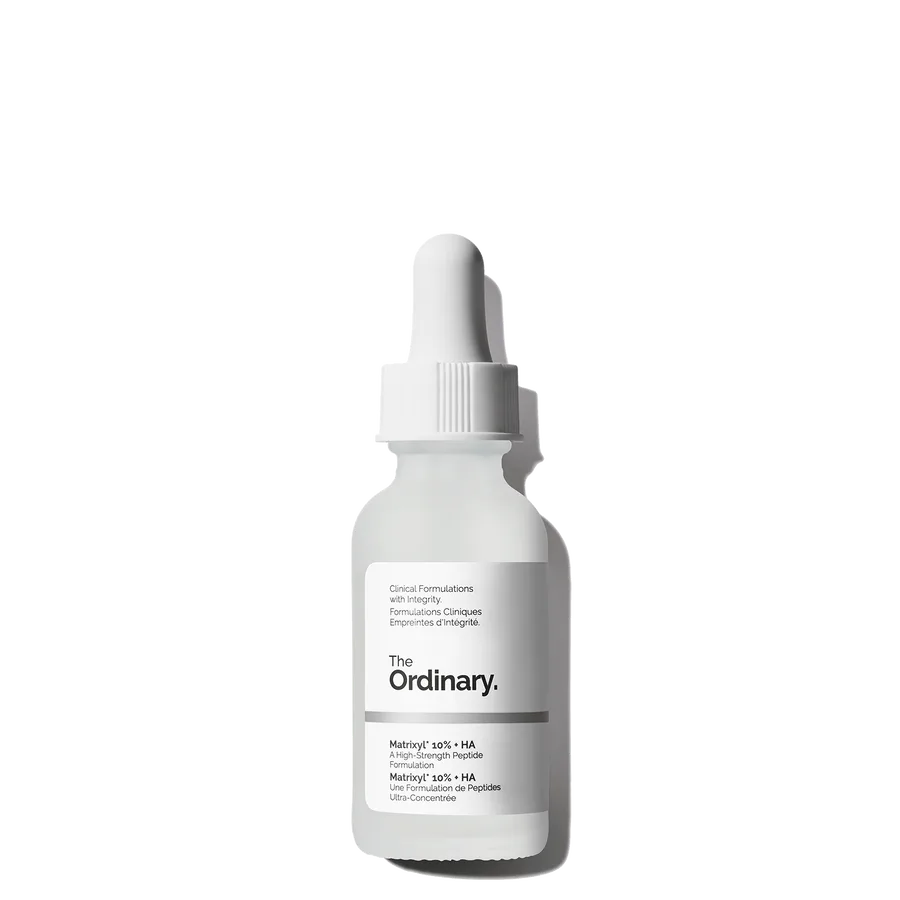
Matrixyl 10% + HA
Budget Peptide Powerhouse
 Verified reviewer
Pros & cons.
- +Two generations of Matrixyl peptides at a generous 10% combined concentration
- +Matrixyl Synthe'6 stimulates six matrix components simultaneously, not just collagen
- +Zero irritation risk — suitable for the most sensitive skin types
- +Pregnancy and breastfeeding safe — fills a gap left by retinoid restrictions
- +Hyaluronic acid base provides immediate hydration alongside long-term peptide benefits
- +Extraordinary value at 0.90 for a peptide concentration that competitors price at 0-150
- +Fragrance-free, vegan, and compatible with retinoids in the same routine
- −Slight tackiness on application from the HA base takes 2-3 minutes to resolve
- −Results are gradual and subtle — requires 2-3 months for visible wrinkle improvement
- −Cannot be combined with direct acids or L-ascorbic acid in the same routine
- −Only available in 30 mL with no larger value size option
- −Clinical studies for Matrixyl peptides are primarily manufacturer-funded rather than independently peer-reviewed
The full review.
There is a version of skincare where anti-aging means retinoids, and retinoids mean redness, peeling, and a two-month adjustment period that tests your commitment to the cause. Then there is Matrixyl. No adjustment period. No irritation. No purging. No pregnancy restrictions. Just peptides, quietly doing their work beneath a layer of moisturizer while you go about your life entirely unbothered.
The Ordinary’s Matrixyl 10% + HA has been part of the brand’s lineup since its 2016 launch, and in many ways it embodies the DECIEM thesis more purely than any other product in the range. Matrixyl — a trade name developed by Sederma, the French cosmetic ingredient company now owned by BASF — had been a prestige ingredient for years, licensed to brands that sold peptide serums for 0, 20, sometimes 00. The Ordinary put it in a 0.90 bottle at 10% concentration and let the ingredient speak for itself.
The formula contains two Matrixyl generations. Matrixyl 3000 combines Palmitoyl Tripeptide-1 and Palmitoyl Tetrapeptide-7 — two peptides that work on opposite sides of the collagen equation. Tripeptide-1 is a matrikine, a signaling peptide that tells fibroblasts to produce new collagen as if they were repairing micro-damage. Tetrapeptide-7 reduces interleukin-6 secretion, an inflammatory cytokine that drives collagen degradation. One peptide pushes production up. The other pushes breakdown down. The combination, in manufacturer-funded clinical trials, reduced wrinkle area by 44% and wrinkle density by 37% over two months of twice-daily application.
Matrixyl Synthe’6, the second generation, goes broader. Palmitoyl Tripeptide-38 signals the production of six different extracellular matrix components simultaneously: collagen I, III, and IV, fibronectin, hyaluronic acid, and laminin 5. This is not just collagen stimulation — it is a comprehensive matrix repair signal. The skin’s structural integrity depends on the interplay between all these components, and Synthe’6 addresses the scaffold as a system rather than targeting one protein in isolation.
The 10% concentration is worth appreciating in context. Many peptide serums list Matrixyl or its components on their INCI but at concentrations well below the levels used in clinical studies. At 10% of the total formula by weight, The Ordinary is delivering a genuinely generous dose. The peptides are dissolved in an aqueous base of glycerin and sodium hyaluronate, which provides immediate surface hydration and helps stabilize the peptides in a skin-compatible pH range of 5.0-6.0.
On the skin, this serum applies as a clear, slightly viscous liquid with a faint tackiness from the hyaluronic acid. It is not unpleasant, but if you have strong preferences about serum texture, you will notice it for the first two to three minutes before it absorbs. Once a moisturizer goes on top, the tackiness vanishes completely. There is no tingling, no warmth, no sensation at all — which is exactly what a peptide serum should feel like. Peptides work through cellular signaling, not through the kind of chemical activity that produces sensory feedback.
The timeline for results is where expectations need careful calibration. Peptides do not work like retinoids. There is no dramatic peeling phase followed by revealed baby-smooth skin. There is no purging period where things look worse before they look better. Instead, there is a slow, incremental improvement that builds over weeks and months. By week four, skin may feel slightly firmer and more hydrated — partly from the HA, partly from the early effects of increased collagen synthesis. By week eight to twelve, fine lines around the eyes and forehead begin to soften in a way that is easier to measure than to perceive in the mirror. By month three to six, the cumulative improvement becomes genuinely visible, particularly in before-and-after photographs.
This gradual nature is both the product’s strength and its PR problem. Plenty of users have posted reviews saying some variation of “I used it for a month and I am not sure it did anything.” Peptide results are not designed to be dramatic — they are designed to be sustainable. The collagen you build with consistent peptide use accumulates over time, and the anti-inflammatory effects of Tetrapeptide-7 help preserve what you build. It is investment-grade skincare: unglamorous in the short term, genuinely valuable over years.
The pregnancy-safe profile is a significant practical advantage. Retinoids — the other major category of collagen-stimulating actives — are contraindicated during pregnancy and breastfeeding. Matrixyl peptides carry no such restriction. For anyone who is pregnant, trying to conceive, or breastfeeding and wants to maintain an anti-aging routine, this product fills a gap that very few others can.
The conflict list is the main practical limitation. Peptides are hydrolyzed by low-pH environments, which means Matrixyl cannot be used in the same routine as glycolic acid, salicylic acid, L-ascorbic acid, or other direct acids. If your anti-aging strategy relies on vitamin C in the morning, you will need to use Matrixyl at night — or choose a vitamin C derivative that operates at a higher pH. For routines that already include retinoids and acids, fitting Matrixyl in requires some scheduling.
At 0.90 for a 30 mL bottle that lasts two to three months with twice-daily use, the annual cost of Matrixyl therapy is approximately 4-66. For context, department store peptide serums with lower Matrixyl concentrations regularly sell for 0-150 per bottle. The math is not subtle, and it is one of the most compelling arguments for The Ordinary’s approach to skincare: that premium ingredients, at generous concentrations, do not require premium pricing.
Formula
Ingredient analysis.
Full INCI list · pH 5.0-6.0
Aqua (Water), Glycerin, Butylene Glycol, Palmitoyl Tripeptide-1, Palmitoyl Tetrapeptide-7, Palmitoyl Tripeptide-38, Sodium Hyaluronate, Hydroxypropyl Cyclodextrin, PPG-26-Buteth-26, PEG-40 Hydrogenated Castor Oil, Polyacrylate Crosspolymer-6, Trisodium Ethylenediamine Disuccinate, Carbomer, Polysorbate 20, Ethoxydiglycol, Phenoxyethanol, Chlorphenesin
Skin match.
The science.
The Science
The Matrixyl peptide complexes in this formula operate through matrikine signaling — the process by which peptide fragments of extracellular matrix proteins signal cells to synthesize new matrix components. This mechanism was first characterized for the original Matrixyl (palmitoyl pentapeptide-4, or pal-KTTKS), a fragment of type I collagen that Robinson et al. demonstrated could improve photoaged facial skin in a 2005 study published in the International Journal of Cosmetic Science.
Matrixyl 3000 advances this concept with two complementary peptides. Palmitoyl Tripeptide-1 activates collagen synthesis through TGF-beta signaling, while Palmitoyl Tetrapeptide-7 reduces IL-6 secretion in keratinocytes — an inflammatory mediator that accelerates matrix metalloproteinase (MMP) activity and collagen degradation. In Sederma's randomized, double-blind clinical study on 24 volunteers, twice-daily application of Matrixyl 3000 for 56 days produced a 44% reduction in deep wrinkle area, 37% reduction in wrinkle density, and measurable improvements in skin tone and elasticity.
Matrixyl Synthe'6 (Palmitoyl Tripeptide-38) represents a broader approach. Rather than targeting collagen alone, it signals the upregulation of six matrix components — collagen types I, III, and IV, fibronectin, laminin 5, and hyaluronic acid. This comprehensive matrix repair addresses the dermal-epidermal junction (collagen IV and laminin 5), the structural dermis (collagen I and III), the extracellular scaffolding (fibronectin), and the hydration matrix (hyaluronic acid) simultaneously. Raab et al. (Journal of Cosmetic Dermatology, 2020) demonstrated that a serum containing Palmitoyl Tripeptide-38 produced measurable improvements in wrinkle features after 56 days in a study of 35 women.
The palmitoyl conjugation of all three peptides is pharmacologically significant. The palmitic acid chain enhances lipophilicity, facilitating penetration through the lipid-rich stratum corneum that would otherwise be impermeable to free peptides. This delivery strategy — attaching a lipid anchor to a hydrophilic signaling peptide — has been validated across multiple cosmetic peptide studies.
References
- Topical palmitoyl pentapeptide provides improvement in photoaged human facial skin — International Journal of Cosmetic Science (2005)
- A serum containing vitamins C & E and a matrix-repair tripeptide reduces facial signs of aging — Journal of Cosmetic Dermatology (2020)
Dermatologist Perspective
Dermatologists view peptide serums as a useful complement to — rather than a replacement for — retinoids in anti-aging regimens. Board-certified dermatologists note that Matrixyl peptides work through a different mechanism than retinoids (matrikine signaling vs. retinoid receptor activation), making them additive rather than redundant when used together. The pregnancy-safe profile makes Matrixyl one of the most commonly recommended anti-aging actives for pregnant and breastfeeding patients. Dermatologists caution that peptide results are more subtle and gradual than retinoid results, and set expectations accordingly — this is maintenance and prevention, not dramatic reversal. The 10% concentration in this product is considered generous by dermatological standards, and the conflict-free profile (except with acids) makes it easy to integrate into existing treatment plans.
Where it fits in your routine.
Apply 4-5 drops to clean, dry skin every morning and evening. Use it after cleansing and toning, but before heavier serums, oils, and moisturizer. Pat it into the face, neck, and eye area. Wait 1-2 minutes for absorption before your next product. You can use it with retinoids (apply Matrixyl first, then the retinoid). Do not use AHA, BHA, L-ascorbic acid, or other low-pH products in the same routine; use them in separate AM/PM routines.
At 0.90, The Ordinary Matrixyl 10% + HA offers high value in the peptide serum category. Established brands use the same Matrixyl 3000 and Synthe'6 complexes, often at lower concentrations, and retail for 0-150. One bottle lasts 2-3 months with twice-daily use, so the annual cost is about 4-66. This price makes long-term peptide therapy accessible compared to most brands. The single 30 mL size lacks a volume discount, but the low base price makes this a minor concern.
This works for anyone seeking a gentle, irritation-free anti-aging approach that fits into almost any routine. It is useful for pregnant and breastfeeding individuals who cannot use retinoids, sensitive skin types who cannot tolerate retinol, and budget-conscious consumers who want premium peptide technology without the 00+ price tag.
If you are looking for fast, dramatic anti-aging results, peptides will feel too slow and too subtle. Prescription tretinoin or high-strength retinol delivers more visible wrinkle reduction on a shorter timeline. Also not the right product if your primary concern is acne, hyperpigmentation, or exfoliation — Matrixyl addresses firmness and fine lines, not surface-level skin concerns.
Product details.
No discernible scent ***
Frosted amber glass dropper bottle with white screw-top cap and glass pipette. Standard The Ordinary minimalist clinical design. ***
The serum feels lightly hydrating on first use without tingling, stinging, or an adjustment period. Application leaves a slight tackiness if you use fast-absorbing serums, but this dissipates quickly. Peptides do not cause purging; any breakouts likely result from base ingredients rather than accelerated turnover. ***
2-3 months with twice-daily use of 4-5 drops ***
12 months ***
All Year ***
The backstory.
Matrixyl 10% + HA was one of approximately ten products in The Ordinary's debut lineup in 2016, and it represented the brand's ambition perfectly: a premium peptide complex that had previously been available only in 00+ serums, offered at 0.90. The Matrixyl name itself was developed by Sederma (now part of BASF), and the peptides have been licensed to hundreds of skincare brands — but few use them at this concentration, and fewer still price them this aggressively.
About The Ordinary
Established Brand (5–20 years)The Ordinary launched under DECIEM in 2016. It disrupted skincare by offering clinical-grade actives at unprecedented price points. Now owned by Estée Lauder Companies, the brand has nearly a decade of consumer trust from ingredient transparency and accessible pricing.
Common myths.
Peptides do not penetrate the skin and are useless.
Large proteins cannot penetrate the stratum corneum, but the Matrixyl peptides in this formula are small, lipid-conjugated (palmitoylated) peptides designed for skin penetration. The palmitoyl chain acts as a delivery vehicle, anchoring the peptide to skin lipids to aid transport. Clinical studies using these specific peptides show measurable changes in wrinkle depth and collagen markers.
Use peptides and acids in the same routine for maximum anti-aging.
Low-pH environments cause peptide hydrolysis, which breaks the amino acid bonds that give peptides their function. Using Matrixyl with glycolic acid, L-ascorbic acid, or other direct acids in the same routine degrades the peptides before they work. Separate them into AM and PM routines, or alternate days, to get the full benefit from both.
FAQ.
What does The Ordinary Matrixyl 10% + HA do?
This serum uses 10% of two Matrixyl peptide generations: Matrixyl 3000 and Matrixyl Synthe'6. These peptides signal skin to produce collagen and five other structural matrix components (fibronectin, laminin, hyaluronic acid, and collagen types I, III, and IV). The hyaluronic acid base hydrates immediately while the peptides improve long-term firmness and wrinkle reduction.
Is The Ordinary Matrixyl better than Buffet?
They serve different purposes. Matrixyl 10% + HA focuses entirely on two targeted peptide complexes at a high concentration, making it more potent for wrinkle-specific concerns. Buffet spreads its approach across multiple peptides, amino acids, and hyaluronic acid forms for broader anti-aging. Choose Matrixyl if your primary concern is fine lines and firmness; choose Buffet if you want a more generalized multi-peptide treatment.
Can I use Matrixyl 10% + HA with retinol?
Yes, but apply them in the right order. Use Matrixyl (water-based) before retinol. Both work in a PM routine. Do not use Matrixyl with direct acids or L-ascorbic acid; the low pH destroys the peptide bonds.
Is The Ordinary Matrixyl 10% + HA safe during pregnancy?
Yes. Peptides are pregnancy-safe. These small amino acid chains lack the teratogenic risks of retinoids. This makes Matrixyl 10% + HA a top anti-aging option for pregnant and breastfeeding individuals who must avoid retinol and retinoids.
How long does it take to see results from Matrixyl?
Peptide results take time. The hyaluronic acid base provides immediate hydration and plumping, but the Matrixyl peptides show collagen-stimulating effects after 4-8 weeks of consistent twice-daily use. Maximum benefits take 3-6 months. Use before-and-after photos to track subtle changes.
Why can't I use Matrixyl with vitamin C?
Pure L-ascorbic acid works at pH 2.5-3.5, but Matrixyl peptides use pH 5.0-6.0. This acidity causes peptide hydrolysis, which breaks the amino acid bonds that give the peptides their function. Use Matrixyl in one routine (e.g., AM) and vitamin C in the other (e.g., PM). Alternatively, use a vitamin C derivative (like ascorbyl glucoside) that works at a higher, peptide-compatible pH.
Community ---
What the community says.
"Exceptional value for a 10% peptide serum — comparable products cost 0-150"
"Noticeable softening of fine lines around eyes and forehead within 4-8 weeks"
"Lightweight texture layers easily under other products without pilling"
"Extremely gentle — suitable for sensitive skin and pregnancy-safe"
"Hydrating HA base provides immediate plumping while peptides work long-term"
"Slight tackiness on application that takes a few minutes to resolve"
"Results are gradual and subtle — difficult to perceive without before/after photos"
"Some users report small whiteheads, possibly from butylene glycol"
"Only available in 30 mL with no larger value size"
"Cannot be combined with acids or vitamin C in the same routine"
People also looked at.