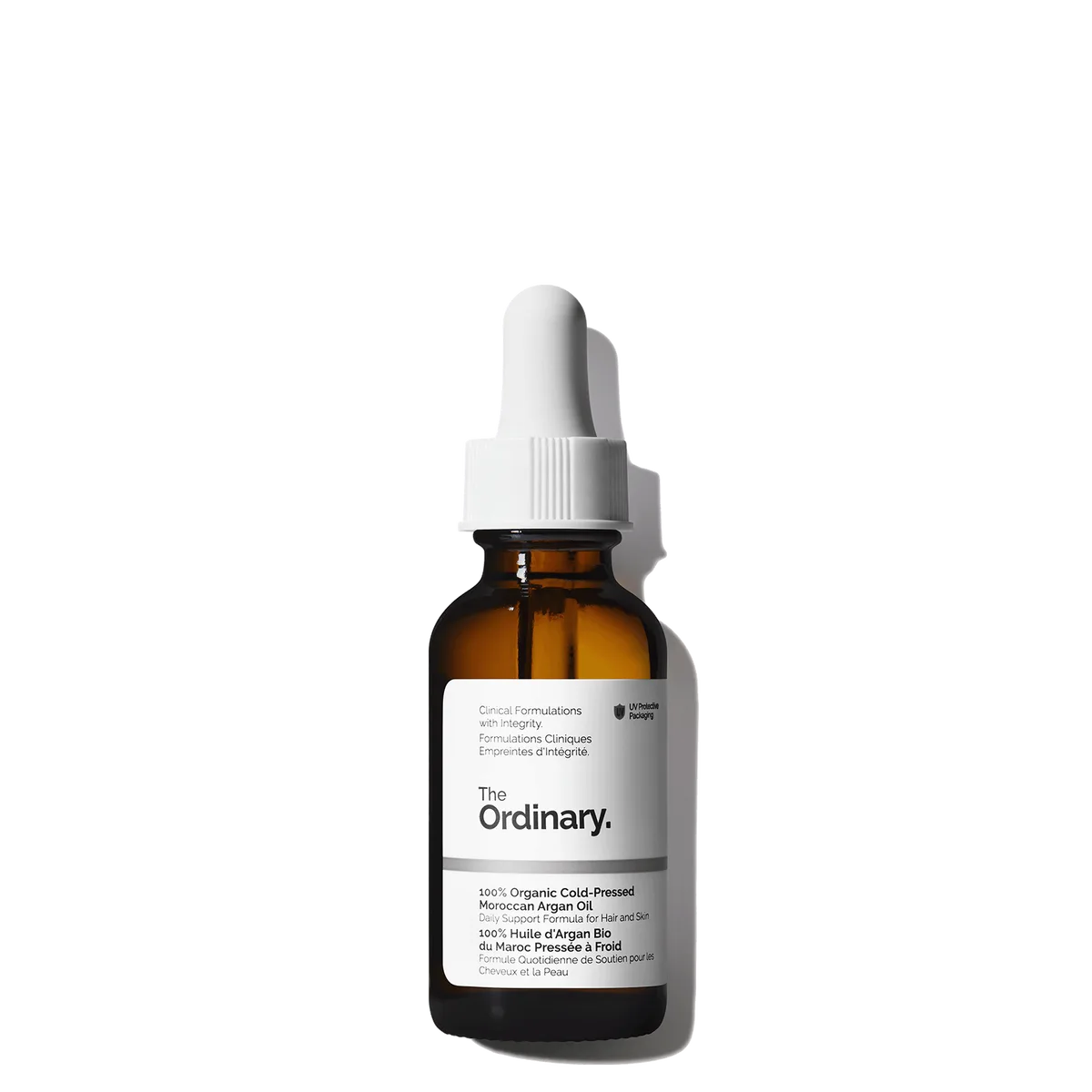
100% Organic Cold-Pressed Moroccan Argan Oil
Single-Ingredient Staple
 Verified reviewer
Pros & cons.
- +Exceptional value at $7.80 for certified organic cold-pressed argan oil
- +Single-ingredient formula eliminates risk of sensitizers or unnecessary additives
- +Cold-pressing preserves full spectrum of tocopherols, polyphenols, and squalene
- +Balanced oleic-to-linoleic acid ratio supports barrier without clogging pores
- +Versatile use across face, body, hair, nails, and cuticles
- +Cruelty-free and vegan with Leaping Bunny and PETA certification
- +Amber glass dropper bottle protects oil from light degradation
- +No adjustment period — softening and hydration benefits from first application
- −Earthy, nutty natural scent may be off-putting for those expecting fragrance-free neutrality
- −Thicker viscosity than refined argan oils requires warming between palms before application
- −Too heavy for oily skin types, particularly in humid climates
- −Oleic acid content feeds Malassezia yeast — unsuitable for fungal acne
- −Lacks the multi-active formulation complexity to target specific skin concerns
The full review.
When DECIEM launched The Ordinary in August 2016, the beauty industry collectively raised an eyebrow. A clinical skincare line where nothing cost more than $15? The initial lineup included just a handful of products, and among them were three pure oils — rosehip, marula, and this cold-pressed Moroccan argan oil. Nearly a decade later, the brand has exploded into hundreds of SKUs, but this argan oil remains exactly what it was on day one: a single ingredient in a glass bottle for under eight dollars.
There’s something almost confrontationally simple about a product with one line on its INCI list. Argania Spinosa Kernel Oil. That’s it. No emulsifiers, no preservatives, no fragrance, no clever delivery systems. Just oil pressed from argan kernels in Morocco, bottled in Toronto, and sold for less than a fancy coffee. The simplicity is the point — and also the product’s greatest limitation, depending on what you’re looking for.
What sets this apart from the refined argan oils that populate drugstore shelves is the cold-pressing. When argan kernels are mechanically pressed without heat, the resulting oil retains its full complement of bioactive compounds: tocopherols (predominantly gamma-tocopherol, which is a more potent antioxidant than the alpha form found in most supplements), polyphenols including caffeic acid, and the naturally occurring squalene that helps this oil feel more compatible with human skin than you’d expect from a plant-derived fat. Refining strips most of these compounds away in exchange for a neutral scent and lighter texture. This oil keeps them and asks you to accept the trade-off.
And there is a trade-off. The natural scent of unrefined argan oil is earthy, nutty, and distinctly present. It’s not unpleasant, exactly, but if you’re coming from fragranced facial oils that smell like a spa retreat, this will feel more like opening a jar in a Moroccan souk. The texture is also thicker than refined versions — slightly syrupy, with a viscosity that takes a moment to warm between your palms before it spreads evenly. These are features, not bugs, but they’re worth knowing about before you commit.
The fatty acid profile is where this oil earns its keep. At approximately 43-49% oleic acid and 29-37% linoleic acid, argan oil sits in an interesting middle ground. The oleic acid provides deep, penetrating moisturization that softens and conditions from within the lipid barrier. The linoleic acid — often deficient in acne-prone skin — supports ceramide synthesis and has been shown in research to actually reduce comedone formation. This balance is why argan oil has a comedogenic rating of zero and why it’s tolerated by a wider range of skin types than you might expect from a pure oil.
Clinical research on argan oil, while not as voluminous as studies on retinoids or niacinamide, is genuinely encouraging. A 2015 study published in Clinical Interventions in Aging found that topical argan oil application significantly improved skin elasticity parameters in postmenopausal women over 60 days. A companion study in Menopause Review demonstrated decreased transepidermal water loss and increased epidermal water content — essentially confirming that argan oil doesn’t just sit on the surface but actively improves barrier function. A 2017 review in the International Journal of Molecular Sciences further documented anti-inflammatory and barrier repair properties.
In daily use, the experience is straightforward. Two to three drops warmed between the fingertips, pressed into skin as the last step of your routine. It absorbs within a few minutes, leaving a dewy but not greasy finish. Dry patches respond almost immediately — that tight, flaky feeling softens within hours of the first application. Over weeks, the cumulative effect is skin that looks healthier and feels more resilient, particularly during harsh winter months when barrier function takes a beating.
The versatility is a genuine bonus. This works on cuticles, dry elbows, split ends, and frizzy hair just as well as it works on facial skin. At $7.80, using it liberally across multiple applications doesn’t trigger the same wince as dripping a $50 oil onto your hair.
Where does it fall short? It’s an oil. A good one, a well-sourced one, a fairly priced one — but still just an oil. It doesn’t contain the sophisticated multi-active formulations that can target specific concerns like hyperpigmentation, acne, or advanced aging. It won’t replace a well-formulated serum or treatment product. For oily skin types, especially in humid climates, it can feel too heavy even in small amounts. And those prone to fungal acne should steer clear entirely — the oleic acid content, while great for barrier support, can feed Malassezia yeast.
The value proposition is almost comically strong. Comparable organic cold-pressed argan oils from luxury brands routinely cost $30-50 for the same volume. The Ordinary’s version isn’t diluted, extended, or adulterated — it’s the same single ingredient, sourced from the same region, processed the same way, and sold at a fraction of the price because the brand’s entire model is built on stripping away the markup that skincare has traditionally demanded.
This isn’t a transformative product. It won’t rewrite your skin’s story the way a well-chosen retinoid or vitamin C serum might. But as a supporting player — a reliable, affordable, genuinely well-sourced oil that softens, protects, and nourishes — it’s been quietly doing its job since the day The Ordinary first opened its doors. Sometimes the simplest answer really is the best one.
Ingredient analysis.
Full INCI list
Argania Spinosa Kernel Oil
Skin match.
The science.
The Science
Argan oil has attracted meaningful scientific attention, particularly for its barrier-repair and anti-aging potential. A 2015 randomized controlled study published in Clinical Interventions in Aging by Boucetta et al. found that topical application of argan oil significantly improved gross elasticity (R2), net elasticity (R5), and biological elasticity (R7) in postmenopausal women over a 60-day intervention period. The same research group published a companion study in Menopause Review (2014) demonstrating that argan oil application significantly decreased transepidermal water loss while increasing water content of the epidermis — direct evidence of barrier function improvement.
The mechanism behind these effects centers on argan oil's unique lipid composition. The fatty acid profile — approximately 43-49% oleic acid and 29-37% linoleic acid — closely mirrors the skin's own lipid composition, facilitating integration into the stratum corneum. Linoleic acid is a precursor to ceramide 1 linoleate, a key structural lipid in the skin barrier, and its topical application has been shown to support ceramide synthesis.
Critically, the cold-pressing method used for this product preserves the non-lipid bioactives that distinguish virgin argan oil from its refined counterpart. A comprehensive characterization published in Frontiers in Nutrition (2021) documented approximately 620 mg/kg of total tocopherols — predominantly gamma-tocopherol, which demonstrates superior antioxidant activity compared to alpha-tocopherol in preventing lipid peroxidation. The preserved polyphenols, including caffeic acid, provide additional anti-inflammatory and antioxidant activity. A 2017 review in the International Journal of Molecular Sciences confirmed that these combined bioactives contribute to argan oil's anti-inflammatory properties and its capacity to support wound healing and barrier restoration.
References
- The effect of dietary and/or cosmetic argan oil on postmenopausal skin elasticity — Clinical Interventions in Aging (2015)
- Skin hydration in postmenopausal women: argan oil benefit with oral and/or topical use — Przeglad Menopauzalny (Menopause Review) (2014)
- Anti-Inflammatory and Skin Barrier Repair Effects of Topical Application of Some Plant Oils — International Journal of Molecular Sciences (2017)
- Argan Oil: Chemical Composition, Extraction Process, and Quality Control — Frontiers in Nutrition (2021)
Dermatologist Perspective
Dermatologists frequently recommend argan oil as a well-tolerated emollient for patients with dry or compromised skin barriers. Board-certified dermatologists note that its comedogenic rating of zero and balanced fatty acid profile make it one of the safer plant oils for facial use across most skin types. The high linoleic acid content is particularly valued in dermatological practice, as linoleic acid deficiency in sebum has been linked to comedone formation in acne-prone skin. Dermatologists commonly suggest argan oil as a supplementary moisturizing step for patients on drying treatments like retinoids or benzoyl peroxide, where it can buffer irritation without interfering with the active ingredient's efficacy. However, dermatologists caution that patients with Malassezia-related conditions should avoid argan oil due to its oleic acid content.
Where it fits in your routine.
Apply 2-3 drops to clean skin after water-based serums and moisturizers. Warm the oil between fingertips, then press it into skin. Do not rub, as rubbing causes friction. In the PM, use it as a final occlusive layer over retinol or hydrating serums. In the AM, apply a small amount and wait 1-2 minutes to absorb before sunscreen. Apply it directly to dry cuticles, rough patches, or hair ends. Store in a cool, dark place to preserve the cold-pressed bioactives.
At $7.80 for 30 mL, this is one of the cheapest organic cold-pressed argan oils from a reputable skincare brand. Luxury and prestige brands charge $30-50 for the same volume and single ingredient. The Ordinary's version is pure Argania Spinosa Kernel Oil, certified organic and cold-pressed to preserve bioactives. It comes in only one size, so there is no bulk-buy discount, but the per-milliliter cost is already lower than most competitors' largest formats. This price makes you question what you paid for other brands.
This facial oil works for dry, normal, or combination skin seeking simplicity and affordability. It provides an emollient buffer for users on drying retinoid treatments and suits anyone preferring single-ingredient transparency over complex formulations.
This works for oily skin types who find facial oils too heavy, people prone to fungal acne or Malassezia-related conditions, and users sensitive to natural unrefined scents. Use a multi-active formulation if you want a face oil that targets specific concerns like hyperpigmentation or acne.
Product details.
This medium-weight oil has a slightly syrupy viscosity, thicker than refined argan oils. It spreads easily and absorbs within a few minutes. Skin feels conditioned, not greasy.
Unrefined cold-pressed argan oil has a natural, earthy, nutty scent. The Ordinary notes this does not mean the oil is rancid; it shows the oil has not been deodorized or stripped.
30 mL amber glass bottle with integrated dropper. The dark glass protects light-sensitive tocopherols and fatty acids from UV degradation.
Skin softens immediately on first application; dry patches and flakiness improve within hours. The natural scent differs from refined or fragranced oils. No adjustment period or purging occurs; benefits start from the first use.
2-3 months with daily facial use (2-3 drops per application)
12 months
All Year
The backstory.
One of The Ordinary's original launch products from August 2016, this argan oil was part of the initial trio of pure oils (alongside rosehip and marula) that helped establish the brand's philosophy of single-ingredient, no-markup transparency. Morocco has produced argan oil for centuries, but The Ordinary made the cold-pressed organic version accessible at a price that undercut luxury brands by 80-90%.
About The Ordinary
Established Brand (5–20 years)The Ordinary launched in 2016 under DECIEM and quickly became a top global clinical skincare brand. Its ingredient-first, transparent approach uses formulation science, but the brand does not run proprietary clinical trials on most products.
Common myths.
Argan oil clogs pores and causes breakouts.
Argan oil has a comedogenic rating of 0. It contains 29-37% linoleic acid, which reduces comedone formation. However, its oleic acid content feeds Malassezia yeast, so people with fungal acne should avoid it.
The nutty smell means the oil has gone rancid.
Unrefined, cold-pressed argan oil has a characteristic earthy, nutty scent. Refined argan oils undergo deodorization, which removes bioactive compounds. Rancid oil smells sharp and unpleasant, unlike the natural nuttiness.
FAQ.
Is The Ordinary Argan Oil good for acne-prone skin?
This argan oil is a pure oil with a comedogenic rating of zero. It contains 29-37% linoleic acid, which reduces comedone formation. Its oleic acid content makes it unsuitable for fungal acne (Malassezia). For non-fungal acne-prone skin, use it sparingly as a PM moisturizing step.
What's the difference between cold-pressed and regular argan oil?
This cold-pressed version keeps heat-sensitive bioactives — tocopherols, polyphenols, and squalene — that refining processes destroy in most commercial argan oils. The trade-off is a stronger natural scent and thicker texture than refined versions, but it has higher antioxidant and anti-inflammatory activity.
Can I use The Ordinary Argan Oil with retinol?
Yes — this is a top pairing for this oil. Use the argan oil after retinol or retinoid treatments; its emollient properties buffer dryness and irritation without affecting retinoid activity. The cold-pressed oil has naturally occurring vitamin E for extra antioxidant support.
Why does The Ordinary Argan Oil smell nutty?
Unrefined cold-pressed argan oil has a characteristic earthy, nutty scent. The Ordinary does not deodorize this oil because refining removes the scent but also destroys beneficial tocopherols and polyphenols. This natural smell does not indicate rancidity; rancid oil has a sharp, unpleasant odor.
Can I use The Ordinary Argan Oil on my hair?
Yes. This pure argan oil tames frizz and adds shine to hair ends, treats dry cuticles, and softens rough body patches. At $7.80 for 30 mL, the price allows for multi-use application on face, body, and hair.
Is The Ordinary Argan Oil safe during pregnancy?
Yes. This single-ingredient product contains only pure argan oil. It has no retinoids, chemical sunscreen filters, salicylic acid, or other ingredients flagged during pregnancy. It is one of the safest moisturizing options for expectant mothers.
How long does a bottle of The Ordinary Argan Oil last?
A 30 mL bottle lasts about 2-3 months at 2-3 drops per facial application. Using it on face, body, and hair lasts 4-6 weeks. The period after opening is 12 months.
What the community says.
"Unbeatable value for organic cold-pressed argan oil"
"Leaves skin soft and deeply hydrated without heavy residue"
"Versatile — works for face, hair, nails, and cuticles"
"Simple single-ingredient formula with no fillers or additives"
"Helps calm dry, flaky winter skin quickly"
"Glass dropper bottle preserves oil quality"
"Natural unrefined scent is earthy and nutty — can be off-putting"
"Thicker, more viscous consistency than expected for a facial oil"
"Can feel too heavy for oily skin or in humid weather"
"Dropper can dispense too much product at once"
"Some users question whether it differs from cheaper argan oils"
People also looked at.