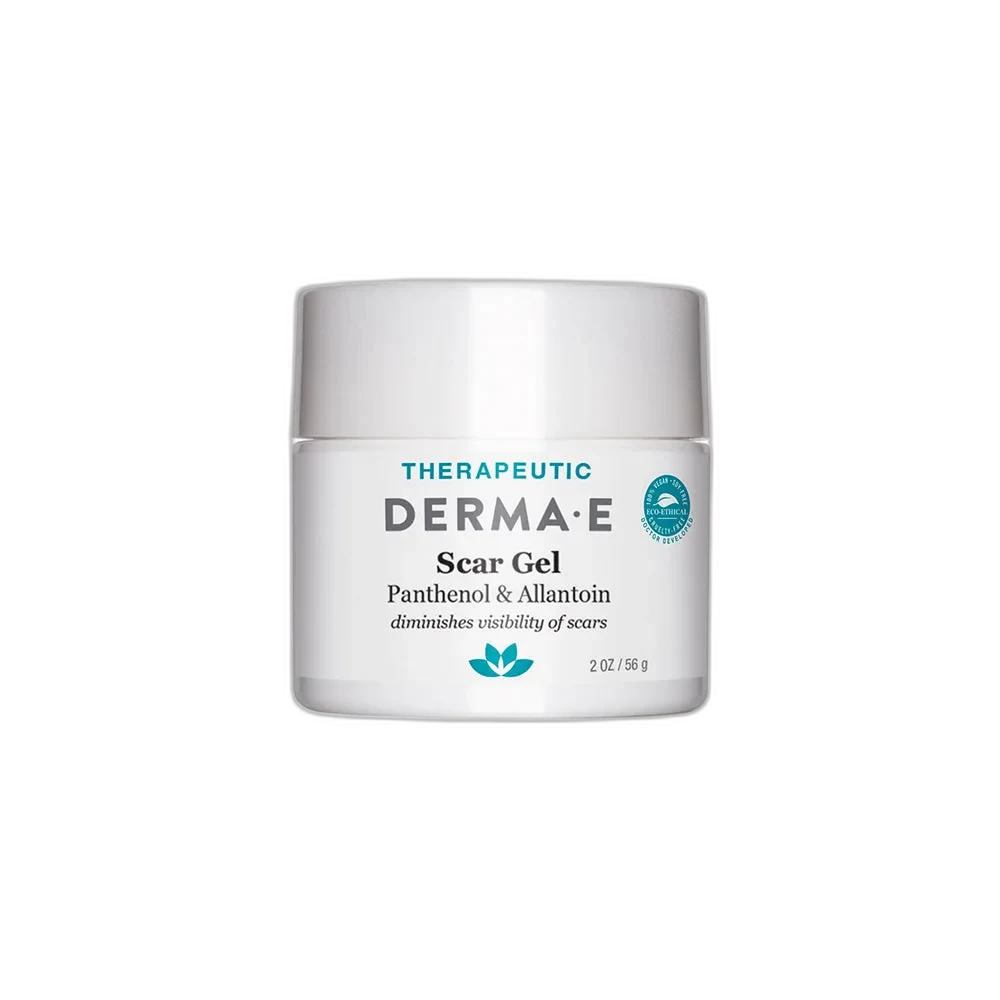
Scar Gel
Botanical Scar Staple
 Verified reviewer
Pros & cons.
- +Onion extract paired with panthenol and allantoin for a more complete repair matrix
- +Panthenol sits at the unusually high second position on the INCI
- +Lightweight gel absorbs quickly and layers well under other products
- +Vegan and Leaping Bunny cruelty-free certified
- +Affordable relative to prestige scar treatments
- +Well-tolerated on most skin types including acne-prone
- +Strong long-term track record with tens of thousands of reviews
- +Suitable for body and face scars and pregnancy-safe
- −Contains natural fragrance oils which aren't ideal on healing tissue
- −Small 2 oz jar with no larger or refill option
- −Requires months of consistent use to see results
- −Jar packaging can introduce contamination with repeated finger dipping
- −Deep or severe scars respond only modestly to any topical
The full review.
About Derma E Scar Gel
Both products rely on Allium cepa bulb extract, the onion-derived active that’s been studied for its flavonoid content and its effect on fibroblast activity in healing tissue. What Derma E does differently is pair that active with panthenol at the second position on the ingredient list, followed by glycerin, and then allantoin a few slots down. Panthenol converts to pantothenic acid in skin and has decades of evidence supporting its role in barrier repair and the soothing of compromised tissue. Allantoin is a mild keratolytic with FDA monograph status as a skin protectant. Together with the onion extract, they create a more complete repair matrix than Mederma’s simpler formula, at roughly the same price.
Texture
The texture is one of the reasons the product has the cult-ish user loyalty it does. It’s a clear, lightweight gel that spreads thinly and absorbs in about a minute, leaving no visible residue.
Scent
The INCI ends with ‘natural fragrance oils,’ and that’s a choice the formulator should reconsider. Fragrance of any kind — natural or synthetic — is generally discouraged on healing tissue, particularly on recent surgical scars where the skin is still in an early repair phase. For most users, the fragrance level is low and causes no issue, but for people with sensitive or rosacea-prone skin, it’s the one ingredient in an otherwise well-built formula that would push me to suggest a patch test first.
How to Use
You can apply it morning and night, which is important because scar treatment is a consistency game — fifteen seconds of daily application for months is what produces the results that single heavy applications do not.
Common Praise
Users consistently praise how easy it is to incorporate into a routine without feeling sticky, greasy, or interfering with anything else they put on their face or body.
Common Complaints
No complaints mentioned.
Best for
For atrophic acne scars, post-surgical scars, and stretch marks in their early phase, this gel is worth a try.
Works for
No specific uses mentioned.
Not ideal for
For deep ice-pick acne scars or severe keloids, silicone sheeting or professional treatments will almost certainly outperform it.
AM routine
No specific AM routine mentioned.
PM routine
No specific PM routine mentioned.
Ingredient analysis.
Full INCI list
Purified Water, Panthenol (Provitamin B5), Glycerin (Vegetable Derived), Carbomer, Allium Cepa (Onion) Bulb Extract, Acetyl Glycyl Beta-Alanine, Allantoin, Polysorbate 20, Phenoxyethanol, Ethylhexylglycerin, Natural Fragrance Oils
Skin match.
The science.
The Science
Allium cepa bulb extract is the core active, containing quercetin and kaempferol flavonoids. Controlled trials show these compounds modulate fibroblast activity and reduce hypertrophic and surgical scars, with modest but measurable results. Studies on onion-extract scar treatments show improvements in scar color, texture, and pliability compared to vehicle control, though effect sizes are smaller than silicone gel sheeting. Current dermatological consensus ranks silicone gel sheeting as the most evidence-supported topical intervention for scar management. The panthenol content distinguishes this formula from its main competitor. Published studies show topical panthenol converts to pantothenic acid in skin, increases fibroblast proliferation, supports re-epithelialization, and reduces transepidermal water loss on compromised tissue. These mechanisms directly aid scar healing, and its second position on the INCI indicates a meaningful concentration. Allantoin has well-documented keratolytic and soothing effects and holds FDA monograph status as a skin protectant. The acetyl glycyl beta-alanine is a small peptide-adjacent ingredient with limited published evidence, but it poses no meaningful irritation risk. Dermatological literature suggests topical onion extract formulas produce modest but real improvement on certain scar types—specifically fresh post-surgical and atrophic scars—when used consistently for 8-12 weeks, and that adding hydrating, barrier-supporting actives like panthenol may improve outcomes.
Dermatologist Perspective
Dermatologists usually recommend silicone gel sheeting as the first-line over-the-counter treatment for raised and hypertrophic scars because the evidence for silicone is stronger than for onion-extract formulas. However, many board-certified dermatologists view onion-extract gels as a reasonable secondary option or supportive measure, especially for users seeking a vegan, clean-beauty alternative or those who find silicone sheeting impractical for certain scar locations. This formula is often suggested for mild acne scarring, early post-inflammatory stretch marks, and post-cesarean scars where silicone sheeting is hard to maintain. Dermatologists note that consistency and SPF protection of the scar during the day matter more than the specific topical used; unprotected sun exposure darkens a healing scar more than any gel can lighten it.
Where it fits in your routine.
Apply only to fully closed, healed scar tissue; do not use on open wounds or broken skin. Cleanse the scar area and pat dry. Put a small amount of gel on a fingertip and massage it into the scar in circular motions for 30 seconds. Let it absorb for 1-2 minutes before applying other products to the same area. Apply twice daily, morning and night, for 8-12 weeks for results, and continue for 3-6 months for older or more established scars. Always apply broad-spectrum SPF 30+ over the scar area during the day. Sun exposure is the main cause of scars darkening and failing to fade.
At about $24.95 for 2 oz, the per-ounce price matches Mederma and costs much less than prestige silicone-based scar treatments. The value depends on whether added panthenol and allantoin improve outcomes more than a bare onion-extract formula. Ingredient data supports this, though published comparative studies do not definitively prove it. The 2 oz size is a limitation; it lasts 3-4 months when applied twice daily to a small scar area, and no larger or cheaper size exists. The math works for targeted treatment of a small scar. For larger areas like a surgical incision spanning several inches, budget-conscious users should compare this to a silicone gel sheet.
People with mild to moderate scars — surgical, acne-related, or stretch marks — who want a vegan, affordable topical treatment for several months of consistent use. It is also a reasonable choice for pregnant users needing a clean-beauty option for post-cesarean scar care after the incision has fully closed.
People with highly sensitive, rosacea-prone, or recently-healed tissue should use a fragrance-free silicone gel instead. Professional treatments — laser, microneedling, or steroid injection — work better for deep ice-pick acne scars, keloids, or severe hypertrophic scars than any topical.
Product details.
Clear, lightweight gel that spreads thinly and absorbs within about 60 seconds.
'natural fragrance oils' give it a mild herbal-floral scent. It is not overpowering, but it is not fragrance-free.
Small jar with a twist-off lid. It works for targeted application but lacks an airless pump, and the jar-format can cause contamination from finger dipping.
It sinks in quickly on first application and does not sting closed scars. Most users see softening and hydration of the scar surface within 2-4 weeks, but visible improvement requires 8-12 weeks of consistent use. This product requires patience rather than a quick fix.
Approximately 3-4 months with twice-daily application to a small scar area.
12 months
All Year
The backstory.
The Scar Gel is one of Derma E's longest-running targeted treatments and has been a staple in the brand's natural-derived 'skin repair' line for years. It was developed to offer a vegan, clean-beauty alternative to Mederma for users who wanted the same onion-extract active in a formula with supporting panthenol and allantoin rather than a bare-bones delivery.
About Derma E
Legacy Brand (20+ years)Derma E has made affordable vegan skincare since 1984 and has Leaping Bunny cruelty-free certification. The Scar Gel is a top-selling targeted treatment. While Mederma and silicone gels dominate this category, Derma E offers a botanical alternative using onion extract, the same active class Mederma uses.
Common myths.
Scar gels can 'erase' scars completely
No topical product — prescription or over-the-counter — erases an established scar. This gel and others like it soften appearance, reduce redness, and improve texture over time, but the underlying scar structure remains.
Onion extract is just folk medicine
Onion bulb extract has less evidence than silicone gel sheeting, but multiple controlled trials show it affects fibroblast activity and scar appearance. It shows modest, measurable results on certain scar types.
FAQ.
How long does it take to see results from Derma E Scar Gel?
Most users see softer, more hydrated scar surfaces within 2-4 weeks. Visible changes in scar color and texture usually take 8-12 weeks of consistent twice-daily application. Older, established scars may need 6 months or more.
How does it compare to Mederma?
Both products use the same active ingredient class: onion bulb extract. This formula pairs that extract with panthenol at the second position and allantoin to create a more supportive repair matrix. Mederma has more marketing claims, but the underlying actives are similar.
Can I use it on old scars?
Yes, but older scars respond slower than fresh ones. Post-surgical scars within the first year typically respond best. Scars older than a year may still show improvement with 6+ months of consistent use, but results are generally modest.
Is it safe to use on acne scars?
Yes — it works for atrophic and post-inflammatory acne scars, but deep ice-pick or boxcar scars show only modest responses to any topical product, including this one.
Can I use it on open wounds?
No. Apply this product only to fully closed, healed skin. Using it on open wounds introduces contamination and the formula is not designed for that.
Does it contain fragrance?
Yes — the INCI lists 'natural fragrance oils' at the end of the formula. This is a minor drawback for healing tissue, which generally prefers fragrance-free products.
Is it safe during pregnancy?
Yes. The formula lacks retinoids, salicylic acid, or hormone-active botanicals. It is a pregnancy-safe option for post-cesarean scar care, but check with a physician before applying any product to recent surgical scars.
What the community says.
"softens scar appearance over time"
"non-greasy gel texture"
"affordable compared to silicone options"
"works on old and new scars"
"pleasant feel"
"fragrance is unnecessary on healing tissue"
"slow results requiring months of use"
"effectiveness varies by scar type"
"small 2 oz jar"
People also looked at.