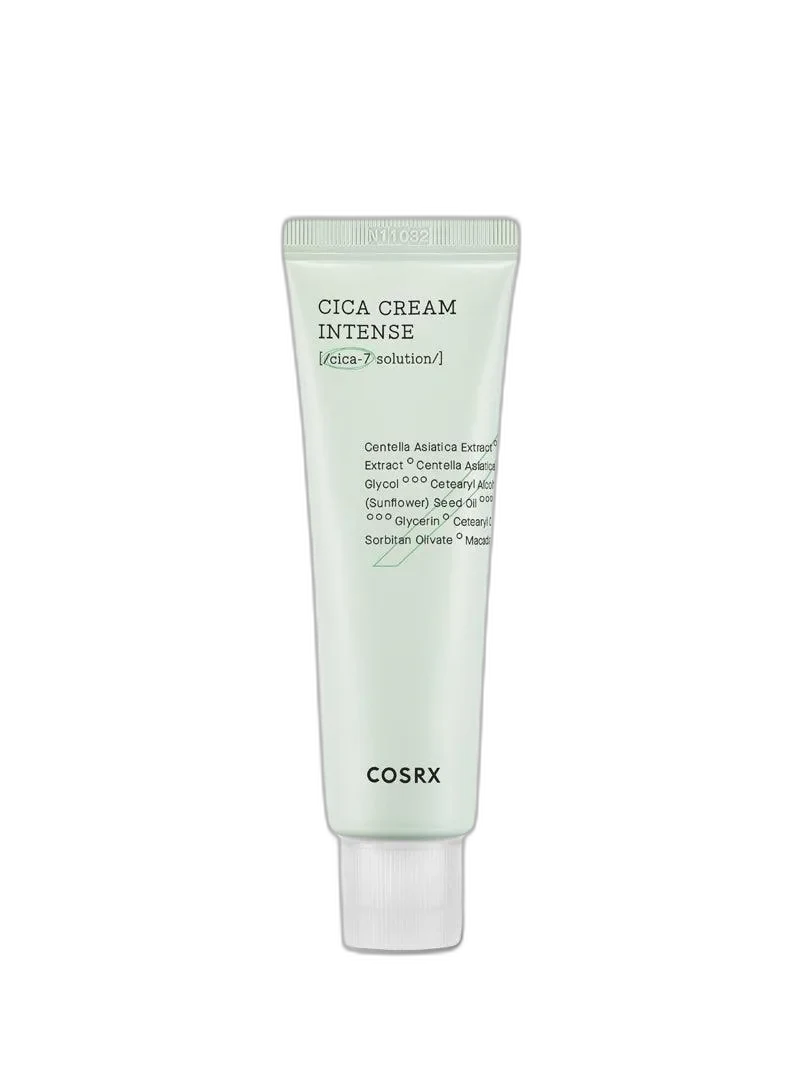
Pure Fit Cica Cream Intense
Winter Barrier Rescue Cream
 Verified reviewer
Pros & cons.
- +Higher CICA-7 Complex concentration (61.2%) with added centella asiatica oil at 1,000 ppm
- +Completely silicone-free — unusual for a rich cream in this price range
- +Fragrance-free formula suitable for the most reactive skin conditions
- +Rich texture absorbs better than expected thanks to olive-derived emulsifiers
- +Pregnancy-safe with no concerning actives for expectant mothers
- +Excellent as an overnight sleeping mask for deep barrier repair
- +Maritime pine bark extract adds antioxidant defense alongside the centella soothing
- −Soybean oil has a comedogenicity rating of 3-4 — risky for clog-prone skin
- −Contains beeswax making it unsuitable for vegan consumers
- −Too rich for oily skin types, especially in warm weather
- −50ml tube at 2 MSRP is premium pricing for COSRX
- −Not suitable for fungal acne due to multiple oils and fatty acids
The full review.
In the world of skincare line extensions, the “Intense” or “Rich” version of an existing product usually follows a predictable formula: take the original, add more silicones and heavier emollients, charge the same price, and call it a day. COSRX did something more interesting with the Pure Fit Cica Cream Intense. They removed the silicones entirely, increased the centella complex concentration, and added centella asiatica oil — an ingredient absent from the original. It is one of the rare cases where the richer version is also the more thoughtfully reformulated one.
The headliner is the CICA-7 Complex, now at 61.2% — a meaningful step up from the regular version’s 58.6%. This proprietary blend combines seven distinct centella-derived ingredients: whole plant extract, leaf extract, root extract, centella oil, plus four individually isolated triterpenoids (asiaticoside, madecassoside, asiatic acid, and madecassic acid). The addition of centella asiatica oil at 1,000 ppm is particularly noteworthy. While the aqueous centella extracts deliver water-soluble actives through the skin’s hydrophilic pathways, the centella oil provides a lipid-soluble delivery route — meaning the formula approaches barrier repair from both sides of the skin’s chemistry. This dual-pathway approach is unusual in the cica category.
The texture reflects the intent. Where the regular Cica Cream is a lightweight gel-cream that melts into skin and disappears, the Intense version announces itself as a proper cream. It is thick and substantial in the tube, with the kind of rich consistency that signals “this is for evening use” to anyone who has built a layered routine. On application, though, it surprises — the olive-derived emulsifiers (cetearyl olivate and sorbitan olivate) give it a smoother, more absorbent feel than the thickness suggests. It does not sit on the surface or leave a greasy film. There is a brief moment of slight tackiness as it sets, then it settles into a satin finish with a barely perceptible protective layer that you can feel but not see.
The silicone-free formulation is worth pausing on. Most rich moisturizers achieve their slip and smooth finish through dimethicone or cyclopentasiloxane. COSRX chose to exclude these entirely from the Intense version (the regular cream contains both cyclohexasiloxane and a dimethicone crosspolymer). The result is a cream that feels more natural on the skin — less of the slippery, almost plastic-wrap quality that silicone-heavy creams can produce. For people whose skin does not tolerate silicones well, this is a meaningful differentiator in the rich cream market.
The emollient base is built on sunflower seed oil, macadamia seed oil, caprylic/capric triglyceride, and soybean oil, sealed with beeswax. It is a proper lipid cocktail designed to reinforce a compromised barrier. Sunflower seed oil is rich in linoleic acid, which studies have shown can help restore barrier function in atopic skin. The beeswax provides occlusion without the heaviness of petrolatum. Panthenol and allantoin add their familiar soothing and wound-healing contributions.
Here is where the honest assessment comes in. The soybean oil carries a comedogenicity rating of 3-4 on the standard scale, which is concerning for anyone prone to clogged pores. If your skin tends toward congestion — even if it is also dry and sensitive — this ingredient may cause problems. The beeswax, while an effective occlusive, makes the product unsuitable for vegan consumers. And the oils throughout the formula mean anyone dealing with fungal acne (Malassezia folliculitis) should avoid this entirely.
The fragrance-free formulation remains intact from the regular version. There is no detectable scent beyond a faint herbal note that some users attribute to the concentrated centella extract itself. For skin in a state of active irritation — red, stinging, freshly over-exfoliated, or post-procedure — the absence of fragrance is as important as the presence of actives.
As a winter cream, this excels. The richer emollient base provides the kind of protective, sealed-in moisture that dry and sensitive skin loses to cold, dry air. It works beautifully as an overnight sleeping mask, layered over hydrating serums to create a cocoon of centella-infused repair. In warmer months or for oily skin types, it will feel too heavy for daytime use — this is unambiguously a cream designed for conditions where skin needs more than a gel-cream can provide.
The value question echoes the regular Cica Cream: 2 for 50ml is premium COSRX territory, and the small tube size makes it feel less generous than the brand’s typically accessible pricing suggests. Discounted pricing on Asian beauty retailers brings it closer to 0-25, which softens the blow. The 2-3 month lifespan with twice-daily use is reasonable, but those who gravitate toward this cream’s richness may find themselves applying generously and finishing the tube faster.
The Intense version represents a genuine formulation upgrade over the regular Cica Cream — not just a heavier texture swap. The added centella oil, removed silicones, and increased complex concentration reflect deliberate choices rather than lazy line extension. For dry, sensitive, and compromised skin that needs more than a lightweight gel-cream can offer, this is one of the more thoughtful barrier-repair options in the K-beauty market.
Formula
Texture
The texture reflects the intent. Where the regular Cica Cream is a lightweight gel-cream that melts into skin and disappears, the Intense version announces itself as a proper cream. It is thick and substantial in the tube, with the kind of rich consistency that signals “this is for evening use” to anyone who has built a layered routine. On application, though, it surprises — the olive-derived emulsifiers (cetearyl olivate and sorbitan olivate) give it a smoother, more absorbent feel than the thickness suggests. It does not sit on the surface or leave a greasy film. There is a brief moment of slight tackiness as it sets, then it settles into a satin finish with a barely perceptible protective layer that you can feel but not see.
Scent
The fragrance-free formulation remains intact from the regular version. There is no detectable scent beyond a faint herbal note that some users attribute to the concentrated centella extract itself. For skin in a state of active irritation — red, stinging, freshly over-exfoliated, or post-procedure — the absence of fragrance is as important as the presence of actives.
Best Season
As a winter cream, this excels. The richer emollient base provides the kind of protective, sealed-in moisture that dry and sensitive skin loses to cold, dry air. It works beautifully as an overnight sleeping mask, layered over hydrating serums to create a cocoon of centella-infused repair. In warmer months or for oily skin types, it will feel too heavy for daytime use — this is unambiguously a cream designed for conditions where skin needs more than a gel-cream can provide.
Best for
For dry, sensitive, and compromised skin that needs more than a lightweight gel-cream can offer, this is one of the more thoughtful barrier-repair options in the K-beauty market.
Not ideal for
The soybean oil carries a comedogenicity rating of 3-4 on the standard scale, which is concerning for anyone prone to clogged pores. If your skin tends toward congestion — even if it is also dry and sensitive — this ingredient may cause problems. The beeswax, while an effective occlusive, makes the product unsuitable for vegan consumers. And the oils throughout the formula mean anyone dealing with fungal acne (Malassezia folliculitis) should avoid this entirely.
Ingredient analysis.
Full INCI list
Water, Centella Asiatica Extract, Centella Asiatica Leaf Extract, Centella Asiatica Root Extract, Butylene Glycol, Cetearyl Alcohol, Helianthus Annuus (Sunflower) Seed Oil, Caprylic/Capric Triglyceride, Glycerin, Cetearyl Olivate, 1,2-Hexanediol, Sorbitan Olivate, Macadamia Ternifolia Seed Oil, Panthenol, Hydroxyethyl Acrylate/Sodium Acryloyldimethyl Taurate Copolymer, Ethylhexylglycerin, Beeswax, Arginine, Carbomer, Asiaticoside, Madecassic Acid, Asiatic Acid, Centella Asiatica Oil, Madecassoside, Allantoin, Sodium Hyaluronate, Glycine Soja (Soybean) Oil, Pinus Pinaster Bark Extract
Skin match.
The science.
The Science
The CICA-7 Complex in the Intense version at 61.2% builds on the same centella asiatica research base as the regular formula, with the notable addition of centella asiatica oil at 1,000 ppm. While aqueous centella extracts deliver triterpenoids through the skin's hydrophilic channels, the oil provides a lipophilic delivery pathway. Research published in the International Journal of Molecular Sciences (2017) has documented that centella triterpenoids delivered through lipid vehicles demonstrate enhanced skin penetration compared to aqueous delivery alone, suggesting the dual-pathway approach in this formula may improve bioavailability of the active compounds.
The silicone-free formulation relies on cetearyl olivate and sorbitan olivate — emulsifiers derived from olive oil — to create its cream matrix. These ingredients form a liquid crystalline structure that mimics the lamellar arrangement of natural skin lipids. Research in the Journal of Cosmetic Dermatology (2010) demonstrated that olive-derived emulsifiers improve skin barrier function more effectively than traditional synthetic emulsifier systems, as the biomimetic structure facilitates integration with the stratum corneum's existing lipid architecture.
Sunflower seed oil's role in barrier repair is supported by a study in Pediatric Dermatology (2014) that found topical sunflower seed oil significantly improved skin barrier function and reduced incidence of nosocomial infections in preterm infants, attributed to its high linoleic acid content that is directly incorporated into the stratum corneum's ceramide synthesis pathway. In this formula, the sunflower oil works synergistically with the centella complex's collagen-stimulating and anti-inflammatory properties to address barrier compromise from both structural and inflammatory angles.
Beeswax provides occlusive properties that reduce transepidermal water loss (TEWL) without completely blocking gas exchange at the skin surface. Unlike petrolatum, which creates a near-complete occlusive seal, beeswax allows some degree of skin respiration while still maintaining a meaningful moisture barrier — a characteristic that may be preferable for compromised skin that benefits from protection without complete occlusion.
References
- Enhanced Skin Penetration of Centella Asiatica Triterpenoids via Lipid-Based Delivery Systems — International Journal of Molecular Sciences (2017)
- Olive-derived emulsifiers and skin barrier function — Journal of Cosmetic Dermatology (2010)
- Effect of sunflower seed oil on skin barrier in preterm infants — Pediatric Dermatology (2014)
Dermatologist Perspective
Dermatologists view the Intense version favorably for patients with severely compromised barriers, winter-aggravated dryness, and post-procedure recovery needs. The silicone-free formulation aligns with growing dermatological interest in biomimetic emollient systems that integrate with the skin's natural lipid architecture rather than sitting as an inert film on top. Board-certified dermatologists specializing in eczema and rosacea management note that the olive-derived emulsifiers and plant oil base may be better tolerated long-term than silicone-heavy alternatives for patients with chronic barrier dysfunction. The one caution raised in dermatological circles concerns the soybean oil, which carries a moderate comedogenicity risk that makes this cream less suitable for patients with concurrent acne concerns.
Where it fits in your routine.
Apply a pea-to-nickel-sized amount after toner and serums. In AM, follow with sunscreen. In PM, use as the last step or apply a thicker layer as an overnight sleeping mask for intensive barrier repair. Pat gently into skin instead of rubbing, especially if the barrier is compromised. For post-procedure use, apply as needed throughout the day on clean skin. Do not layer under heavy sunscreens to prevent pilling.
At 2 MSRP for 50ml, the Intense version costs the same as the regular Cica Cream. The centella oil and silicone-free reformulation are upgrades that justify the price. Asian beauty retailers often discount to 0-25, making the per-day cost roughly 25-40 cents for twice-daily use over 2-3 months. This silicone-free, fragrance-free barrier repair cream with a centella complex is reasonably priced—though COSRX fans used to the brand's sub-0 staples may find it more expensive.
Dry and sensitive skin types who find the regular Cica Cream too lightweight will like the thicker emollient base. This works well for winter barrier recovery, post-procedure soothing, and skin that is chronically reactive to environmental stressors.
Oily skin types will find this too heavy for daily use. People prone to clogged pores should watch for the comedogenic soybean oil. Vegan consumers must look elsewhere because of the beeswax content, and those with active fungal acne should avoid the multiple oils in the formula.
Product details.
fall winter *** Certifications Dermatologically testedHypoallergenic *** Background
The backstory.
Introduced in 2021 as the richer sibling of the 2020 Pure Fit Cica Cream, the Intense version was developed for users who found the original too lightweight for dry skin or harsh winter conditions. It fills the gap between the original lightweight gel-cream and a full occlusive ointment, adding centella oil, soybean oil, and a heavier emollient base while maintaining the fragrance-free, silicone-free approach that defined the Pure Fit Cica line.
About COSRX
Established Brand (5–20 years)COSRX launched in 2013 and is now a globally recognized K-beauty brand. COSRX uses minimal-ingredient, functional formulations and builds a following through transparent labeling and effective products, though independent clinical studies on its specific formulations are limited.
Common myths.
Thicker creams soothe more than lighter formulas.
The Intense version soothes more because it has a higher CICA-7 Complex concentration (61.2% vs 58.6%) and adds centella asiatica oil, not just because it is thicker. The emollient base improves occlusion and prevents moisture loss, but centella compounds drive the anti-inflammatory and repair activity, not the cream's weight.
Silicone-free creams can't feel as elegant as silicone-based ones.
This cream uses olive-derived emulsifiers (cetearyl olivate, sorbitan olivate) and a hydroxyethyl acrylate copolymer instead of silicones to absorb fast and leave a smooth finish. It creates a natural-feeling protective film, not the slippery, plasticized feel silicone-heavy creams often produce.
FAQ.
What is the difference between COSRX Pure Fit Cica Cream and Cica Cream Intense?
The Intense version has a higher CICA-7 Complex concentration (61.2% vs 58.6%), includes 1,000 ppm centella asiatica oil (absent in the regular), and uses a thicker emollient base with soybean oil and heavier beeswax. The regular is a light gel-cream for all seasons and oily-combination skin, while the Intense is a thick cream for dry skin, winter conditions, and severely compromised barriers.
Is the COSRX Pure Fit Cica Cream Intense good for eczema?
The high-concentration centella complex and fragrance-free formula soothe eczema-related redness and discomfort. This cream is not an eczema treatment and lacks medicated actives like colloidal oatmeal or hydrocortisone. It works best as a soothing moisturizer used with eczema-specific treatments.
Can you use the COSRX Cica Cream Intense as a sleeping mask?
Yes — the thick, emollient texture works well as an overnight sleeping mask. Apply a thicker layer as your final PM step. The beeswax and plant oils create a seal that locks in hydration and centella actives while you sleep.
Is the COSRX Cica Cream Intense silicone-free?
Yes — the Intense version is completely silicone-free, unlike the regular Cica Cream which contains cyclohexasiloxane and a dimethicone crosspolymer. It uses olive-derived emulsifiers (cetearyl olivate and sorbitan olivate) to get its smooth texture.
Is the COSRX Cica Cream Intense safe during pregnancy?
Yes — this cream lacks retinoids, salicylic acid, hydroquinone, or other ingredients flagged during pregnancy. The centella asiatica complex, panthenol, and plant oils are safe for topical use during pregnancy and breastfeeding.
What the community says.
"Effectively soothes irritated and sensitive skin"
"Rich but non-greasy texture that absorbs well"
"Fragrance-free formula gentle enough for reactive skin"
"Works well under makeup despite richer consistency"
"Helps repair compromised skin barriers"
"Silicone-free formula is a standout in the rich cream category"
"Can feel too rich for oily skin, especially in daytime"
"Some users feel it doesn't hydrate as deeply as the thick texture suggests"
"Faint medicinal herbal smell from raw centella ingredients"
"50ml size feels small for the 2 MSRP"
"Contains beeswax making it unsuitable for vegans"