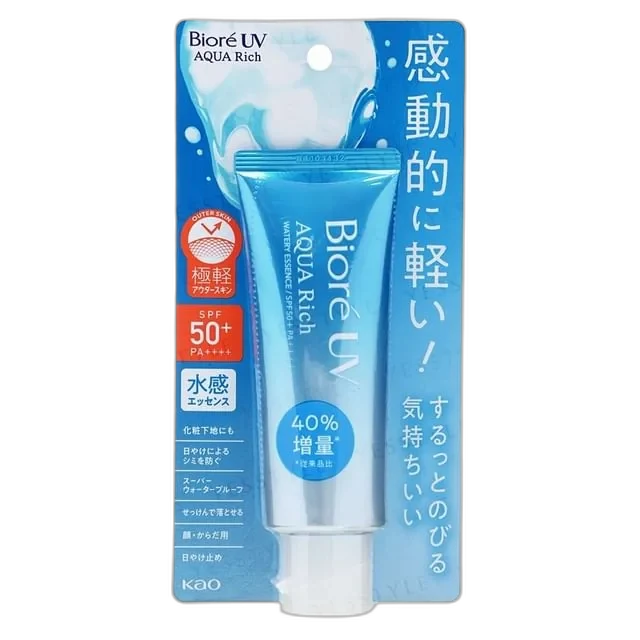
UV Aqua Rich Watery Essence SPF 50+
The J-Beauty Sunscreen That Started It All
 Verified reviewer
Pros & cons.
- +Legendary watery texture absorbs within seconds and feels genuinely weightless on skin
- +Four-filter UV system with Tinosorb S photostabilization for robust SPF 50+ PA++++ protection
- +Zero white cast on any skin tone — one of the first high-SPF sunscreens to achieve this
- +Functions beautifully as a makeup primer with no pilling or separation
- +Paraben-free formula reformulated multiple times for improved performance
- +Exceptional value at $15 for 70g compared to Western sunscreens with inferior UV systems
- +Over a decade of continuous refinement backed by Kao Corporation's R&D resources
- −High ethanol content causes stinging and dryness on sensitive or barrier-compromised skin
- −Contains fragrance that adds irritation risk without functional benefit to the formula
- −Requires importing from Japanese retailers — not available in Western drugstores
- −Some independent testing suggests real-world UV protection may fall below labeled SPF rating
- −Octinoxate is restricted in some regions for environmental reef-safety concerns
- −Can feel drying on very dry skin in cold or low-humidity environments
The full review.
Before the Bioré UV Aqua Rich Watery Essence reached Western markets, daily sunscreen felt like a chore. Users accepted thick, white, or greasy formulas because dermatologists recommended them. It was the skincare equivalent of flossing: necessary, but unpleasant.
Then this watery Japanese essence arrived. Users began describing sunscreen application like applying a light serum. It is light, hydrating, and disappears without a white cast on any skin tone. On forums, people describe the feel as “like water.”
Kao Corporation launched the Aqua Rich line in Japan in the mid-2010s, following decades of Japanese sunscreen innovation. The Japanese market requires cosmetically elegant protection due to humidity, long commutes, and a cultural focus on fair skin. By the time Western beauty communities found the Watery Essence, multiple formulation generations had already refined it.
The current version uses a four-filter UV system with smart chemistry. Octinoxate and ethylhexyl triazone absorb UVB rays (sunburn), while Tinosorb S and DHHB cover the UVA spectrum (photoaging and pigmentation). Tinosorb S photostabilizes the system; it stops octinoxate from degrading under sun exposure, a common weakness in isolated cinnamate-class filters. This formulation detail separates well-engineered sunscreens from those that only meet lab numbers.
The texture is the product’s main achievement. Ethanol is the second ingredient. While controversial, it makes the wear experience extraordinary. The alcohol drives near-instant absorption, spreads UV filters into a thin, uniform film, and removes the tacky, heavy feel of most high-SPF products. The sunscreen vanishes within thirty seconds of application. It leaves a hydrated, slightly dewy finish that looks and feels like clean skin.
Sodium hyaluronate, glycerin, and xylitol counteract the alcohol’s drying effect, which works for most normal-to-oily skin types. The formula feels hydrating despite the high ethanol content. However, dry skin types may feel tightness, especially in winter or air-conditioned rooms. A hydrating toner underneath solves this for most.
This sunscreen excels under makeup. It creates a smooth, non-greasy base that prevents foundation from pilling or separating. Many users replace their primer with this because the dimethicone and silicone crosspolymers provide a silky, blurring base layer that works like a lightweight primer.
The honest part: independent testing using UV cameras and spectrophotometer measurements suggests real-world UV protection may be lower than the SPF 50+ PA++++ rating. This gap between lab tests and real-world application affects the entire sunscreen category, not just Bioré. The solution is not to avoid the product, but to apply enough. Most people use only a quarter of the recommended amount, which reduces effective protection regardless of the SPF label.
The fragrance is a mild citrus-floral scent that fades in minutes. It is subtle and inoffensive to most, but unnecessary and adds an irritation risk for fragrance-sensitive users. The formula also contains BHT as an antioxidant preservative; it is safe at this concentration but appears on some avoidance lists.
Value is strong. At roughly $15 for 70g from import retailers—enough for two to three months of daily facial application—it costs less than most prestigious Western sunscreens while using a more advanced UV filter system. Note that import retailers have variable shipping times and require you to verify product authenticity. The US-market Bioré sunscreen sold at Target and CVS uses a different formulation and is not this Japanese-market product.
The Watery Essence has undergone multiple reformulations, including updates in 2019 and 2023. Each version refined the texture and improved the Micro Defense technology for even UV filter distribution. These changes are incremental; the current version is similar to the 2019 version but slightly smoother.
This is not a perfect sunscreen. The alcohol affects dry and sensitive skin. The fragrance is unnecessary. The octinoxate is environmentally controversial. It requires importing. But for the millions who moved from reluctant SPF users to daily enthusiasts because this product feels good, these are manageable trade-offs for an experience that still feels unique after a decade.
Formula
Texture
The texture is the product’s main achievement. Ethanol is the second ingredient. While controversial, it makes the wear experience extraordinary. The alcohol drives near-instant absorption, spreads UV filters into a thin, uniform film, and removes the tacky, heavy feel of most high-SPF products. The sunscreen vanishes within thirty seconds of application. It leaves a hydrated, slightly dewy finish that looks and feels like clean skin.
Scent
The fragrance is a mild citrus-floral scent that fades in minutes. It is subtle and inoffensive to most, but unnecessary and adds an irritation risk for fragrance-sensitive users.
Best for
This sunscreen excels under makeup. It creates a smooth, non-greasy base that prevents foundation from pilling or separating. Many users replace their primer with this because the dimethicone and silicone crosspolymers provide a silky, blurring base layer that works like a lightweight primer.
Not ideal for
This is not a perfect sunscreen. The alcohol affects dry and sensitive skin. The fragrance is unnecessary. The octinoxate is environmentally controversial. It requires importing.
Ingredient analysis.
Full INCI list
Water, Ethanol, Ethylhexyl Methoxycinnamate, Ethylhexyl Triazone, Isopropyl Palmitate, Lauryl Methacrylate/Sodium Methacrylate Crosspolymer, Diethylamino Hydroxybenzoyl Hexyl Benzoate, Hydrogenated Polyisobutene, Bis-Ethylhexyloxyphenol Methoxyphenyl Triazine, Dextrin Palmitate, Butylene Glycol, Xylitol, Acrylates/C10-30 Alkyl Acrylate Crosspolymer, Dimethicone, C12-15 Alkyl Benzoate, Glycerin, Glyceryl Stearate, Propanediol, Glyceryl Behenate, Vinyl Dimethicone/Methicone Silsesquioxane Crosspolymer, Cetyl Alcohol, Agar, Sorbitan Stearate, Isoceteth-20, Polyvinyl Alcohol, Dimethicone/Vinyl Dimethicone Crosspolymer, Sodium Stearoyl Glutamate, Arginine, Potassium Hydroxide, Sodium Hydroxide, Royal Jelly Extract, Sodium Hyaluronate, Phenoxyethanol, Disodium EDTA, BHT, Fragrance
Skin match.
The science.
The Science
The Watery Essence UV filter architecture balances protection, photostability, and cosmetic elegance. Four complementary filters cover the 280-400nm ultraviolet spectrum: octinoxate (peak absorption ~310nm, UVB), ethylhexyl triazone (peak ~314nm, UVB), Tinosorb S (broad absorption 310-340nm, UVA/UVB), and DHHB (peak ~354nm, UVA-I).
The photostability engineering is notable. Octinoxate (ethylhexyl methoxycinnamate) is a common global UVB filter, but it undergoes photoisomerization—changing structure under UV exposure and reducing its absorptive capacity. Studies in Photochemical and Photobiological Sciences quantify this degradation at roughly 10% loss per hour of sun exposure for octinoxate alone. By including Tinosorb S (bis-ethylhexyloxyphenol methoxyphenyl triazine), Kao uses its ability to absorb the triplet-state energy that drives octinoxate's degradation, acting as an energy sink that keeps the UV system functional longer.
DHHB (diethylamino hydroxybenzoyl hexyl benzoate) targets the UVA-I range (340-400nm), the wavelengths that penetrate deepest into the dermis. Research in the Journal of the European Academy of Dermatology and Venereology shows UVA-I radiation primarily drives matrix metalloproteinase (MMP) activation, which breaks down collagen and elastin. The PA++++ rating requires a UVA protection factor of 16 or higher, so this formula provides substantial protection against these photoaging wavelengths.
Kao's Micro Defense technology solves a common sunscreen problem: application uniformity. Aqueous micro-capsules containing UV filters burst upon application and self-level across the skin, reducing protection gaps caused by unevenly applied thick formulas. This matters because research shows most consumers apply only 25-50% of the recommended 2mg/cm² density, making uniform distribution of any amount critical.
The high ethanol content does more than affect texture: alcohol reduces the formula's surface tension, letting it spread thinner and more evenly than water-based vehicles. This creates a more uniform UV-absorbing film per unit of applied product—a clear advantage for real-world protection where application technique varies.
Dermatologist Perspective
Board-certified dermatologists often use the Bioré UV Aqua Rich Watery Essence to show how cosmetic elegance drives sunscreen compliance. Dermatological consensus says the best sunscreen is the one patients use daily; the Watery Essence's lightweight texture converts non-sunscreen-wearers into daily users, a behavioral shift with long-term skin health benefits. Dermatologists note the four-filter system with PA++++ rating provides protection exceeding most Western drugstore options. However, dermatologists caution that the high alcohol content makes this inappropriate for patients with rosacea, eczema, or compromised barriers, and they recommend alcohol-free alternatives for these populations. Some dermatologists also flag the octinoxate, preferring newer filters without photostability concerns.
Where it fits in your routine.
Apply a generous amount as your last morning skincare step, after moisturizer and before makeup. Use at least 1/4 teaspoon (a two-finger-length strip) on the face to reach the labeled SPF. Spread it evenly over the forehead, cheeks, nose, chin, and neck. The formula absorbs in seconds and leaves a natural finish. Reapply every 2 hours during continuous sun exposure, after swimming, heavy sweating, or towel-drying. The water-based formula removes with a regular face wash, but double cleansing ensures the waterproof film is gone.
At about $15 for 70g — roughly $0.17 per daily application — this provides a four-filter UV system with PA++++ protection for much less than comparable Western formulations. The UV filter portfolio (Tinosorb S, DHHB, ethylhexyl triazone, octinoxate) uses more sophisticated sun science than most American sunscreens at any price point, as two of these filters are not yet FDA-approved for the US market. Importing adds a minor inconvenience and occasional shipping cost, but the value is outstanding for anyone comfortable ordering online. Some markets offer multiple sizes, and the 85g size has even better per-gram economics.
This SPF 50+ sunscreen works for oily, combination, or normal skin and feels very light. It suits sunscreen skeptics who dislike heavy, greasy, or chalky formulas. Use it daily for the office or commute as a makeup primer.
Avoid this if you have dry, sensitive, eczema-prone, or barrier-compromised skin due to the high alcohol content. Skip it if you need fragrance-free products, avoid octinoxate for environmental reasons, or want a sunscreen available at local retail without importing.
Product details.
True to its name, this watery, liquid essence flows from the tube and absorbs into skin within seconds, leaving a thin hydrated film.
Mild citrus-floral fragrance typical of Japanese cosmetics; fades within 2-3 minutes of application
70g squeeze tube with flip-top cap uses Bioré's signature blue and white Aqua Rich branding. Some markets also sell 50g and 85g sizes.
The first application surprises users used to thick, greasy Western sunscreens. The watery texture spreads easily and vanishes into the skin within seconds. It leaves no white cast, no heavy layer, and no greasy residue. Skin feels hydrated and fresh. The alcohol content causes tightness for those with very dry or sensitized skin — if this happens, layer a hydrating toner underneath.
2-3 months with daily facial application at recommended amounts
12 months
All Year
The backstory.
When the Bioré UV Aqua Rich Watery Essence arrived in Western consciousness around 2014-2015 — largely through Reddit's SkincareAddiction community and early Asian beauty bloggers — it triggered a paradigm shift. Suddenly, people who hated sunscreen were wearing it daily, because this one felt like nothing at all. Kao has reformulated it multiple times since (notably in 2019 and 2023), each iteration refining the texture and UV filter stability. It remains the bestselling face sunscreen in Japan and the single most recommended Asian sunscreen in English-language skincare communities.
About Biore
Legacy Brand (20+ years)Bioré, part of Kao Corporation, has refined sunscreen formulations since the 1980s using Japan's advanced cosmetics regulation framework and Kao's large R&D budget. The UV Aqua Rich Watery Essence has undergone continuous reformulations across multiple generations and is one of the most widely recommended Asian sunscreens globally.
Common myths.
This sunscreen is too thin and watery to provide SPF 50+ protection.
Standardized in-vivo testing determines SPF ratings at 2mg/cm² application density, regardless of viscosity. The watery texture helps even distribution; thicker sunscreens often apply unevenly and leave protection gaps. However, some independent tests show real-world protection may be slightly lower than rated, so application amount matters.
Japanese sunscreens lack the strength of Western ones because they feel lighter
Japan's sunscreen testing standards (JCIA) are among the world's most rigorous. The PA++++ rating (Protection Grade of UVA) requires a UVA protection factor of 16+. Many Japanese sunscreens use newer-generation UV filters like Tinosorb S and DHHB. These filters are not yet FDA-approved in the US, but they provide more photostable, cosmetically elegant protection than most American sunscreens.
FAQ.
Is the Biore UV Aqua Rich Watery Essence really SPF 50?
It has an SPF 50+ PA++++ rating verified by Japan's JCIA testing standards using four complementary UV filters. Some independent UV camera and spectrophotometer tests show real-world protection is lower than the label. You must use 1/4 teaspoon for the face and reapply every 2 hours to reach the rated protection level.
Does the Biore Watery Essence cause a white cast?
No. This sunscreen uses only organic (chemical) UV filters without zinc oxide or titanium dioxide. It absorbs completely clear on all skin tones. This is why it became a cult favorite; it was one of the first widely available high-SPF sunscreens that disappears on the skin.
Why does the Biore Watery Essence contain so much alcohol?
Ethanol is the second ingredient and has three roles: it spreads UV filters into a thin, uniform protective film; it drives rapid absorption for a weightless texture; and it prevents the heavy, occlusive sensation typical of high-SPF products. The trade-off is that the alcohol causes stinging and dryness on sensitive or compromised skin.
Can I use the Biore Watery Essence on sensitive skin?
High alcohol content and added fragrance make this a poor choice for sensitive, reactive, or barrier-compromised skin. If application causes stinging, tightness, or redness, use an alcohol-free sunscreen. Bioré's US-market reformulation removes alcohol for this reason, but the texture differs.
How does the 2023 reformulation compare to the original?
The 2023 version uses the same four UV filters and watery texture but improves Kao's Micro Defense technology for more uniform UV film distribution. Users report the newer version absorbs faster and pills less under makeup. The core experience — weightless texture, no white cast, strong protection — stays consistent across reformulations.
Is the Biore Watery Essence waterproof?
Bioré rates this 'Super Waterproof,' and it lasts through daily activity and light sweating. It is not for prolonged water sports or intense exercise. Reapply after swimming, heavy sweating, or towel-drying. Use the Bioré UV Athlizm line for high-activity outdoor use.
Where can I buy the authentic Japanese Biore Watery Essence?
Import retailers like YesStyle, Stylevana, Amazon Japan, and Japanese Taste sell the Japanese-market version. Prices usually range from $12-20. The US-market Bioré sunscreen at Target and CVS uses a different formulation — check the ingredient list to ensure you have the Japanese Aqua Rich version.
What the community says.
"Feels like water — completely weightless on the skin"
"No white cast on any skin tone"
"Excellent under makeup with no pilling"
"Pleasant light scent that fades quickly"
"Affordable compared to Western sunscreens with inferior UV systems"
"High alcohol content causes stinging on sensitized or broken skin"
"Contains fragrance that sensitive users prefer to avoid"
"Not available in most Western retail stores — requires importing"
"Some independent testing suggests real-world UV protection may be lower than labeled"
"Can feel drying on very dry skin types in cold weather"
Featured in.
People also looked at.