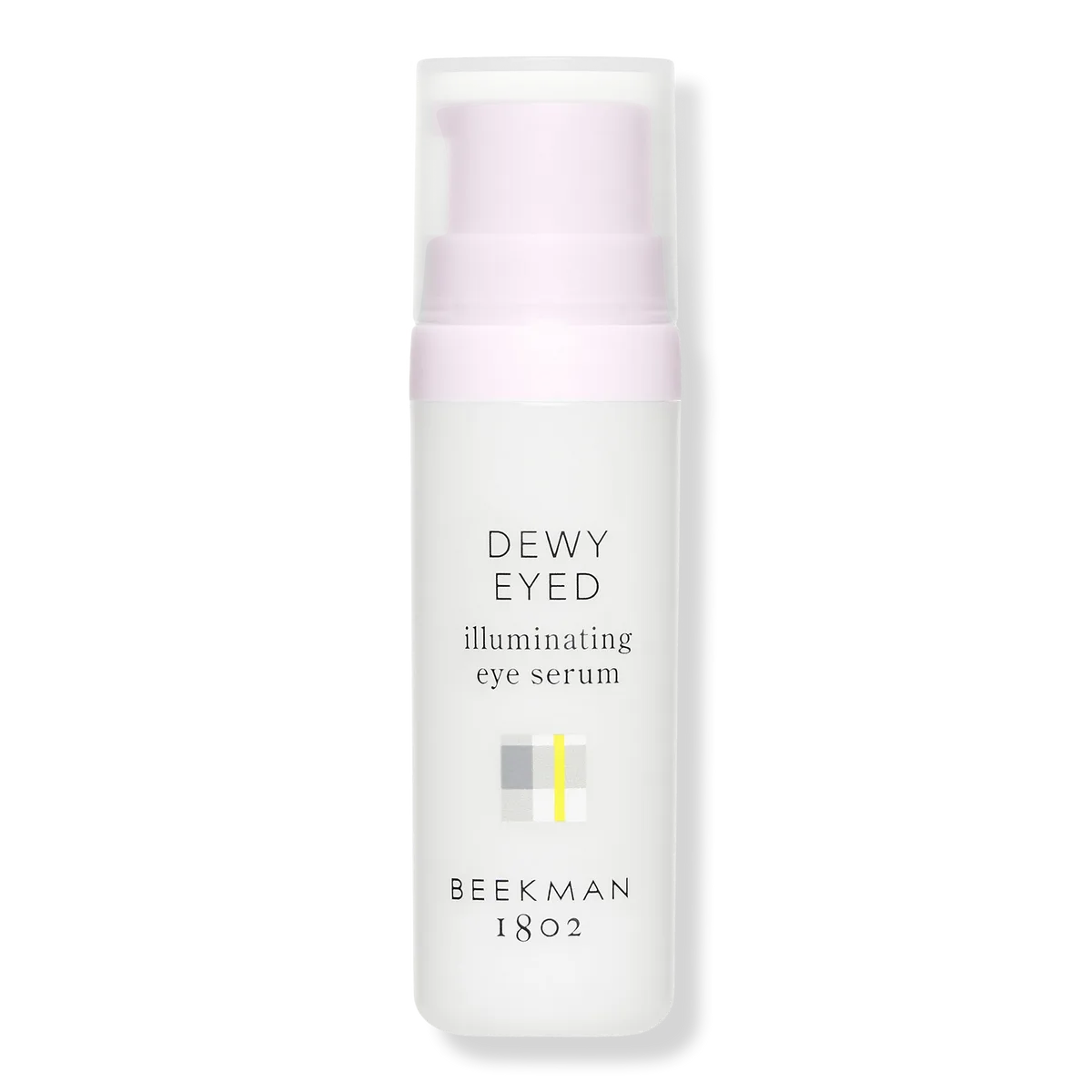
Dewy Eyed Illuminating & Depuffing Eye Serum
Sensitive-Skin Eye Serum
 Verified reviewer
Pros & cons.
- +Persian silk tree extract is an underused depuffing active with growing clinical evidence
- +Coherent microbiome story with goat milk, colostrum, Bifida lysate, and darutoside
- +Fragrance-free formula safe for sensitive eyes and contact lens wearers
- +Gentle preservation system aligned with the microbiome positioning
- +Pregnancy-compatible with no flagged actives
- +Lightweight, fast-absorbing texture that layers cleanly under makeup
- +Three-year track record with substantial user feedback
- −$44 for 15 ml is mid-range but not a bargain
- −Depuffing effect is subtle compared to caffeine-and-rollerball products
- −Dropper applicator can be imprecise for such a small product
- −Milk-derived ingredients rule it out for vegan users
- −Faint natural dairy/honey aroma may surprise users expecting odorless serum
The full review.
Skincare stores stock dozens of depuffing eye serums using the same formula: caffeine, a cold metal rollerball, and a few peptides. This mechanism works—caffeine constricts surface vessels to reduce overnight fluid pooling—but the category is repetitive. Beekman 1802’s Dewy Eyed uses a different approach. It has no caffeine and no rollerball. The depuffing active is Albizia julibrissin — Persian silk tree bark extract — which uses a different chemistry than caffeine.
This is worth noting. Cosmetic chemistry literature shows Persian silk tree extract has two effects: it tightens periorbital skin surface to address puffiness and reduces glycation-related darkening to address the brown component of dark circles that caffeine misses. The mechanism is structural and biochemical, not vascular constriction. This makes Albizia complementary to caffeine rather than redundant, explaining why this product exists in a saturated category.
Beekman 1802 surrounds the silk tree extract with its signature dairy-derived microbiome approach. Goat milk is fifth on the INCI list—lower than the second position in the brand’s other serums, but still present. Colostrum sits above it, providing growth factors and immunoglobulins for barrier resilience. Below it is Bifida ferment lysate, a probiotic-derived ingredient used in luxury barrier serums for DNA repair and barrier reinforcement. Below that is darutoside, a plant-derived diterpenoid used for surface smoothing. This is a coherent dairy-and-ferment microbiome formula. Most eye serums ignore the microbiome or lack three to four ingredients working together like this.
The rest of the formula supports the actives. Sodium hyaluronate provides hydration. Cucumber, aloe, chamomile, blue thistle, and comfrey soothe the skin. Honey adds humectant properties and trace antioxidants. The preservation system—sodium levulinate, sodium anisate, sodium benzoate, and potassium sorbate—is gentle and avoids the parabens and phenoxyethanol that would conflict with Beekman 1802’s microbiome positioning. The texture is a lightweight gel-serum with a slick water-based slip. It absorbs in about thirty seconds, does not pill under makeup, and feels cooling without a metal applicator.
The formula is fragrance-free. Most Beekman 1802 eye products contain light fragrance, but the periorbital area often reacts to fragrance with contact dermatitis. By omitting fragrance from Dewy Eyed, the brand makes it usable for sensitive users. The actives create a faint natural dairy-honey aroma, but there is no added perfume.
The caveats are brief. Fifteen milliliters at $44 is mid-range; you pay for ingredient complexity rather than a bargain. The depuffing effect is real but subtle. It delivers consistent results over weeks instead of instant theater. The dropper applicator works but is imprecise for this small bottle. Milk-derived ingredients mean this is not for vegan users.
Buy Dewy Eyed if you have sensitive eyes that react to fragrance, want a depuffing mechanism other than caffeine, or like the Beekman 1802 microbiome approach. Skip it if you want immediate dramatic depuffing, if the price-to-volume ratio is too high, or if you avoid animal-derived ingredients.
Ingredient analysis.
Full INCI list
Water (Aqua), Glycerin, Propanediol, Hydroxyethylcellulose, Caprae Lac (Goat Milk), Colostrum, Bifida Ferment Lysate, Lactose, Milk Protein, Sodium Hyaluronate, Darutoside, Cucumis Sativus (Cucumber) Fruit Extract, Aloe Barbadensis Leaf Juice, Chamomilla Recutita (Matricaria) Flower Extract, Eryngium Alpinum (Blue Thistle) Flower Extract, Albizia Julibrissin (Silk Tree) Bark Extract, Honey, Linum Usitatissimum (Flax) Seed Extract, Symphytum Officinale (Comfrey) Leaf Extract, Whey Protein, Sodium Levulinate, Sodium Anisate, Citric Acid, Panthenol, Sodium Phytate, C10-18 Triglycerides, Lecithin, Potassium Sorbate, Sodium Benzoate
Skin match.
The science.
The Science
Dewy Eyed uses more than just typical caffeine-based depuffing ingredients. Albizia julibrissin (Persian silk tree) bark extract shows two parallel effects on the eye area: structural tightening of the periorbital skin and inhibition of glycation, the chemical process where sugars bind to skin proteins to cause yellow-brown discoloration. Cosmetic chemistry literature on Albizia julibrissin is smaller than the work on caffeine, but published studies show measurable eye-area firmness improvements and reduced glycation markers over 4-8 week use periods at typical cosmetic concentrations. Bifida ferment lysate has more evidence—it is the active in several luxury repair products and studies show its effects on DNA repair after UV stress and barrier function in compromised skin. Goat milk and colostrum are emerging. Beekman presented in-house research at dermatology conferences showing goat milk influences cutaneous microbial diversity, and skin microbiome literature has grown substantially over the last decade. Colostrum contains documented growth factors and immunoglobulins; topical application's systemic effects are debated, but its barrier-supportive effects are well documented. Darutoside, a plant-derived diterpenoid, has smoothed skin surfaces in eye products for years and has in vitro work supporting collagen synthesis. Sodium hyaluronate has a robust evidence base for eye-area hydration. This formulation uses a multi-mechanism approach: Albizia provides surface tightening and glycation reduction, Bifida ferment lysate reduces glycation, goat milk and colostrum support the barrier, sodium hyaluronate hydrates, and darutoside smooths the surface—none of which overlap with the caffeine-based approach of most depuffing serums.
Dermatologist Perspective
Dermatologists note the under-eye area is a common site for fragrance-related contact dermatitis, so they often recommend fragrance-free eye products like this one to sensitive patients. Board-certified dermatologists recognize Albizia julibrissin as a less common but legitimate depuffing active with evidence for skin tightening and glycation reduction—it has less study than caffeine but has backing. Dermatology opinion divides on the microbiome: some practitioners favor the growing evidence for Bifida ferment lysate and similar probiotic-derived ingredients, while others wait for larger controlled trials. The main caveat dermatologists raise applies to all topical eye products: no serum addresses structural under-eye issues like fat pad herniation or deep hollows from bone resorption—those require in-office procedures.
Where it fits in your routine.
Apply 1 small drop per eye, morning and/or night, after cleansing and water-based serums but before moisturizer. Pat gently along the orbital bone from the inner to outer corner — avoid the lash line and waterline. Let absorb for thirty to sixty seconds before applying concealer, eye cream, or other products. The lightweight water-based gel causes a normal cooling sensation. In the AM, it layers cleanly under concealer; in the PM, use a richer eye cream or a retinol eye product after it. Store the dropper bottle upright.
At $44 for 15 ml — or $35 on Ulta sale — Dewy Eyed is a mid-range treatment eye product. Using it twice daily on both eyes lasts three to four months, costing roughly $11-$15 per month at full price. Value depends on your current routine: upgrading from a fragranced eye serum that fails your sensitive skin makes this worth it. Comparing it to a $15 caffeine eye serum from a drugstore brand makes the math harder. A 0.16 oz travel size exists but lacks better per-ml value — it is for testing the product first. Beekman's three-year track record on this specific product, the unusual ingredient choices, and the sensitive-skin-friendly formulation justify the price better than a typical premium-tier eye serum.
Buyers with sensitive eyes that react to typical fragranced eye serums, people seeking a depuffing product that uses a different mechanism than caffeine, and existing fans of Beekman's microbiome-forward formulations who want a real eye-area option from the brand.
Skip if you want dramatic immediate depuffing (a caffeine eye serum with a cold metal rollerball will be faster), if you avoid animal-derived ingredients on principle, or if the price-to-volume math at 15 ml doesn't work for your budget.
Product details.
Lightweight gel-serum has a slick water-based slip and absorbs in about thirty seconds
The backstory.
Beekman 1802 launched the Dewy Eyed line in 2021 to give microbiome-focused users a real eye-area option built on the brand's core research platform. The product became one of the line's bestsellers and earned a microbiome-friendly certification. Beekman uses honey and milk-derived ingredients across the line, reflecting the founders' commitment to small-batch, farm-derived ingredient sourcing.
About Beekman 1802
Established Brand (5–20 years)Beekman 1802 launched in 2008 from a Sharon Springs, NY goat farm and has built a microbiome-focused skincare line with several National Eczema Association seals and published in-house research on goat milk's effect on the skin microbiome.
Common myths.
Depuffing eye serums need caffeine to work
Caffeine is the most common depuffing active because it is cheap and well-known. However, Albizia julibrissin (Persian silk tree) has growing clinical evidence for depuffing and dark-circle improvement. It works through different mechanisms: vasoconstriction, glycation reduction, and skin tightening.
Goat milk in skincare is a marketing gimmick
Beekman's research, presented at dermatology conferences, shows goat milk affects cutaneous microbial diversity. The evidence is early but exists, so we call it an emerging active instead of a fully established one.
FAQ.
Does this actually depuff morning eye bags?
For fluid-related puffiness, yes — silk tree extract and the cooling water-based gel reduce puffiness in minutes for most users. No topical serum addresses fat pad herniation (permanent under-eye bags).
Is this eye serum pregnancy-safe?
Yes. The active roster — Persian silk tree extract, goat milk, Bifida ferment lysate, hyaluronic acid, panthenol — is pregnancy-compatible. There's no retinol, salicylic acid, or essential oils, and it's fragrance-free.
How does this compare to caffeine eye serums?
Caffeine-based eye serums work via vasoconstriction, which is fast but temporary. This serum uses Persian silk tree extract to target fluid-related puffiness and glycation-related darkening that caffeine doesn't address. The mechanisms differ, but the results complement each other.
Is it safe for sensitive eyes and contact lens wearers?
Yes. This fragrance-free, gentle formulation is one of the safest depuffing eye serums for sensitive users. Apply it along the orbital bone and let it absorb fully before inserting contact lenses.
Can I use this with a retinol eye cream?
Yes. Apply this serum first, let it absorb, then layer your retinol eye cream on top. The peptides and ferments in this formula buffer retinol irritation in the delicate eye area.
Does the dropper give consistent dosing?
The glass dropper gives about 0.5 ml per full pump. This covers both eyes; most users use only a quarter to half dropper. Some users find the dropper imprecise for this small product.
How long does the 15 ml bottle last?
Two small drops per eye twice daily lasts most users three to four months. This costs roughly $11-$15 per month, a mid-range price for treatment eye products.
Community
What the community says.
"Users consistently praise the gentle, fragrance-free formula"
"Visible reduction in morning puffiness"
"Lightweight texture that doesn't pill"
"Suitable for sensitive eyes"
"Price feels steep for 15 ml"
"Depuffing effect is subtle for some users"
"Slow visible results on dark circles"
"Dropper applicator can be messy"
People also looked at.