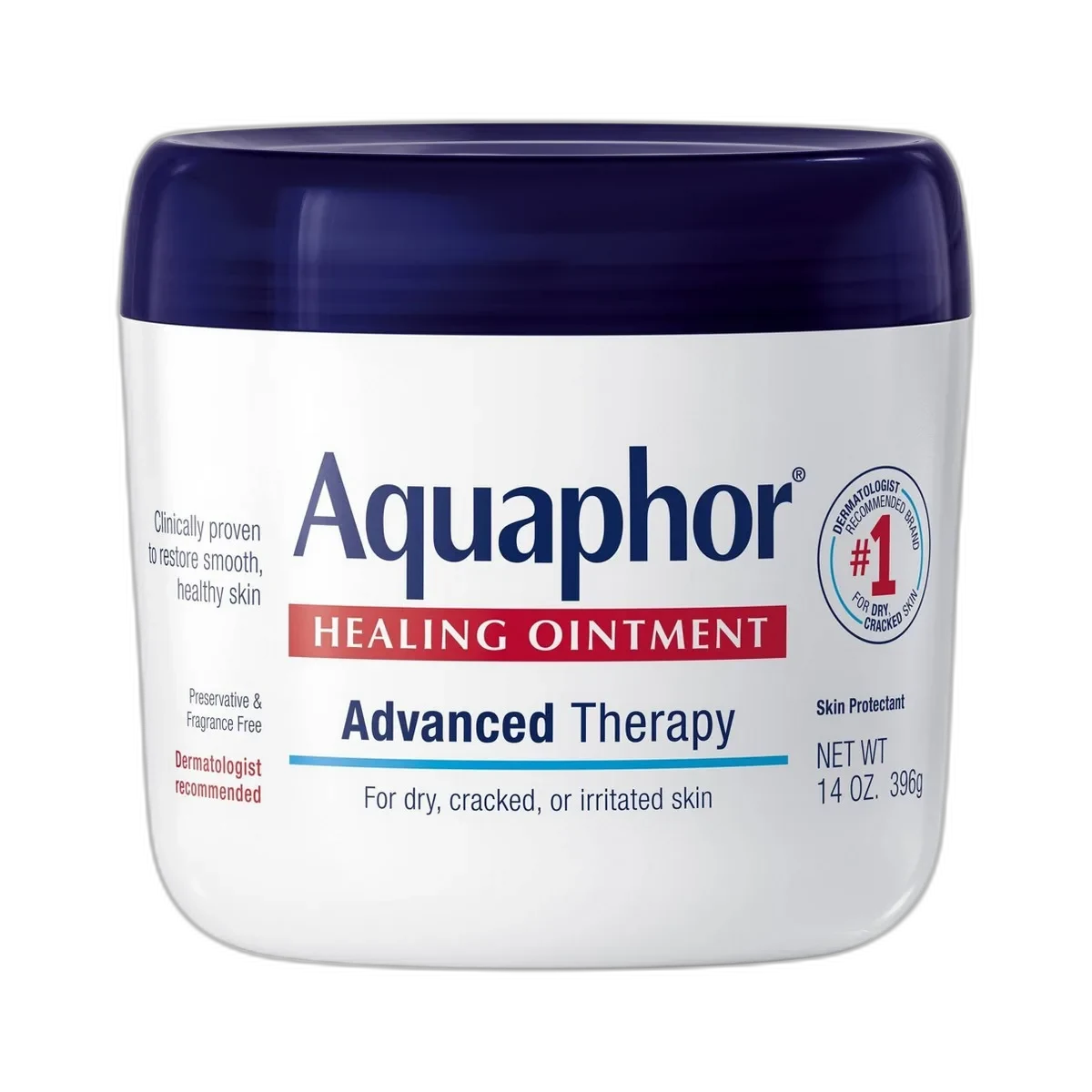
Healing Ointment
Derm Office Holy Grail
 Verified reviewer
Pros & cons.
- +Seven-ingredient formula where every component serves a specific dermatological purpose
- +Petrolatum reduces transepidermal water loss more effectively than any other topical ingredient
- +Panthenol and glycerin add genuine hydration and healing that pure petroleum jelly lacks
- +National Eczema Association Seal, Good Housekeeping Seal, and FDA OTC drug registration
- +Extraordinary value — a fourteen-ounce jar under twenty dollars lasts months of daily use
- +Unmatched versatility: lips, hands, feet, post-procedure, tattoo aftercare, eczema, slugging
- +A century of dermatological trust and over 55,000 consumer reviews averaging 4.8 stars
- −Greasy, heavy texture does not absorb — impractical for daytime facial use
- −Contains lanolin alcohol, a known allergen for approximately 1-2% of the population
- −Not vegan (lanolin is animal-derived) and not cruelty-free certified
- −Can stain pillowcases, fabrics, and clothing when used on the face at night
- −Too occlusive for oily skin — may trap sebum and worsen congestion in some users
The full review.
There are products in skincare that require explanation. You need to understand the peptide technology, the vitamin C derivative, the encapsulation system. And then there’s Aquaphor, which requires exactly one sentence: it puts a seal on your skin so moisture stays in and everything else stays out.
That simplicity is not a limitation. It’s the entire point. Aquaphor Healing Ointment contains seven ingredients. Seven. In a jar. No fragrance, no preservatives, no dyes, no silicones, no trendy botanicals. Just petrolatum, mineral oil, ceresin wax, lanolin alcohol, panthenol, glycerin, and bisabolol. It reads less like an ingredient list and more like a dermatology textbook’s definition of what a healing ointment should contain.
The history matters for context. Aquaphor was developed in 1925 by Beiersdorf’s U.S. laboratories — the same company behind Eucerin and NIVEA. For its first fifty-seven years, it was sold exclusively to medical professionals. Doctors, hospitals, and pharmacies. The first five-pound containers went to burn units and dermatology offices, not Sephora shelves. Consumer availability didn’t happen until 1982, and the current Advanced Therapy formulation — the one you can buy at Target today — was introduced in 1991. This product has been earning the trust of dermatologists longer than most skincare brands have existed.
About Aquaphor
The active ingredient is petrolatum at 41%. This is an FDA-registered OTC skin protectant, not a cosmetic claim. Petrolatum is the most effective occlusive ingredient ever studied — research demonstrates that it reduces transepidermal water loss by up to 99%, outperforming every cream, lotion, and gel moisturizer on the market. At 41%, Aquaphor delivers serious occlusive power while leaving room for functional inactive ingredients that petroleum jelly alone cannot provide.
Myth
This is the critical distinction between Aquaphor and Vaseline that the internet endlessly debates. Vaseline is 100% petrolatum — a pure seal with no additional activity. Aquaphor adds panthenol (provitamin B5), which is a humectant that pulls moisture into the stratum corneum and actively supports cellular repair. It adds glycerin, the most studied humectant in dermatology. And it adds bisabolol, a chamomile-derived anti-inflammatory that calms irritated, compromised skin. These four ingredients — petrolatum sealing, panthenol healing, glycerin hydrating, bisabolol soothing — create a system that’s greater than the sum of its parts.
Texture
The texture is exactly what you’d expect from an ointment and nothing like what you’d want from a daytime moisturizer. Thick, translucent, waxy, and unapologetically greasy. It melts on contact with warm skin and spreads more easily than you’d think, but it does not absorb. It sits there, forming a visible glossy barrier, which is precisely its job. If you’re using this on your face, it’s a nighttime-only proposition. Accept the greasy pillowcase. Your skin will thank you by morning.
How to Use
The “slugging” trend brought Aquaphor back into mainstream skincare conversation, but dermatologists have been recommending it for decades. Apply a thin layer as the final step in your nighttime routine — over hyaluronic acid, over ceramide cream, over whatever your skin needs — and the petrolatum seal locks everything in. The result is skin that wakes up softer, plumper, and more hydrated than any overnight mask has managed. It’s not glamorous. It works.
Works for
Beyond facial slugging, Aquaphor’s versatility is legendary. Cracked heels, chapped lips, dry cuticles, minor cuts, diaper rash, tattoo aftercare, post-procedure healing, eczema flares, winter-cracked hands. The National Eczema Association gave it their Seal of Acceptance. Good Housekeeping has maintained its seal since 2013. It’s HSA/FSA eligible. A fourteen-ounce jar costs under twenty dollars and lasts months. The value proposition is almost embarrassingly good.
Conflicts With
The lanolin alcohol question deserves a direct answer. Lanolin is derived from sheep’s wool and is one of the more common contact allergens — it appears on standard dermatology patch test trays. For the roughly 1-2% of people with lanolin sensitivity, Aquaphor is not an option. For everyone else, a clinical study of 499 subjects showed zero allergic contact dermatitis reactions with Aquaphor’s purified lanolin alcohol. The risk is real but small, and it means the product is neither vegan nor suitable for those with wool allergies.
Not ideal for
The cruelty-free status is similarly straightforward: Beiersdorf, the parent company, allows animal testing where required by law for market access. Aquaphor is not Leaping Bunny or PETA certified. For consumers who prioritize cruelty-free certification, this is a dealbreaker, and alternatives exist.
Reality
What Aquaphor represents, fundamentally, is the argument that skincare doesn’t need to be complicated to be effective. A hundred years of dermatological evidence supports petrolatum-based barrier protection. The additions of panthenol, glycerin, and bisabolol are thoughtful and purposeful, not decorative. Every ingredient in this formula has a clear job, and no ingredient is included for marketing reasons.
In a market where moisturizers routinely contain fifty ingredients, twelve peptides, and a story about a remote mountain spring, Aquaphor sits quietly in its blue-and-white jar, doing exactly what it’s always done. Sealing skin. Supporting healing. Seven ingredients. A century of proof.
Ingredient analysis.
Full INCI list
Active Ingredient: Petrolatum 41% (Skin Protectant). Inactive Ingredients: Mineral Oil, Ceresin, Lanolin Alcohol, Panthenol, Glycerin, Bisabolol
Skin match.
The science.
The Science
Petrolatum is the most validated occlusive agent in dermatological research. A 1992 study by Ghadially et al. in the Journal of Clinical Investigation shows that petrolatum-based formulations speed barrier recovery after induced damage. It provides an external lipid source so the stratum corneum repairs without losing moisture. Unlike inert occlusives, petrolatum permeates the intercellular lipid domains of the stratum corneum to help restore the barrier instead of just sitting on the surface.
Panthenol (provitamin B5) converts to pantothenic acid in the skin. This acts as a precursor to coenzyme A, which is essential for fatty acid synthesis and cellular energy metabolism. A 2017 review by Proksch et al. in the Journal of Dermatological Treatment confirms topical panthenol improves stratum corneum hydration, reduces transepidermal water loss, and speeds epidermal wound healing. In this formula, panthenol provides active healing support that pure petrolatum lacks.
Bisabolol (alpha-bisabolol) comes from chamomile and has anti-inflammatory effects by inhibiting cyclooxygenase and 5-lipoxygenase pathways. Its presence in Aquaphor matters for compromised or eczematous skin where inflammation follows barrier damage.
A clinical study in the Journal of Drugs in Dermatology addressed the lanolin alcohol concern. It found zero cases of allergic contact dermatitis in 499 subjects using this specific Aquaphor formulation. The study linked allergenicity to impurities in lower-grade lanolin rather than the lanolin alcohol molecule, citing the high purity of the lanolin alcohol used here.
References
- Effects of petrolatum on stratum corneum structure and function — Journal of the American Academy of Dermatology (1992)
- Topical use of dexpanthenol in skin disorders — Journal of Dermatological Treatment (2017)
Dermatologist Perspective
Aquaphor is unique in dermatology: it is both the simplest and most universally recommended product in many dermatologists' arsenals. Board-certified dermatologists recommend Aquaphor for post-procedural care (after laser treatments, chemical peels, and microneedling), for eczema management via soak-and-seal therapy, and as the occlusive step in barrier-repair regimens. Dermatologists note that adding panthenol and glycerin to the petrolatum base makes Aquaphor more effective than petroleum jelly for healing. The one consistent caveat dermatologists raise is lanolin sensitivity; they recommend patch testing for patients with known contact dermatitis histories before widespread use.
Where it fits in your routine.
For facial slugging: After your complete nighttime routine (cleanser, serums, moisturizer), apply a thin, even layer of Aquaphor as the final step. A pea-sized amount covers the full face. For targeted use: Apply directly to dry patches, cracked lips, cuticles, or rough skin as needed throughout the day. For post-procedure care: Apply a thin layer to treated areas as directed by your dermatologist. For eczema: Apply generously over affected areas after bathing while skin is still slightly damp to seal in moisture.
At $18.39 for a 14-ounce jar ($1.31 per ounce), Aquaphor offers high value. The product lasts 4-6 months with nightly facial use and longer when used on targeted areas. Smaller tube formats (1.75 oz at $6.29) are portable but cost more per ounce. HSA/FSA eligibility lowers the effective price. As a legacy pharmacy brand backed by Beiersdorf's century of dermatological research, the price reflects value rather than brand positioning. No other skincare product offers a better value proposition.
This works for anyone with dry, compromised, or irritated skin needing the most effective occlusive barrier at any price. It is essential for eczema sufferers, post-procedure patients, retinol users experiencing dryness, winter skin warriors, and anyone wanting to try slugging with the product dermatologists actually recommend for it.
Avoid this product if you have a lanolin allergy or wool sensitivity. People seeking vegan and cruelty-free certification should choose other options. The occlusive texture is too heavy for full-face use on very oily or acne-prone skin, but you can apply it to dry patches.
Product details.
Thick, semi-solid, translucent ointment with a waxy texture that melts on warm skin. It is heavier than a cream but lighter and more spreadable than pure petroleum jelly. It does not absorb; it forms a visible protective film.
Unscented. Most users do not notice the faint inherent petrolatum base scent. It has no added fragrance.
The 14 oz size uses a wide-mouth screw-top plastic jar with Aquaphor's blue and white branding. Squeeze tubes (1.75 oz, 3.5 oz, 7 oz) with flip-top caps and travel-size tubes (0.35 oz, 2-pack) are also available. The jar has the Good Housekeeping Seal and NEA Seal of Acceptance.
The ointment feels thick and greasy on first application — this is intentional. It forms an immediate, visible occlusive seal over the skin. Dry, tight skin feels relieved within minutes. The texture takes time to learn; this is not a disappearing moisturizer. For nighttime slugging, apply a thin layer and expect a glossy face. By morning, the skin underneath feels much softer and more hydrated.
4-6 months with nightly facial use (14 oz jar); lasts much longer if used only on targeted areas
24 months
fall winter
The backstory.
Aquaphor was born in 1925 in the U.S. laboratories of Beiersdorf, originally sold in five-pound containers to doctors and pharmacists. For its first fifty-seven years, it was a professional-only product — the ointment dermatologists kept in their offices and hospitals stocked in their burn units. Consumer availability didn't begin until 1982, and the current Advanced Therapy formulation launched in 1991. A century later, it remains essentially the same concept: petrolatum made smarter with a handful of functional additions.
About Aquaphor
Legacy Brand (20+ years)Beiersdorf Inc. (parent company of Eucerin and NIVEA, headquartered in Hamburg, Germany) developed Aquaphor in 1925 in U.S. laboratories. Beiersdorf Inc. introduced the current Advanced Therapy formulation in 1991. Aquaphor has the National Eczema Association Seal of Acceptance and the Good Housekeeping Seal. It is the number-one dermatologist-recommended brand for dry, cracked skin. Dermatological literature from the last century references its petrolatum-based formulations.
Common myths.
Petroleum jelly and Aquaphor are the same thing.
Pure petroleum jelly (Vaseline) contains 100% petrolatum. Aquaphor uses 41% petrolatum mixed with panthenol, glycerin, bisabolol, and other ingredients to add humectant, healing, and anti-inflammatory properties. Aquaphor hydrates; pure petroleum jelly only seals.
Petrolatum-based products clog pores and cause acne.
Cosmetic-grade petrolatum is clinically non-comedogenic. Dermatological tests confirm Aquaphor is non-comedogenic. The thick texture may trap sebum in already-oily skin, but the ingredient does not block pores. Dermatologists routinely recommend Aquaphor for compromised skin, including acne patients on drying medications.
Aquaphor is too heavy to use on the face.
Dermatologists often recommend Aquaphor for the face — as a lip treatment, a post-procedure protectant, and the final step in 'slugging' routines. Use a thin layer instead of a thick coat, and use Aquaphor on the face mostly at night.
FAQ.
What is the difference between Aquaphor and Vaseline?
Vaseline is 100% petrolatum, a pure occlusive with no other active ingredients. Aquaphor contains 41% petrolatum plus panthenol (vitamin B5), glycerin, and bisabolol to add humectant hydration, wound-healing support, and anti-inflammatory properties. Aquaphor hydrates and soothes; Vaseline only seals.
Can I use Aquaphor on my face for slugging?
Yes. Aquaphor is a top dermatologist-recommended product for facial slugging — applying a thin occlusive layer as the final step in your nighttime routine. Apply it over a hydrating serum and moisturizer on damp skin. Use a thin layer at night; the glossy finish is impractical during the day.
Is Aquaphor safe for eczema?
Yes. Aquaphor has the National Eczema Association Seal of Acceptance and dermatologists widely recommend it for eczema management. Its occlusive barrier reduces transepidermal water loss and protects compromised skin, while panthenol and bisabolol support healing and reduce inflammation.
Does Aquaphor clog pores?
Aquaphor is clinically tested and non-comedogenic. Cosmetic-grade petrolatum does not clog pores. But a heavy occlusive layer traps existing sebum in very oily skin. If you are acne-prone, use Aquaphor on targeted dry areas instead of full-face application.
Can I use Aquaphor over retinol?
Use caution. Applying an occlusive like Aquaphor over retinol traps the active ingredient against the skin, increasing both its effects and irritation. Dermatologists sometimes recommend applying Aquaphor around the eyes, nose, and mouth before retinol to protect sensitive areas, but layering it over retinol-treated skin causes more peeling and redness.
Is Aquaphor safe during pregnancy?
Yes. The seven-ingredient formula has no retinoids, salicylic acid, or other ingredients flagged during pregnancy. People use Aquaphor during pregnancy for dry skin, cracked nipples during breastfeeding, and general skin protection.
Is Aquaphor vegan and cruelty-free?
No on both counts. Aquaphor contains lanolin alcohol (derived from sheep's wool), so it is not vegan. The parent company Beiersdorf allows animal testing where law requires it for market access; the brand lacks cruelty-free certification.
What the community says.
"Heals cracked, dry, chapped skin within 24-48 hours of first application"
"Incredibly versatile — lips, hands, feet, cuticles, minor cuts, tattoo aftercare"
"A little goes a very long way, making even the large jar extremely economical"
"Fragrance-free and gentle enough for sensitive skin, babies, and post-procedure care"
"The gold standard occlusive for nighttime 'slugging' in skincare routines"
"Greasy, heavy texture that sits on skin rather than absorbing"
"Too shiny and occlusive for daytime facial use in most situations"
"Contains lanolin alcohol, which can cause reactions in lanolin-sensitive individuals"
"Not vegan-friendly due to the lanolin-derived ingredient"
"Can stain pillowcases, fabrics, and clothing if not fully absorbed"