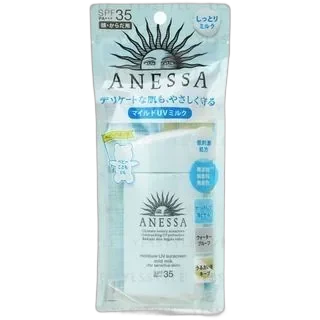
Moisture UV Sunscreen Mild Milk SPF 35
Sensitive Skin MVP
 Verified reviewer
Pros & cons.
- +Completely free of alcohol, fragrance, parabens, colorants, and mineral oils
- +Hybrid mineral-chemical filter system achieves broad-spectrum protection with minimal irritation risk
- +Lightweight milky texture sets to a natural matte finish without pilling
- +Removable with regular soap — no oil cleanser required for sensitive-skin routines
- +Sodium acetylated hyaluronate provides lasting hydration under the matte finish
- +Suitable for children and post-procedure skin recovery
- +Licorice root derivative adds anti-inflammatory calming to reactive skin
- −SPF 35 and lower filter concentrations may not suffice for intense prolonged sun exposure
- −60ml size at premium pricing means high cost per daily application
- −Less water-resistant than alcohol-containing Anessa variants
- −No treatment actives — purely protective, no brightening or anti-aging benefits
- −Can leave very slight white cast on deeper skin tones
The full review.
Every sunscreen brand has a flagship. Anessa’s is the Perfect UV Milk — a high-alcohol, high-SPF powerhouse that has led Japanese sunscreen sales for over two decades. But dominance has a blind spot. The features that make the Perfect UV Milk effective — its alcohol-driven quick-dry finish, its fragrance, and its aggressive water resistance — also drive away sensitive-skin types. The Moisture UV Mild Milk exists because Anessa addressed the consumers it was excluding.
The formula uses deliberate restraint. While the Perfect UV line uses dense filter concentrations, the Mild Milk uses modest amounts: zinc oxide at 3.85%, Tinosorb S at 1.5%, DHHB at 1.0%, and ethylhexyl triazone at 1.0%. Combined with titanium dioxide, this five-filter hybrid system reaches SPF 35 PA+++ — a rating sufficient for daily urban life that avoids the SPF 50+ ceiling, which requires higher filter loads and often causes irritation.
The ingredient list avoids common irritants. No denatured alcohol. No fragrance or essential oils. No parabens. No mineral oils. No colorants. The base uses emollients, humectants, and silicone polymers to deliver the product without irritation. For those who feel the sting of high-SPF sunscreen on irritated, eczema-prone, or recently treated skin, the absence of these ingredients is the entire point.
Texture
This is a fluid milk, not a cream or gel. It has a slightly watery consistency and spreads easily. The cyclopentasiloxane and caprylyl methicone base provides a silky, primer-like glide, while silica and hydrated silica create a natural matte finish that avoids uncomfortable dewiness under makeup. It sets within about sixty seconds and does not pill, even over serums or moisturizers — a common issue for gentler sunscreen formulas.
Works for
Glycerin and sodium acetylated hyaluronate provide hydration. The acetylated hyaluronate is a better option than standard hyaluronic acid here — its skin adhesion means moisture retention lasts while the matte-finish powders work. Dipotassium glycyrrhizate adds anti-inflammatory soothing from licorice root, creating a moisturizing and calming base for reactive skin.
How to Use
Regular soap removes this product easily. While most water-resistant sunscreens require an oil cleanser or micellar water — adding an extra irritation step for sensitive skin — the Mild Milk dissolves with gentle face wash. This is not an incidental convenience. For people whose skin flares from aggressive double-cleansing, it removes a daily friction point.
Best for
Performance is modest. This is not a sunscreen for a beach day or a marathon. It holds up during normal daily activity and light perspiration, but extended water exposure or heavy sweating will compromise the film. For commuting, office life, running errands, or protecting healing skin, it performs reliably. Those needing heavy-duty water resistance should use the Perfect UV line and accept the tradeoffs.
Common Complaints
The main concern is value. At roughly $28 for 60 milliliters, the cost per application is higher than many competing gentle sunscreens. The smaller bottle size requires frequent repurchasing for daily users. Whether the Anessa name and Shiseido’s formulation expertise justify the premium over pharmacy-brand alternatives depends on how much your skin has suffered from cheaper options.
Common Complaints
There is also a question of protection adequacy. Some independent reviewers noted that the UV filter concentrations are at the lower end of what is considered reliable, questioning if the SPF 35 rating holds up at real-world application amounts. This is a fair concern, though it applies to all sunscreens — protection depends on the amount you apply.
Best for
The Mild Milk fills a gap for sensitive, reactive, post-procedure, or dermatologically challenged skin. It is the sunscreen to use when everything else stings. It is not the most protective Anessa, nor the best value, but it earns the most gratitude from skin that needs the most care.
Ingredient analysis.
Full INCI list
Water, Diisopropyl Sebacate, Butylene Glycol, Cyclopentasiloxane, Caprylyl Methicone, Glycerin, Triethylhexanoin, Dipropylene Glycol, Zinc Oxide, Titanium Dioxide, Pentaerythrityl Tetraethylhexanoate, Silica, PEG-100 Hydrogenated Castor Oil, Bis-Ethylhexyloxyphenol Methoxyphenyl Triazine, Dextrin Palmitate/Ethylhexanoate, Isostearic Acid, Diethylamino Hydroxybenzoyl Hexyl Benzoate, Ethylhexyl Triazone, Hydrated Silica, Acrylamides/DMAPA Acrylates/Methoxy PEG Methacrylate Copolymer, Bis-Butyldimethicone Polyglyceryl-3, Phenoxyethanol, Aluminum Hydroxide, Dimethicone, Hydrogen Dimethicone, Succinoglycan, Dimethylacrylamide/Sodium Acryloyldimethyltaurate Crosspolymer, Citric Acid, Hydroxypropyl Methylcellulose Stearoxy Ether, Dextrin Palmitate, PEG/PPG-14/7 Dimethyl Ether, Stearic Acid, Sodium Citrate, Dipotassium Glycyrrhizate, Tocopherol, Sodium Acetylated Hyaluronate
Skin match.
The science.
The Science
The UV filter system in this product employs a conservative approach to broad-spectrum protection. Zinc oxide at 3.85% provides the broadest individual UV filter coverage available, absorbing across both UVA and UVB spectra. A 2016 study in the Journal of the American Academy of Dermatology confirmed that zinc oxide remains one of the safest and most stable UV filters for sensitive skin populations, with minimal photodegradation and low allergenic potential.
The chemical filter complement uses three next-generation organic filters: bis-ethylhexyloxyphenol methoxyphenyl triazine (Tinosorb S) at 1.5%, diethylamino hydroxybenzoyl hexyl benzoate (DHHB) at 1.0%, and ethylhexyl triazone at 1.0%. Research published in Photodermatology, Photoimmunology & Photomedicine has demonstrated that Tinosorb S functions as both a UV absorber and a photostabilizer for other filters in the formula, meaning its benefits extend beyond its own absorption capacity.
The deliberate use of lower filter concentrations reflects a dermatological principle: for sensitive skin, the irritation risk from high-concentration chemical filters can outweigh the marginal UV protection gained. A 2018 review in Contact Dermatitis documented that chemical UV filter sensitization, while uncommon, disproportionately affects those with existing skin barrier compromise — precisely the population this product targets.
Dipotassium glycyrrhizate contributes anti-inflammatory activity through inhibition of 11-beta-hydroxysteroid dehydrogenase, effectively enhancing cortisol activity at the skin surface. This mechanism has been documented in the International Journal of Cosmetic Science as providing measurable calming effects on UV-stressed skin.
References
- Safety and efficacy of zinc oxide in sunscreen formulations — Journal of the American Academy of Dermatology (2016)
- Chemical UV filter sensitization in compromised skin barriers — Contact Dermatitis (2018)
Dermatologist Perspective
Board-certified dermatologists frequently recommend alcohol-free, fragrance-free sunscreens for patients with rosacea, eczema, contact dermatitis, or post-procedure healing skin. Dermatologists note that SPF 35 PA+++ provides clinically meaningful protection for daily indoor-outdoor use, particularly when the alternative is a higher-SPF product that the patient avoids due to irritation. The gentle formulation is commonly suggested for pediatric use and for patients recovering from laser treatments, chemical peels, or retinoid-induced sensitivity, where skin barrier integrity is temporarily compromised.
Where it fits in your routine.
Shake well before use. Dispense a large amount (about a nickel-sized dollop for face) and spread it evenly over your face and neck as the last step in your morning skincare routine. The fluid texture spreads easily — pat gently instead of rubbing for even coverage. Reapply every 2-3 hours during sun exposure. Remove with regular soap or a gentle cleanser at the end of the day. No oil cleanser is needed.
At about $28 for 60ml, this costs more than most daily sunscreens, especially for an SPF 35 rating. One 60ml bottle lasts six to eight weeks if used daily on the face, costing roughly $3.50-4.50 per week. The price reflects Anessa's formulation and Shiseido's R&D in sensitive-skin-safe filter technology. If your skin cannot tolerate cheaper alternatives, this price avoids daily irritation. If your skin is resilient and you just want gentle products, cheaper fragrance-free options exist.
This works for sensitive, reactive, eczema-prone, or post-procedure skin needing daily sun protection without common irritants. It is also excellent for parents seeking a gentle, fragrance-free sunscreen safe for children, and for anyone who finds most sunscreens sting or burn on application.
People in direct sun, at the beach, or doing intense outdoor activity need higher SPF products with stronger water resistance. The milky texture lacks enough mattifying power for oily skin types.
Product details.
Unscented. No fragrance or essential oils.
Small plastic bottle with dispensing cap, 60ml. Compact and travel-friendly.
Applies smoothly with no stinging, tingling, or tightness — even on freshly irritated or post-procedure skin. The milk texture feels hydrating during application but sets to a comfortable matte finish within a minute. No adjustment period needed.
1. 5-2 months with daily face application
12 months
All Year
The backstory.
Anessa's Mild Milk line exists because even Japan's #1 sunscreen brand recognized that its flagship products — with their alcohol and fragrance — left sensitive-skin consumers behind. This formula was developed specifically to bring Anessa's UV protection expertise to those who need the gentlest possible formulation, including children and those with dermatological conditions.
About Anessa
Established Brand (5–20 years)Anessa launched in 1992 as Shiseido's sun care line. It has held the #1 sunscreen sales position in Japan for over two decades. The Mild Milk line uses Shiseido's dermatological research to provide sensitive-skin-safe sun protection.
Common myths.
SPF 35 does not protect skin enough from UV damage.
SPF 35 blocks about 97% of UVB rays, while SPF 50 blocks 98%. This difference is minimal for daily urban use. Consistent application and reapplication matter more, and this comfortable, non-irritating formula encourages those habits.
Alcohol-free sunscreens can't be water-resistant.
Silicone polymers and dextrin palmitate film-formers make this formula water resistant instead of alcohol. It lacks the extreme water resistance of alcohol-containing formulas, but works for everyday perspiration and light water contact.
FAQ.
Is the Anessa Moisture UV Mild Milk safe for sensitive or eczema-prone skin?
Yes — this is one of the gentlest sunscreens in the Anessa line. It lacks alcohol, fragrance, parabens, mineral oils, and colorants, and uses lower UV filter concentrations to reduce irritation risk. It works for sensitive skin types and children.
How to Use
Can this sunscreen be removed with regular soap?
Yes. Most water-resistant sunscreens require an oil cleanser to remove fully, but the Anessa Moisture UV Mild Milk washes off with regular soap or a gentle face wash. This reduces aggressive cleansing for sensitive skin.
Best for
Is SPF 35 enough for daily use?
SPF 35 PA+++ provides adequate protection for daily urban use with limited direct sun exposure, blocking about 97% of UVB rays. Use the Anessa Perfect UV SPF 50+ variants for extended outdoor activities, beach days, or intense sun.
Works for
Does this sunscreen leave a white cast?
The formula uses micronized zinc oxide and titanium dioxide with chemical filters to reduce white cast. Most users see a natural finish without visible residue, but those with deeper skin tones may see a slight cast that fades fast.
Pregnancy-safe
Is this sunscreen pregnancy-safe?
This formula avoids common pregnancy concerns. It contains no retinoids, high-concentration chemical actives, or fragrance. The mineral filters (zinc oxide, titanium dioxide) are safe during pregnancy. Always consult your OB-GYN for personalized guidance.
What the community says.
"Extremely gentle — no stinging or irritation on reactive skin"
"No alcohol or fragrance makes it safe for eczema-prone skin"
"Lightweight milky texture blends without white cast"
"Can be removed with regular soap"
"SPF 35 may not be sufficient for intense sun exposure"
"Smaller 60ml size means higher cost per use"
"Not as water-resistant as the SPF 50+ variants"
"UV filter concentrations are relatively low"
Featured in.
People also looked at.