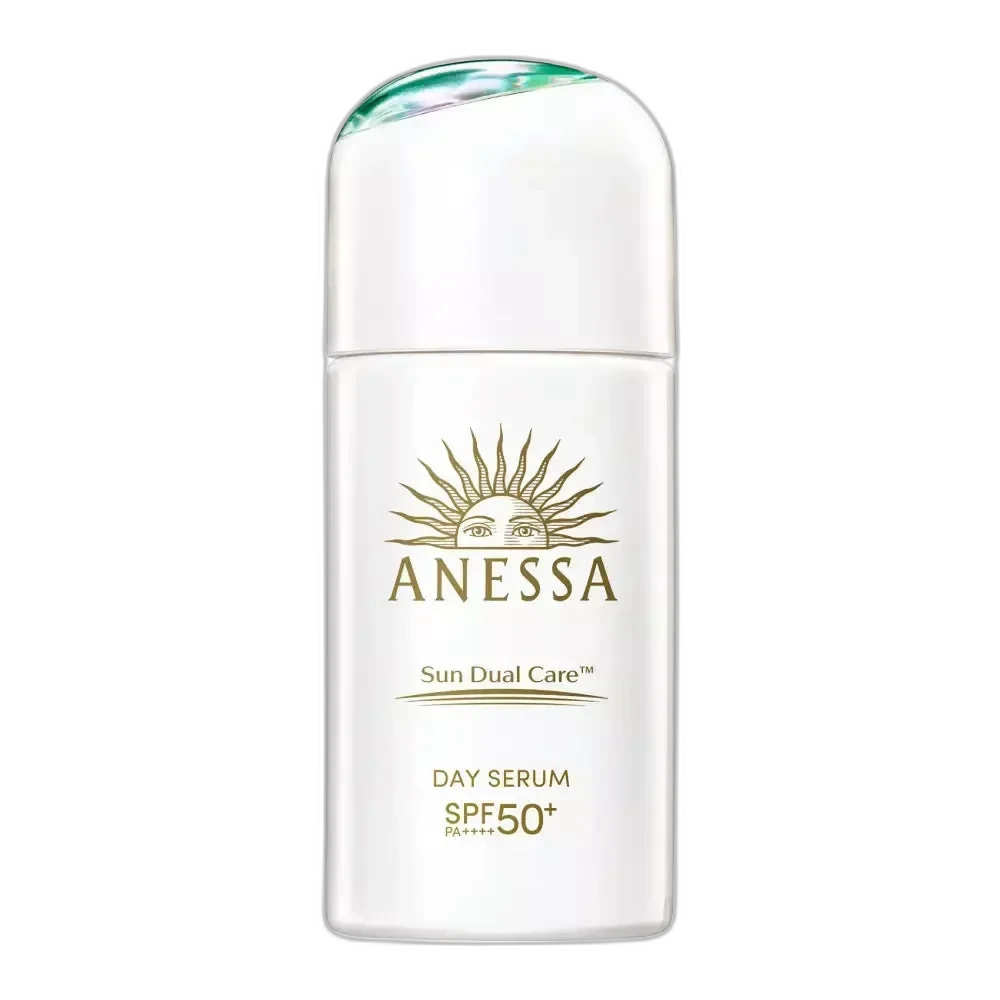
Day Serum Sunscreen SPF 50+
J-Beauty Innovation Pick
 Verified reviewer
Pros & cons.
- +Five-filter photostable UV system provides robust, long-lasting SPF 50+ PA++++ broad-spectrum protection
- +Elegant serum texture and dewy finish function as both sunscreen and lightweight illuminating primer
- +Zero white cast despite containing mineral UV filters (nano zinc oxide and titanium dioxide)
- +Genuine skincare actives including acetylated hyaluronate, spirulina, collagen, and licorice root
- +Backed by Shiseido's 150+ years of cosmetic R&D and Anessa's 30+ year sunscreen expertise
- +Subtle tone-up brightening effect makes skin look healthier without obvious product coverage
- −Contains fragrance and common fragrance allergens (citronellol, limonene, linalool)
- −Alcohol as fourth ingredient may not suit very dry or barrier-compromised skin
- −Small 30ml size at ~$38 makes it expensive for daily use at roughly $400-500 annually
- −Contains octinoxate, which is restricted in some locations due to coral reef concerns
- −Dimethicone-first formula may not appeal to those avoiding heavy silicone content
The full review.
There’s a reason Japanese sunscreens have developed a devoted following that crosses oceans and ignores language barriers. The cosmetic elegance — that ability to provide serious UV protection without feeling, looking, or behaving like sunscreen — represents a fundamentally different philosophy from the thick, white, mineral-heavy approach that dominated Western sun care for decades. Anessa, Shiseido’s dedicated sun care brand since 1992, has been at the forefront of this philosophy for over thirty years, and the Day Serum represents their most ambitious attempt to blur the line between sunscreen and skincare serum entirely.
The UV filter system is where the engineering shines brightest. Rather than relying on one or two filters at high concentrations, Anessa deploys five: ethylhexyl methoxycinnamate (octinoxate) for UVB, octocrylene for UVB stability, diethylamino hydroxybenzoyl hexyl benzoate (Tinosorb S) for broad-spectrum coverage and photostabilization, plus nano zinc oxide and titanium dioxide for mineral backup. This multi-filter approach is the gold standard of photoprotection engineering — each filter covers a different portion of the UV spectrum while photostabilizing the others, resulting in protection that lasts rather than degrading under the very light it’s supposed to block.
Timosorb S deserves special recognition here. It’s a broad-spectrum filter that absorbs both UVA and UVB while actively preventing the photodegradation of surrounding filters — particularly octinoxate, which is notoriously unstable on its own. The inclusion of Tinosorb S transforms the entire filter system from adequate to genuinely robust, which is part of why Anessa products test so well in real-world UV exposure studies.
The serum-sunscreen hybrid concept goes beyond marketing. The formula includes sodium acetylated hyaluronate — a modified hyaluronic acid that clings to skin more tenaciously than standard HA — providing sustained hydration underneath the silicone UV shield. Spirulina platensis extract brings potent antioxidant activity, though Anessa’s marketing claim that it converts UV rays into ‘beauty beams’ is more poetic license than hard science. What’s less debatable is that spirulina is rich in phycocyanin, a powerful antioxidant that neutralizes UV-generated free radicals before they can damage cellular structures. Dipotassium glycyrrhizate from licorice root provides anti-inflammatory and melanin-inhibiting activity — a practical inclusion in a sunscreen designed for brightening and tone-up effects.
On the skin, the Day Serum is immediately, almost disarmingly pleasant. The dimethicone-first base gives it a slip that’s pure skincare — it glides on without pulling, sets within a minute to a dewy, luminous finish, and produces zero white cast despite the mineral filter content. The mica adds a subtle, natural-looking radiance that functions as a tone-up effect — not a full-coverage tint, but a gentle brightening that makes skin look healthier and more even. It’s the kind of finish that makes people ask if you’re wearing anything at all.
Under makeup, it performs like a lightweight, illuminating primer. The smooth silicone base fills minor texture imperfections, the mica provides a luminous canvas, and the non-tacky finish gives foundation or tinted moisturizer something to grip without sliding. On bare-skin days, it provides enough cosmetic benefit to skip additional products entirely.
The limitations are specific and worth noting honestly. The fragrance is present — a light floral scent that most users find inoffensive but that automatically disqualifies the product for fragrance-sensitive individuals. Alcohol is the fourth ingredient, which aids in the lightweight, fast-drying application but can be problematic for very dry or barrier-compromised skin. And octinoxate, while an effective UVB filter, is banned in Hawaii and parts of the Caribbean for coral reef concerns — environmentally conscious swimmers should be aware.
The 30ml size at approximately $38 makes this one of the more expensive sunscreens on a per-ounce basis. With daily facial application at the recommended amount, a bottle lasts roughly four to six weeks — translating to an annual cost of $400-500 on sunscreen alone. That’s premium territory, though not unusual for Japanese facial sunscreens. The per-use value improves if you’re replacing both a sunscreen and a primer with this single product.
Anessa’s legacy as Japan’s bestselling sunscreen brand for over two decades isn’t built on marketing — it’s built on Shiseido’s R&D infrastructure, one of the largest in the cosmetics industry, and on formulations that consistently outperform in real-world wear testing. The Day Serum extends that heritage into the serum-sunscreen hybrid category with characteristic Japanese precision: every ingredient has a clear function, the filter system is photostable and comprehensive, and the finish is effortlessly elegant.
For those seeking a sunscreen that genuinely doubles as a skincare treatment and a makeup primer — and who don’t mind fragrance, alcohol, or a premium price for a small package — the Day Serum delivers on its ambitious positioning. It’s sunscreen reimagined as something you look forward to applying, and in the compliance-dependent world of UV protection, that’s more valuable than any single ingredient.
Formula
Ingredient analysis.
Full INCI list
Dimethicone, Water, Ethylhexyl Methoxycinnamate, Alcohol, Caprylyl Methicone, Diisopropyl Sebacate, Butylene Glycol, Octocrylene, Silica, Glycerin, Mica, Diethylamino Hydroxybenzoyl Hexyl Benzoate, Trifluoropropyldimethyl/Trimethylsiloxysilicate, PEG-9 Polydimethylsiloxyethyl Dimethicone, Dextrin Palmitate, Trehalose, Isododecane, PEG/PPG-14/7 Dimethyl Ether, Sorbitan Sesquiisostearate, Phytosteryl Macadamiate, PPG-17, Bis-Ethylhexyloxyphenol Methoxyphenyl Triazine, Disteardimonium Hectorite, Triisostearin, PEG-10 Dimethicone, Isostearic Acid, Aluminum Hydroxide, Stearic Acid, Triethoxycaprylylsilane, Fragrance, PEG/PPG-17/4 Dimethyl Ether, Trisodium EDTA, BHT, Tocopherol, Sodium Metabisulfite, Sodium Polyacrylate, Synthetic Fluorphlogopite, Talc, Sodium Citrate, Citric Acid, Dipotassium Glycyrrhizate, Camellia Sinensis Leaf Extract, Potentilla Erecta Root Extract, Triethoxysilylethyl Polydimethylsiloxyethyl Dimethicone, Hydrogen Dimethicone, Plankton Extract, Phenoxyethanol, Sodium Acetylated Hyaluronate, Rosa Roxburghii Fruit Extract, Spirulina Platensis Extract, Soluble Collagen, Citronellol, Limonene, Linalool, Zinc Oxide, Titanium Dioxide, CI 77491, CI 77891, CI 77947
Skin match.
The science.
The Science
The Day Serum uses modern multi-filter engineering for UV protection. The combination of ethylhexyl methoxycinnamate (UVB, peak absorption ~310 nm), octocrylene (UVB, ~303 nm, stabilizer), bis-ethylhexyloxyphenol methoxyphenyl triazine/Tinosorb S (UVA+UVB, broad absorption 310-340 nm), zinc oxide (broad-spectrum, physical), and titanium dioxide (primarily UVB, physical) creates overlapping coverage across the entire UV spectrum.
Tinosorb S is the keystone of this system. As a photostable broad-spectrum filter, it absorbs UV energy and dissipates it as heat without degrading. It also absorbs and re-emits energy from adjacent unstable filters—specifically octinoxate, which loses up to 50% of its photoprotective capacity within hours of UV exposure without stabilization. Studies in Photochemical and Photobiological Sciences show that Tinosorb S-containing formulations maintain their SPF rating longer than formulations without photostabilizers.
The skincare component uses sodium acetylated hyaluronate—a hyaluronic acid derivative where acetyl groups increase lipophilicity and skin adhesion compared to standard sodium hyaluronate. This modification lets the humectant stay on the skin surface despite the sunscreen's hydrophobic silicone matrix, providing hydration that standard HA cannot deliver in this formulation.
Spirulina platensis extract contains phycocyanin, a biliprotein with antioxidant and anti-inflammatory properties. While Anessa marketing describes UV energy "conversion," phycocyanin actually scavenges reactive oxygen species (specifically superoxide and hydroxyl radicals) produced by UV-induced photochemical reactions in the skin.
Dipotassium glycyrrhizate inhibits tyrosinase activity and blocks cyclooxygenase and lipoxygenase pathways, providing melanin-suppressive and anti-inflammatory effects. In a sunscreen, this dual activity addresses both UV-triggered pigmentation and UV-induced inflammation, moving the formula beyond pure UV filtration into photoprotective skincare.
Dermatologist Perspective
Dermatologists view Anessa as one of the most technically sophisticated sunscreen brands globally, supported by Shiseido's research infrastructure. Board-certified dermatologists note that the multi-filter approach with Tinosorb S photostabilization provides more reliable real-world UV protection than simpler formulations using one or two filters. Dermatologists treating hyperpigmentation and melasma value the PA++++ rating (the highest UVA protection grade under Japanese testing standards). However, dermatologists warn that the fragrance and alcohol content make this unsuitable for patients with rosacea, eczema, or severe sensitivity; for those patients, the Anessa Mild Milk is the recommended alternative.
Where it fits in your routine.
Apply a nickel-sized amount to your face and neck after moisturizer as the final morning step. Spread the serum evenly with fingertips; the texture glides without tugging. Wait 1-2 minutes for the product to set before applying makeup. Reapply every 2 hours during prolonged sun exposure. To remove it, use an oil-based cleanser or micellar water, then a gentle water-based cleanser.
At about $38 for 30ml, this costs more than most Japanese sunscreens. Daily facial use lasts 4-6 weeks per bottle, costing $400-500 annually. The price covers Shiseido's R&D, the multi-filter system, and the skincare ingredient complex. The per-use value increases if this replaces both a sunscreen and a primer. The small size matches Japanese facial sunscreen market norms but may frustrate Western consumers used to larger volumes. Value-conscious consumers can find cheaper Japanese sunscreens, but few match the Day Serum's filter sophistication and skincare integration.
People who want a sunscreen that works as both a skincare serum and makeup primer. J-beauty enthusiasts who value cosmetic elegance and sophisticated UV filter engineering. Normal to oily skin types seeking a lightweight, dewy, high-SPF option without white cast or greasiness.
The formula contains fragrance and alcohol, so avoid it if you are sensitive to either. Use it if you have very dry or barrier-compromised skin and need fragrance-free, alcohol-free sun protection. It suits budget-conscious consumers seeking daily sunscreen at a lower price point. It also works for those concerned about octinoxate's environmental impact on coral reefs.
Product details.
Lightweight, fluid serum with a silky slip from the dimethicone base. Spreads easily and sets into a dewy, slightly luminous finish. More serum-like than traditional sunscreen — feels like applying a skincare product rather than a sun protectant.
Light floral fragrance is pleasant but present. It dissipates within a few minutes of application. This is not for those who require fragrance-free products.
A 30ml bottle uses a pump dispenser. The sleek, minimal Japanese design is travel-friendly. This small size matches premium positioning and Asian facial sunscreen market norms.
The serum glides on smoothly with no white cast on first application. A subtle brightening/tone-up effect shows immediately; skin looks more luminous and even-toned. It does not sting or feel heavy. The finish is dewy but not shiny, settling into a natural glow within 1-2 minutes.
1-1.5 months with daily facial application
12 months
All Year
The backstory.
Anessa launched the Day Serum in 2023 as an evolution beyond traditional sunscreen — a product designed for consumers who wanted their sun protection to contribute positively to their skin rather than just sit on it. The Sun Dual Care technology, incorporating spirulina extract and advanced UV filter engineering, represents Shiseido's patent-backed attempt to transform sunscreen from a defensive product into an active skincare treatment. It's positioned as the premium, skincare-forward entry in Anessa's range.
About Anessa
Established Brand (5–20 years)Anessa launched in 1992 as Shiseido's sun care brand, using Shiseido's 150+ years of cosmetic science heritage (founded 1872). Anessa has been Japan's #1 sun care brand for over 20 years and sells in 13 Asian countries. The brand uses Shiseido's patented UV protection technologies and R&D.
Common myths.
Japanese sunscreens offer less protection than Western SPF 50 products.
Japanese sunscreens meet rigorous JCIA standards. Anessa's SPF 50+ PA++++ rating shows maximum UVB and UVA protection. This formula uses a multi-filter system—combining chemical and mineral filters with photostabilizers—to provide more comprehensive, longer-lasting protection than many single-filter Western sunscreens.
Alcohol in sunscreen always damages the skin barrier.
Denatured alcohol in sunscreens performs key formulation tasks: it allows lightweight application, fast drying, and dissolves UV filters for even distribution. This formula balances the alcohol content with hydrating ingredients like sodium acetylated hyaluronate, glycerin, and trehalose. The alcohol does not negate skincare benefits for most skin types, though it is not ideal for very dry or barrier-compromised skin.
FAQ.
Where can I buy Anessa Day Serum in the USA?
Anessa Day Serum sells at Target stores, Target.com, and Japanese beauty importers like Japanese Taste, Buy Me Japan, and Stylevana. The 30ml size costs between $36-40 USD. Anessa now targets the US market alongside its established Asian presence.
Does Anessa Day Serum leave a white cast?
No — the nano-sized particles and sophisticated silicone delivery system prevent a visible white cast, even with zinc oxide and titanium dioxide. The formula gives a subtle brightening/tone-up effect and a natural, dewy glow that works on many skin tones.
Can I use Anessa Day Serum as a primer under makeup?
Yes — the silicone-based formula with mica creates an excellent base for makeup. The smooth, non-tacky finish and subtle luminosity work similarly to a lightweight illuminating primer. Many users wear it alone on light-makeup days for a natural, protected, glowing look.
Is Anessa Day Serum good for oily skin?
Yes — the dimethicone and silica-based formula sets to a semi-matte, non-greasy finish that suits oily and combination skin. The lightweight serum texture adds no heaviness, and the silicone base controls shine all day. It is a top high-SPF option for oily skin types.
What is Sun Dual Care technology in Anessa products?
Sun Dual Care is Shiseido's patented method combining UV protection with active skincare. This technology uses spirulina extract and advanced UV engineering to protect skin while delivering hydrating, brightening, and antioxidant ingredients. Shiseido claims it converts some UV energy into beneficial effects, but the main value is the multi-filter UV protection paired with skincare actives.
Is Anessa Day Serum safe for sensitive skin?
This formula has fragrance, denatured alcohol, and chemical UV filters like octinoxate, which can irritate sensitive skin. For reactive, rosacea-prone, or eczema-prone skin, Anessa's Perfect UV Sunscreen Mild Milk (designed for sensitive skin) is a safer choice. The Day Serum works best for normal to oily skin types.
What the community says.
"Beautiful dewy, natural glow finish without looking greasy"
"Lightweight serum texture feels more like skincare than sunscreen"
"Excellent under makeup — works as a subtle tone-up primer"
"SPF 50+ PA++++ offers maximum broad-spectrum UV protection"
"Contains fragrance and alcohol, limiting suitability for sensitive skin"
"Small 30ml size at $38 makes it expensive per daily use"
"Dimethicone as first ingredient may not suit those avoiding silicones"
"Subtle pink tone-up effect may not suit all skin tones"
People also looked at.