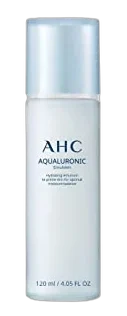
Aqualuronic Emulsion
K-Beauty Layering Essential
 Verified reviewer
Pros & cons.
- +Niacinamide at the fourth INCI position — exceptional for the price
- +Five-ceramide complex provides real barrier support
- +Lightweight emulsion absorbs instantly without residue
- +Perfect for K-beauty layering routines
- +Suits combination and oily skin in humid weather
- +120ml bottle lasts 3-4 months with twice-daily use
- −Added fragrance bothers fragrance-reactive users
- −Not cruelty-free due to mainland China distribution
- −Vinyl dimethicone makes it not fungal acne safe
- −Not enough alone for very dry skin in winter
The full review.
If you browse Korean skincare and wonder why brands sell both an ‘emulsion’ and a ‘cream’, the answer is simple: Western skincare mostly skipped the emulsion category. American routines usually go from toner to a cream moisturizer. Korean routines traditionally include an intermediate step—a lightweight, fast-absorbing watery lotion called an emulsion. It hydrates without weight, acting as a layer under a cream in winter or a standalone moisturizer in summer. This format works for humid climates and layered routines where heaviness matters. AHC Aqualuronic Emulsion executes this step well for the price.
The formula is structurally similar to the matching Aqualuronic Cream but uses a lighter texture and absorbs faster. Water leads, followed by propanediol, glycerin, and niacinamide at the fourth INCI position. This niacinamide position is higher than in the cream, suggesting a concentration in the 3-5% range. In an emulsion, the watery base maximizes ingredient spread and absorption. This niacinamide load provides effective barrier and tone benefits because the active distributes quickly and evenly across the skin.
The rest of the active stack carries over from the line. Three marine algae extracts—codium tomentosum, enteromorpha compressa, and undaria pinnatifida—sit high on the INCI and provide the polysaccharide-driven humectant activity behind the brand’s marine-hydration positioning. Sodium hyaluronate adds the named hyaluronic acid component for multi-weight water binding. The five-ceramide complex (NP, AS, AP, NS, EOP) plus cholesterol and phytosphingosine sits lower on the list but provides the same physiological barrier lipid support found in the cream. Centella triterpenes—madecassic acid, asiatic acid, and asiaticoside—complete the calming and tissue-supporting profile. This level of actives is unexpected at the $28 price point.
The practical experience makes this product useful. A small pump dispenses about half a teaspoon of cool, thin lotion that spreads instantly on damp skin and absorbs within seconds. There is no slip, no tackiness, no waiting period, and no residue. Skin feels immediately hydrated and slightly more luminous, but you cannot feel the product on your skin. For combination and oily skin types in summer or humid climates, this absorption profile is the main selling point. Most creams feel too heavy and most serums feel insufficient; an emulsion like this hits the middle ground.
Layering versatility proves the emulsion’s worth. In a minimalist summer routine for oily skin, this is your only moisturizing step—toner, serum, emulsion, sunscreen, done. In an elaborate winter routine, layer it under a richer cream for extra hydration without affecting the cream’s occlusion. In K-beauty layering culture, where seven or ten steps are common, the emulsion provides hydration without bulk. Western shoppers trying this format often find a missing step.
The limitations mirror those of the cream. Added fragrance—moderate but real—makes this emulsion a poor match for sensitive or fragrance-reactive skin. The brand is not cruelty-free because AHC sells in mainland China through retail channels that require animal testing for some categories. The silicone components (vinyl dimethicone) mean the product is not fungal-acne-safe for users dealing with malassezia. These are standard considerations for a mainstream K-beauty drugstore product designed for a large audience.
For very dry skin, the emulsion alone is not enough. Winter conditions or dehydrated skin need a richer cream on top, and the lightweight format may lack sufficient lipid load. AHC sells the matching cream for this purpose; the two products work together in cold weather or for drier skin types. If you choose only one, the cream is the more flexible single product. The emulsion is a smart add-on for layering or warm-weather hydration.
The value case is as strong as the rest of the Aqualuronic line. At $28 for 120ml, an emulsion with niacinamide at this concentration, a five-ceramide complex, three algae extracts, and centella triterpenes, AHC delivers more functional ingredient depth than nearly any product in this format at this price. Most affordable emulsions skimp on ceramides, list niacinamide at the bottom of the INCI, or rely on plain humectants without barrier support. AHC includes all of it for less than $30. For the right skin type and routine, it is one of the smartest affordable K-beauty purchases.
Ingredient analysis.
Full INCI list · pH 6
Water, Propanediol, Glycerin, Niacinamide, Pentylene Glycol, Cetyl Ethylhexanoate, 1,2-Hexanediol, Vinyl Dimethicone, Ethylhexyl Palmitate, Butylene Glycol, Codium Tomentosum Extract, Enteromorpha Compressa Extract, Undaria Pinnatifida Extract, Cetearyl Olivate, Sorbitan Olivate, Carbomer, Palmitic Acid, Tromethamine, Stearic Acid, Polyglyceryl-10 Oleate, Artemisia Princeps Leaf Extract, Parfum, Maris Aqua, Ethylhexylglycerin, Adenosine, Hydrogenated Lecithin, Disodium EDTA, Sodium Hyaluronate, Myristic Acid, Caprylic/Capric Triglyceride, Rosa Damascena Flower Water, Punica Granatum Fruit Extract, Lepidium Meyenii Root Extract, Butyrospermum Parkii Butter, Ceramide NP, Prunus Armeniaca Kernel Extract, Ceramide AS, Eucalyptus Globulus Leaf Extract, Ceramide AP, Cholesterol, Ceramide NS, Caprylhydroxamic Acid, Caprylyl Glycol, Madecassic Acid, Asiatic Acid, Phytosphingosine, Asiaticoside, Chenopodium Quinoa Seed Extract, Ceramide EOP
Skin match.
The science.
The Science
This emulsion hydrates using a multi-humectant approach, barrier lipid support, and active ingredient delivery. The humectant base — propanediol, glycerin, butylene glycol, sodium hyaluronate, and the marine algae polysaccharides — draws water into the upper skin layers. Published research shows multi-humectant formulations work better than single humectants because different humectants work at different humidity levels and depths.
Niacinamide is fourth on the INCI, suggesting a 3-5% concentration. This is the range where published research shows consistent benefits. At functional concentrations, niacinamide upregulates ceramide biosynthesis in keratinocytes, improves barrier function via transepidermal water loss (TEWL) measurements, reduces sebum production, refines pore appearance, and evens skin tone by interfering with melanosome transfer to keratinocytes. Niacinamide is a well-studied multifunctional active; this concentration turns the emulsion from a basic hydrator into a treatment-grade product.
The ceramide complex (NP, AS, AP, NS, EOP) plus cholesterol and phytosphingosine includes the full physiological barrier lipid family. Research shows physiological ratios of ceramides, cholesterol, and free fatty acids restore barrier function better than any single lipid class. While the lightweight format keeps the absolute concentration modest, this combination ensures the watery base leaves a meaningful moisture footprint instead of just evaporating.
The centella triterpenes — madecassic acid, asiatic acid, asiaticoside — add anti-inflammatory and tissue-supportive activity. Marine algae polysaccharides add humectant capacity and provide mild antioxidant benefits.
Dermatologist Perspective
Dermatologists view K-beauty emulsions as useful for combination, oily, and acne-prone skin types who find traditional creams too heavy or occlusive. Board-certified dermatologists note the niacinamide concentration in this emulsion matches the range supported by published research for barrier and tone benefits. The five-ceramide complex with cholesterol and phytosphingosine is the physiological lipid combination dermatologists commonly recommend for barrier support. For sensitive or fragrance-reactive patients, dermatologists typically recommend fragrance-free alternatives. For combination and oily skin patients seeking lightweight functional hydration, dermatologists may recommend this well-formulated affordable option as the moisturizer step in a Korean-style layering routine.
Where it fits in your routine.
Apply morning and night after cleansing and toner. Pump about a half teaspoon into your palm and press it onto a damp face and neck. Wait 30 seconds to absorb. Use this as your only moisturizer before sunscreen or treatments in summer or for oily and combination skin. In winter or for dry skin, layer a thicker cream on top for more barrier support. It layers cleanly under sunscreen and makeup without pilling.
At $28 for 120ml, AHC Aqualuronic Emulsion offers high value in the K-beauty emulsion category. No larger size exists. AHC Aqualuronic Emulsion has more ingredients than similar emulsions from Innisfree, Etude House, or Laneige at a similar or lower price. The formulation depth exceeds American drugstore lightweight moisturizers. The high niacinamide position is unusual for this price, and the five-ceramide complex adds more value. For buyers using K-beauty layering who want a serious lightweight moisturizer without luxury spending, this emulsion is hard to beat in its category.
Buyers with combination, oily, or normal skin want a lightweight, fast-absorbing moisturizer with active ingredients. It works well for K-beauty layering, humid climates, and warm weather. The niacinamide concentration offers excellent value.
Choose a fragrance-free alternative if you have sensitive, rosacea-prone, or fragrance-reactive skin. Skip this if you require strict cruelty-free products because of mainland China distribution. This emulsion alone lacks the thickness needed for very dry skin in winter conditions.
Product details.
Lightweight watery lotion that absorbs instantly
Fresh marine-floral fragrance
Plastic pump bottle
The first application feels like a cool watery essence with almost no slip or weight. Skin absorbs it in seconds and feels hydrated immediately without tackiness or residue. The fragrance is moderate and fades fast.
About 3-4 months with twice-daily face application
12 months
spring summer
The backstory.
Emulsions are a Korean skincare staple — a lightweight intermediate moisturizer step that bridges toner and cream — and AHC developed the Aqualuronic Emulsion as the flagship lightweight option in their hydration range. The format is designed for the humid Korean summer when even gel-creams can feel like too much.
About AHC
Established Brand (5–20 years)AHC launched in Korea in 1999. It built its reputation in Korea's professional aesthetics market before moving into consumer retail. Carver Korea (Unilever) now owns the brand. AHC is available in Korean drugstores and global K-beauty retailers.
Common myths.
Emulsions are just diluted versions of creams.
A well-formulated emulsion serves a specific function: it provides fast-absorbing hydration for hot weather, layering routines, and oily skin types that find creams too heavy. The active ingredient profile can be as effective as a cream's.
You don't need an emulsion if you already use a cream.
K-beauty layering routines often use both — emulsion first for fast hydration, then cream to seal and support the barrier. For combination and oily skin, the emulsion alone works as the only moisturizing step in summer.
FAQ.
What is an emulsion in K-beauty routines?
An emulsion is a lightweight moisturizer between a toner and a cream. It is thinner than a cream but thicker than a watery essence. This Korean skincare staple absorbs fast and works well in humid weather or for oily and combination skin types.
Should I use the emulsion or the cream from this line?
Use the emulsion in summer or for oily and combination skin. Use the cream in winter or for normal-to-dry skin. Many K-beauty routines use both — emulsion first, then cream — to layer hydration during colder months.
Is AHC Aqualuronic Emulsion good for oily skin?
Yes, and it works well for oily skin. The lightweight texture absorbs instantly without residue. The niacinamide concentration balances sebum production and refines pore appearance over time.
Is AHC cruelty-free?
AHC sells in mainland China through retail channels. Chinese regulations require animal testing for some categories. The brand lacks cruelty-free certification.
Can I skip cream if I use this emulsion?
The emulsion works as a single moisturizing step for combination and oily skin in moderate to humid weather. Dry skin or winter conditions require layering a cream on top for more barrier support.
Does the emulsion contain alcohol?
The product contains no denatured alcohol or SD alcohol. Hexanediol and other glycols belong to different ingredient categories and do not dry the skin like denatured alcohol.
``` ```
Community
What the community says.
"Lightweight emulsion absorbs instantly"
"Hydrates without any greasy feel"
"Excellent value for the formulation"
"Perfect for layering in K-beauty routines"
"Fragrance bothers some users"
"Pump can be inconsistent"
"Bottle is a bit bulky"